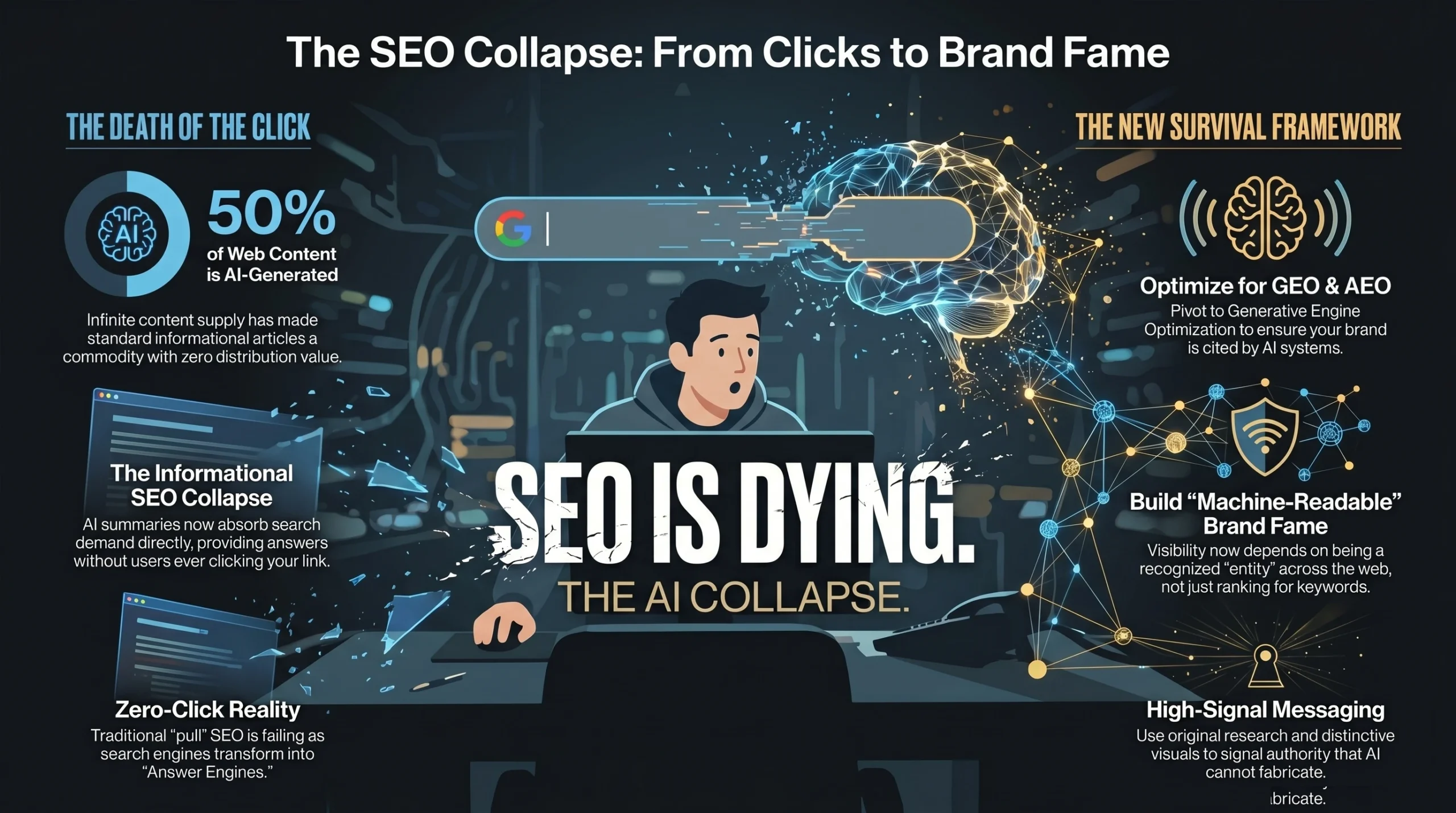
The Indian digital market is currently drowning in a sea of generic, AI-generated informational content. This saturation has caused a massive collapse in traditional “pull” SEO traffic as users stop clicking and start asking. Most brands in India are facing a silent crisis where their hard-earned visibility is being swallowed by AI summaries.
If you do not evolve, your brand will become “beige wallpaper”—perfectly optimized but completely invisible. Google AI Overviews and LLMs like ChatGPT are now hiding brands behind direct answers. This brand dilution means that appearing on page one is no longer enough if the AI doesn’t mention your name.
The only way forward is an integrated framework of Answer Engine Optimization (AEO), Generative Engine Optimization (GEO), and “Fame Engineering.” You must move beyond traffic and focus on mental availability. AI in SEO in 2026 is an intelligence system that uses machine learning to ensure your brand is cited as the primary authority in conversational search.
Key Takeaways for 2026
- Shift your primary objective from “Traffic Volume” to “Brand Fame” and mental availability.
- Prioritize Answer Engine Optimization (AEO) to capture specific passages in AI summaries.
- Use Generative Engine Optimization (GEO) to close citation gaps across Perplexity and ChatGPT.
- Deploy a “Human-in-the-loop” strategy to solve the “beige wallpaper” problem of generic content.
- Implement the BLUF (Bottom Line Up Front) approach to maximize “Time to Value” for users.
- Invest in proprietary data and original research to achieve a 110% boost in organic engagement.
- Treat SEO as an intelligence system rather than a set of manual checklists.
Table of Contents
- What is AI SEO and why is it transforming the Indian digital landscape?
- How can you use AI to supercharge your SEO workflow?
- Which AI SEO tools deliver the best results for Indian businesses?
- How do brands maintain their ‘soul’ amidst AI automation?
- What are the advanced techniques to maximize your search real estate?
What is AI SEO and why is it transforming the Indian digital landscape?
AI SEO in 2026 is the integration of Answer Engine Optimization (AEO) and Generative Engine Optimization (GEO) into traditional search strategies. It ensures brands are not just ranking on page one but are actively cited by LLMs as authoritative sources. In my experience with Indian SMEs, those who ignore this shift lose 40% of their top-of-funnel visibility within months.
In India, the shift is driven by Tier 1 and Tier 2 cities moving from “searching” to “asking.” Users now prefer voice-led searches in Hinglish and expect direct recommendations from AI assistants. What most agencies in Mumbai or Bangalore miss is that ranking #1 is a failure if the AI summary doesn’t recommend your brand by name.
To win in this landscape, you must optimize for “machine readability” while maintaining human trust. This requires moving from keyword density to entity-based authority. You are no longer just building pages; you are building a digital footprint that AI models can verify and trust.
Answer Engine Optimization (AEO): A 2026 process that ensures content is structured for passage-level relevance, allowing AI summaries to pull direct, self-contained answers from your site.
How can you use AI to supercharge your SEO workflow?
You use AI to supercharge workflows by treating SEO as an intelligence system that automates data analysis and prioritizes brand fame. This shifts your team from manual execution to high-level strategic oversight. By automating the “average,” you free up resources to focus on the exceptional content that builds real authority.
Recent data shows that 60% of top marketers use AI for keyword research, while 48% use it for brainstorming content ideas. Kochi-based agency Adviciya, operating from Infopark, has set the standard here. They use an AI-first approach to connect SEO, AEO, and GEO into a single growth strategy that treats brand visibility as a continuous intelligence loop.
Keyword Research and Topic Clusters
In 2026, AI tools group thousands of keywords by intent and “passage potential” in seconds. This allows you to build topic clusters that satisfy user queries before they even search for them. You must focus on topical authority rather than isolated blog posts to signal expertise to both Google and LLMs.
SERP and AI Visibility Analysis
AI speeds up the analysis of top-ranking pages and AI summaries to find “citation gaps.” It identifies exactly what information is missing from current AI answers. By filling these gaps with proprietary data, you increase the likelihood of your brand being the “cited source” in a Perplexity or ChatGPT response.
2026 Prompt Engineering Process for Content Ideas
- Define the Persona: “Act as a Lead SEO Strategist specializing in the Indian B2B SaaS market.”
- Set Context: “Targeting CTOs in Bangalore and Delhi who are currently evaluating AI security tools.”
- Identify Citation Gaps: “Analyze current Perplexity answers for ‘AI security trends 2026’ and identify what E-E-A-T signals are missing.”
- Enforce Constraints: “Generate 5 topics that incorporate firsthand experience and proprietary data points.”
- Output Structure: “Present ideas with a focus on ‘Passage-level relevance’ and BLUF formatting.”
Which AI SEO tools deliver the best results for Indian businesses?
| Tool Name | Best For | Key AI Feature |
|---|---|---|
| Semrush (Copilot) | All-in-one SEO | AI strategy suggestions and personalized keyword plans |
| Wellows | GEO Score | Tracking AI visibility scores across ChatGPT and Perplexity |
| Surfer SEO | Content Scoring | Real-time SERP analysis and semantic optimization |
| Airops | Visibility Workflows | Closing the loop between AI visibility data and published content |
A non-obvious insight for 2026 is the shift from rank tracking to “AI Visibility Scores.” Traditional tracking only tells you where you sit in Google’s blue links. A tool like Wellows or Airops tells you if AI models actually mention your brand when a user asks a category-level question.
How do brands maintain their ‘soul’ amidst AI automation?
Brands maintain their “soul” by implementing a “Human-in-the-loop” strategy where AI handles the structure and humans handle the emotional intelligence. In the Indian market, this “soul” is what prevents your content from becoming ignored “beige wallpaper.” Content that lacks personality will never build the mental availability required for brand fame.
The Human-in-the-Loop Strategy
You must keep humans in charge of final judgment and cultural context. AI falls apart in three specific areas that are critical for the Indian audience:
- Emotional Intelligence: AI cannot empathize with the specific financial anxieties or aspirations of a Tier 2 business owner.
- Cultural Nuance: AI often misses local idioms, Hinglish subtleties, and the specific market behaviors found in cities like Kochi or Ahmedabad.
- Ethical and Commercial Judgment: AI cannot decide if a specific brand tone aligns with your long-term business reputation.
In India’s cost-sensitive market, volume is no longer a competitive advantage because the cost of production has hit zero. Investing in “originality”—such as proprietary surveys or expert interviews—creates a much higher ROI. Unique research makes your brand worth citing, which is the only way to escape the AI summary trap.
What are the advanced techniques to maximize your search real estate?
Advanced techniques in 2026 prioritize “Time to Value” through the BLUF method and passage-level relevance. These tactics ensure your brand is chosen by AI engines that extract specific paragraphs to answer complex user queries. You must maximize your SERP real estate by winning featured snippets and AI Overview citations.
Improving Time to Value with BLUF
Indian users in 2026 have zero patience for long-winded introductions. You must use the “Bottom Line Up Front” approach to provide immediate value:
- Place the direct answer or core definition in the first 40 words of the section.
- Use a “Key Takeaways” box at the top of every article to improve “Fluency.”
- Keep intros to a maximum of two sentences and move immediately to the solution.
- Optimize for “Passage-level relevance” so AI can extract your answer without the surrounding context.
Diversifying your visuals is another massive growth lever that signals human effort. Data shows that using custom, proprietary visuals can lead to a 110% traffic boost. In an era of generic AI images, original charts and infographics signal to both users and algorithms that your brand has invested real effort into the content.
FAQ Section
Can ChatGPT do my entire SEO?
No. ChatGPT is a drafting assistant, but it lacks real-time search data and citation tracking. To succeed in 2026, you must use dedicated tools like Semrush or Wellows to identify current gaps. AI can handle the volume, but humans must handle the commercial strategy and E-E-A-T signals.
What is GEO in 2026?
Generative Engine Optimization (GEO) is the process of making your brand “machine-readable.” It ensures that LLMs like Perplexity and Gemini cite your brand as a trusted source. This requires high-quality brand mentions, original data, and a consistent digital footprint that AI models can verify through the Knowledge Graph.
Is traditional SEO dead in India?
Traditional SEO is the foundation but no longer the ceiling. While technical health and site structure remain essential, they are not sufficient on their own. You must integrate traditional SEO with AEO and GEO to remain visible as search engines transform into conversational answer engines across the Indian market.
How to optimize for AI Overviews?
Focus on clarity and “Passage-level relevance.” Use descriptive H2 and H3 headings and provide concise, self-contained answers that AI can easily extract. Implementing FAQ schema and providing original data points significantly increases your chances of being the primary citation in an AI-generated summary.
Are AI SEO tools worth the investment for small startups?
Yes, because they allow a small team to compete with much larger agencies. By automating repetitive tasks like keyword clustering and technical audits, startups can focus their limited resources on brand distinctiveness. The efficiency gains from AI tools often justify the subscription costs within the first quarter.
Conclusion
SEO in 2026 is no longer about just being found; it is about being chosen by AI through clarity and authority. Brands that combine AI efficiency with human strategy will dominate the Indian digital landscape. If you are still focusing only on keywords, you are already falling behind the “intelligence systems” of your competitors.
Book a free counselling session with an academic counsellor for our AI-powered Niche Specific Digital Marketing course to master these 2026 frameworks.
Book a Free Counselling Session