
Selecting the appropriate keyword match type is essential for maximizing ad effectiveness in Google Ads’ constantly changing environment. Phrase match keywords are among the best but least used possibilities. They provide flexibility without sacrificing relevance by finding the ideal mix between wide match and exact match.
Google’s algorithm has been improved, and by taking user intent into account, phrase match keywords are now much more effective. Because of this, they are a crucial tool for advertisers looking to optimize their return on investment without squandering money on pointless visitors.
To assist you in successfully incorporating phrase match keywords into your PPC approach, we will examine their functions, advantages, and real-world applications in this article.
Phrase match keywords are a keyword match type in Google Ads that allow ads to appear when users search for a phrase or close variations of it. Unlike exact match, which requires an exact keyword order, phrase match allows slight variations while maintaining the original meaning.
Phrase match keywords are particularly useful for advertisers looking to target specific search intent while still allowing some flexibility in the variations of the search terms. They help in reaching potential customers who are actively searching for related products or services without being too restrictive or overly broad.
For example:
This flexibility ensures phrase match keywords target relevant searches while filtering out completely unrelated queries, providing advertisers with better control over ad spend. Additionally, phrase match keywords help advertisers optimize ad placements, ensuring that they attract qualified leads rather than users who may not be interested in their offering.
Another key advantage of phrase match is that it considers search intent rather than just the exact words. This means that even if users phrase their search queries differently, as long as the intent matches, Google Ads may still trigger the ad. This allows advertisers to tap into a broader audience segment while maintaining relevance.
By leveraging phrase match keywords, advertisers can improve their ad campaign performance, reduce wasted spend, and increase click-through rates (CTR) by ensuring their ads appear in front of high-intent searchers.
Google Ads uses phrase match keywords to determine which queries trigger ads. The search intent must match the meaning of the keyword, even if word order varies slightly.
Key Features:
Example Comparisons:
| Keyword | Possible Searches | Will Not Match |
| “digital marketing course” | best digital marketing course, online digital marketing course | free marketing course, social media course |
| “affordable hotels in NYC” | cheap hotels in New York, best hotels in NYC | hotels in New York luxury, resorts in NYC |
With Google’s updates, phrase match keywords now behave more like a refined broad match, incorporating intent-based matching while maintaining contextual relevance.
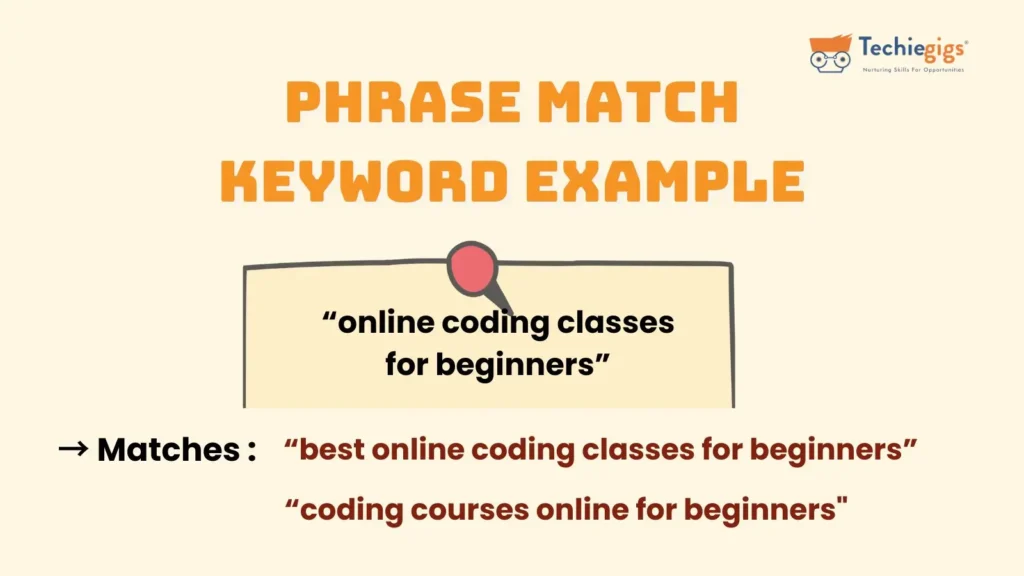
Here are practical phrase match keyword examples to illustrate how they work:
1. Travel Industry
2. E-commerce & Retail
3. Local Business
4. Education & Online Courses
5. Healthcare & Wellness
These examples highlight how phrase match keywords allow advertisers to target user intent accurately while avoiding irrelevant searches. They help businesses reach more relevant audiences without being too restrictive.
Using phrase match keywords in Google Ads offers multiple advantages:
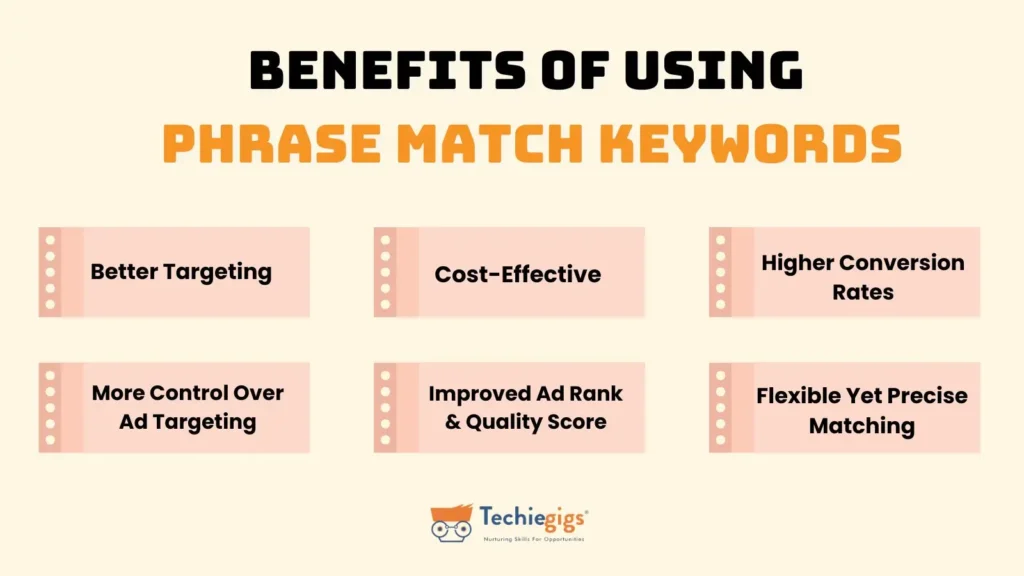
1. Better Targeting: Ensures your ads appear for relevant searches, allowing you to attract users who are actively searching for your products or services. This improves the efficiency of your ad spend and minimizes wasted clicks.
2. Cost-Effective: Since phrase match keywords narrow down the audience to those with high purchase intent, they help advertisers spend their budget more efficiently, reducing unnecessary expenses on unrelated search queries.
3. Higher Conversion Rates: By targeting the right audience, phrase match keywords can significantly increase the chances of conversions. Users clicking on your ads are more likely to be interested in your offering, improving conversion rates and overall campaign success.
4. More Control Over Ad Targeting: Unlike broad match, which can lead to irrelevant clicks, phrase match keywords provide a higher degree of control. They allow some flexibility while ensuring that searches are still closely related to the target keyword.
5. Improved Ad Rank and Quality Score: Since phrase match keywords improve relevance, they enhance Google Ads Quality Score. A higher Quality Score results in lower cost-per-click (CPC) and better ad placements, making your campaigns more effective.
6. Flexible Yet Precise Matching: Unlike exact match, which limits search reach, phrase match keywords provide a balance between specificity and reach. Advertisers can capture relevant traffic while still allowing for minor variations in searches.
Compared to broad match, phrase match keywords deliver more focused results while allowing necessary flexibility.
To understand the effectiveness of phrase match keywords, let’s compare them with other match types:
| Match Type | Description | Example Query | Advantages | Disadvantages |
| Broad Match | Shows ads for any related query | “buy running shoes online” → “buy jogging sneakers” | Reaches a wider audience, increases impressions | Can lead to irrelevant traffic, higher costs |
| Phrase Match | Matches searches with the keyword phrase in order | “buy running shoes” → “buy running shoes online” | Balances reach and control, improves relevance | Slightly less reach than broad match |
| Exact Match | Only shows ads for exact keywords with minor variations | “buy running shoes” → “buy running shoes” | High precision, best for conversion optimization | Limited reach, may miss valuable variations |
Unlike broad match, phrase match keywords filter out completely unrelated searches, ensuring better targeting and higher ad relevance. Additionally, phrase match keywords provide flexibility without sacrificing too much precision, making them an ideal choice for advertisers who want to maximize their return on ad spend (ROAS).
To maximize the effectiveness of phrase match keywords, follow these best practices:
By applying these strategies, you can improve your Google Ads campaign performance significantly.
Even experienced advertisers make mistakes when using phrase match keywords. Here’s what to watch out for:
Avoiding these pitfalls will help you maximize the potential of phrase match keywords in your campaigns.
Although phrase match keywords are primarily used in Google Ads, they also influence SEO strategies.
Marketers who integrate phrase match keywords into their content strategy can enhance both paid and organic search performance.
Phrase match keywords offer an excellent balance of flexibility and control, making them a powerful tool for Google Ads campaigns. They help advertisers reach relevant audiences while optimizing ad spend and improving conversion rates.
By implementing best practices, avoiding common mistakes, and regularly monitoring performance, you can harness the full potential of phrase match keywords in your PPC strategy.
Ready to take your Google Ads to the next level? Start optimizing your campaigns with phrase match keywords today!