
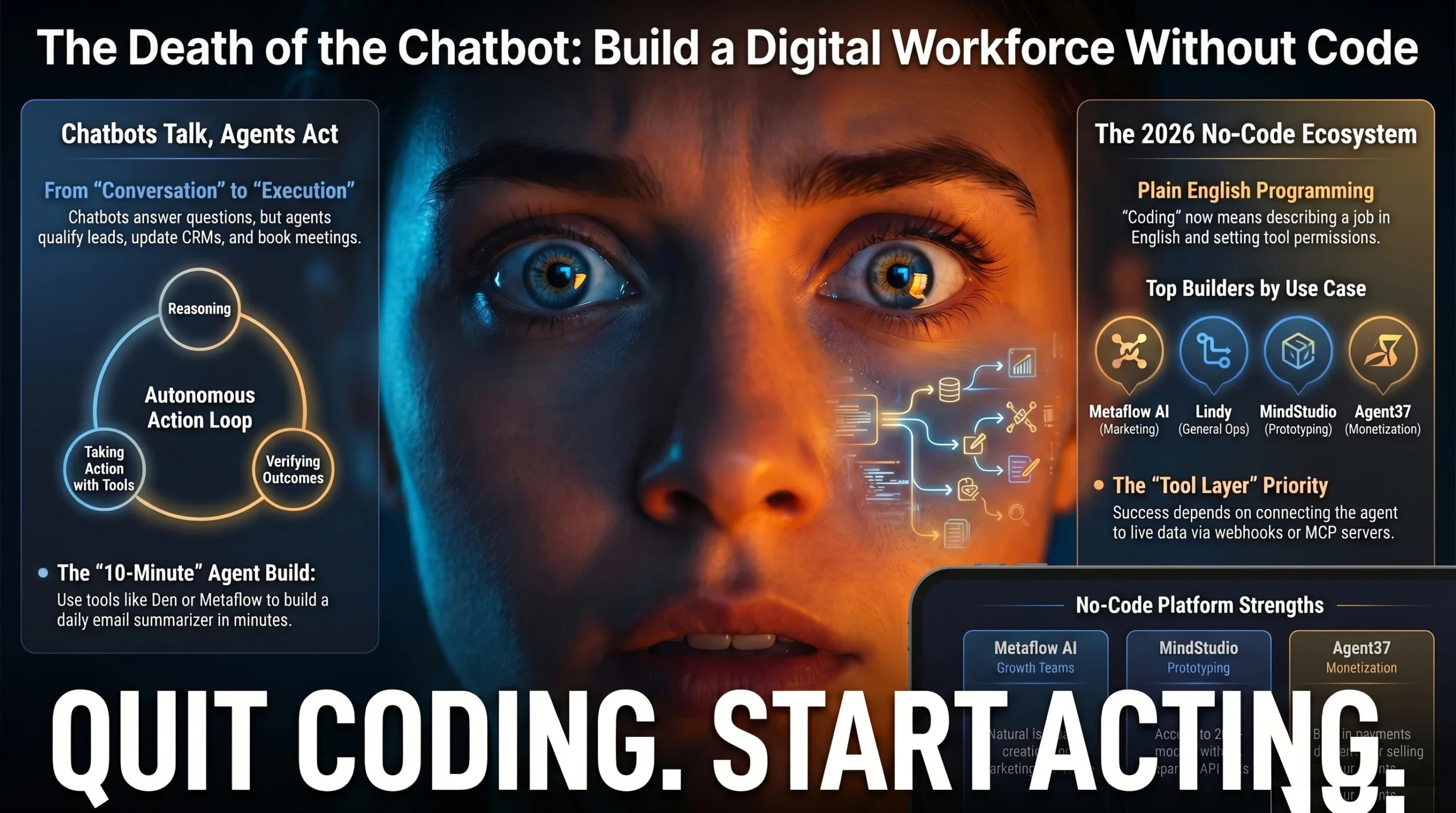
Many Indian freelancers and small business owners are currently hitting a technical wall. You see global competitors using an ai agent to automate lead generation and client support while you remain trapped in manual, soul-crushing repetitions. This gap creates a massive disadvantage in the hyper-competitive Indian market, leading to lost revenue and operational burnout. However, the barrier to entry has finally collapsed. Creating a high-performing ai agent today requires absolutely zero coding knowledge and can be launched via visual builders like Make.com or Zapier Central. This guide provides the strategic blueprint you need to deploy autonomous digital workers that perceive, decide, and act on your behalf.
Key Takeaways
- Action over Talk: Chatbots are limited to conversation, but true agents execute multi-step business actions autonomously using external tools.
- The 10-Minute Reality: In 2026, platforms like Den allow you to describe a workflow in plain English and deploy a functional agent in minutes.
- Top Indian Tech Stack: Make.com serves as the “King” of deep automation, while Zapier Central remains the best entry point for absolute beginners.
- Cost Sensitivity: Professional automation now starts at approximately ₹800 to ₹2,800 per month, making it accessible for startups in Tier 2 cities.
- Revenue Potential: Indian creators are now using platforms like Agent37 to host and sell agent “skills,” keeping 80% of the revenue.
- Strategic Advantage: By 2028, Gartner predicts that one-third of enterprise software applications will include agentic AI, up from less than 1% in 2024.
Table of Contents
- Beyond the Hype: Defining the AI Agent in the Modern Indian Economy
- The Blueprint of Autonomy: Implementing the 7-Layer Agent Architecture
- From Idea to Execution: A 10-Step Masterclass in No-Code Development
- The 2026 Tech Stack: Ranking the Best No-Code AI Agent Platforms for Indian Businesses
- Counting the Paise: The Real Economics of Running Agents in Tier 2 Cities
- The High-Growth Opportunity: Monetizing AI Skills in the Indian Creator Economy
- FAQ: Common Questions About AI Agents
Beyond the Hype: Defining the AI Agent in the Modern Indian Economy
An ai agent is far more than a sophisticated chatbot: it is an autonomous system designed to perceive its environment, reason through complex goals, and take multi-step actions without constant human direction. While a chatbot is built to talk, an agent is built to do. This distinction is critical for any Indian business looking to scale. An agent runs a continuous loop: it gathers context, makes a decision, uses a tool to take action, and then verifies the result.
An AI Agent is a software system that uses Large Language Models (LLMs) as a central reasoning engine to execute tasks through external tools and APIs. Unlike deterministic workflows, agents can adapt to new situations and handle messy, real-world data that would break a standard automation script.
For a freelancer in Bengaluru or Mumbai managing a coaching business, the difference is practical. A chatbot merely answers “What are your fees?” but an agent qualifies the lead via WhatsApp, checks your Google Calendar for availability, creates a Zoom link, and updates your CRM automatically. Gartner expects that 15% of everyday business decisions will be made autonomously by these agents by 2028, signaling a shift from “AI as a tool” to “AI as a workforce.”
| Feature | Chatbot (Talks) | Workflow (Deterministic) | AI Agent (Does/Acts) |
|---|---|---|---|
| Logic Type | Scripted/Prompted | If-Then Rules | Reasoning & Planning |
| Autonomy | Low | None | High |
| Tool Usage | None | Limited/Static | Multi-tool dynamic capability |
| End Goal | Conversation | Data Transfer | Autonomous Task Completion |
The Blueprint of Autonomy: Implementing the 7-Layer Agent Architecture
To move from a simple demo to a production-ready agent that survives the “messiness” of Indian business operations, you must build through a structured 7-layer framework. This ensures reliability and professional-grade performance.
1. Job Definition (JTBD): You must define a singular “Job to be Done.” A “General Assistant” is a recipe for failure. Instead, build a “GST Compliance Agent” or a “WhatsApp Lead Qualifier.” Clarity in the job description is the foundation of the agent’s reasoning.
2. Knowledge and Indexing: This layer involves the data the agent uses. In 2026, we utilize “Index Knowledge” (as seen in V7 Go), which differs from standard Retrieval-Augmented Generation (RAG). Indexing uses the model to create a data extraction plan, allowing it to query information from dense PDFs or spreadsheets with higher precision. You should provide 10 to 30 examples of high-quality outputs to help the agent recognize patterns.
3. Tools and Actions: This is the agent’s “arms and legs.” For Indian SMBs, this usually means connecting to the WhatsApp Business API, Google Sheets for data logging, or CRM connectors like HubSpot. Tools should be assigned with “read-only” permissions initially to ensure security.
4. Memory and State: Your agent needs to remember customer history and preferences across multiple turns. Without memory, a returning client in Jaipur has to explain their problem from scratch, destroying the user experience.
5. Interface and Distribution: Decide where the interaction happens. In India, WhatsApp is the dominant interface for business. Other options include Slack for internal teams or voice-call interfaces for high-touch services like storytelling coaching.
6. Guardrails and Governance: Professional agents require permission gating. For example, an agent can draft an invoice, but it should never send it without a human clicking “Approve.” This prevents “hallucinations” from affecting your bank account.
7. Evals and Iteration: This is the most overlooked layer. You must create an “Eval Set” consisting of 30 to 100 test cases, including “Adversarial Paths” where you intentionally try to break the agent’s logic. This ensures the agent behaves consistently before you launch it to the public.
Gartner predicts that by 2028, one-third of enterprise software will include agentic AI, but without these seven layers, most projects will be canceled due to high costs or weak risk controls.
From Idea to Execution: A 10-Step Masterclass in No-Code Development
Building a high-performing agent is now a process of configuration rather than coding. Follow these ten steps to ensure your agent is production-ready.
- Pick one monetizable job: Focus on a task where success is easily measured, such as “Qualify 50 WhatsApp leads per day.”
- Define the Agent Contract: Write a one-page document outlining exactly what the agent will do, what it is forbidden from doing, and the exact moment it must escalate to a human.
- Map the human-first workflow: Write out the 10 to 15 steps a human currently takes to do the job. This becomes the logic the agent follows.
- Build a Knowledge Pack: Gather 10 to 30 real-world examples of successful task completions. The agent will learn the “vibe” and accuracy of your work from these.
- Design the funnel-style conversation: Structure the interaction so the agent gathers all necessary information before attempting to execute a tool call.
- Assign tools safely: Connect your APIs (Gmail, Sheets, CRM) but keep them in “read-only” mode during the testing phase.
- Add guardrails: Implement rate limits to prevent cost spikes and permission gates for any action that involves writing data or spending money.
- Create an Eval Set: Build a suite of 30 to 100 test cases. Test the “Happy Path” where everything goes right and the “Adversarial Path” where the user provides conflicting information.
- Deploy to the right interface: For Indian consumers, deploy via WhatsApp or a web widget. For internal teams, Slack is often more effective.
- Launch small and iterate: Release the agent to 10 to 20 trusted users first. Monitor their conversations, identify where the agent fails, and fix those failures weekly.
A 2026 EY AI Pulse Survey highlighted that 74% of organizations found AI investments met or exceeded expectations when following a structured deployment path like this.
The 2026 Tech Stack: Ranking the Best No-Code AI Agent Platforms for Indian Businesses
The market for AI agents reached $7.84 billion in 2025, and as a consultant, I recommend different tools based on your specific business scale and technical comfort.
- Make.com: The undisputed “King” for serious automation. It uses a visual drag-and-drop builder that is perfect for complex, multi-step logic. At roughly ₹800 ($9) per month, it is the most cost-effective way for Indian freelancers to build deep workflows.
- Zapier Central: The best starting point for absolute beginners. It allows you to build agents using natural language. While slightly more expensive (approx. ₹2,800/month), it offers 400 free runs per month, which is more generous than competitors like Den.
- Botsify: Highly recommended for Indian agencies. It offers “White-Label” capabilities, meaning you can build agents and sell them to clients under your own brand name and logo.
- Agent37: This is the “Gumroad for Claude.” It is specifically designed for creators to host and monetize their agents. It handles the billing and infrastructure, allowing you to focus on the “skill” logic.
- MindStudio: Ideal for those who need model flexibility. It gives you access to over 200 models (GPT-4, Claude, Gemini) in one interface, starting at $20 (approx. ₹1,700) per month.
| Tool Name | Best For | Free Tier Status | Complexity Level |
|---|---|---|---|
| Make.com | Deep Automation | Available (Limited ops) | Medium |
| Zapier Central | Absolute Beginners | 400 runs/month | Easy |
| Botsify | Agency White-Label | Trial Available | Easy |
| Agent37 | Monetization & Hosting | Trial Gating | Medium |
| MindStudio | Multi-Model Apps | Available | Easy |
Counting the Paise: The Real Economics of Running Agents in Tier 2 Cities
For a startup in Indore, Coimbatore, or Jaipur, every rupee matters. Understanding the cost model of an ai agent is essential for maintaining a positive ROI.
The Practical Cost Model
The formula for your monthly expenditure is:
Monthly model cost per user = n x ((tokens_in price) + (tokens_out price))
Indian Pricing Benchmarks (Approximate Rupee Values)
- MindStudio Pro: $16 per month (approx. ₹1,350).
- Zapier Pro: $33.33 per month (approx. ₹2,800).
- Make.com Core: $9 per month (approx. ₹760).
Consultant’s Corner on ROI: In a Tier 2 city, the cost of a full-time employee for data entry might be ₹15,000 to ₹20,000 per month. An agent doing the same work 24/7 costs less than ₹3,000. EY research shows that companies allocating 5% or more of their budget to AI gain significantly higher ROI. In India’s WhatsApp-first culture, an agent that qualifies leads while you sleep can pay for its annual subscription in a single week of improved lead conversion.
The High-Growth Opportunity: Monetizing AI Skills in the Indian Creator Economy
The most exciting path for Indian experts is “Path F”: monetizing your knowledge by hosting agents on platforms like Agent37. This bypasses the need for complex local servers and allows you to sell “digital expertise.”
The Agent37 Revenue Model
Creators build specialized “skills” or “agents” using a hosted runtime. These agents can scrape websites, execute Python code, or process complex legal documents. When a user pays for access, the creator keeps 80% of the earnings, while the platform takes 20% to cover the hosting, Stripe payment processing, and security.
Practical Use Case: The Storytelling Coach
An Indian storytelling coach can build an agent that reviews speech drafts or LinkedIn posts. Instead of charging ₹5,000 per 1-hour session, the coach can charge a monthly subscription of ₹2,000 for unlimited agent reviews. The agent handles the bulk of the work, and the coach only steps in for final high-level polishing. 75% of senior executives surveyed by V7 believe agents will transform the workplace more than the internet did, and the Indian creator economy is perfectly positioned to lead this shift through these subscription-based “expertise bots.”
FAQ: COMMON QUESTIONS ABOUT AI AGENTS
Can I really build an agent without code?
Yes, in 2026, this is the standard. Using platforms like MindStudio or Zapier Central, you describe the agent’s job in plain English. The “work” has shifted from writing Python to designing the workflow, gathering the right knowledge documents, and setting the correct tool permissions.
Is it safe to give agents access to my private data?
Safety is a matter of configuration. You should always use platforms that offer enterprise-grade encryption and OAuth connections. The most important security rule is to start with “read-only” permissions and implement human-in-the-loop approvals for any action that modifies data or communicates with clients.
How do I prevent AI hallucinations in production?
You cannot “prompt away” hallucinations. Instead, you must narrow the agent’s scope and use “tool-backed verification.” For example, if an agent needs to state a price, it should look it up in a Google Sheet rather than relying on its memory. Implementing an Eval Set of 30 to 100 test cases will help you catch these errors before launch.
What is the cheapest way to start for an Indian student?
The most affordable route is using the free tiers of Make.com or Botpress. Make.com provides a generous free plan that is perfect for learning the logic of triggers and actions. You can combine this with free versions of LLMs to build simple productivity agents for your own study routines.
How long does it take to deploy a working agent?
A basic “Daily Task Summarizer” can be deployed in under 10 minutes using Den. However, a business-grade agent that handles customer payments or lead qualification typically requires one to two weeks of testing and refining through the 7-layer framework to ensure absolute reliability.
CONCLUSION
Creating a high-performing ai agent without coding is the ultimate competitive advantage for the modern Indian professional. By mastering the 7-layer framework and utilizing the right no-code tech stack, you can transform your manual workflows into an autonomous digital workforce that operates 24/7.
Ready to master AI automation? Book a free counselling session with an academic counsellor for our AI-powered Niche Specific Digital Marketing course and start building your future today.