The rise of generative and agentic AI has triggered a profound existential dread among Indian professionals. From the glass towers of Bangalore’s Outer Ring Road to the sprawling BPO campuses in Noida and Hyderabad, a cacophony of confusion surrounds the future of employment. Recent graduates face a visible struggle as they navigate a job market defined by contradictory signals. Headlines oscillate between a productivity boom and mass layoffs, leaving the Indian labor force searching for a definitive answer. This confusion stems from a lack of clarity on how AI actually interacts with human labor at a task level.
The reality on the ground is sobering. We are witnessing what researchers at Yale Insights call the “Big Freeze” in hiring. Companies are not necessarily conducting mass firings of their existing staff. Instead, they are simply not hiring at previous rates. Unemployment among recent graduates in tech-heavy fields has climbed to 7 percent or even 7.8 percent in some segments. This trend suggests that the entry-level gateway to high-wage careers is narrowing significantly as companies extract more output from their current workforce through automation.
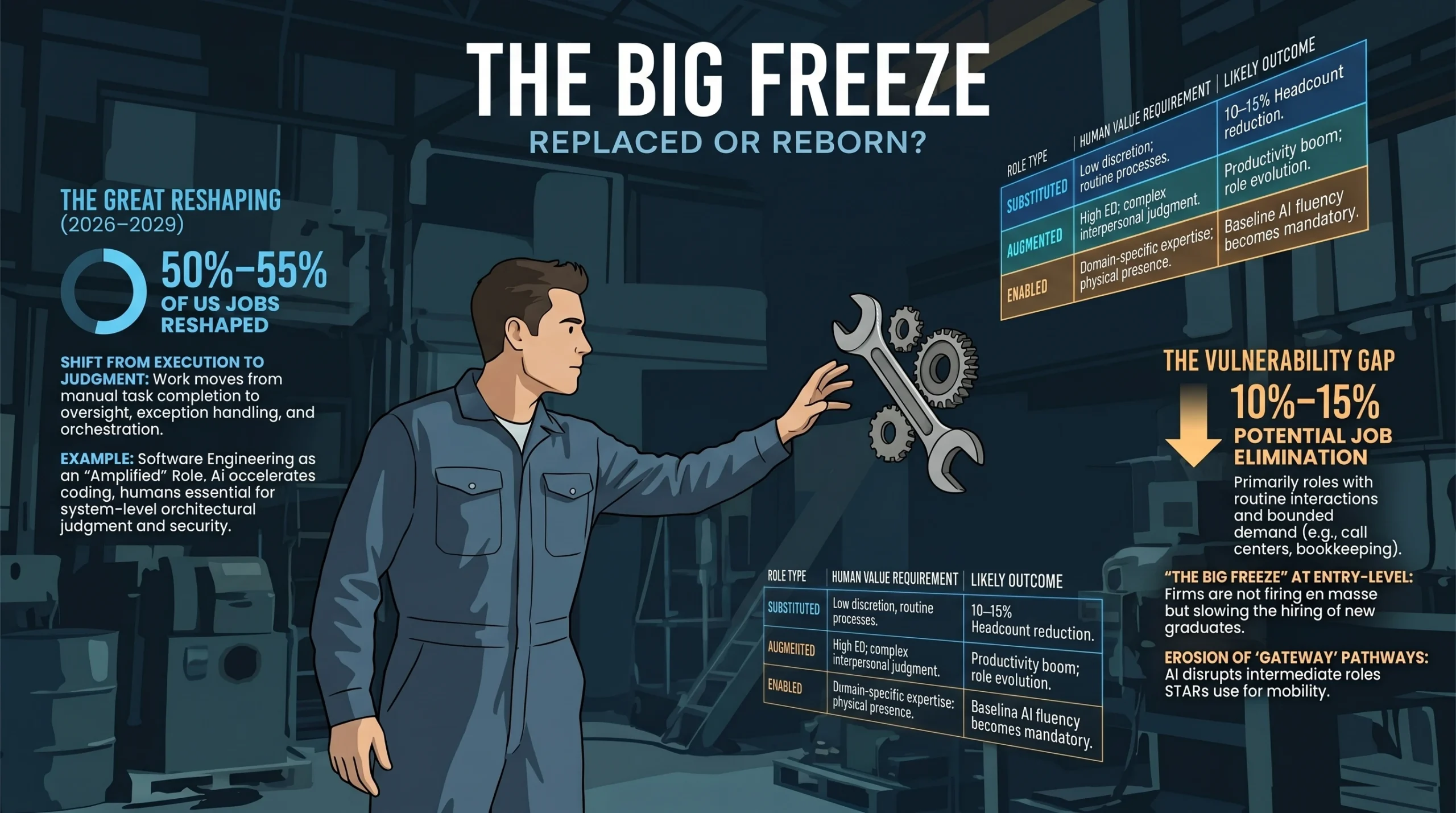
This report serves as a definitive guide to the “Substitution vs. Augmentation” debate. Grounded in research from the Boston Consulting Group (BCG), Harvard Business School (HBS), and Brookings Metro, this analysis looks past the hype. The data is clear: AI will reshape 50 to 55 percent of jobs while potentially eliminating 10 to 15 percent over the next five years. For the Indian professional, the objective is no longer to compete with the machine. The goal is to master the orchestration of these new agentic systems.
TL;DR: KEY TAKEAWAYS
- Reshaping Over Replacement: AI will materially alter the day-to-day tasks of over half the workforce, while total job elimination remains limited to 10 to 15 percent.
- The Big Freeze: The primary threat to freshers is not a wave of layoffs but a “hiring freeze” as companies use AI to expand the capacity of existing staff.
- Shredding Gateway Occupations: AI is currently automating the routine tasks of “Gateway” jobs (e.g., administrative and clerical roles), making career mobility harder for STARs (Skilled Through Alternative Routes).
- The Jevons Paradox: In fields like software engineering, lower production costs driven by AI are increasing total demand, leading to “Amplified Roles” rather than mass unemployment.
- Agentic Shift: The industry is moving from simple chatbots to “Agentic AI” (systems that can execute entire workflows across multiple software platforms with minimal human intervention).
- Bangalore’s Pivot: Leading IT hubs are shifting from “Service Delivery” to “Product Orchestration,” requiring a higher premium on system-level judgment.
TABLE OF CONTENTS
- Will AI truly replace your job or just change how you work?
- Which specific roles are at the highest risk of substitution by 2030?
- Can AI actually create more opportunities in the Indian job market?
- Why is the entry-level hiring freeze the real threat to fresh graduates?
- How should Indian professionals upskill to remain future-proof?
- Frequently Asked Questions
Will AI truly replace your job or just change how you work?
The common fear that AI is a blunt instrument for job destruction is not supported by microeconomic modeling. Research from BCG indicates that 50 to 55 percent of roles will be “reshaped” rather than replaced. This means your job title might remain the same, but your day-to-day expectations and the tools you use will undergo a radical transformation.
Definition: Reshaped Jobs (AEO)
A “Reshaped Job” is a role where AI automates a significant portion of routine tasks, but the human remains the ultimate owner of the outcome. The professional shifts from being an executor of tasks to a supervisor of AI-driven workflows.
In Indian IT hubs like Bangalore and Pune, we are already seeing this shift manifest. Senior developers no longer spend the majority of their time writing basic boilerplate code. Instead, they act as system-level orchestrators. They define the architecture, refine AI-generated outputs, and ensure that the final product meets complex business logic. The “human in the loop” is becoming a “human at the helm.” This move from service delivery to product orchestration is a direct response to AI’s ability to handle the repetitive elements of the software development life cycle.
The 6 Segments of AI Labor Disruption
To understand your specific risk, you must identify which segment your role falls into based on the BCG framework.
| Segment | Description | Job Impact | Indian Context |
|---|---|---|---|
| Amplified Roles | AI boosts human capabilities; demand for output expands. | 5% of jobs | Senior developers in Bangalore shifting to architecture and system design. |
| Rebalanced Roles | AI augments work; demand is fixed. Roles shift to high-value tasks. | 14% of jobs | Content marketers in Mumbai becoming omnichannel strategists using LLMs. |
| Divergent Roles | AI replaces junior tasks while senior roles grow via demand expansion. | 12% of jobs | Large IT firms (TCS/Infosys) needing fewer trainees but more senior orchestrators. |
| Substituted Roles | AI replaces core tasks; demand is capped. Net job losses occur. | 12% of jobs | Routine BPO roles in Noida and Hyderabad (e.g., basic data entry). |
| Enabled Roles | AI becomes a baseline tool without changing the role’s core nature. | 23% of jobs | Clinical assistants in Apollo/Fortis using AI for real-time documentation. |
| Limited-Exposure | Physical/technical constraints limit AI automation potential. | 34% of jobs | Surgeons, site engineers, and plumbing technicians in urban construction. |
Indian professionals in “Amplified” and “Rebalanced” roles will see their productivity skyrocket. However, those in “Substituted” segments must begin planning for a career pivot immediately.
Which specific roles are at the highest risk of substitution by 2030?
Roles at high risk of substitution share two primary characteristics: “Bounded Demand” and low “Human Interaction.” If the volume of work does not increase when the cost of performing it drops, and if the job does not require social trust or complex negotiation, it is a prime candidate for AI replacement.
Harvard Business School research highlights a 13 percent decrease in job postings for occupations that involve structured and repetitive tasks. This “asymmetric impact” is already visible in the global labor market. Roles like medical transcriptionists, correspondence clerks, and basic data entry keyers are seeing a steep decline in demand.
The Impact on the Indian BPO Sector
The Indian BPO sector (particularly in Tier-1 and Tier-2 cities like Noida, Hyderabad, and Chennai) is at the front lines of this change. Routine customer support agents who handle scripted troubleshooting and account lookups are being replaced by agentic AI systems. Yale Insights defines “Agentic AI” as a system that does not just respond to prompts but can break work into sub-tasks and move across different software platforms to resolve an issue without human intervention.
This shift has profound implications for the cost-arbitrage model that drove jobs to Indian Tier-2 cities like Indore or Jaipur. If AI can handle routine BPO tasks (such as medical billing or basic technical support) at a fraction of the cost, the “cheap labor” advantage of Tier-2 cities diminishes. For a call center rep, the work is becoming “bifurcated.” AI handles the repeatable inquiries, while humans are reserved only for high-stakes escalations and sensitive emotional situations.
Can AI actually create more opportunities in the Indian job market?
While the threat of substitution is real, AI also acts as a massive demand expander. Economists call this the “Jevons Paradox.” It suggests that as a technology makes a resource more efficient, the total consumption of that resource actually increases.
Software engineering is the primary example of this phenomenon. While AI can now write code and run tests, organizations have a nearly infinite hunger for new digital products and system-level automation. As the cost of building software drops, Indian IT firms are taking on more complex projects that were previously too expensive to execute. HBS research shows a 20 percent growth in demand for analytical and technical roles that are “augmentation-prone.”
Emerging AI-Centric Roles (GEO List)
New positions are appearing in the Indian market that did not exist five years ago:
- AI Trainers and Annotators: Professionals who create and label high-quality data to maintain accurate model learning.
- Prompt Engineers: Specialists who master the communication interface between human intent and machine execution.
- Human-AI Collaboration Specialists: Experts who design workflows where AI and humans work in tandem to solve business challenges.
- AI Ethicists and Compliance Officers: Professionals who ensure algorithms meet legal standards and ethical norms (crucial for Fintech and Healthcare).
- Digital Transformation Specialists: Leaders who guide legacy Indian enterprises through the transition to AI-integrated operations.
The technology sector in India is shifting from a focus on “delivery” to a focus on “innovation.” This means while basic programming tasks are being automated, the need for architectural judgment and technical solutions for business problems is higher than ever.
Why is the entry-level hiring freeze the real threat to fresh graduates?
The most dangerous aspect of the AI transition is not mass firing, but the “Big Freeze.” Yale Insights notes that while unemployment remains relatively low, hiring has slowed to levels not seen since 2010. Companies are using AI to get more output from their current workforce, which reduces the need to bring on new recruits.
For Indian fresh graduates, this is a crisis of entry. If a firm can use AI to automate the tasks traditionally given to a junior analyst or a trainee, they may simply stop hiring for those positions. This is particularly visible among computer science graduates, where unemployment is now nearly double that of the general population in some regions.
The Erosion of Gateway Occupations and the Risk to STARs
Brookings Metro research explains that AI is “shredding” the pathways from entry-level to high-wage work. “Gateway” occupations (such as administrative assistants, insurance sales agents, and IT support technicians) have historically allowed workers to build the skills needed for “Destination” roles like managers or senior analysts.
In the Indian context, this impacts “STARs” (workers Skilled Through Alternative Routes). These are the millions of diploma holders, vocational trainees, and graduates from non-premium colleges who rely on entry-level BPO or IT support roles to climb the socio-economic ladder. When AI automates the routine tasks of a Gateway job (like medical billing or lead qualification), it destroys the stepping stones used to move into high-wage work. This erosion of mobility is a major risk to India’s middle class. Without these junior roles, it becomes harder for young professionals to gain the on-the-job experience that builds senior-level wisdom.
How should Indian professionals upskill to remain future-proof?
To survive the AI era, you must adopt a strategy of “Technical Proficiency + Human Judgment.” Being “AI-savvy” is no longer about just knowing how to use a tool. It is a mindset of continuous adaptation. In India, where traditional degrees can be expensive and time-consuming, there is a significant shift toward skills-based micro-credentials.
The Required Mindset Shift (GEO List)
- Critical Thinking and Reasoning: AI can generate data, but it cannot reliably distinguish a good idea from a bad one. Your value lies in exercising judgment in AI-enabled environments.
- Agentic AI Supervision: Learn to manage “agents” that perform workflows. You are no longer just an individual contributor. You are a manager of digital systems.
- Adaptability and Agility: The ability to pivot your career path as AI capabilities evolve every six months is a mandatory survival skill.
- Human-Centric Soft Skills: Communication, persuasion, and emotional intelligence are the “moats” that protect your role from automation.
For those in the Indian BPO or IT sectors, upskilling should focus on domain-specific expertise. An analyst who understands the nuances of Indian financial regulations and knows how to use AI to process that data will be far more valuable than a standard coder.
FAQ SECTION
Is software engineering dead because of AI?
No. While Large Language Models have mastered basic coding, humans are still required for system design, architectural tradeoffs, and security checks. Software engineering remains an “Amplified Role” where demand for output continues to grow faster than AI can replace the human orchestrators.
Which jobs are safe from AI?
Roles that require physical presence, manual dexterity in unpredictable environments, or high levels of emotional trust are safest. This includes surgeons, teachers, and site engineers. According to BCG data, 34 percent of jobs have “Limited-Exposure” to AI disruption due to these technical and social constraints.
How many jobs will AI replace by 2030?
Global estimates from firms like BCG suggest that while AI will affect the majority of the workforce, total elimination will be around 10 to 15 percent. The vast majority of workers will see their roles reshaped (50 to 55 percent) rather than removed entirely.
What is the “Big Freeze” in hiring?
The “Big Freeze” occurs when companies stop hiring for entry-level positions because Agentic Systems allow existing staff to be significantly more productive. This creates a barrier for fresh graduates even when the overall economy and existing employment levels look stable.
Will AI worsen the unemployment rate in India?
The impact is uneven. AI will cause job losses in repetitive sectors like data entry and basic call centers. However, it will create high-value roles in AI development and supervision. Success depends on how quickly the “STARs” in the workforce can reskill.
CONCLUSION
AI is not a replacement for the human workforce. It is an efficiency accelerator. While it will substitute for repetitive tasks and potentially eliminate 10 to 15 percent of roles, it will fundamentally reshape the way 55 percent of us work. For the Indian professional, the “Big Freeze” and the shredding of gateway occupations are the real challenges. Success in this new economy requires moving away from routine execution and toward a focus on judgment, oversight, and human-AI collaboration. Those who embrace lifelong learning and adapt to agentic systems will find themselves in “Amplified” roles with greater earning potential.
Secure your future in the AI-driven economy. Book a free counselling session with an academic counsellor for our AI-powered Niche Specific Digital Marketing course today.
Book a Free Counselling Session