Operating a business in competitive hubs like Mumbai, Bangalore, or Delhi makes organic visibility a massive challenge. Most Indian brands lose high-quality leads to competitors daily because they lack a clear search strategy. This search engine optimization guide provides the roadmap to reclaim your market share. Search engine optimization, or SEO, is the process of improving a website’s visibility in organic search results. By optimizing your site’s technical structure and content authority, you ensure that search engines understand and rank your pages for the relevant, growth-driving queries that matter to your business.
TL;DR: Key Takeaways For Quick Navigation
- Foundation First: Crawlability and technical health are the non-negotiable prerequisites for all search visibility.
- Asset Management: SEO serves as a sustainable asset, providing compounding value without the recurring costs of paid ads.
- Three Pillars: Success requires a balance between on-page content, technical infrastructure, and off-page authority signals.
- Intent Mapping: Content must match specific user search intents, ranging from informational learning to transactional readiness.
- The GEO Shift: Prepare for the 2026 tipping point by optimizing for AI-driven answer engines like ChatGPT and Gemini.
- Authority Ranking: Search engines reward content that demonstrates Experience, Expertise, Authoritativeness, and Trustworthiness (E-E-A-T).
Table Of Contents
- What is Search Engine Optimization and Why Does It Drive Growth in India?
- How Do Google’s Crawling, Indexing, and Ranking Processes Actually Work?
- What Are the Three Pillars of a Successful Search Engine Optimization Guide?
- How Can You Find the Right Keywords to Match Indian Search Intent?
- Why Is Generative Engine Optimization (GEO) the Next Frontier for 2026?
- What Are the Biggest SEO Mistakes Indian Startups Should Avoid?
- FAQ: Common Questions About the SEO Guide
What Is Search Engine Optimization And Why Does It Drive Growth In India?
Search engine optimization is the strategic process of enhancing your website to improve its visibility when users search for your products or services. Unlike paid advertising, where you must pay for every click, SEO focuses on earning organic traffic. This makes it a sustainable asset for any business. For Indian enterprises, organic traffic builds long-term credibility that paid ads cannot replicate.
In the Indian market, digital experiences are the primary gateway to commerce. A staggering 93 percent of all online experiences begin with a search engine. For a brand to thrive, it must appear exactly when a user expresses a need. In cities like Delhi or Mumbai, where the cost per click for PPC can be prohibitively high, SEO provides a path to high-intent traffic without the constant financial drain.
The cost sensitivity of Indian SMEs makes SEO a critical growth lever. The “Jio effect” has brought cheap data and high-speed internet to the masses, creating a mobile-first revolution. While Tier 1 markets are often saturated with heavy ad spend, businesses in Tier 2 and Tier 3 cities can use SEO to gain a significant competitive edge. By building a technically sound site and high-quality content, an SME in a smaller city can outrank larger competitors by serving local search intent more effectively.
How Do Google’S Crawling, Indexing, And Ranking Processes Actually Work?
To master SEO, you must understand the three-step journey a search engine takes to find and display your content. This process ensures that users receive the most relevant and helpful results for their queries.
What is a Search Crawler?
A search crawler is an automated software bot that systematically browses the internet to discover, scan, and understand website content, code, and images.
Step 1: Crawling
The journey begins when search engine bots, known as spiders, move from link to link across the web. These bots scan the structure of your site to understand its contents. If your website lacks structure, crawlers may miss important pages.
- The bot first looks for the robots.txt file to see which pages it is allowed to access and which it should ignore.
- It then scans the XML sitemap to find and prioritize your most important URLs, which is vital for large e-commerce sites.
- The bot follows internal links to discover new content and assess how your pages relate to one another.
Step 2: Indexing
After crawling a page, the search engine stores and organizes the information in a massive database called an index. Think of this like a library filing system. If a page is indexed, it becomes eligible to appear in search results. Technical errors, duplicate content, or low-quality material can prevent indexing, making your site invisible to users.
Step 3: Ranking
Ranking is the final step where algorithms evaluate indexed pages to determine their order in search results. The goal is to match user intent with the most authoritative content. Search engines use hundreds of signals, such as relevance and user experience, to decide which page earns the top spot. High-quality, helpful content that answers questions is more likely to rise in the rankings.
What Are The Three Pillars Of A Successful Search Engine Optimization Guide?
Successful SEO is built on three core pillars: On-Page, Technical, and Off-Page optimization. Think of this like a cricket team. Technical SEO is your defense, On-Page SEO is your offense, and Off-Page SEO is your loyal fanbase.
On-Page SEO
This pillar focuses on the elements directly on your website pages. It involves optimizing content so that it is useful for humans and readable for bots. Key elements include:
- Title Tags and Meta Descriptions: These are the headlines and summaries that appear in search results. They must be clear, relevant, and keyword-rich.
- H1 to H6 Hierarchy: Proper use of header tags organizes content and helps search engines understand page structure.
- E-E-A-T: You must demonstrate Experience, Expertise, Authoritativeness, and Trustworthiness. This is especially vital for Indian consumers who rely on reviews and validation before they transact.
Technical SEO
Technical SEO ensures your website’s infrastructure supports crawling and indexing. For India’s mobile-first users, technical health is paramount, especially on low-bandwidth connections.
- Site Speed: You should aim for a loading time of under 3 seconds. Slow sites frustrate users and lead to lower rankings.
- Mobile-Responsiveness: Your site must function perfectly on all screen sizes, as the majority of Indian searches occur on mobile devices.
- HTTPS Security: Secure encryption is essential for building trust with both users and search engines.
Off-Page SEO
Off-Page SEO involves signals outside your website that build authority. This is primarily about earning backlinks, which act as “votes of confidence” from other reputable sites. For example, being mentioned in a prominent Bangalore-based tech blog or a regional news outlet can significantly boost your local authority and search rankings. Quality always beats quantity here. One link from an authoritative industry source is worth more than a hundred links from low-quality directories.
How Can You Find The Right Keywords To Match Indian Search Intent?
Keywords are the foundation of any search engine optimization guide, but they only work if you understand the intent behind them. Search intent describes the “why” behind a query. Matching your content to this intent is the only way to achieve sustainable organic rankings.
| Search Intent Type | Definition | Example Indian Query |
|---|---|---|
| Informational | User wants to learn something new. | “How to start a business in India” |
| Navigational | User is looking for a specific brand. | “Tata Motors official website” |
| Transactional | User is ready to make a purchase. | “Buy iPhone 16 online India” |
| Commercial | User is researching before buying. | “Best SEO agency in Delhi” |
Advanced Intent Types for 2026
Beyond the four basics, modern keyword research must account for behavioral goals:
- Local Intent: Used when users seek physical businesses nearby (e.g., “Organic grocery store near me”).
- Reassurance Intent: Seekers look for trust validation or risk reduction (e.g., “Is [Brand Name] safe for payments?”).
- Temporal Intent: Searches that are time-sensitive and require the freshest content possible (e.g., “Current gold price in Mumbai”).
To succeed in keyword research, you must look beyond broad head terms and focus on long-tail keywords. These are specific phrases that often have lower competition and higher conversion rates.
Why Is Generative Engine Optimization (Geo) The Next Frontier For 2026?
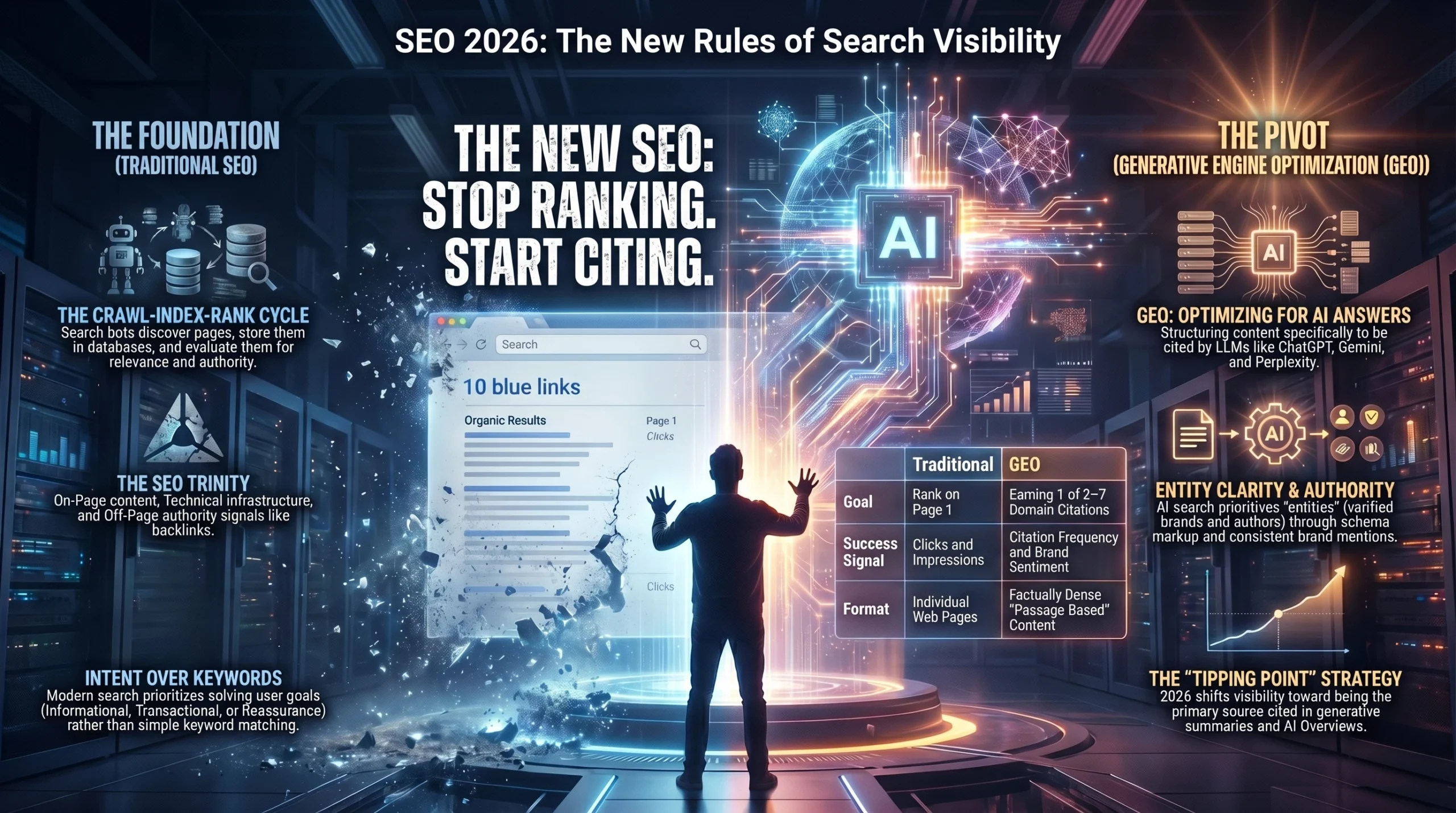
The way people search is undergoing a massive transformation. We are approaching a 2026 tipping point where traditional search volume is predicted to drop by 25 percent. Users are shifting toward AI-powered answer engines like ChatGPT, Gemini, and Perplexity. Generative Engine Optimization (GEO) is the practice of ensuring your brand is cited and recommended by these AI systems.
AI engines prioritize fact-dense passages and clear, unambiguous information. Research, including a Princeton study, shows that AI engines favor earned media (third-party coverage and reviews) over brand-owned content. To master this, you must follow a practical GEO framework.
The Four-Phase GEO Framework
Phase 1: Assess
Before optimizing, establish a baseline. Use tools to see if major AI engines are citing your content. Determine how your brand appears in AI-generated answers and whether the sentiment is positive or accurate. Identify where competitors are earning AI citations that you are currently missing.
Phase 2: Optimize
Structure your content for AI retrieval by using clean heading hierarchies. Every section must stand on its own. Add brief TL;DR statements under key headings and include FAQ sections that provide direct answers to common questions. Focus on entity clarity by keeping brand mentions consistent across the web and managing your knowledge panel.
Phase 3: Measure
Track metrics that matter for AI search. This includes citation frequency (how often you are named), share of voice (your mentions versus competitors), and citation sentiment. Monitor AI-referred traffic in GA4 to see which platforms are driving actual visitors to your site.
Phase 4: Iterate
The AI landscape shifts fast as models update. Use your performance data to identify which content formats are earning citations and scale those efforts. Turn a well-cited guide into video scripts or data-led PR pieces to maintain visibility.
What Are The Biggest SEO Mistakes Indian Startups Should Avoid?
Many Indian startups fail to see results because they fall into common traps. Avoiding these pitfalls is essential for long-term success in a market where mobile penetration is reaching new heights.
- Keyword Stuffing: Repeating keywords excessively makes content unreadable. Your priority should be humans, not robots.
- Thin Content: Publishing low-quality or duplicate content provides no value. Search engines prioritize originality and depth.
- Ignoring Mobile Users: With over 900 million active internet users expected in India by 2025, failing to optimize for small screens is a fatal error. Your site must be fast and accessible on mobile.
- Buying Low-Quality Links: Using link farms can result in your site being permanently removed from search results. Build genuine relationships instead.
- Neglecting Technical SEO: Great content cannot overcome a site that is broken or impossible for bots to crawl.
Search engine understanding is a prerequisite for success. If you prioritize “tricks” over providing real value to the user, your organic rankings will eventually suffer.
FAQ: Common Questions About SEO
How long does SEO take to show results?
SEO is a long-term strategy. While you might see minor technical improvements in a few weeks, meaningful organic growth typically takes three to six months. Competitive keywords in the Indian market may take even longer to reach the first page as your site builds necessary authority and trust.
Is SEO better than PPC for Indian startups?
Both have value, but SEO is more cost-effective over time. PPC requires continuous spend to maintain traffic. In contrast, SEO builds a sustainable asset that drives leads long after the initial work is done. This makes it ideal for budget-conscious startups looking for compounding returns.
What is the difference between On-page and Technical SEO?
On-page SEO focuses on the content and keywords visible to the user, such as headlines and paragraph text. Technical SEO focuses on the backend infrastructure, such as site speed, mobile-responsiveness, and secure connections. You need both to ensure search engines can successfully crawl and rank your site.
How do I optimize for Google’s AI Overviews?
To appear in AI Overviews, provide direct and fact-dense answers to common questions. Use clear headings and include TL;DR statements that summarize your main points. Utilizing Schema markup and earning citations from authoritative third-party sites also increases your chances of being featured in these generative summaries.
Do I need a professional SEO service or can I DIY?
Founders often start with DIY SEO to save costs and understand the basics. However, as your business grows and competition increases, professional SEO services become necessary. Experts have the specialized tools and experience required to handle complex technical audits and advanced link-building strategies that drive scaling.
Conclusion
Search engine optimization is an essential investment that provides compounding value over time. By building authority and relevance today, you ensure long-term visibility and growth for your business in the digital landscape. Consistent effort in technical health and quality content will yield sustainable results for years to come.
Call To Action (Cta)
Master the future of digital growth by applying expert-level search strategies to your business today.
Book a free counselling session with an academic counsellor for our AI-powered Niche Specific Digital Marketing course to master these strategies.
Book a Free Counselling Session