Indian businesses often struggle to cut through crowded inboxes, resulting in the “blast and pray” problem. This agitates your strategy with low click-through rates and severe list decay, specifically during the high-stakes Diwali rush. The ultimate solution is a localized framework. The primary types of email marketing include welcome series, newsletters, promotional campaigns, transactional messages, abandoned cart recoveries, and re-engagement flows. By matching specific email types to clear goals, Indian brands transform their database into a high-conversion sales channel. This strategic mix ensures your message arrives at the perfect moment for your audience, securing long-term loyalty and measurable growth in the competitive digital economy.
Strategic Takeaways
- Massive ROI: Email marketing delivers a return of 3,500% to 4,200%, translating to roughly $36 to $45 for every $1 spent.
- Automation is Essential: Automated sequences, such as welcome or cart abandonment flows, can generate up to 30 times more revenue per recipient than manual blasts.
- Infrastructure Priority: High deliverability requires technical protocols like SPF, DKIM, and DMARC to avoid being blocked by Google or Yahoo.
- List Hygiene: Digital marketing lists decay at a rate of 22% annually: consistent “cleaning” of inactive users is mandatory to protect sender reputation.
- Mobile-First Design: With the majority of Indian users checking email on smartphones, single-column layouts and 16px fonts are non-negotiable for accessibility.
Table of Contents
- What exactly is email marketing?
- How do manual vs. automated campaigns drive results?
- Why are welcome emails your digital handshake in India?
- Can promotional and seasonal emails survive the Indian festive rush?
- How do abandoned cart emails recover lost revenue?
- What role do newsletters play in long-term relationship building?
- Why are transactional emails the “hidden” growth engine?
- How should you handle re-engagement and sunset policies?
- What are the technical deliverability and compliance essentials?
- How do Indian market dynamics affect email strategy?
- What are the most common questions about Indian email marketing strategy?
What exactly is email marketing?
Email marketing is a direct, permission-based digital communication channel used by businesses to promote products, build brand trust, and incentivize customer loyalty. It involves sending targeted commercial messages to a list of subscribers who have explicitly opted in to receive them.
How do manual vs. automated campaigns drive results?
The distinction between manual (broadcast) and automated (triggered) campaigns defines the efficiency of your strategy. Manual emails are sent as one-time updates to a large group, while automated emails are pre-created sequences that fire based on specific user actions.
| Campaign Category | Examples | Primary Goal |
|---|---|---|
| Manual Campaigns | Newsletters, Seasonal Promos, Product Announcements | Ongoing engagement, time-sensitive sales, and general awareness. |
| Automated Campaigns | Welcome Series, Abandoned Cart, Post-Purchase Nurture | Relevant, behavior-based conversion and automated lead nurturing. |
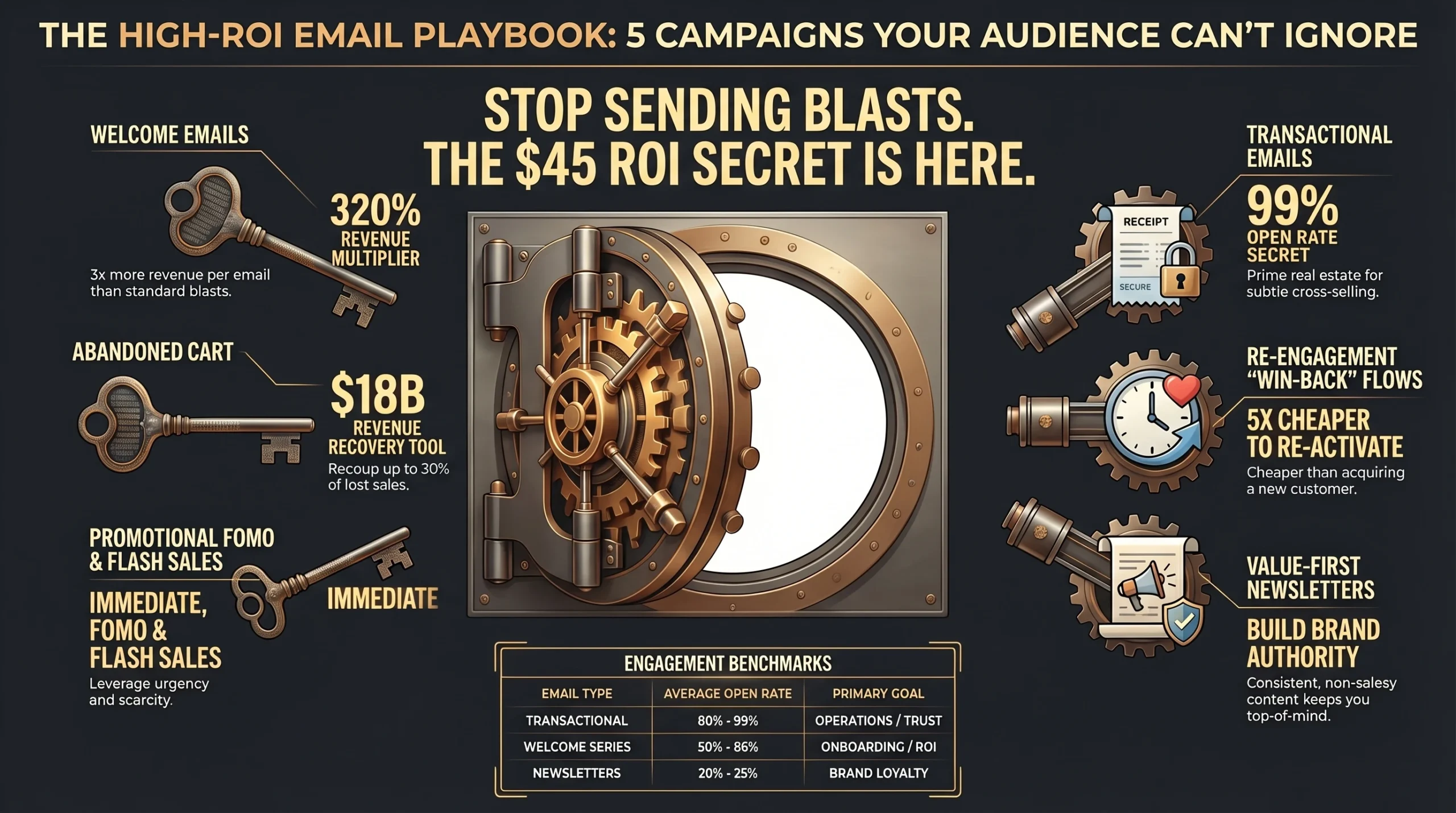
According to industry data cited by verified.email, email marketing provides a massive 3,500% to 4,200% ROI, making it the most impactful digital channel when these two categories are balanced effectively.
Why are welcome emails your digital handshake in India?
Welcome emails are the first communication a lead receives after signing up. They set the tone for the brand and establish trust. In the competitive Indian D2C space, brands like Zomato and Myntra use these to manage expectations and provide immediate value, such as a first-order discount. Data from SAP indicates that 89% of marketers still use email as their primary channel for lead generation, proving the welcome series is the most critical engagement window for new users.
Non-obvious insight: While some best practices suggest a 24-hour window, the most effective welcome emails are sent within minutes of signup. This captures interest at its peak and prevents conversion decay before the user moves to a competitor.
Can promotional and seasonal emails survive the Indian festive rush?
Promotional emails focus on driving immediate sales through scarcity and urgency. In India, timing these around Diwali, Holi, or major e-commerce sales like the Big Billion Days is critical. These campaigns often use countdown timers and clear discount amounts to cut through the noise.
The Festive Factor: During holiday rushes, Indian consumers are highly cost-sensitive. Statista data indicates that 40% of shoppers abandon carts due to “unexpected costs” such as shipping fees and taxes. Successful promotional strategies highlight “all-inclusive” deals or free shipping early in the subject line to prevent this friction.
How do abandoned cart emails recover lost revenue?
Abandoned cart emails act as reminders for users who added items to their shopping cart but did not complete the checkout. These emails can recoup 30% of lost customers, resulting in a 64% increase in revenue.
A recommended 3-email sequence follows this timeline:
- 1 Hour Later: A gentle reminder with an image of the left-behind product.
- 24 Hours Later: A follow-up including social proof, such as customer reviews or testimonials, to build trust.
- 72 Hours Later: A final incentive, such as a discount or free shipping offer, to overcome purchase barriers.
What role do newsletters play in long-term relationship building?
Newsletters are regular, recurring emails that provide updated content like articles, company news, and blog summaries. Unlike promotional blasts, they focus on providing value to stay top-of-mind without causing subscriber fatigue.
According to Adobe, newsletters are the second most widely used type of marketing email after promotional campaigns. By delivering helpful tips, businesses build deep rapport before asking for a sale.
Why are transactional emails the “hidden” growth engine?
Transactional emails include order confirmations, shipping updates, and password resets. Because these messages contain information the user is actively waiting for, they consistently see the highest open rates in the industry.
Data from Brevo states that 99% of email users check their email every single day, and transactional triggers are the most frequent touchpoint. Savvy Indian marketers use these for subtle cross-selling, such as recommending a screen protector within a smartphone shipping confirmation.
How should you handle re-engagement and sunset policies?
Re-engagement campaigns target “sleeping” subscribers who have not engaged in 3 to 6 months. It is five times cheaper to turn an inactive subscriber into a customer than to acquire a new one.
However, continuing to email “ghost” subscribers who remain inactive after a win-back attempt poisons your sender reputation. ISPs like Gmail interpret low engagement as a sign of spam. A “Sunset Policy” dictates that users who do not engage after 90 days should be suppressed or removed.
What are the technical deliverability and compliance essentials?
Reliable deliverability depends on proper infrastructure and permission-based sending. List hygiene is a core requirement, as data decays at a rate of approximately 22% per year.
| Protocol | Purpose |
|---|---|
| SPF | A DNS list of approved IP addresses authorized to send your emails. |
| DKIM | A digital signature that proves the email has not been tampered with in transit. |
| DMARC | A policy telling receivers to reject or flag emails that fail SPF or DKIM checks. |
How do Indian market dynamics affect email strategy?
The Indian market requires a nuanced approach to accessibility. There is a significant difference between Tier 1 and Tier 2 consumers in terms of internet reliability and device usage. Email strategy must be mobile-first, using single-column layouts and at least a 16px font size to ensure readability on smaller screens.
Additionally, the Indian market is moving toward unified omnichannel strategies. In Tier 2 cities, email often acts as the formal confirmation that validates a purchase made via WhatsApp or social commerce. Integrating email with WhatsApp ensure that if a customer ignores a crucial shipping email, a triggered message on their preferred chat app maintains a seamless customer experience.
What are the most common questions about Indian email marketing strategy?
Is email marketing still effective in 2026?
Yes, email marketing remains the highest-performing channel for Indian businesses. Because you own the relationship with your audience, you are not vulnerable to shifting social media algorithms. It continues to deliver high ROI by automating conversion and retention through personalized messaging that cuts through digital noise.
How often should I send emails?
Consistency is more important than high frequency. Most Indian brands find success with one weekly newsletter and two to three promotional emails per month. You must monitor your unsubscribe and engagement rates to find the “sweet spot” that keeps your brand visible without causing audience fatigue or complaints.
Is buying an email list okay?
No, buying email lists is a dangerous practice that can destroy your brand’s reputation. Purchased lists lead to high spam complaints and bounce rates, which results in ISPs blocking your domain. Permission-based, organic list growth is the only sustainable way to ensure your emails actually reach the inbox.
What is the difference between broadcast and drip campaigns?
A broadcast campaign is a one-time email sent to your entire list or a segment at a specific, scheduled time. A drip campaign is an automated series of emails triggered by a user’s behavior, such as signing up for a lead magnet, delivering personalized messages over a set period.
How do I avoid the spam folder?
To avoid the spam folder, you must use authentication protocols like SPF, DKIM, and DMARC. Additionally, maintain list hygiene by removing inactive users, avoid using all-caps or excessive punctuation in subject lines, and always include a clear, easy-to-find unsubscribe link in every marketing email you send.
Conclusion & Primary CTA
Effective email marketing in India depends on a “goal-audience-trigger” framework that prioritizes the customer’s journey and mobile-first accessibility. By choosing the right email type for each stage of the funnel, businesses build lasting loyalty and predictable revenue.
Book a free counselling session with an academic counsellor for our AI-powered Niche Specific Digital Marketing course to master high-ROI email strategies.
Don’t leave your festive revenue to the algorithm gods. Master the frameworks used by India’s top D2C brands to guarantee inbox placement and 40x returns.
Book a Free Counselling Session