
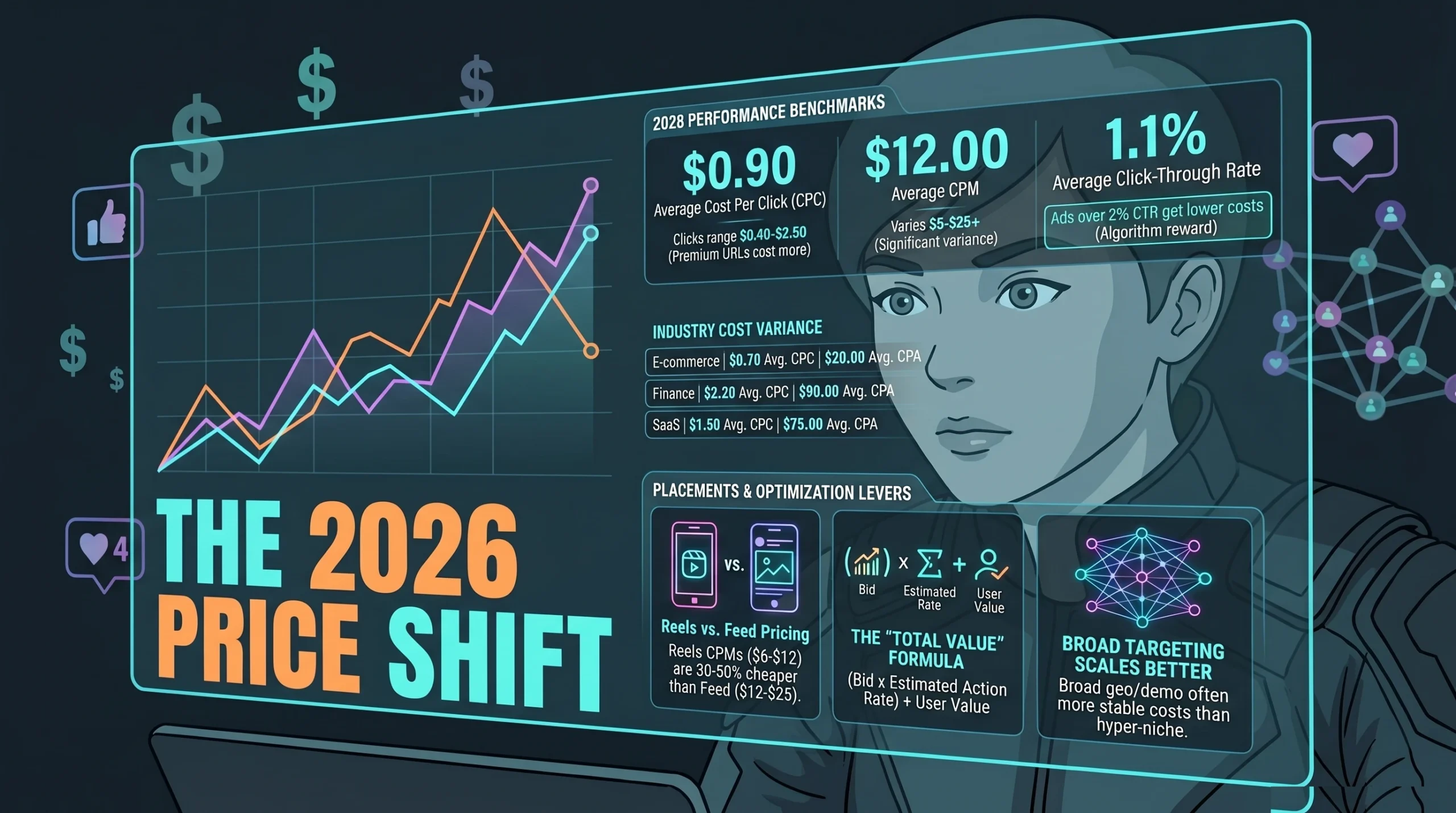
The Indian digital landscape is currently witnessing an unprecedented surge in competition, leading many business owners to “burn” their marketing capital with little to show for it. It is common for advertisers in cities like Mumbai or Delhi to face the frustration of rising CPCs (Cost Per Click) and high engagement that fails to translate into actual sales. This guide serves as your strategic blueprint for navigating the complex auction environment of 2026. To answer the most pressing question immediately: standard benchmarks for Instagram ads in 2026 indicate a CPC range of $0.40–$2.00 and a CPM range of $5–$15. For Indian advertisers, this translates to approximately ₹35–₹170 per click, depending on the niche and targeting precision.
TL;DR Actionable Takeaways
- Creative Dominance: In the “Andromeda Era,” your high-quality creative assets act as the primary targeting mechanism.
- Reels Efficiency: Reels currently offer the most cost-effective engagement, often yielding a lower CPM (approx. $4.29) compared to traditional Feed ads.
- Auction Logic: Success depends on the “Total Value” formula (Bid × Estimated Action Rate + User Value).
- Strategic Segmentation: Indian Tier 2 cities like Patna and Lucknow often provide better ROI for local businesses than oversaturated Tier 1 markets.
- The 10-Day Fatigue Rule: Winning ads at scale often fatigue in as little as 10 days, requiring a rapid creative refresh cycle.
- Learning Phase: Campaigns require 50 optimization events per week to stabilize and exit the volatile learning stage.
Interactive Table of Contents
- What is the average instagram ads cost for businesses in 2026?
- Which factors influence your instagram advertising cost in the Indian market?
- How do different ad placements like Reels and Stories affect your spend?
- Can you run profitable instagram ads on a small budget?
- What is the Andromeda Era and how does AI impact your ROI?
- How should Indian businesses allocate their digital marketing budget?
- FAQ: Clearing the Confusion About Instagram Ad Spending
What is the average instagram ads cost for businesses in 2026?
Understanding the financial landscape of Instagram advertising requires a deep dive into three primary metrics: Cost Per Click (CPC), Cost Per Mille (CPM), and Cost Per Engagement (CPE). The auction system determines these rates based on real-time supply and demand within the Meta ecosystem.
| Metric | 2026 Global Average | Estimated Indian Range (INR) |
|---|---|---|
| Cost Per Click (CPC) | $0.40 – $2.00 | ₹35 – ₹170 |
| Cost Per 1,000 Impressions (CPM) | $5.00 – $15.00 | ₹425 – ₹1,275 |
| Cost Per Engagement (CPE) | $0.03 – $0.08 | ₹2.50 – ₹7.00 |
There is a non-obvious but critical distinction between “All Clicks” and “Link Clicks” (Destination URL clicks). Source data shows that “All Clicks” typically range between $0.40 and $0.70 because they include low-intent actions like expanding a caption or liking a post. Conversely, “Link Clicks” focus on users who actually navigate to your website or landing page. These clicks cost between $0.50 and $1.20 (₹42 – ₹100) because they represent a higher level of user intent. If you prioritize sales, you must expect to pay this premium for a higher quality of traffic. As a performance strategist, I always recommend that Indian SMEs use the “Facebook Ads Performance Grader” to see how their specific CPC compares to these broader benchmarks.
Which factors influence your instagram advertising cost in the Indian market?
Several variables dictate the final price of your campaign. In the Indian market, geography, seasonality, and auction mathematics play outsized roles.
Audience Specificity and Geographic Tiers
Targeting Tier 1 cities like Mumbai or Bangalore often results in a higher Cost Per Impression. The density of advertisers in these hubs creates intense competition. However, shifting focus toward Tier 2 cities such as Patna or Lucknow can lower costs (often by 20% to 30%). You must be careful with “compression” in these smaller markets: narrowing your audience too far by restricting age, gender, or specific interests can actually backfire. This limits the available auction inventory, which forces CPMs upward and destabilizes delivery.
The Total Value Auction Formula
Meta does not simply award the top spot to the highest bidder. The platform uses a specific calculation to decide which ad to show: Total Value = Bid × Estimated Action Rate + User Value
- Bid: The amount you are willing to pay for a specific action.
- Estimated Action Rate (EAR): How likely Meta thinks a user is to complete your goal (click or purchase).
- User Value: A measure of ad quality and how much the user will actually enjoy the content. This includes penalties for “Negative User Experiences” (like slow-loading landing pages or misleading “Hinglish” captions).
If your ad provides high User Value and has a strong EAR, Meta might reward you with a lower cost than a competitor who bids more but has boring content.
Seasonality and the Diwali Factor
Indian businesses must plan for significant cost spikes during Q4 (October to December). Major festivals like Diwali cause a dramatic increase in advertiser demand, which can raise CPMs by 30% to 50%. Professional consultants recommend a “pre-heating” strategy starting in September. By building warm audiences before the October rush, you can retarget them during peak season at lower costs than if you were bidding on cold traffic in November.
How do different ad placements like Reels and Stories affect your spend?
Placement liquidity is the key to lowering your overall spend. When you allow Meta to use “Automatic Placements” (found within the Meta Business Suite), the algorithm finds the cheapest opportunities across the entire platform.
The Power of Reels and Stories
Reels are currently the fastest-growing phenomenon on the platform. Because the inventory for Reels is still expanding, the CPM is often significantly lower (averaging around $4.29 or ₹365) compared to traditional Feed ads. Reels also generate 38% more engagement than other visual formats, making them ideal for brand building among younger demographics in India. Many brands in Mumbai are now using “Hinglish” scripts in Reels to drive authenticity and lower their CPE.
Design Safe Zones and User Experience
To avoid “Negative User Experience” penalties, which drive up costs, your creative must follow placement-specific “Safe Zones.” You can use WASK’s Cost Calculator to estimate how these design choices impact your final bill.
- Stories/Reels: Ensure your text and calls-to-action (CTAs) are not covered by the UI elements (profile icon at the top or the CTA button at the bottom).
- Aspect Ratio: Use a 9:16 vertical format for Stories/Reels and a 1:1 or 4:5 ratio for Feed posts.
- Visual Quality: Professional-looking, high-resolution imagery and clear, mobile-optimized text are mandatory to maintain a high Relevance Score.
Can you run profitable instagram ads on a small budget?
Many Indian entrepreneurs believe that they cannot compete without a massive budget. However, a focused strategy can yield significant results with as little as ₹800 per day.
The Localized Success Framework
If you operate a local business (like a dental clinic in Patna or a retail store in Lucknow), avoid trying to target all of India. A more effective approach is to set a specific radius (for example: a 17km–24km radius around your physical location). This ensures that every rupee spent reaches a potential customer who can actually visit your premises. This geographic focus reduces competition with national brands and stabilizes your CPM.
Bidding for Success
- Automatic Bidding: This is the recommended choice for beginners. It allows Meta’s machine learning to find the best balance between cost and delivery.
- Manual Bidding: Expert advertisers use this to cap their spending at precise levels. However, if you set your bid too low, your ad may never be shown in competitive markets like Mumbai.
The Creative Refresh Speed
On a small budget, creative fatigue is your biggest enemy. Winning ads can “fatigue” in as little as 10 days when scaled. To keep costs low, you should introduce at least 2–3 new creative concepts every week. This prevents users from getting bored and ensures your engagement rates stay high, which keeps your CPMs low in the auction.
What is the “Andromeda Era” and how does AI impact your ROI?
We have entered a phase of advertising where Meta’s neural networks have replaced manual targeting as the primary driver of performance. In 2026, “Creative is the new targeting.”
Neural Network Scanning
Meta’s AI now “scans” your video and static assets to understand the context. It analyzes the visuals, the text on the screen, and even the spoken words in your audio (including local languages like Hindi) to figure out exactly who should see the ad. This means you no longer need to spend hours manually selecting interests in the Ads Manager. Instead, you must focus on making the creative so clear that the AI can easily identify your target audience. For instance: if you are selling high-end luxury fashion, your visuals should feature premium settings and appropriate keywords in the audio.
Generative Engine Optimization (GEO)
Generative Engine Optimization (GEO) involves optimizing your ad assets so that Meta’s generative AI can effectively interpret and deliver your content to the highest-intent users. This includes using clear primary text and high-resolution visuals that align with modern discovery patterns. AI tools help minimize overspending by:
- Dynamic Allocation: Automatically shifting budget toward the best-performing ad sets.
- Predictive Analysis: Identifying which users are ready to purchase versus those who are just browsing.
- Creative Enhancements: Automatically adjusting brightness or aspect ratios to improve user engagement.
How should Indian businesses allocate their digital marketing budget?
Your budget allocation depends heavily on your business size and your primary objective. Most successful Indian brands dedicate 11-20% of their total digital budget to Instagram.
| Business Type | Recommended Monthly Spend (INR) | Primary Objective | Benchmark LCTR |
|---|---|---|---|
| Startup / Local Shop | ₹8,500 – ₹25,000 | Brand Awareness | 1.1% |
| SME | ₹25,000 – ₹70,000 | Lead Generation | 1.2% |
| E-commerce / Brand | ₹70,000 – ₹4,25,000+ | Direct Sales | 1.5%+ |
For e-commerce brands, the strategy should involve allocating 70% of the budget to “proven performers” and 30% to testing new creative concepts. This ensures a steady flow of sales while simultaneously searching for the next “winning” ad.