Frustrated with ranking for high-volume keywords in India only to see zero conversions: stagnant revenue: and high bounce rates? You are not alone. Many brands chase search volume while ignoring the psychological “why” behind the query. In the era of AI Overviews and shifting search behaviors: blind keyword targeting is effectively dead. Ranking at the top of the search results page matters very little if your content fails to satisfy the user’s specific objective or intent. Keyword intent is the underlying goal or reason behind a search query. It acts as the functional bridge between search volume and revenue: explaining exactly what a user hopes to achieve when they type a phrase into a search engine.
TL;DR: Actionable Insights for 2026
- Four Primary Buckets: Master Informational: Navigational: Commercial: and Transactional intent categories.
- The 80/20 Split: Research indicates that approximately 80% of all web queries are informational: while the remaining 20% are split between navigational and transactional.
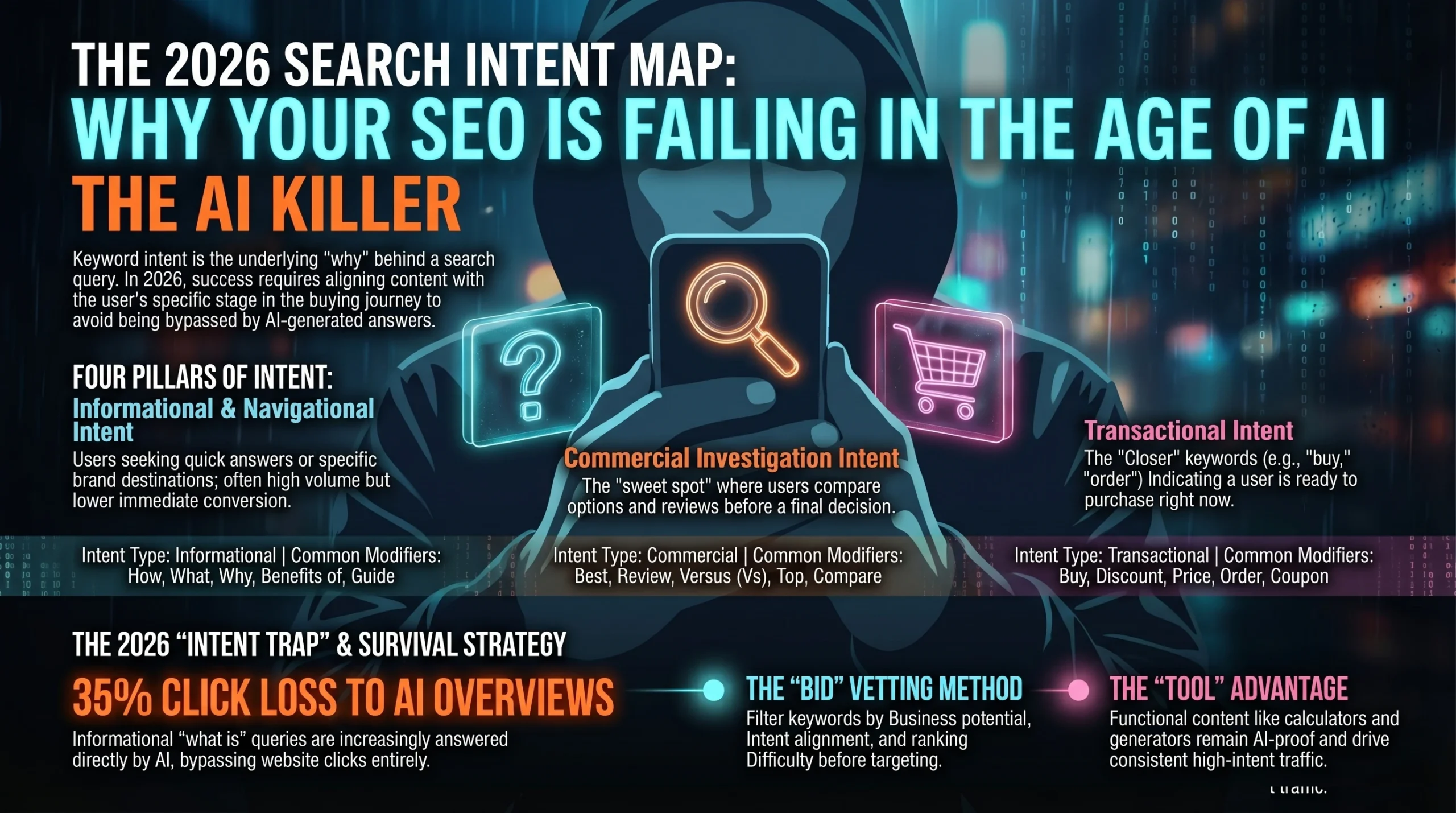
- The AI Impact: AI Overviews (SGE) are capturing up to 35% of clicks for simple informational queries: necessitating a shift toward high-intent: expert content.
- The 3 Cs Framework: Analyze Content Type: Content Format: and Content Angle to mirror what Google is already rewarding.
- The BID Method: Vet every keyword using the “Business potential: Intent: and Difficulty” framework before committing resources.
- Intent Drift: Indian search behavior shifts seasonally: especially during major festivals like Diwali or sporting events like the IPL.
Table of Contents
- What is the fundamental meaning of keyword intent?
- Why is keyword intent critical for SEO success in the Indian market?
- What are the four core types of search intent you must master?
- How does local and branded intent change the search landscape?
- How can you identify keyword intent using the 3 Cs and BID methods?
- Operationalizing Intent: The Keyword Gap and Clustering Strategy
- How should you align your content format with the user journey?
- How do AI Overviews and GEO impact keyword intent in 2026?
- FAQ Section
What is the fundamental meaning of keyword intent?
Keyword intent is the motive behind the action: moving beyond the literal words to the intended outcome. While search engines have evolved: their primary goal remains to reward pages that best fulfill the user’s underlying intent. To master this: you must distinguish between three distinct concepts.
Keyword Intent vs. Search Intent vs. User Intent
Keyword intent is the intent implied by the word itself: such as the word “buy” signaling a purchase. User intent refers to the specific person’s actual: often hidden: goal. Search intent is how search engines like Google interpret that goal based on semantic meaning and historical behavior. A classic example of the gap between these is the query “buy Apple.” The keyword intent is transactional: but the user intent could be seeking fruit rather than tech. Google’s search intent analysis currently favors the tech giant: meaning a fruit vendor will struggle to rank regardless of their SEO strength.
The Concept of Intent Proximity
Intent Proximity refers to how close a searcher is to taking a final action. Some keywords have “Adjacent Intent”: where a user is likely to move from a broad search to a specific one. For example: a search for “Invisalign” often leads to “Invisalign cost” and then “Orthodontist near me.” Understanding these transitions allows you to build a content web that captures users at every step.
Why is keyword intent critical for SEO success in the Indian market?
Aligning with intent is the most effective way to build authority. Modern algorithms prioritize “helpfulness” as a core ranking signal. When your content matches intent: users stay longer: bounce rates drop: and your pages earn more stable positions.
The Scale of Indian Digital Adoption
India’s digital landscape is growing at an unprecedented rate. Data from the Reserve Bank of India (RBI) indicates a massive surge in digital payments: with UPI transactions seeing triple-digit growth. This shift has turned many “informational” searchers into “transactional” buyers almost overnight. According to Statista: India’s internet user base surpassed 900 million in 2024. This massive scale means that even slight shifts in how intent is interpreted can result in millions of lost or gained visitors. In Tier 2 and Tier 3 cities: the rise of “Vernacular Search” and voice queries is changing long-tail intent: making conversational optimization a requirement.
Managing Intent Drift
A non-obvious insight for the Indian market is “Intent Drift.” Search terms can change their meaning based on seasonality. A broad term like “luxury ethnic wear” might be informational in June: but it shifts to high-transactional intent during the October wedding season or Diwali. Failing to account for these psychological shifts makes your SEO strategy reactive rather than proactive.
What are the four core types of search intent you must master?
Most search queries fall into four specific buckets. Each bucket requires a unique content strategy and different on-page elements to satisfy the user.
Informational Intent
These users are looking for knowledge. They want to learn something new or solve a specific problem.
- What to do: Create detailed how-to guides: listicles: and infographics. Establish trust through accuracy.
- What to skip: Avoid broad: surface-level answers like “what is marketing” if you cannot provide a unique angle.
- Intent Modifiers: “how to”: “what is”: “why”: “benefits of”: “guide to.”
Navigational Intent
The searcher wants to reach a specific destination. They already know where they want to go and use the search engine as a shortcut.
- What to do: Ensure your branded pages: login portals: and contact pages are perfectly optimized.
- What to skip: Do not try to rank for competitors’ navigational terms unless you are offering an “alternative” comparison.
- Intent Modifiers: “login”: “official site”: “support”: “[Brand Name].”
Commercial Investigation Intent
This represents a user in the consideration phase. They have identified a need but are still researching brands: comparing features: and reading reviews.
- What to do: Use product comparisons: “best of” lists: and case studies.
- What to skip: Don’t be overly sales-driven: users at this stage want honest analysis: not a pitch.
- Intent Modifiers: “best”: “top”: “review”: “vs”: “comparison”: “pros and cons.”
Transactional Intent
These users have reached the end of the funnel. They are ready to buy: subscribe: or hire immediately.
- What to do: Focus on optimized product pages and landing pages with frictionless checkout paths.
- What to skip: Avoid long: educational blocks of text. The user wants the product: not a history lesson.
- Intent Modifiers: “buy”: “price”: “order”: “discount”: “coupon”: “purchase.”
| Intent Type | Searcher’s Goal | Example Indian Query |
|---|---|---|
| Informational | Gain knowledge | “How to make paneer at home” |
| Navigational | Reach a destination | “Airtel Thanks app login” |
| Commercial | Compare options | “Best affordable smartphones under 20k” |
| Transactional | Complete a purchase | “Buy paneer online BigBasket” |
The Golf Club vs. Golf Bag Lesson
As highlighted in Ahrefs’ search intent research: different products trigger different SERP layouts. A search for “golf clubs” often yields 100% ecommerce category pages: signaling a pure shopping intent. However: “golf bags” often results in a “mixed SERP” featuring both category pages and blog-style “best of” reviews. You must analyze the SERP before deciding whether to build a blog or a product page.
How does local and branded intent change the search landscape?
Local and branded intent are two critical categories that traditional four-bucket models often overlook. They function differently within the Search Engine Results Pages (SERPs) and require specialized optimization.
Local Search Dynamics
Local intent is triggered by queries seeking services in a specific geography. In India: queries like “Dentist in Indiranagar” or “Gyms in Bandra” trigger the Local Pack and Google Business Profiles. This is particularly relevant in the “Quick Commerce” era: where brands like Blinkit and Swiggy Instamart compete for local “transactional” intent for daily essentials. Success in local SEO depends on local citations and reviews. If the intent is local: Google will prioritize proximity and reputation over a general informational guide.
The Power of Branded Intent
Branded intent queries include a specific organization by name: such as “Tata Neu” or “Zomato.” These searches are resilient against AI click erosion because users are seeking a specific relationship. Whether they are looking for “brand pricing” or “brand alternatives”: these queries represent direct loyalty that generic AI answers cannot easily replace.
How can you identify keyword intent using the 3 Cs and BID methods?
To accurately identify intent without guesswork: expert strategists use two primary frameworks.
The 3 Cs of Search Intent
- Content Type: Identify if the top results are blog posts: product pages: category pages: or landing pages. For “best smartphones”: blogs dominate.
- Content Format: Determine the structure. Are they how-to guides: listicles: or comparison tables? Listicles are the winning format for “best” queries.
- Content Angle: Find the unique hook or benefit. For “Best Golf Shoes”: the winning angle is often “Freshness”: indicated by the current year in the title. If the top results are all “Best of 2026”: you cannot rank with an outdated guide.
The BID Method
- Business Potential: Rated on a scale of 0 to 3. If a keyword like “what is coffee” has high volume but users won’t buy your espresso machine: the score is 0. “Best espresso machine under 50k” scores a 3.
- Intent: Can you realistically match what is ranking? If the SERP is all product pages and you want to rank a blog: you will fail the intent test.
- Difficulty: Use tools like Ahrefs or Semrush to check Keyword Difficulty (KD). Look at the “Referring Domains” and “Domain Rating” (DR) of the top 10 results to see if your site has the authority to compete.
Advanced Micro-Intent Identification
By using the Model Context Protocol (MCP) with LLMs like Claude: you can query Ahrefs data to identify “micro-intents.” This allows you to group thousands of keywords by intent types in seconds: flagging high-traffic opportunities that traditional manual research might miss.
Operationalizing Intent: The Keyword Gap and Clustering Strategy
Mastering intent requires a structured workflow to find where your competitors are winning.
Keyword Gap Analysis
Using the Semrush Keyword Gap tool: you can compare your domain (e.g.: BigBasket) with competitors (e.g.: Zepto: Blinkit).
- Missing Keywords: High-volume terms where competitors rank in the top 10 but you don’t. These are prime targets for new intent-aligned content.
- Weak Keywords: Terms where you rank on page 2 (positions 11-30). These are “low-hanging fruit” where small optimizations can push you to the high-converting page 1.
Intent Clustering Once you have your keywords: cluster them. If “mini chocolate chip cookies” and “small cookies” share the same informational intent: group them into one detailed article. This prevents “Content Cannibalization”: where multiple pages on your site compete for the same keyword: ultimately weakening your authority.
How should you align your content format with the user journey?
Your content must meet the user exactly where they are in their decision-making process. The average conversion rate in organic search is 2.7%: according to Moz. To hit or exceed this: you must map intent to the funnel correctly.
- Informational (ToFu): Use blogs: how-to guides: and FAQs. Focus on establishing your brand as a helpful expert.
- Commercial (MoFu): Use product comparisons: case studies: and “top 10” lists. Help the user evaluate their options.
- Transactional (BoFu): Use optimized product pages: landing pages with clear CTAs: and special offer pages to facilitate the final purchase.
The Indian Student Journey
Consider a student interested in technology. They might start with “What is artificial intelligence” (Informational): move to “Best AI courses in India reviews” (Commercial): and finally search for “Apply for [Brand Name] AI Certification” (Transactional). By providing tailored content for each transition: you guide the user through the funnel without friction.
How do AI Overviews and GEO impact keyword intent in 2026?
The rise of Generative AI has changed the value of certain keywords. Simple informational queries that require no nuance are now often answered directly by AI Overviews.
The AI Trap
For queries with simple answers: AI Overviews can reduce clicks to organic websites by up to 35%. If a user’s intent is just to find a quick definition: they no longer need to visit your site. This makes “what is” keywords a potential trap if they lack a unique product angle.
GEO and Brand Citations
Generative Engine Optimization (GEO) focuses on becoming the brand that the AI recommends. In 2026: being mentioned by AI in queries like “best electric bikes in India” is the new benchmark. This is driven by “Brand Mentions” across high-authority platforms like Reddit and LinkedIn.
Entity Richness
To succeed in an AI-driven environment: your content must be “entity-rich.” This means citing specific tools: recognized Indian brands: and authoritative data points. The more often AI models see your brand connected to a high-intent topic: the more confidently they will recommend you as the definitive solution.