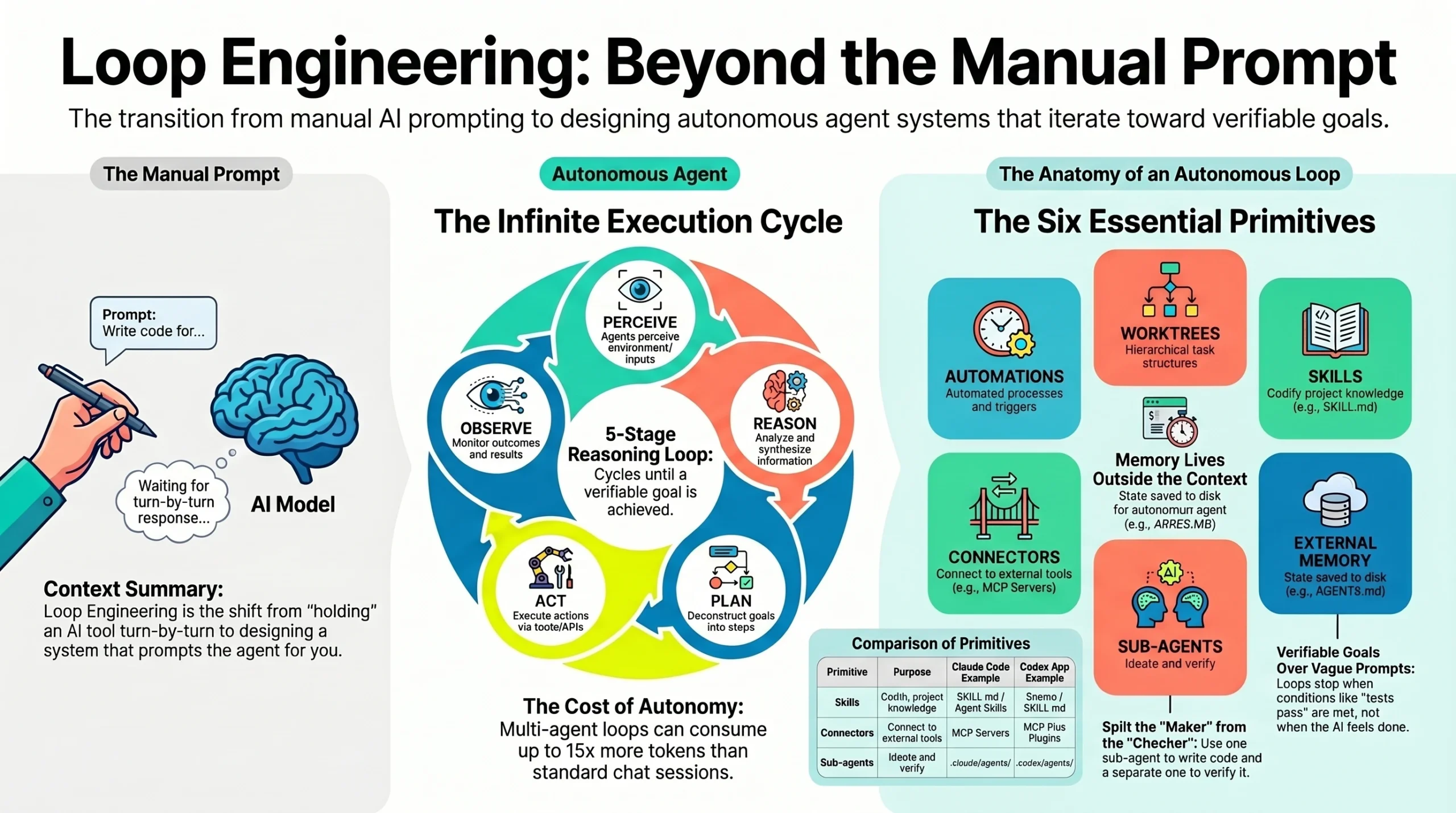
Manual prompting has emerged as the single greatest bottleneck in the modern development lifecycle, requiring exhaustive human oversight and repetitive context setting. This traditional “chat-and-wait” approach often triggers a “goldfish effect,” where agents lose track of architectural conventions or succumb to “context overflow.” For large-scale teams, this agitation is compounded by ballooning token costs, exemplified by monthly usage bills reaching $1.3 million. Loop engineering offers the definitive solution by shifting the developer’s role from “holding the agent” to “designing the system” that directs it.
Loop engineering is the practice of designing recursive systems where a trigger initiates an AI agent to work toward a verifiable goal until completion without manual prompting. It replaces the turn-by-turn chat interface with an autonomous execution model where the engineer manages the factory, not the individual tool.
TL;DR: Key Insights
- Architectural Pivot: Leverage has moved from crafting the perfect prompt to designing the loop that prompts the agent.
- The Six Primitives: Production-ready systems require Automations, Worktrees, Skills, Connectors, Sub-agents, and State.
- The Ralph Loop: This practitioner-led technique solves context overflow by using infinite shell loops that reset context windows while maintaining state on disk.
- Maker/Checker Split: High-performance systems separate implementation from verification, increasing performance by up to 90.2%.
- Enterprise Governance: Production loops must migrate from personal laptops to governed runtimes like TrueFoundry to ensure RBAC, sandbox isolation, and cost control.
- Verification over Implementation: In the loop era, the primary constraint is no longer code generation but proving correctness through automation.
Table of Contents
- Why is Loop Engineering replacing prompt engineering in 2026?
- What are the six primitives of a production-ready loop?
- How do specific loop types like the Ralph Loop solve context overflow?
- Why is the Maker-Checker split essential for autonomous verification?
- Is your laptop the wrong runtime for enterprise loops?
- What are the non-negotiable guardrails for unattended AI agents?
Why is Loop Engineering replacing prompt engineering in 2026?
The industry has moved decisively away from “vibe coding” toward closed-loop systems. Boris Cherny, Head of Claude Code at Anthropic, describes his own evolution clearly: “I don’t prompt Claude anymore. I have loops running that prompt Claude and figuring out what to do. My job is to write loops.” Peter Steinberger, creator of OpenClaw, echoes this sentiment, noting that the skill of 2026 is designing the systems that orchestrate agents rather than typing into a chat box.
Data confirms this transition. Reasoning and Acting (ReAct) frameworks show a 34% improvement on benchmarks like ALFWorld compared to simple action-only approaches. In the product labs of Bengaluru and Hyderabad, this shift reflects a move toward “factory model” engineering. Indian developers are increasingly building autonomous setups that find work in a backlog, hand it out to sub-agents, and verify the output against production-like observability tools without human intervention.
What are the six primitives of a production-ready loop?
A robust loop relies on six architectural components to ensure the system does not “drift” or repeat mistakes. A critical concept here is Intent Debt, which occurs when an agent starts a session “cold” and fills gaps in its knowledge with “confident guesses.” Using the Skills primitive prevents this by codifying project knowledge into durable documentation.
| Primitive | Job in the Loop | Codex App Implementation | Claude Code Implementation |
|---|---|---|---|
| Automations | Discovery and triage on a schedule | Automations Tab: /goal for run-until-done, results in Triage Inbox | /loop for cadence: cron tasks, hooks, and /goal for end-states |
| Worktrees | Isolate parallel features to prevent collisions | Built-in worktree per thread to isolate edits | git worktree: –worktree flag for session isolation |
| Skills | Codify project knowledge (Intent) | SKILL.md: Agent Skills pattern invoked with $name | SKILL.md: Instructions the agent reads every run |
| Connectors | Plug agents into external tools | MCP Connectors and plugins for Jira/Slack | MCP servers and plugins for API access |
| Sub-agents | Separate ideation from verification | TOML definitions in .codex/agents/ | Task sub-agents in .claude/agents/ |
| State | Track progress outside context windows | Markdown files or Linear boards via connectors | AGENTS.md: Progress files stored on disk |
How do specific loop types like the Ralph Loop solve context overflow?
“Generation 4” loops prioritize context management over simple prompt persistence. The Ralph Loop, also known as the Ralph Wiggum Technique, was invented by Geoffrey Huntley. Named after the Simpsons character who announces “I’m helping!” while walking into doorframes, it is a deceptively simple pattern that solves context degradation.
- Infinite Shell Loop: The agent runs inside a continuous shell loop.
- Fresh Context Windows: Every iteration restarts with a clean context, preventing the “forgetfulness” that occurs as windows fill.
- State on Disk: All progress lives on the file system (codebase, TODO files, git history) rather than in volatile context memory.
This approach solves the Premature Exit problem. Most LLMs stop when they subjectively feel finished. The Ralph Loop utilizes a “Stop Hook” that intercepts exit attempts, checks if objective completion criteria (like green tests) are met, and reinjects the prompt if they are not. Native commands like `/goal` (Codex) and `/loop` (Claude Code) now integrate these behaviors. In one documented experiment, a Codex loop ran for 25 hours uninterrupted, consuming 13 million tokens to process 30,000 lines of code.
Why is the Maker-Checker split essential for autonomous verification?
A single agent is often “too nice” to its own code, overlooking bugs it just introduced. Splitting the logic into a “Maker” (to implement) and a “Checker” (to verify) is the only way to ensure unattended quality.
- The Maker: Focuses on exploration, drafting, and tool execution.
- The Checker: Performs adversarial review, running tests and linting against project skills.
Anthropic’s research indicates that multi-agent systems outperform single agents by 90.2%. In the Indian startup ecosystem, where token costs can explode by 15x when moving to multi-agent architectures, this split is a non-negotiable investment. Startups in Koramangala use this “Maker-Checker” logic to justify the cost, ensuring that expensive “silent failures” are caught before they reach production.
Is your laptop the wrong runtime for enterprise loops?
“Laptop Loops” create a significant “Enterprise Gap.” If a loop runs on a local machine, its identity is tied to personal developer tokens, and the process dies the moment the laptop lid closes. Governed Runtimes solve this through:
- RBAC and Identity: The loop runs as its own registered agent with scoped permissions rather than a personal user account.
- Sandbox Isolation: Every agent receives its own secure, ephemeral execution environment (harness sandbox).
- Orchestration at Scale: Enterprise gateways like TrueFoundry handle 350+ requests per second (RPS) on just 1 vCPU, providing the backend durability that a personal terminal lacks.
What are the non-negotiable guardrails for unattended AI agents?
Unattended loops can call broken tools 400 times in five minutes if they are not bounded by “Circuit Breakers.” Mandatory guardrails include:
- Hard Iteration Caps: A maximum number of cycles allowed before reporting state to a human.
- Token and Cost Budgets: Hard spending limits per run to prevent “invoice shock.”
- Human-in-the-Loop Gates: Mandatory human approval for destructive actions, such as merging Pull Requests or hitting production APIs.
- No-Progress Detection: Automatic termination if the output state remains unchanged across multiple iterations.
What is an Agentic Loop?
An agentic loop is an AI architecture consisting of a trigger and a verifiable goal. It iterates autonomously, reasoning and acting until the goal is achieved or a stopping condition is met.
What is the difference between Automation and a Loop?
Automation executes a static, pre-defined series of steps. A loop includes active decision-making, where the agent evaluates its own progress and adjusts its next action based on real-time feedback.
Indian Context: Localizing the AI Revolution
The AI landscape in India is shifting from service-based delivery to a Factory Model. In Tier 1 cities like Bengaluru and Pune, developers are transitioning into “Loop Designers,” moving away from writing line-by-line code to building the systems that generate it. This shift is particularly critical for Global Capability Centers (GCCs) that require governed AI access.
Indian firms are also uniquely sensitive to the “Token Cost Explosion.” While single agents consume roughly 4x more tokens than standard chat, multi-agent loops can consume 15x. Local firms manage this through “Cost-Management Stacks” in enterprise gateways, ensuring that autonomous agents remain within strict VC-funded or project-based budgets.
FAQ Section
Can I start with ReAct?
Yes, Reasoning + Acting (ReAct) is the foundational pattern for production loops. It is the best starting point before adding more expensive layers like Reflexion or multi-agent orchestration.
Why do loops fail?
Most failures stem from ambiguous specifications or lack of objective stopping conditions. Without a verifiable goal, agents enter infinite loops or experience “goal drift” by pursuing related but incorrect tasks.
Is loop engineering expensive?
Yes, due to recursive calls and multi-agent verification, token consumption can be 15x higher than standard chat. Budgeting, rate limits, and per-run attribution are essential to maintain fiscal control.
What is the Ralph Loop?
Created by Geoffrey Huntley, it is a technique that runs a coding agent in an infinite shell loop. It resets the context window each iteration while keeping state on disk, effectively solving context overflow.
Do humans become obsolete?
No, the human role shifts to “factory design” and high-level judgment. Humans remain the ultimate authority on verification, as an agent’s “done” status is merely a claim, not a proof.
Conclusion
By 2026, the unit of leverage has shifted from the prompt to the designed system. To maintain code quality and control costs, you must evolve from a coder to a loop engineer. Stay the engineer: design the loop.
Transitioning from simple prompt engineering to advanced agentic architectures requires a shift in how you view growth and automation. Book a free counselling session with an academic counsellor for our AI-powered Niche Specific Digital Marketing course to master the future of AI-driven growth and learn how autonomous loops are redefining campaign execution and digital scale.
Book a Free Counselling Session