
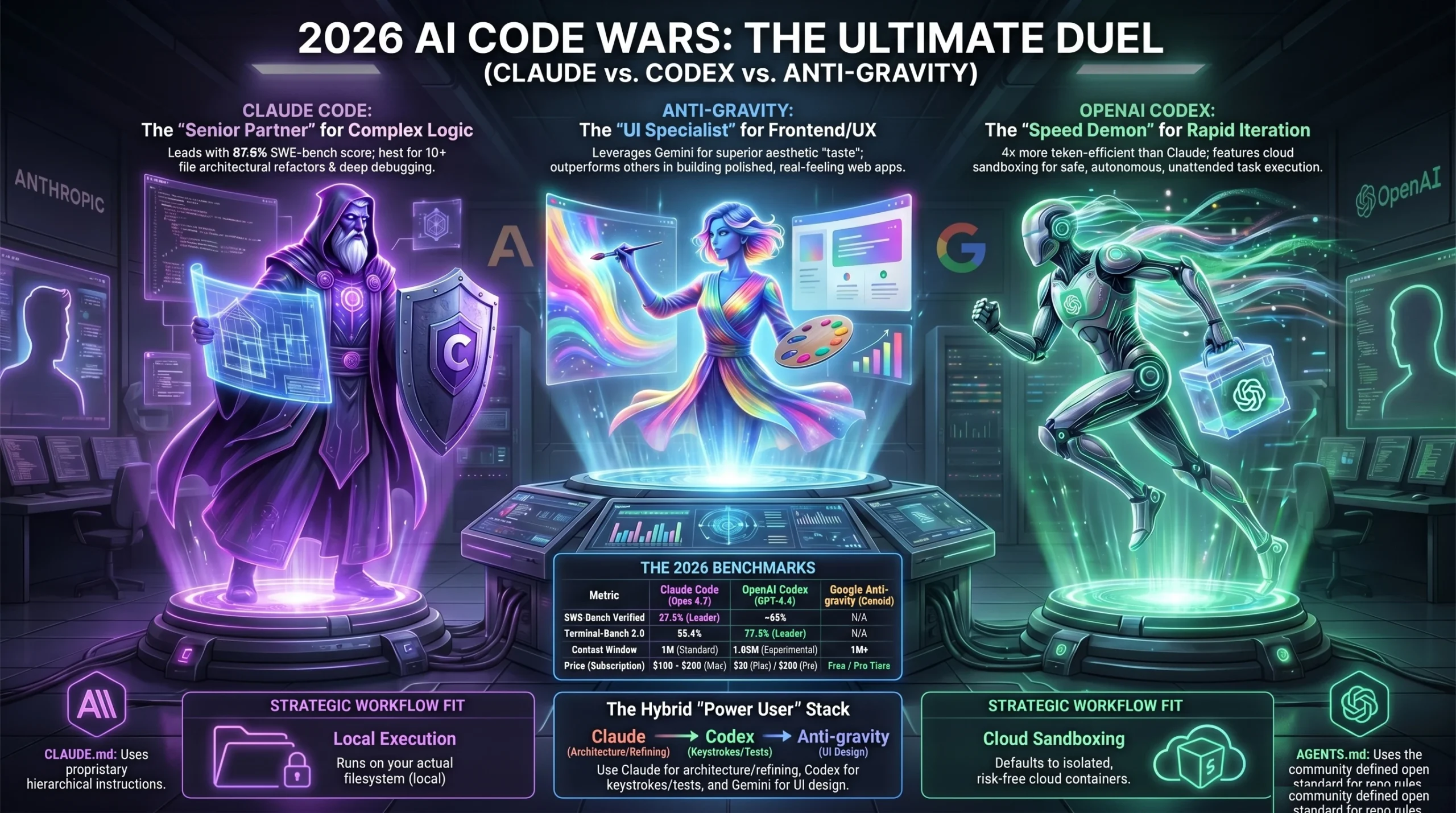
The 2026 developer landscape has transitioned from manual writing to agentic orchestration, yet choosing the wrong tool leads to fragmented codebases and unsustainable API bills. Claude Code (powered by Opus 4.8) leads the market in deep reasoning and multi-file architectural refactoring, while Codex (powered by GPT-5.5) dominates in raw throughput and cloud-sandboxed efficiency. For Indian engineers, the choice hinges on balancing precision with cost. Claude Code is the definitive choice for complex local reasoning, whereas Codex provides the speed and token economy required for rapid, secure enterprise iteration at scale.
TL;DR: Quick Comparison
- Primary Models: Claude Code utilizes Opus 4.8; Codex runs GPT-5.5 (Local) and GPT-5.3-Codex (Cloud).
- Architecture: Claude Code is terminal-first and local-execution; Codex is Rust-based and cloud-sandboxed by default.
- Context Engineering: Claude Code uses hierarchical `CLAUDE.md`; Codex adheres to the open-standard `AGENTS.md`.
- Speed: Codex offers 65-70 tok/s; Claude Code is slower at 15-25 tok/s due to deep reasoning overhead.
- Cost: Claude Code has a 1.4x token gap (higher cost) compared to Codex for similar agentic tasks.
- Availability: Codex is available via ChatGPT Plus; Claude Code requires the Claude Max tier for high-volume work.
Table of Contents
- Architectural Philosophies for Complex Codebases
- 2026 Pricing Tiers and the Indian Context
- Benchmark Performance: Speed and Throughput
- Agent Teams and Multi-Agent Orchestration
- Security Standards: Local vs. Kernel Sandboxing
- Verdict: The 2026 Power-User Configuration
Architectural Philosophies for Complex Codebases {#complex-codebases}
Claude Code operates on a terminal-native, local-execution model. It builds a comprehensive mental map of the codebase, prioritizing reasoning depth and causal tracing across files before writing code.
Codex utilizes a Rust-based binary and a cloud-sandboxed approach by default. It isolates code runs to protect the local filesystem, optimizing for high-speed execution and standardized CI/CD integration.
Non-obvious Insight: While Codex uses the community-standard `AGENTS.md`, Claude Code’s `CLAUDE.md` leverages hierarchical memory. It supports @path imports, allowing developers to compose instruction files that inherit context across nested microservices.
By 2026, Bangalore is projected to host the world’s highest density of AI-first developers. This scale demands tools like Claude Code that can handle massive, legacy enterprise repositories without losing architectural coherence.
2026 Pricing Tiers and the Indian Context {#pricing-context}
For Indian freelancers and dev shops, pricing is the ultimate filter. Codex remains bundled with ChatGPT Plus, making it highly accessible for individual developers in Tier 1 and Tier 2 cities.
| Plan Tier | Claude Code Cost (Monthly) | Codex Cost (Monthly) |
|---|---|---|
| Pro (Entry) | $20 (Limited daily usage) | $20 (Meaningful daily access) |
| Max 5x (Volume) | $100 (Daily professional use) | $100 (High-volume tier) |
| Max 20x (Enterprise) | $200 (Unlimited feel) | $200 (Extreme volume) |
Indian Context: A freelancer in Mumbai or GIFT City sees a major jump from ₹1,600 ($20) to over ₹8,000 ($100). Codex often absorbs a full workload at the lower tier due to its superior token efficiency.
Claude Code exhibits a 1.4x token gap, consuming more tokens because of its “plan-before-code” loop. This makes it roughly 25% more expensive for tool-heavy MCP (Model Context Protocol) workflows.
Benchmark Performance: Speed and Throughput {#speed-throughput}
Codex is the clear winner for developers prioritizing rapid iteration. GPT-5.5 handles standard tasks with significantly higher tokens-per-second (tok/s) compared to the reasoning-heavy Opus models.
- GPT-5.5 Performance: 65-70 tok/s (Standard iteration).
- Codex Spark: 1,000+ tok/s on Cerebras hardware (optimized for speed over precision).
- Claude Opus 4.8: 15-25 tok/s (Heavy reasoning and multi-file mapping).
Indian Example: A developer at a Pune startup fixing a UI bug would find Codex almost instantaneous. However, a lead dev refactoring a legacy banking system for a global client would value Claude Code’s first-pass correctness.
Agent Teams and Multi-Agent Orchestration {#multi-agent}
Claude Code features Agent Teams, where multiple subagents coordinate through a lead session. This uses the `SKILL.md` framework and Hooks to automate complex pipelines across parallel branches.
Codex focuses on Goal Mode and task queuing. It is designed as a “managed” assistant that handles background tasks in cloud containers without the overhead of local terminal coordination.
Claude Code also serves as a brilliant marketing showcase for Anthropic. Its terminal UI uses flickering loading states and “slot machine” visual engagement to make token-heavy runs feel hyper-productive and gamified.
Security Standards: Local vs. Kernel Sandboxing {#security-standards}
Security is non-negotiable for Indian firms adhering to RBI-level security standards in fintech. Codex enforces sandboxing at the kernel level using Seatbelt (macOS) and Landlock (Linux).
This hardware-level isolation guarantees the AI cannot access files outside the workspace or touch the network without explicit permission. Claude Code uses application-layer governance through 26 programmable Hooks, which is more expressive but less deterministic.
Warning: Developers deploying Claude Code or Moltbot on public VPS instances must be cautious. Over 900 servers have been found exposed without authentication, leading to critical API key leaks and private history exposure.
What is Claude Code?
Claude Code is a terminal-native AI agent by Anthropic (2026) powered by Opus 4.8. It performs local file edits, executes tests, and manages agentic orchestration via MCP and hierarchical instruction files.
What is Codex?
Codex is an open-source, Rust-based AI agent by OpenAI (2026) utilizing GPT-5.5. It provides high-throughput code generation, cloud-sandboxed safety, and seamless integration with the ChatGPT ecosystem and mobile surfaces.
FAQ Section
Is Claude Code better than Cursor?
Claude Code is a terminal-native agent, while Cursor is an AI-integrated IDE. In 2026, Claude Code is preferred for autonomous terminal-based tasks and deep refactors, while Cursor remains the standard for developers who want a visual, sidebar-driven coding experience.
Can I use Codex on my mobile?
Yes. As of its May 2026 General Availability (GA), Codex is fully integrated into the ChatGPT mobile app. You can initiate a refactor via the cloud sandbox on your phone and resume the session later on your desktop CLI without context loss.
Which model is more token-efficient for Indian developers?
GPT-5.5 (used in Codex) is significantly more token-efficient, using 2-3x fewer tokens than Opus 4.8 for comparable tasks. This makes Codex the budget-friendly choice for developers on a standard ₹1,600/month Plus subscription.
Does Claude Code support the Model Context Protocol (MCP)?
Yes, Claude Code natively supports MCP, enabling connections to external tools like GitHub, Postgres, and Google Search. This extensibility is central to its ability to perform deep architectural research and multi-agent coordination.
What is the difference between Opus 4.8 and GPT-5.5?
Opus 4.8 is optimized for high-fidelity reasoning and architectural coherence in large-scale, multi-file projects. GPT-5.5 is optimized for extreme speed, throughput, and “clean-state” reliability within kernel-level sandboxed environments.
Verdict: The 2026 Power-User Configuration {#verdict}
The most effective strategy for modern Indian developers is a “Hybrid Workflow.” Routing tasks based on complexity ensures you maximize ROI without sacrificing code quality.
- Gemini CLI: Utilize for simple, well-scoped tasks (leveraging the high-speed free tier).
- Codex: Use for daily coding, CI/CD automation, and cloud-sandboxed execution to keep token costs down.
- Claude Code: Reserve for architectural reasoning and complex refactors where multi-file coherence is mandatory.
This three-tool stack is the gold standard for local dev shops in India aiming to ship elite software while managing the ₹8,000+ monthly overhead of professional plans.
Book a free counselling session with an academic counsellor for our AI-powered Niche Specific Digital Marketing course to master these advanced strategies.