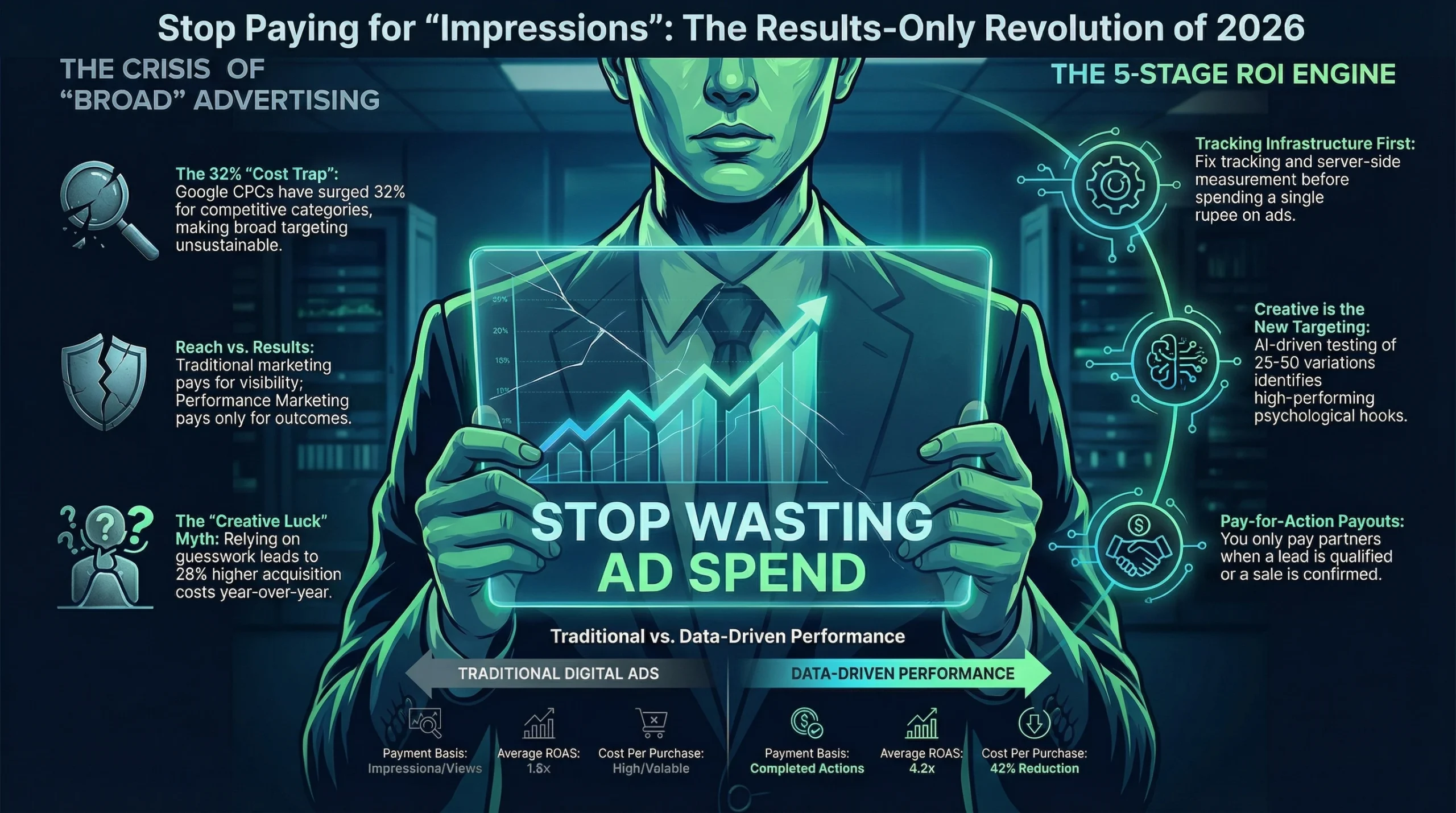
Indian brands face a massive hurdle in 2026. Media costs are skyrocketing. Meta CPMs have increased by 21 percent, and Google CPCs have risen by 32 percent in competitive categories.
Reach-based ads are draining your profit margins without driving actual growth. Indian consumers now possess shorter attention spans. Traditional targeting is failing due to privacy shifts and market fragmentation.
Performance marketing is a data-driven strategy where you pay only when a specific, measurable action occurs. This model represents the only sustainable growth engine for Indian businesses. It turns ad spend into predictable revenue.
TL;DR: Key Takeaways
- Pay for Outcomes: Transition from paying for visibility to paying only for leads, sales, or downloads.
- Combat Ad Inflation: Performance systems offset the 28 percent year-on-year increase in Indian eCommerce acquisition costs.
- Creative is Targeting: Since algorithms now handle audience selection, your ad creative must do the heavy lifting.
- Technical Foundations: High-performance tracking requires Meta CAPI, GA4, and Google Enhanced Conversions to ensure data integrity.
- Indian Market Nuances: Success requires regional language content and funnels integrated with WhatsApp for social proof.
- The 3-Levers System: Focus on lowering CAC, increasing average order value, and improving customer lifetime value.
Table of Contents
- What is Performance Marketing and How Does It Work?
- Why is Performance Marketing Essential for Indian Brands in 2026?
- What are the Core Performance Marketing Channels for the Indian Market?
- What are the Key Benefits of a Result-Oriented Strategy?
- How Can You Build a Data-Driven Performance Strategy?
- How Do Real-World Indian Case Studies Prove the Model?
- What Performance Metrics Should You Track for Profitability?
- Indian Context: How to Navigate Local Market Nuances?
- Frequently Asked Questions
What is Performance Marketing and How Does It Work?
Performance marketing is a comprehensive term for online programs where advertisers only pay when a specific action occurs. This results-oriented approach uses AI to deliver ads to the right audience at the right time.
| Feature | Traditional Digital Ads | Performance Marketing |
|---|---|---|
| Payment Basis | Paying for Reach/Impressions | Paying for Outcomes/Actions |
| Primary Goal | Brand Awareness | Tangible ROI and Sales |
| Accountability | Low (Vanity Metrics) | High (Measurable Results) |
| Optimization | Manual and Slow | Real-Time AI Driven |
Why is Performance Marketing Essential for Indian Brands in 2026?
The Indian digital advertising industry will surpass ₹69,856 crore by 2026. Accountability is no longer optional for scaling brands. Meta CPMs have risen 21 percent while Indian eCommerce CAC rose 28 percent year-on-year.
According to “Data-Driven Performance Marketing for Indian Brands,” consumers here are highly price-sensitive. They rely heavily on multi-touch decision patterns across different platforms. Performance marketing allows brands to adapt to Tier 2 and Tier 3 markets.
Hyperlocal targeting and regional language content are the keys to these segments. A data-driven model adapts to income brackets and device types. This prevents the “broad targeting” wastage that kills profit margins.
What are the Core Performance Marketing Channels for the Indian Market?
Paid Search & Social
Google Ads and Meta remain the dominant platforms for capturing intent. AI-driven discovery tools now target users based on full search history. This ensures you reach users during their highest-intent moments.
Retail Media Networks
Amazon Ads, Flipkart Ads, and Reliance Retail Media are essential for purchase-intent audiences. These shopping ecosystems outperform static banners. They are mandatory for FMCG, electronics, and fashion brands seeking high ROI.
Short-Form Video
Video-first marketing is foundational in 2026. Content on YouTube, Moj, and Instagram Reels delivers 20 to 30 percent higher conversion rates. Short-form formats blend native content with seamless purchase flows.
Influencer-Led Performance
Regional micro-influencers are central to Indian social commerce. Indian video affiliates currently average 6 to 10 percent conversion rates. This is double the rate of traditional display ads.
What are the Key Benefits of a Result-Oriented Strategy?
- Lower Financial Risk: You pay only for specific actions. This model protects your budget from underperforming campaigns.
- Complete Transparency: Modern tracking tools provide a “digital trail.” This follows every step from the initial click to the final conversion.
- Scalability: Successful campaigns scale predictably. You can increase spend once you identify a winning ROI formula.
- Real-Time Optimization: AI algorithms tweak campaigns instantly. This delivers an average 15 to 25 percent boost in ROAS.
How Can You Build a Data-Driven Performance Strategy?
The “Ideamagix 5-Stage System” provides a structured roadmap for Indian brands. This framework moves beyond guesswork to generate predictable growth loops.
Stage 1: Infrastructure
Fix tracking integrity immediately. Use Meta CAPI, GA4 custom events, and Google Enhanced Conversions. Strict UTM hygiene ensures your data remains clean and actionable.
Stage 2: Research
Deploy micro-segmentation based on city tiers and income brackets. Understand the behavioral signals of your audience. Better segmentation equals fewer wasted impressions and lower CAC.
Stage 3: Creative Testing
Treat every ad as a hypothesis. Test 25 to 50 variations of hooks, angles, and formats within 60 days. Regional languages often outperform English in major Indian metros.
Stage 4: Optimization
Reallocate budgets to winning combinations daily. Prune negative audiences to double your ROI within 45 to 60 days. Landing page optimization is critical for reducing friction.
Stage 5: Reporting
Generate business insights that help forecast growth. Focus on spend-to-return projections rather than vanity metrics. This turns marketing into a measurable business function.
How Do Real-World Indian Case Studies Prove the Model?
Fashion/Retail Success
An Indian retail brand reconstructed its tracking and launched 47 ad variations. This resulted in ROAS improving from 1.8x to 4.2x. Sales increased 2.7x without any budget increase.
Mumbai Real Estate Results
A premium developer in Mumbai used micro-location targeting and WhatsApp funnels. They reduced their CPL from ₹2,400 to ₹980. Lead qualification improved by 62 percent.
Nationwide EdTech Scaling
An EdTech brand divided India into region-based acquisition models. They used age-aligned creative narratives and tier-based bidding. CAC reduced by 36 percent and retention rates improved by 19 percent.
What Performance Metrics Should You Track for Profitability?
ROI and ROAS measure total revenue generated against your costs. CAC (Customer Acquisition Cost) calculates the exact amount spent to acquire one customer. LTV (Lifetime Value) tracks long-term value beyond the first purchase.
Marketing Efficiency Ratio (MER) measures the total impact of spend across all channels. This provides a holistic view of your growth engine. It prevents you from over-focusing on single-channel data.
A brand doesn’t need higher ad budgets; it needs better levers. Focusing on these metrics allows you to scale sustainably. Every click must be optimized for long-term profitability.
Indian Context: How to Navigate Local Market Nuances?
Indian markets require a deep understanding of regional psychology. Pricing sensitivity remains the primary driver for conversions. Regional language performance often beats English in metros like Mumbai and Bengaluru.
Budget Benchmarks for 2026:
- Lead Generation: ₹35,000+ per month.
- eCommerce Brands: ₹60,000+ per month.
- Pan-India Presence: ₹1,00,000+ per month.
Indian buyers rely heavily on social proof. Integrating WhatsApp-first funnels often leads to faster closures. This channel builds the trust necessary for high-ticket conversions.
Frequently Asked Questions
Q: How long does it take to see performance marketing results?
Most brands see early signals within 21 to 30 days. CAC usually stabilizes within 60 to 90 days. Scalable ROI generally requires 120 days or more of consistent testing and optimization to build high-confidence data.
Q: Is performance marketing suitable for small Indian startups?
Performance marketing is ideal for small startups because it offers absolute control over lean budgets. You can initiate social media campaigns with small daily spends. However, we recommend monthly budgets starting at ₹35,000 for lead generation to see consistent traction.
Q: Why choose an agency over a freelancer?
Agencies provide deeper stability and enterprise-grade tracking setups. They offer dedicated designers and analysts for creative testing at scale. This structured approach is essential for mid-market brands seeking measurable growth through a full-stack optimization model.
Q: How does AI change performance ads in 2026?
AI now powers predictive budget allocation and smart creative personalization. It helps brands anticipate consumer behavior and market trends. It manages bid management and content creation with much higher accuracy than manual management, boosting ROAS significantly.
Q: What is the difference between Performance Marketing and SEO?
Performance marketing is a results-driven paid system where you pay for specific actions like clicks or sales. SEO is a long-term organic strategy focused on maximizing visibility in search results. While performance marketing delivers immediate leads, SEO builds compounding value.
Conclusion & Next Steps
Measurability is the new standard for business growth in the Indian market. Every click and sale must be optimized to ensure long-term profitability. Stop gambling with your budget and start building a predictable revenue engine.
Ready to master the future of growth? Book a free counselling session with an academic counsellor for our AI-powered niche-specific performance marketing course and turn your ad spend into a predictable revenue engine.