
The rapid “AI boom” is leaving many Indian professionals and students feeling overwhelmed by technical jargon and the velocity of global innovation. With India’s AI market projected to hit $17 billion by 2027, staying ignorant isn’t just a missed career opportunity — it’s a significant risk in an increasingly automated economy. This comprehensive guide strips away the complexity, breaking down core concepts of artificial intelligence while providing a strategic roadmap tailored to the Indian context.
Key Takeaways
- Core Definition: AI involves systems mimicking human cognitive functions like learning from experience and handling unpredictable tasks.
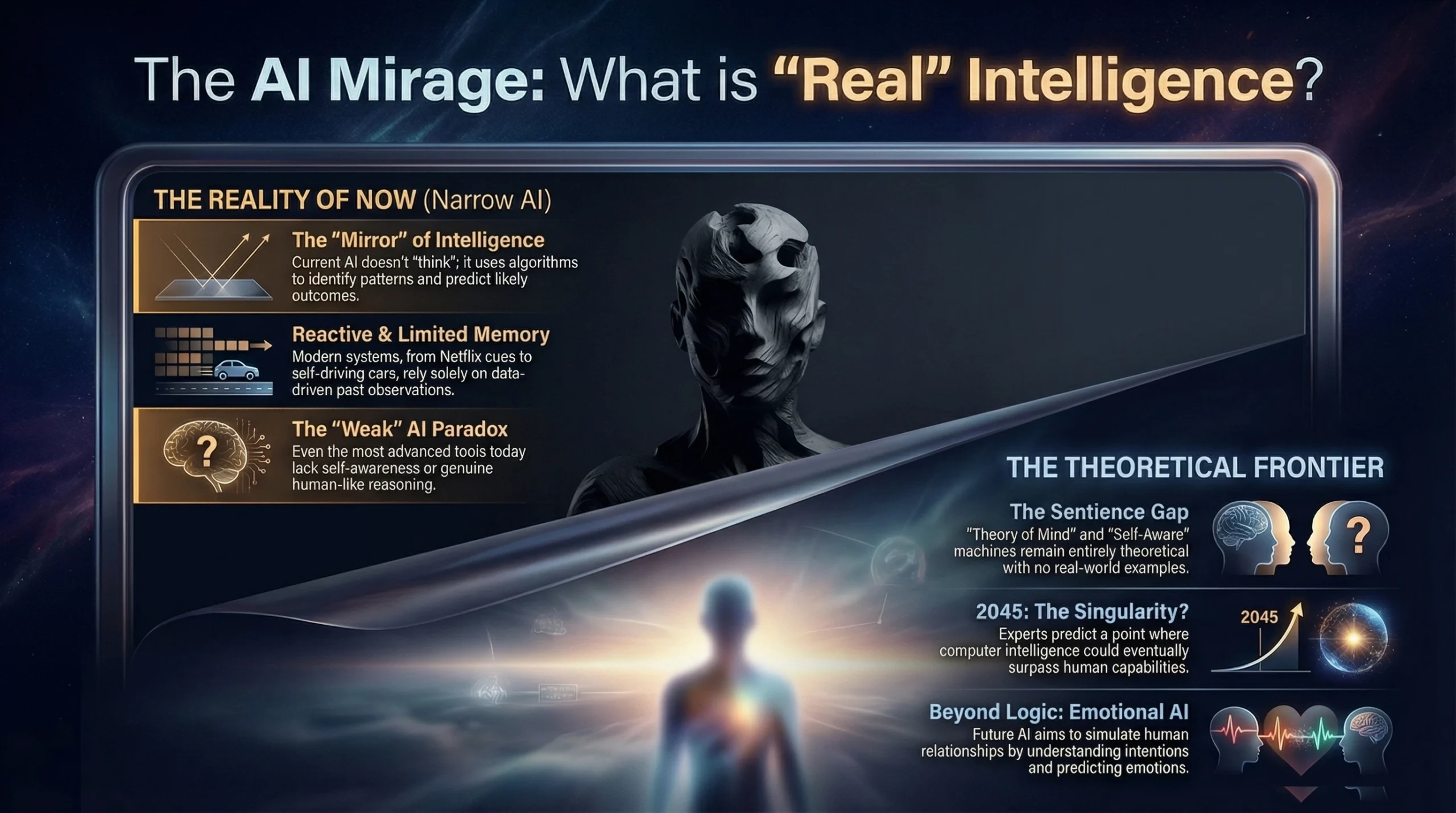
- Evolutionary Stages: Intelligence scales from Reactive Machines and Limited Memory to theoretical Theory of Mind and Self-Awareness.
- Market Momentum: India is maintaining a 40% CAGR in the AI sector, positioning it as a top-tier global innovation hub.
- Sovereign Infrastructure: The ₹10,371.92 crore IndiaAI Mission is building national “Compute” and “AIKosha” dataset platforms.
- Sector Impact: Massive transformation is occurring in Agriculture (Dhenu 2.0), Healthcare (Oncology), and Defense (Indrajaal).
- Labor Shift: The World Economic Forum predicts 97 million new roles will emerge globally, far outstripping the 85 million roles displaced.
Table of Contents
- What is Artificial Intelligence and How Does It Work?
- The Different Types of Artificial Intelligence
- Evolution of India’s Artificial Intelligence Landscape
- Impactful AI Applications and Use Cases in India
- Technical Deep Dive: How A* and BFS Algorithms Function
- AI and the Indian Workforce: Threat or Opportunity?
- Frequently Asked Questions
What is Artificial Intelligence and How Does It Work?
Artificial Intelligence (AI) is the science and engineering of creating machines that perform complex tasks requiring human-like perception, cognition, and reasoning. Synthesizing definitions from NASA and the NIBIB, AI enables systems to learn from experience (proficiency through examples) and handle unpredictable circumstances without constant human oversight. Unlike traditional software that follows a rigid “recipe,” AI identifies patterns in data to handle “hard problems” where a predetermined solution doesn’t exist.
The Trinity of AI
To navigate the industry, one must understand the hierarchy of AI technologies:
| Artificial Intelligence | Machine Learning (ML) | Deep Learning (DL) |
|---|---|---|
| The broad field of creating systems that mimic human behavior and intelligence. | A subset of AI focused on algorithms that learn patterns from data to make predictions without explicit programming. | A specialized subset of ML using multi-layered neural networks (brain-inspired) to process complex, unstructured data. |
Market Insight: India’s commitment to this tech is clear; the nation currently ranks 10th globally for private sector investments in AI, according to the 2025 Technology and Innovation Report.
The Different Types of Artificial Intelligence
Weak (Narrow) AI vs. Strong (General) AI
Current global technology is categorized as Weak or Narrow AI. These systems — including Siri, Alexa, and Tesla’s autopilot — are designed for specific, predefined tasks. In contrast, Strong AI (Artificial General Intelligence or AGI) remains a theoretical milestone where a machine possesses a general intelligence equal to a human, capable of applying knowledge across any diverse domain.
The Four-Type Framework
Analysts classify AI evolution into four functional categories:
- Reactive Machines: Systems that respond to current inputs with no memory of past events (e.g., Deep Blue chess computer).
- Limited Memory: Systems that use past data to inform current decisions, such as self-driving cars monitoring approaching vehicles.
- Theory of Mind: Theoretical machines capable of understanding human emotions and social representations.
- Self-Aware AI: The final stage where machines possess consciousness and an internal sense of self.
Generative AI (GenAI)
GenAI creates original content (text, images, or code) via user prompts. In India, we are seeing the rise of localized Large Language Models (LLMs) like the Hanooman series, which features models ranging from 1.5 billion to 40 billion parameters and supports 22 Indian languages. It is vital to distinguish between the Bharat GPT Consortium (a public-private partnership) and BharatGen, the world’s first government-funded “sovereign” multimodal LLM project designed to safeguard Indian linguistic nuances and data.
Evolution of India’s Artificial Intelligence Landscape
The Foundations (1950s–1980s)
India’s journey began with the development of the TIFRAC (Tata Institute of Fundamental Research Automatic Calculator) in 1954. By 1986, the Knowledge-Based Computer Systems Project marked the first major sovereign research initiative, laying the groundwork for language technologies and image processing.
The IndiaAI Mission
The Government of India has committed ₹10,371.92 crore to the IndiaAI Mission, organized under seven strategic pillars:
- IndiaAI Compute: A shared high-performance computing infrastructure.
- AIKosha (Datasets Platform): A centralized repository for high-quality, ethically sourced Indian data.
- IndiaAI FutureSkills: A nationwide initiative to build a 600,000-strong pool of AI professionals.
- Other Pillars: Innovation Centers, Startup Financing, Application Development, and Safe & Trusted AI.
Compute Power and Accessibility
To democratize AI development, the government is providing massive GPU resources through a 40% government subsidy, bringing access rates for researchers and students to under ₹100/hour.
| Spec Feature | IndiaAI Compute Details |
|---|---|
| GPU Target | 10,000+ Units |
| Hardware | Nvidia H100, H200, A100; AMD Instinct MI300 series |
| Portal Access | Subsidized cloud services via AWS Trainium, Gaudi 2, and others |
Impactful AI Applications and Use Cases in India
Agriculture: Solving Global Challenges Locally
India is pioneering “Open Source AI” in farming. While Dhenu 1.0 was the first agri-specific LLM, the newer Dhenu2 (powered by Llama 3 with 1.5 million instructions) allows for precision farming at scale. In Khutbav village, Microsoft and Agripilot.ai helped farmers achieve a 40% yield increase while reducing production costs by 50% through data-driven pest and water management.
Healthcare: Bridging the Rural-Urban Gap
IBM Watson has been utilized to cross-reference 20 million oncology records to assist Indian clinicians in diagnosing rare conditions. Simultaneously, NITI Aayog has deployed AI models for diabetic retinopathy screening, identifying blindness-causing conditions through retina scans in underserved areas.
Defense: Sovereign Security
The Ministry of Defense has authorized 129 AI projects, supported by a budget of ₹1,000 crore annually for capacity building. Key deployments include the UDAAN initiative, swarm drone systems for high-altitude LAC monitoring, and Indrajaal, an autonomous defense dome designed to neutralize drone threats.
Industry and Finance
Reliance’s Jio Brain suite is integrating 5G with AI to drive predictive forecasting for the $2.1 trillion fintech market (projected for 2030). AI is now the primary defense against real-time fraud in India’s high-volume digital banking sector.
Technical Deep Dive: How A* and BFS Algorithms Function
For engineers and computer science students, understanding search algorithms is fundamental to AI logic.
A* Algorithm (Informed Search)
A* is an admissible algorithm, meaning it is mathematically guaranteed to find the optimal solution. It operates on the equation: f(N) = g(N) + h(N)
- g(N): The actual cost from the start node to current node N.
- h(N): The heuristic value (estimated cost to the goal).
A* is highly efficient because it uses domain knowledge to prune the search space, making it more efficient in practice than uninformed methods.
Breadth-First Search (BFS)
BFS is a “blind” search technique that traverses a tree or graph level-by-level using a FIFO (First In, First Out) queue. It ensures the shallowest goal node is found first. It is considered “complete,” meaning it will always find a solution if one exists, though it is memory-intensive.
AI and the Indian Workforce: Threat or Opportunity?
The “jobs” debate is often framed as a zero-sum game, but the data suggests a transformation. The World Economic Forum estimates 85 million jobs will be displaced, while 97 million new roles will emerge — a net gain that favors those with the right skills.
The Scaling Disruption
Companies that previously required lakhs of employees are being out-produced by lean, AI-augmented firms of just 400 people. This “exponential growth vs. linear staffing” model places creative and white-collar jobs (copywriters, entry-level coders, photographers) at higher risk of displacement than basic labor.
The Solution: AI Augmentation
The strategy for survival is upskilling. Programs like IndiaAI FutureSkills focus on transitionary training, moving workers from manual execution to AI orchestration.
Frequently Asked Questions
Q: Who is the father of Artificial Intelligence?
John McCarthy is the pioneer who coined the term “Artificial Intelligence” in 1956 during the Dartmouth Conference, defining it as the science of making intelligent machines.
Q: What is the IndiaAI Mission?
It is a ₹10,371.92 crore initiative by the Government of India to establish a sovereign AI ecosystem, including 10,000+ GPUs and the AIKosha dataset platform.
Q: What is the difference between AI and Machine Learning?
AI is the broad science of mimicking human intelligence; Machine Learning is a specific subset of AI that uses data to train algorithms to learn without explicit coding.
Q: Are there Indian-made AI models?
Yes. Significant indigenous models include Sarvam AI, BharatGPT, and Gnani.ai.
Q: Does India have AI regulations?
India utilizes the Digital Personal Data Protection Act 2023 and NITI Aayog’s “Principles for Responsible AI” to govern ethics, privacy, and accountability.
Conclusion: Leading the AI Revolution in India
Artificial Intelligence is no longer a futuristic vision; it is the infrastructure of Digital India. From increasing crop yields in Khutbav to securing national borders with Indrajaal, AI is the catalyst for India’s transition into a global tech powerhouse. To remain relevant, Indian professionals must pivot from viewing AI as a competitor to using it as a force multiplier.
Are you ready to lead the AI revolution? Book a free counselling session with an academic counsellor for an AI-powered niche-specific artificial intelligence course today and future-proof your career.