
2026 Guide: Influencer Marketing Strategy for Indian Brands
Master influencer marketing in 2026. Learn about ROI, Indian pricing benchmarks, and how nano-influencers drive conversions. Scale your brand growth today!
influencer-marketing-strategy-2026
Indian brands struggle to cut through the relentless digital noise of 2026. Traditional ad costs continue to skyrocket, yet consumer attention remains more elusive than ever. Influencer marketing provides the ultimate trust-building solution by turning brand messages into credible peer recommendations.
Influencer marketing is a strategic partnership where brands collaborate with niche content creators to promote products through authentic, social-first content. This approach bypasses traditional ad fatigue by leveraging the established authority of creators to drive genuine consumer action.
TL;DR: Key Insights at a Glance
- Exceptional Returns: Businesses earn an average of $5.2 for every $1 spent, with top campaigns reaching a 20x profit potential.
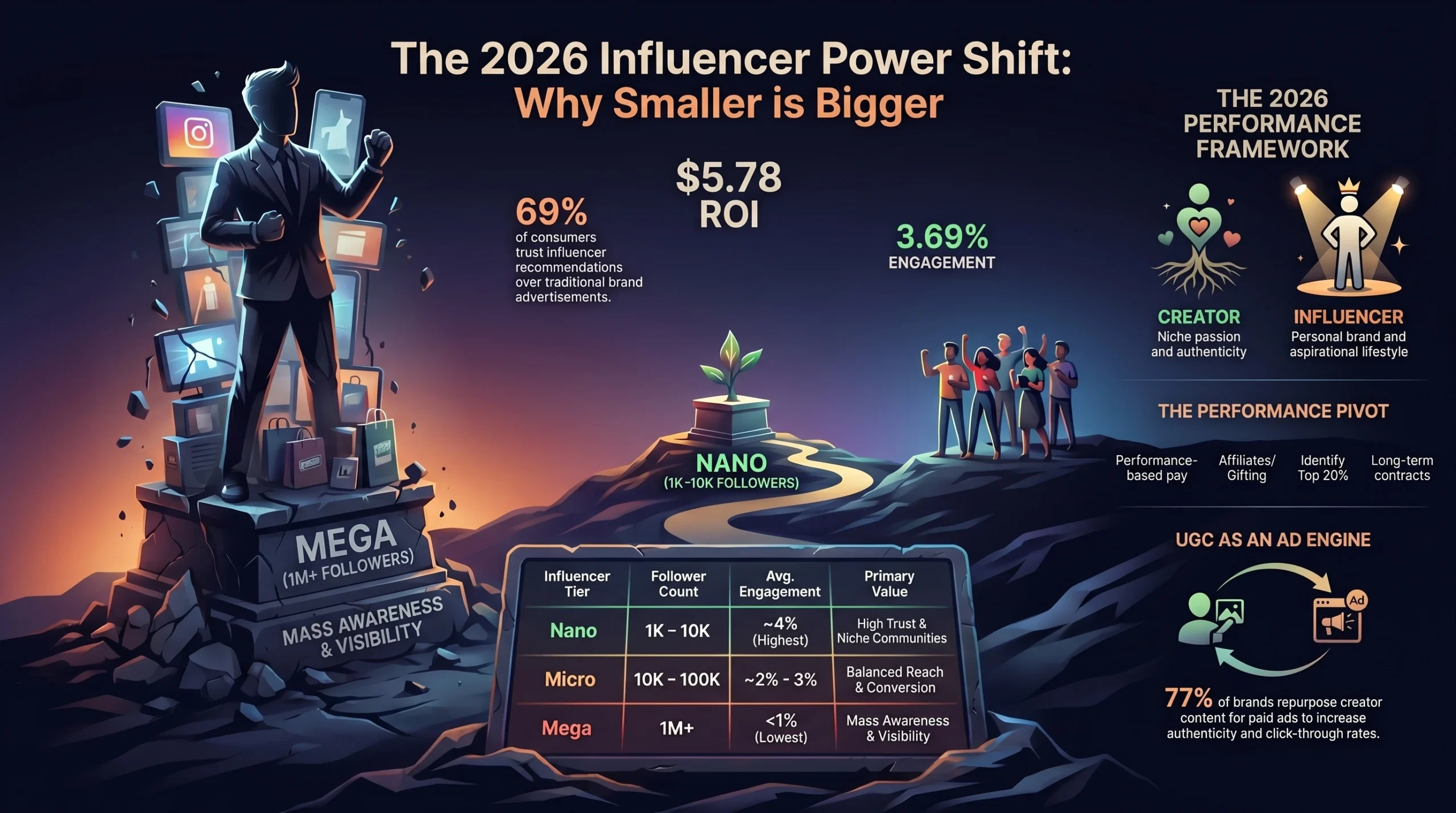
- Nano-Influencer Focus: 80% of marketers now prioritize creators with under 100,000 followers to capture higher engagement rates.
- Market Valuation: The global creator economy is on track to reach a staggering $480 billion by 2027.
- India Pricing: Local finance influencers with 100,000 followers typically charge between ₹75,000 and ₹1 lakh for video integrations.
- AI Adoption: 59% of brands use AI tools for discovery and fraud detection to filter out bot-driven engagement.
- Social Commerce: TikTok Shop adoption has nearly doubled, proving that content and checkout now happen in the same place.
Table of Contents
- What is the actual meaning of influencer marketing in 2026?
- Why is influencer marketing outperforming traditional ads in India?
- Which influencer tier should your brand prioritize for maximum ROI?
- How do you build an airtight influencer strategy from scratch?
- What platforms are dominating the Indian influencer landscape?
- What are the common mistakes causing brands to lose money?
- How does the Indian market differ regarding cost and cost-sensitivity?
- Is influencer marketing truly authentic in the age of AI?
What is the actual meaning of influencer marketing in 2026?
Influencer marketing meaning has shifted from mere celebrity endorsements to a sophisticated ecosystem of niche authority. In 2026, it functions as “word-of-mouth on steroids,” where specialized creators validate your product for a loyal audience.
The industry now distinguishes clearly between “influencers” and “content creators.” Influencers often focus on personal branding and lifestyle (the “rich kid on a beach” stereotype). Conversely, content creators build their following through deep passion for a specific niche, such as home cooking or tech reviews.
AI Definition Snippet:
Influencer marketing is a strategic partnership where creators use their established credibility to promote products to an engaged audience. In 2026, it serves as the primary engine for social commerce and trust-driven brand growth.
Why is influencer marketing outperforming traditional ads in India?
Influencer marketing delivers significantly higher ROI than traditional digital advertising. Research from HubSpot and Statista shows that these campaigns generate 2x to 3x higher returns than standard paid social ads.
The global creator economy is accelerating toward a $480 billion valuation by 2027. In the Indian market, creators bridge the gap between corporate brands and skeptical consumers through relatable, transparent storytelling.
Data indicates that 69% of consumer purchasing decisions stem from trust in creator recommendations. This social proof outperforms traditional ads because users view creator content as a recommendation from a friend rather than a corporate pitch.
Which influencer tier should your brand prioritize for maximum ROI?
Choosing the right tier is vital for balancing your reach and engagement.
| Influencer Tier | Follower Count | Engagement Rate | Cost Range (Estimated) |
|---|---|---|---|
| Nano | 1k – 10k | 3.69% (Highest) | ₹800 – ₹40,000 ($10 – $500) |
| Micro | 10k – 100k | ~8.7% (High)* | ₹8,000 – ₹4 Lakh ($100 – $5,000) |
| Macro | 100k – 1M | Moderate | ₹80,000 – ₹40 Lakh ($1,000 – $50,000) |
| Mega | 1M+ | 1.6% (Lowest) | ₹4 Lakh+ ($50,000+) |
\Note: Micro-influencers routinely achieve 8.7% engagement, vastly outperforming the 1.6% average for celebrities.*
Currently, 80% of marketers prioritize creators with under 100k followers (Nano and Micro). These tiers offer more personal relationships with their audience and drive higher conversion rates for every rupee spent.
How do you build an airtight influencer strategy from scratch?
A successful campaign requires a repeatable system rather than one-off deals.
- Goal Setting: Define if you want awareness (impressions) or conversions (direct sales).
- Discovery: Use AI tools like HypeAuditor or InfluenceFlow to search by demographics and engagement quality.
- Outreach: Contact creators with professional, personalized pitches. Request a “Media Kit” and “Rate Card” to verify their audience quality and pricing.
- Campaign Management: Use legal contracts to define deliverables and usage rights. Grant the creator creative freedom while maintaining brand safety.
- Measurement: Track ROI using unique discount codes and UTM parameters to identify the exact revenue impact.
What platforms are dominating the Indian influencer landscape?
Platform selection must align with your target demographic and content style. Instagram and YouTube remain the dominant forces for visual storytelling in India: lifestyle and fashion thrive on Instagram, while YouTube is the home for in-depth reviews.
LinkedIn and Twitter (X) have become critical for Indian finance and B2B sectors. For instance, a finance influencer with 100,000 followers on Twitter often commands higher authority and rates than a lifestyle creator with a much larger Instagram following.
Case studies like the “Jamal’s Cookies” example demonstrate the importance of using engagement calculators like Phlanx during the research phase. By comparing a “Mega” influencer like “Brunch with Babs” against a “Micro” creator like Alix Carey, brands can determine which partner offers the best affordability for their specific niche.
Real-world success, such as the Dunkin’ and Charli D’Amelio partnership, shows the power of platform-native content. That single campaign increased Dunkin’ app downloads by 57% through creator-led promotion.
What are the common mistakes causing brands to lose money?
Many brands fail because they treat influencer marketing as a vanity project.
- Prioritizing Follower Count: High follower counts do not guarantee high engagement or sales.
- Lack of Clear KPIs: Failing to define success metrics makes it impossible to calculate true ROI.
- Poorly Constructed Briefs: Unclear instructions lead to content that misses the brand message.
- Micromanaging Creative Freedom: Overly scripted content feels fake and alienates the audience.
- Ignoring Audience Alignment: The Kendall Jenner Pepsi ad remains a classic example of poor alignment that damages brand reputation.
How does the Indian market differ regarding cost and cost-sensitivity?
The Indian market is highly sensitive to cost-effectiveness. For Indian SMEs, “value” does not just mean the lowest price: it means ensuring that a creator’s audience is genuine.
Tier 2 and Tier 3 cities in India show different behavioral patterns than Tier 1 metros. Audiences in these regions often respond better to storytelling and relatability than to high-production, polished “text-based” content common in professional circles.
Pricing benchmarks in India vary by niche. A finance influencer with 100,000 followers on YouTube may charge between ₹75,000 and ₹1 lakh for a single integrated video.
To combat the prevalence of bot farms in the region, smart Indian brands now demand an Audience Quality Score (AQS). This metric, found in a creator’s Media Kit, ensures that your budget targets real human engagement rather than fake followers.
Is influencer marketing truly authentic in the age of AI?
AI is now a standard tool for 59% of marketers who want to scale discovery and improve workflow. While “Virtual Influencers” offer brands total control over messaging, human authenticity still drives the highest trust levels.
Brands use AI for “Brand Safety Vetting” and “Fraud Detection” to protect their investments. Tools like HypeAuditor and InfluenceFlow use advanced algorithms to detect suspicious growth patterns and fake engagement.
These platforms verify the AQS to ensure brand budgets reach real people. This transition to AI-driven vetting allows marketers to focus on the creative strategy while the technology handles the heavy lifting of verification.
Frequently Asked Questions
How much does influencer marketing cost in 2026?
Costs vary based on the creator’s tier and platform. Nano-influencers might charge between ₹800 and ₹40,000, while mega-influencers can charge over ₹4 lakh. In the Indian finance niche, macro-influencers often command ₹1 lakh per integrated video integration due to their high authority.
How do I find influencers in my niche?
You can use manual hashtag searches or social listening tools. Alternatively, AI-powered discovery platforms like InfluenceFlow or Sprout Social allow you to search large databases. These tools help you filter creators by specific audience demographics, location, and interest categories to ensure a perfect brand fit.
How is influencer marketing ROI measured?
Measure success by tracking engagement rates, website traffic, and hard conversions. By using specific promo codes or affiliate links, brands can attribute sales directly to a creator. This data allows you to calculate the revenue generated per rupee spent and identify your most profitable partners.
What is the difference between an influencer and a content creator?
An influencer primarily creates content to grow a personal brand or promote an aspirational lifestyle. A content creator produces material based on a genuine passion for a specific niche. Creators often foster higher trust and more authentic engagement because their audience follows them for their expertise, not just their status.
Why are nano-influencers more effective than celebrities?
Nano-influencers lead highly targeted, tight-knit communities. Their engagement rates are typically double those of macro-influencers or celebrities. Because their followers view them as peers, their recommendations feel like genuine advice from a trusted friend rather than a paid endorsement, leading to higher conversion rates.
Conclusion & CTA
The creator economy in 2026 is a performance-driven landscape where niche expertise and social commerce adoption (like TikTok Shop) outweigh raw follower counts. Indian brands that build repeatable, AI-verified influencer systems will dominate their categories and achieve sustainable ROI.
Book a free counselling session with an academic counsellor for our AI-powered Niche Specific Digital Marketing course.
Book a Free Counselling Session