Traditional prompt engineering fails to produce reliable production code. Indian engineering teams frequently face the problem of slop, where AI agents generate unpredictable failures because they must guess codebase structures. This uncertainty leads to wasted tokens and broken deployments that require constant human intervention.
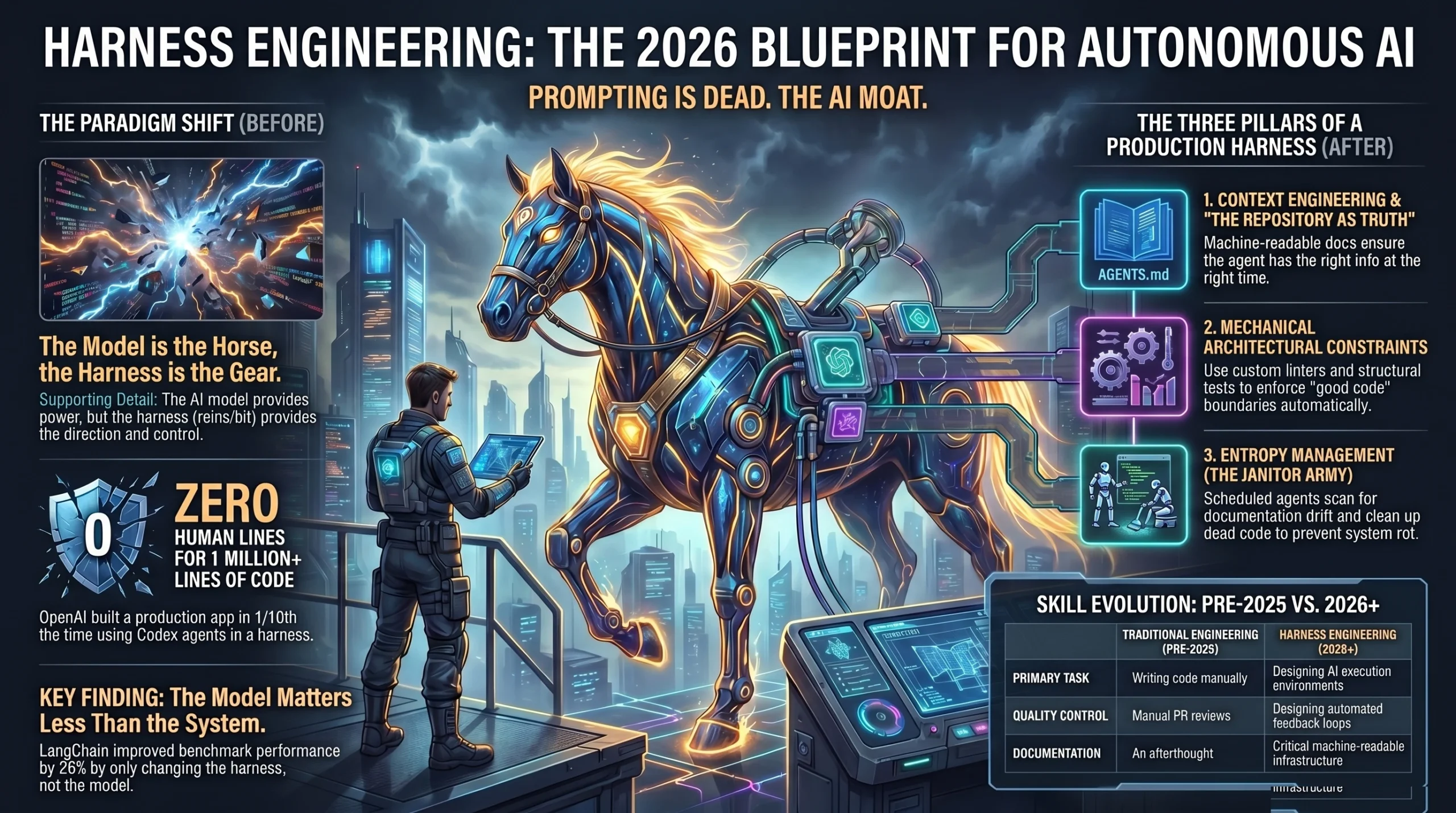
Harness engineering provides the solution as an environment-first fix for these systemic failures. Harness engineering is the system of constraints and feedback loops surrounding an AI model. By focusing on the infrastructure rather than the prompt, teams in hubs like Bengaluru transform powerful but unpredictable models into reliable contributors. This shift ensures agents operate as stable, high-performance assets rather than flighty assistants.
- Model as Commodity, Harness as Moat: The underlying AI model matters less than the system of controls built around it.
- WIP=1 Principle: Limiting agents to one task at a time improves completion by 37% by managing attention capacity.
- The Three Pillars: Context Engineering, Architectural Constraints, and Entropy Management form the core of reliability.
- Productivity Gains: OpenAI built a 1 million line product in 1/10th the time using zero human-written code within a harness.
- Verification is Key: Only passing tests, linting, and type-checks count as victory for a production agent.
Table of Contents:
- What is Harness Engineering and why is it the new moat in 2026?
- How do the three pillars of Harness Engineering secure agent reliability?
- Can Indian startups scale production with zero human-written code?
- What are the core components of a high-performing agent harness?
- How do you build your first harness in four steps?
- Why is the role of the software engineer evolving from writer to manager?
- FAQ Section
What is Harness Engineering and why is it the new moat in 2026?
Harness engineering uses the Horse Metaphor to explain the relationship between technology and infrastructure. The horse is the AI model: powerful and fast but lacking direction. The harness is the infrastructure of constraints and feedback loops. The rider is the human engineer providing direction.
Harness engineering is the design of systems that constrain, inform, verify, and correct AI agents. It ensures reliable output by focusing on the agent execution environment rather than simple prompt text.
Data from the Stanford HAI group (2025) shows that harness-level changes improved quality by 28–47%. In contrast, prompt refinement alone improved output by less than 3%. This evidence shifts the focus from writing better prompts to building better environments.
In Indian tech hubs like Bengaluru and Hyderabad, teams are moving away from vibe coding. They are adopting structured execution to manage high-volume development. This transition makes the technical harness a competitive moat for modern startups.
How do the three pillars of Harness Engineering secure agent reliability?
Context Engineering
Context engineering ensures the agent has the right information at the right time. Static context includes files like AGENTS.md, while dynamic context uses LSP or MCP servers. The critical rule states that if it is not in the repository, it does not exist for the agent.
Architectural Constraints
Harnesses use mechanical enforcement to define good code. This includes dependency layering and deterministic linters. These constraints improve agent convergence by preventing the AI from wasting tokens on exploring dead ends.
Architects also focus on ambient affordances. These are the structural properties of a repository, such as strong typing, that make the environment legible and tractable for an agent.
Entropy Management
This pillar acts as a Garbage Collection system. Dedicated agents scan for documentation drift and fix deviations from established patterns. This keeps the codebase healthy for both future AI agents and human reviewers.
| Pillar Name | Core Function | Example Tool |
|---|---|---|
| Context Engineering | Informs agent intent | MCP Servers / AGENTS.md |
| Architectural Constraints | Enforces code structure | Custom Linters / ArchUnit |
| Entropy Management | Cleans documentation drift | Cleanup Agents |
Harness changes alone drove a 13.7% jump in performance for coding agents on the Terminal Bench 2.0. LangChain benchmarks show scores rising from 52.8% to 66.5% without changing the underlying model.
Can Indian startups scale production with zero human-written code?
OpenAI demonstrated that three engineers could build a production application with over 1 million lines of code. Zero lines were written by humans. The team completed the project in 1/10th the time usually required by traditional methods.
Stripe uses Minion agents to produce over 1,000 merged pull requests per week. These agents run in isolated devboxes and pass CI before a human reviews the code. This level of automation relies entirely on a robust harness.
Harnessability determines how well an agent performs. Codebases with strong typing and clear module boundaries are easier for AI to manage. This makes structural decisions more important than individual lines of code.
For Indian startups in Tier 1 cities, hiring a Harness Captain is becoming more cost-effective than hiring traditional Senior Developers. This role designs the environment where AI writes code. A task costing 50,000 INR in manual senior developer labor drops to just 450 INR in API and harness session costs.
What are the core components of a high-performing agent harness?
Every successful harness requires mandatory files in the repository root. These include AGENTS.md for operating instructions, CLAUDE.md for project conventions, and an init.sh script for environment health checks.
The Sub-Agent strategy serves as a Context Firewall. By delegating tasks to sub-agents, the system prevents context rot. This ensures that intermediate noise does not accumulate in the primary orchestration thread.
The Back-Pressure mechanism is the final gatekeeper. An agent cannot declare victory until it passes full-pipeline verification. This include unit tests, linting, and type-checks.
Recent SWE-bench results indicate that even top AI models only hit a 50–60% pass rate without a harness. This highlights the necessity of infrastructure to reach production-grade reliability in complex repositories.
How do you build your first harness in four steps?
- Define Task Boundary: Set clear inputs, expected outputs, and failure modes for the agent.
- Design Context Pipeline: Determine what information the agent needs and store it as the single source of truth in the repository.
- Implement Tool Layer: Connect the agent to external capabilities via MCP or CLI tools to allow the agent to interact with its environment.
- Build Orchestration Loop: Create a cycle of model calls, tool executions, and validation checks.
For an MVP in the Indian market, running a harness-native workflow is significantly cheaper than manual development. One session often costs 450 INR compared to the 50,000 INR daily rate of a senior engineer.
Indian digital marketing agencies use this for Agentic SEO workflows. By building a harness around agents, they automate brand consistency checks and SEO validation across thousands of pages with high reliability.
Why is the role of the software engineer evolving from writer to manager?
The engineering role is shifting from a maker schedule to a manager schedule. This evolution requires high-value skills focused on systems thinking and specification writing.
- Before: Writing code, debugging individual lines, and manual testing.
- After: Designing environments, analyzing agent behavior patterns, and managing agent fleets.
This evolution is critical for Indian IT services firms like those modeled after TCS or Infosys. To remain competitive globally, these firms utilize Harness Templates to manage large-scale agent fleets.
These templates apply Ashby’s Law, which states that a regulator must have as much variety as the system it governs. By using templates to reduce codebase variety, firms ensure agents can govern and maintain massive software systems efficiently.
FAQ SECTION
What is the difference between prompt engineering and harness engineering?
Prompt engineering focuses on the wording of a single interaction with a model. Harness engineering focuses on the entire system surrounding the model. This includes constraints, feedback loops, and the execution environment. It treats the model as a component of a larger, reliable production system.
Do I need special tools for harness engineering?
You can start with basic tools like Markdown files and shell scripts. Advanced harnesses use Model Context Protocol (MCP) servers, deterministic linters, and structural tests. The goal is to create a structured environment where the agent can verify its own work through tests and builds.
How does AGENTS.md help AI agents?
AGENTS.md acts as an operating manual for the AI. It provides the agent with project-specific rules, build steps, and common pitfalls. This file is injected into the agent’s system prompt, ensuring the model understands the specific context of the repository before it begins generating code.
Is harness engineering only for large companies like OpenAI?
No, harness engineering is effective for individual developers and startups. A basic harness involving a few Markdown files and pre-commit hooks can prevent common errors. As the team grows, the harness scales to include complex middleware and automated observability to maintain high quality.
What is “Context Rot” and how do sub-agents fix it?
Context rot occurs when irrelevant tool results fill an agent’s context window, degrading its reasoning. Sub-agents act as a context firewall. They perform discrete tasks in isolated windows and only return the final result. This keeps the primary agent’s context window clean and efficient.
CONCLUSION
The success of an AI system depends more on the car (harness) than the engine (model). Investing in the environment ensures that AI agents become reliable, production-ready contributors for your business.
Ready to master the future of AI-driven growth? Book a free counselling session with an academic counsellor for our AI-powered Niche Specific Digital Marketing course to learn how to leverage agentic workflows for your brand.