Businesses across India are drowning in the noise of outdated traditional media. With consumer attention spans shrinking and a 170 billion dollar social media domain dominating the landscape, ignoring digital channels means invisible stagnation. Missing this transition means losing to competitors who engage audiences in real-time while 60% of all advertising spend shifts to online platforms. The solution lies in adopting digital marketing as a connected ecosystem that drives measurable ROI. Digital marketing is the practice of promoting products, services, or brands using digital channels where people spend their time, such as search engines, social media, email, and mobile apps.
Quick Takeaways
- Digital Dominance: Over 60% of Indian ad spend is now digital, fueled by 78% mobile penetration.
- Targeting Precision: Digital tools allow for hyper-local targeting, such as reaching specific North India demographics rather than wasting budget on national broadcasts.
- The Value Ladder: High-paying careers are built by moving from free content to high-ticket personal consultations.
- ROI Focus: Industry leaders now pitch based on reducing Customer Acquisition Cost (CAC) rather than just counting video views.
- AI Integration: Tools like ChatGPT, Claude, and Gemini are mandatory for efficiency and predictive analytics in 2026.
- AEO and Zero-Click: The future is about being the direct answer provided by AI search engines, not just a link on a page.
Table of Contents
- What is the meaning of digital marketing?
- Why is digital marketing superior to traditional marketing in India?
- What are the 8 critical types of digital marketing you must know?
- How does the digital marketing funnel guide the buyer’s journey?
- How can you build a high-paying career in digital marketing?
- What are the mandatory steps to start digital marketing in India today?
What is the meaning of digital marketing?
In 2026, digital marketing has evolved far beyond simple banner ads or social media posts. It is now a highly organized approach to brand building that integrates Search Engine Results Page (SERP) promotion, strategic content creation, and real-time behavioral analytics into a single, measurable growth plan. It is about creating a strong brand voice through digital means that feel natural and valuable to the end user.
Digital Marketing Definition: An integrated system of methods and technologies used to reach, engage, and convert consumers on digital platforms through data-driven strategies and personalized messaging.
Understanding this landscape is no longer an optional skill for Indian professionals. With 30,000 to 40,000 new MSMEs registering every month in India, the demand for digital visibility is fundamental. In 2026, digital marketing means being present at the exact moment of “Search Intent,” where a user is looking for a solution, or “Discovery,” where a brand interrupts a social scroll with a relevant offer.
Why is digital marketing superior to traditional marketing in India?
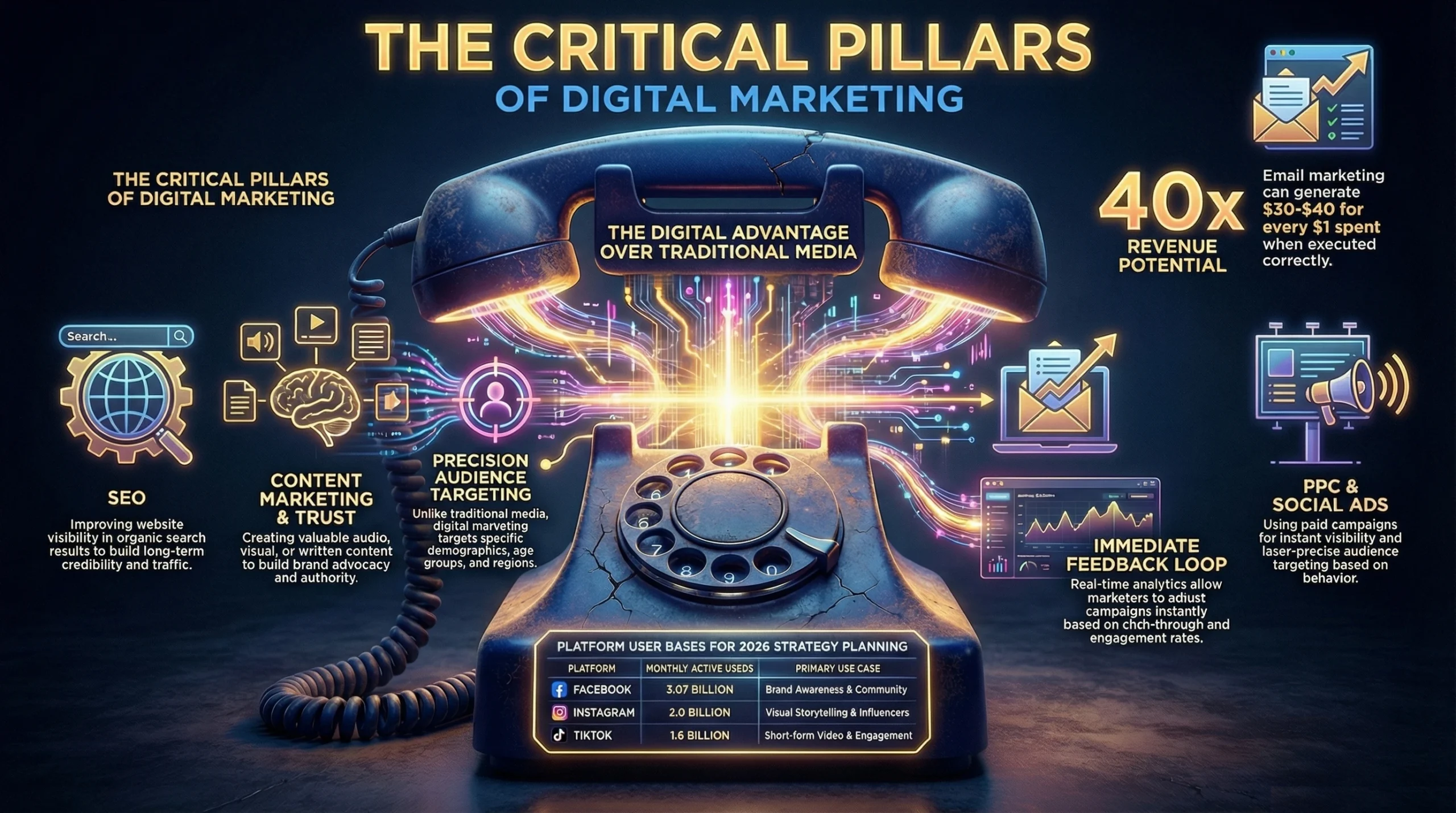
Digital marketing provides a level of precision and flexibility that traditional media, such as TV, radio, or newspapers, simply cannot match. The shift in India is primarily driven by mobile internet usage, which reached 52.4% of the population in 2024. This allows businesses to stop “spraying and praying” and start targeting with laser focus.
Consider the example of a brand launching a regional product for North India. In the traditional model, placing an ad on a national channel like Durdarshan results in massive waste. People in South or West India see the ad despite the product being unavailable to them. Digital marketing solves this by allowing businesses to pay only to reach their specific target demographic based on age, location, and even occupation.
| Category | Traditional Marketing | Digital Marketing |
|---|---|---|
| Audience Reach | Limited by physical broadcast | Global or hyper-local reach |
| Targeting Precision | Broad and generalized | Laser-focused (Interests, Intent) |
| Cost-Effectiveness | High entry barrier (Front page ads) | Flexible (Start with small budgets) |
| Feedback Speed | Weeks or months to measure | Immediate, real-time data |
| Measurability | Vague estimates and surveys | Exact (Clicks, Sales, Leads) |
| Pivot Speed | Sunk cost if the ad fails | Stop or modify campaigns instantly |
The ability to test is the greatest advantage. You can run a sample campaign for 10,000 rupees to gauge response. If a traditional billboard does not work, your money is gone. If a digital ad underperforms, you can pivot your strategy in minutes based on real-time analytics.
What are the 8 critical types of digital marketing you must know?
To build a robust strategy in 2026, you must master the eight pillars of the digital ecosystem. Each serves a specific psychological purpose in the buyer’s journey.
1. Search Engine Optimization (SEO)
SEO is the science of ranking higher on search engines naturally. In 2026, this involves more than just keywords. It requires “Content Indexing,” ensuring your text and images have alt-text for accessibility, and a solid “Link Structure.” Think of search engines as digital librarians: your site must be organized so they can find and recommend you easily. The goal is to drive consistent, organic traffic without paying for every click.
2. Pay-Per-Click (PPC)
PPC is a paid model where companies pay only when a user clicks on their link. This is common on Google and Amazon. Marketers must be calculated here because high-demand keywords often have higher costs. Success in PPC requires optimizing landing pages to ensure that the cost of acquiring a customer does not exceed the profit from the sale.
3. Social Media Marketing (SMM)
Platforms like Instagram, Facebook, and LinkedIn are used to build brand awareness. Consistency is the most vital factor here. In the 2026 landscape, SMM is about being relevant by following major trends and engaging directly with followers. Replying to comments and managing the community is just as important as the post itself.
4. Content Marketing
Content is the foundation of trust. It includes blogs, videos, and podcasts. Rather than just selling, content marketing aims to build advocacy. By providing valuable information, you turn repeat customers into brand advocates. AI tools like ChatGPT are now used for brainstorming, while Jasper AI helps draft specific pieces like blogs and emails to maintain a high volume of output.
5. Email Marketing
Email remains the king of ROI. For every $1 spent, email can generate $30 to $40 in revenue. A professional checklist for 2026 includes catchy subject lines, mobile-friendly designs, and clear footer contact links. It is a direct connection to a known database, making it highly personalized and effective for closing sales.
6. Mobile Marketing
With 78% mobile penetration in India, a mobile-first strategy is mandatory. This involves SMS, mobile apps, and social media. Marketers must track the types of devices used by their audience to estimate purchasing capacity. If your website is not optimized for a vertical screen, you are essentially invisible to half of the Indian market.
7. Affiliate and Influencer Marketing
This is a performance-based strategy where you let others speak for your brand. Affiliates receive a commission for every sale or lead. In India, the IAMAI projected this sector to reach approximately $8.3 billion by 2025. It leverages the trust influencers have built with their niche audiences to drive authentic conversions.
8. Marketing Analytics
Analytics is the glue that ties all types together. It involves tracking Click-Through Rates (CTR) and Engagement Rates. Professionals use tools like Google Analytics, SEMRush, Tableau, and CleverTap to draw insights about consumer behavior. If you cannot measure it, you cannot improve it.
How does the digital marketing funnel guide the buyer’s journey?
Effective digital marketing does not force an immediate sale. Instead, it supports the customer through a three-stage psychological process.
Stage 1: Awareness
The user realizes they have a problem. Digital marketing provides educational content, such as “How-to” videos or informative blogs, to introduce the brand without a hard sell. This builds initial trust.
Stage 2: Consideration
The user is exploring solutions and comparing brands. Marketers use comparison articles, detailed guides, and personalized email sequences to stay top-of-mind. This stage is about proving your expertise over the competition.
Stage 3: Decision
The user is ready to buy. High-performance landing pages, strong calls to action (CTAs), and customer testimonials are used to convert interest into a final purchase.
In 2026, a major insight is that marketing must support decision-making rather than just pushing for a transaction. If you skip the awareness and consideration phases, your conversion rates will remain low because the trust is not there.
How can you build a high-paying career in digital marketing?
The digital marketing industry in India is booming, but the highest salaries go to those who understand the business of marketing.
The Specialization Route
Beginners should focus on one specific area, such as SEO or Meta Ads, before becoming a generalist. By becoming “the expert” in a niche, you can demand higher fees. As you grow, you can expand into complementary areas like content marketing or data science.
The Value Ladder Business Model
The most successful marketers in India, like Sahil Khanna, use a tiered “Value Ladder” to grow their income:
- Level 1 (Top of Funnel): Free or low-cost value (Free workshops, ₹999 recorded courses) to build a massive audience.
- Level 2 (Mid-Tier): Specialized training or managed services (₹5,000 to ₹35,000) where you provide more direct value.
- Level 3 (High-End): Personal consultation or agency-level strategy (₹1.5 Lakh to ₹10 Lakh) for established businesses.
The ROI-Based Pitch
When pitching to companies, do not talk about “deliverables” like 12 videos a month. Instead, follow Ishan Sharma’s advice: talk about ROI. If you can tell a founder, “I will reduce your Customer Acquisition Cost from 20 rupees to 5 rupees,” you are no longer a service provider; you are a revenue generator. This mindset is what leads to lakh-plus monthly retainers.
What are the mandatory steps to start digital marketing in India today?
- Understand the Landscape: Learn the basics of how search and social differ before touching any tools.
- Choose a Channel: Pick one platform that aligns with your interest, such as Instagram for creatives or Google Search for analytical minds.
- Learn Core Skills: Focus on keyword research and performance analysis. Use a “second brain” tool like Notion to store your findings and case studies.
- Enroll in a Recognized Course: Structure is key. Look for courses that offer practical exposure and AI-powered curriculum.
- Launch Real Campaigns: Practice is the only teacher. Start a blog, an anonymous Etsy shop for Canva templates, or help a local Kirana store with their digital presence for free to build a portfolio.
- Master the Tools: Get comfortable with Google Analytics, SEMRush, and AI assistants.
- Network and Stay Updated: Follow industry leaders on Twitter and LinkedIn. The digital space changes weekly; staying stagnant is the only way to fail.
Indian Context and 2026 Trends
The Indian market is unique due to its massive scale and cost sensitivity. Marketers must navigate the divide between Tier 1 and Tier 2 cities. Regional language content is no longer a niche; it is the primary driver for growth in 2026. Localized targeting is essential for brands that want to resonate with the “Next Billion” users.
A critical trend for 2026 is the rise of Zero-Click Optimization and Answer Engine Optimization (AEO). With AI-powered search, users often get their answers directly on the Google results page without ever clicking on a website. To survive, your content must be optimized to be the definitive “Answer” that AI provides to the user. This requires deep authority and highly structured data.
FAQ
Q: What is digital marketing and why is it important in 2026?
Digital marketing is the use of online channels to promote products and services. In 2026, it is vital because consumer behavior is now digital-first. For businesses, it is the only way to reach specific audiences with measurable, data-driven strategies at a fraction of the cost of traditional media.
Q: Is digital marketing a good career option in India?
Yes, it is one of the fastest-growing fields in the country. As Indian MSMEs shift their budgets online, the demand for skilled professionals in SEO, paid ads, and analytics is skyrocketing. It offers high salary potential and the flexibility of freelancing or agency roles.
Q: How long does it take to learn digital marketing for a beginner?
A beginner can grasp the core fundamentals within 3 to 6 months of consistent study and practice. However, because algorithms and AI tools evolve constantly, mastering the field is an ongoing journey of practical application and staying updated with industry reports.
Q: Do I need technical coding knowledge for digital marketing?
No, advanced coding is not required for most roles. However, a basic understanding of HTML or experience with platforms like WordPress is a significant advantage, especially for SEO specialists who need to optimize site structures for search engine crawlers.
Q: Which digital marketing skill has the highest ROI?
SEO and Email Marketing generally offer the highest ROI. SEO provides long-term organic traffic that does not require a daily ad spend, while Email Marketing allows for direct, personalized communication with a conversion rate that often exceeds social media ads.
Conclusion
Digital marketing is no longer just a trend: it is the essential foundation for business development in 2026. For brands to survive and professionals to thrive, they must adapt to an ecosystem driven by data, mobile accessibility, and strategic content. The future belongs to those who can bridge the gap between human psychology and digital algorithms.
Take the Next Step Toward Your Digital Future
Book a free counseling session with an academic counselor today to explore an AI-powered, niche-specific digital marketing course. Staying updated is non-negotiable in the evolving Indian ecosystem: start building your high-income skills now.