
Tech companies produce more content than almost any other industry, yet most of it disappears without a trace. Blog posts go unread, whitepapers sit in folders nobody opens, and social posts get a handful of likes before vanishing into the algorithm. The problem is rarely a lack of effort. It is usually a lack of strategy.
Knowing how to build a content strategy for tech brands is different from building one for a fashion label or a restaurant chain. Tech audiences are skeptical, technically literate, and allergic to fluff. They want proof, specificity, and substance. A content strategy that works for a consumer lifestyle brand will fall flat with developers, IT decision-makers, or enterprise buyers who research for weeks before they ever talk to sales.
TL;DR
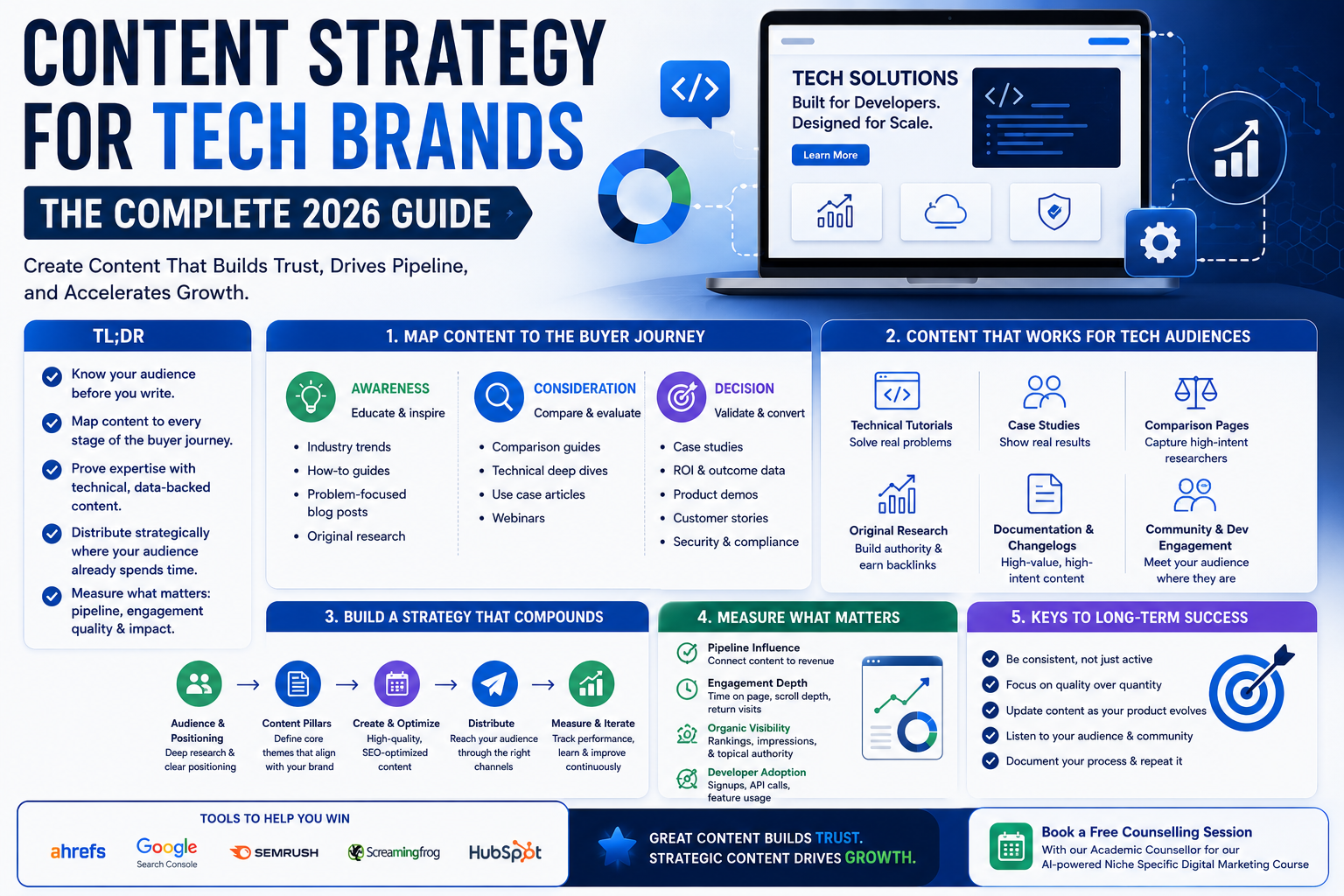
- A content strategy for tech brands starts with deep audience research, not content ideas. Know who you are writing for before you decide what to write.
- Tech buyers move through long, research-heavy journeys, so your content needs to map to awareness, consideration, and decision stages.
- Technical credibility matters more than polish. Tech audiences trust content written by people who actually understand the product and the problem.
- Distribution deserves as much planning as creation. Great content with no distribution plan is wasted effort.
- SEO, developer communities, and product-led content (docs, changelogs, tutorials) are often more valuable for tech brands than traditional blog posts alone.
- Measurement should track pipeline influence and engagement quality, not just traffic and pageviews.
- Consistency and iteration beat one-off viral attempts. A documented, repeatable system is what separates tech brands that grow from those that stall.
Table of Content
- Why Do Tech Brands Need a Different Content Strategy Than Other Industries?
- How Do You Define Your Audience and Positioning Before Creating Content?
- What Types of Content Actually Work for Tech Audiences?
- How Do You Measure Whether a Tech Content Strategy Is Working?
- FAQ
- Conclusion
Why Do Tech Brands Need a Different Content Strategy Than Other Industries?
Tech buyers behave differently from consumer buyers, and that difference should shape everything about your content approach. A purchase decision for software, infrastructure, or developer tools usually involves multiple stakeholders, a longer evaluation period, and a higher bar for technical proof. A flashy headline might get a click, but it will not convince a CTO to migrate a production system or a procurement team to sign a six-figure contract.
This is why generic content marketing advice often fails tech brands. Templates built for ecommerce or local business marketing assume a short, emotion-driven buying journey. Tech buying journeys are rational, research-intensive, and collaborative. A single buyer might read a comparison article, then a technical whitepaper, then a case study, then ask a colleague in a Slack community before ever filling out a demo form.
Tech content strategy also has to account for two audiences at once in many cases: the technical user who will actually use the product, and the economic buyer who approves the budget. The same blog post rarely speaks to both. This means a tech content strategy needs distinct content tracks, one focused on technical depth and credibility, and another focused on business outcomes and ROI.
How Do You Define Your Audience and Positioning Before Creating Content?
The most common mistake tech brands make is jumping straight into a content calendar before answering a more fundamental question: who exactly are we writing for, and why should they care what we say?
Start by building detailed buyer personas that go beyond job titles. For a tech brand, useful persona details include the tools the buyer already uses, the technical stack they work within, the metrics they are evaluated on, and the specific friction points that make their job harder. A persona for a backend engineer evaluating an API platform needs different information than a persona for a marketing ops lead evaluating a CDP.
Next, map your audience to the buyer’s journey. Most tech buying journeys move through three broad stages:
Awareness, where the buyer is identifying a problem but may not know solutions exist. Content here should focus on education: explaining concepts, frameworks, and industry trends rather than your product.
Consideration, where the buyer is comparing approaches and vendors. Content here should focus on differentiation: comparison guides, technical deep dives, and use-case breakdowns.
Decision, where the buyer needs proof before committing. Content here should focus on validation: case studies, customer results, security documentation, and detailed product walkthroughs.
Once personas and journey stages are mapped, define your positioning. Positioning answers a simple but often-skipped question: why does your tech brand deserve attention in a crowded market? Strong positioning is specific. “We help developers ship faster” is vague. “We cut API integration time from three weeks to three days for fintech engineering teams” is positioning a tech content strategy can actually be built around, because every piece of content can reinforce that specific claim with evidence.
What Types of Content Actually Work for Tech Audiences?
Tech audiences respond to substance over style. The formats that consistently perform well share one trait: they demonstrate real expertise rather than just describing it.
Technical tutorials and how-to guides perform especially well because they solve an immediate problem and build trust through demonstrated competence. A tutorial that walks a developer through implementing a specific feature does more to build credibility than ten generic thought-leadership posts.
Comparison and alternative pages matter enormously in tech, because buyers actively search for “[Competitor] vs [Your Product]” or “[Competitor] alternatives.” These pages capture high-intent traffic from people who are already evaluating solutions, making them some of the highest-converting content tech brands can produce.
Case studies and customer stories carry outsized weight in tech buying decisions because they provide third-party proof. A case study that includes specific metrics, implementation details, and a named customer is far more persuasive than an anonymous testimonial.
Original research and benchmark reports build authority and attract backlinks, which strengthens SEO over time. Tech audiences are particularly receptive to data they cannot get anywhere else, such as performance benchmarks, survey results, or industry trend analysis.
Product documentation, changelogs, and release notes are often overlooked as content assets, but they are some of the most consistently visited pages on a tech company’s site. Treating documentation as part of the content strategy, rather than a separate technical function, can significantly improve both SEO and user retention.
Community-driven content, including contributions to developer forums, open-source documentation, and platforms like Stack Overflow or GitHub, builds trust in places where tech buyers already spend time, often more effectively than owned-channel content alone.
How Do You Measure Whether a Tech Content Strategy Is Working?
Vanity metrics like raw traffic and social impressions tell an incomplete story for tech brands, especially because much of the buying journey happens outside any single content touchpoint.
Pipeline influence is one of the most important metrics to track. This means connecting content engagement to actual sales conversations, demo requests, or signups, even if content was not the last touchpoint before conversion. Marketing attribution tools or even simple UTM tracking combined with CRM data can reveal which content types and topics are actually influencing revenue.
Engagement depth matters more than surface-level metrics for technical content. Time on page, scroll depth, and return visits indicate whether a tutorial or guide is actually being used, rather than just clicked and abandoned.
Keyword rankings and organic visibility for target terms show whether SEO efforts are compounding over time. For tech brands, tracking rankings for both branded comparison terms and unbranded problem-focused terms gives a fuller picture than tracking domain authority alone.
Developer adoption metrics are uniquely important for tech brands with technical content programs. If a tutorial or documentation page is meant to drive product usage, metrics like signups, API calls, or feature activation tied to that content are far more meaningful than pageviews.
Content efficiency, meaning output relative to results, helps tech teams avoid the common trap of publishing more content without checking whether existing content is actually working. Regular content audits that identify underperforming pages for updates or removal keep a content strategy lean and effective rather than bloated.
FAQ
What is a content strategy for tech brands?
A content strategy for tech brands is a documented plan that defines who the brand is creating content for, what topics and formats it will focus on, how that content will be distributed, and how success will be measured, all tailored to the long, research-driven buying journeys typical of technical and B2B tech audiences.
How long does it take to see results from a tech content strategy?
Most tech brands see meaningful organic traffic and lead generation results within six to twelve months of consistent execution, though comparison pages, bottom-funnel content, and community engagement can produce faster results within the first few months.
What is the difference between B2B content strategy and tech content strategy?
Tech content strategy is a subset of B2B content strategy that places extra emphasis on technical credibility, developer-focused content like documentation and tutorials, and audiences who are highly skeptical of marketing language and expect detailed, accurate information.
How much content should a tech startup publish per week?
Quality and consistency matter more than volume. Many successful tech brands publish one to three high-quality, well-researched pieces per week rather than daily lower-effort content, especially in the early stages when resources are limited.
Should tech brands focus on SEO or social media first?
Most tech brands benefit from prioritizing SEO early because organic search compounds over time and captures high-intent buyers actively searching for solutions, while social media is better suited for building awareness and community once foundational SEO content exists.
Conclusion
Building a content strategy for tech brands is not about producing more content. It is about producing the right content, for the right audience, distributed through the right channels, and measured against outcomes that actually matter to the business. Tech buyers reward substance, specificity, and proof, which means every piece of content should be built to demonstrate real expertise rather than simply fill a calendar.
The brands that win in tech content are the ones that treat strategy as an ongoing system, not a one-time project. They revisit personas as their market evolves, update content as their product changes, and double down on what the data shows is actually driving pipeline and adoption.