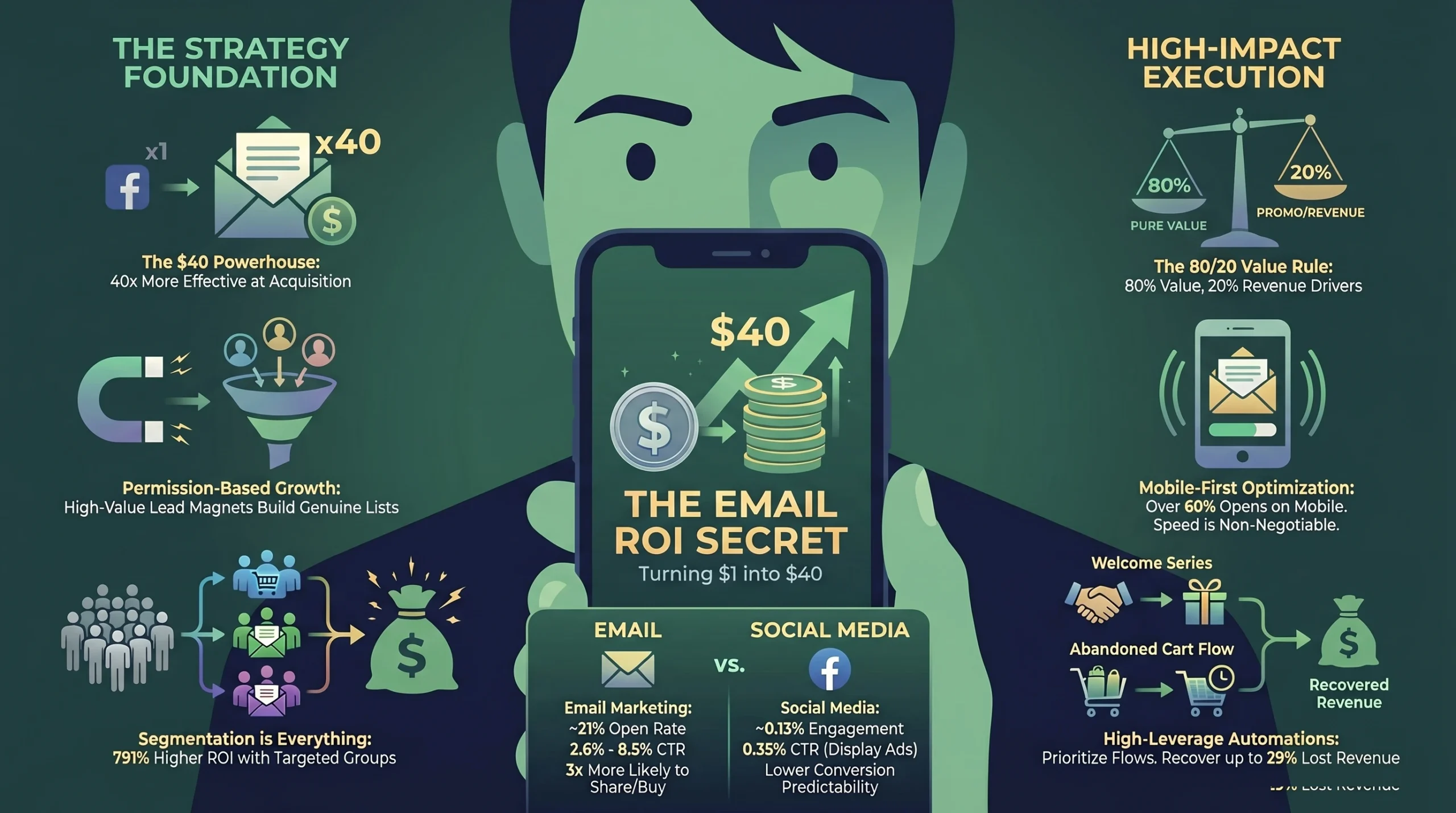
The Indian inbox is a crowded battlefield where most promotional messages are ignored. Email marketing is a powerhouse direct-response channel that involves sending targeted messages or newsletters to a list of subscribers via electronic mail. Many business owners struggle because they send one-off emails without a plan, leading to lost revenue and a frustrating “doom loop” of poor results. This guide provides the roadmap to escape that cycle and achieve the industry-standard 36:1 ROI. This channel remains 40 times more effective at customer acquisition than social media. Start your journey toward high engagement and sustainable growth today by treating your list as a sacred asset.
TL;DR
- Rhythm Method: Maintain an 80/20 ratio to balance educational value with promotional offers.
- Asset Control: You own your email list. This allows you to bypass unpredictable social media algorithms.
- List Hygiene: Never buy lists. Clean your data regularly to protect your sender reputation and domain authority.
- Golden Metric: Focus on Click-to-Open Rate (CTOR) to measure the true effectiveness of your content.
- Frictionless Success: Provide discount codes on the signup success page, not just via email, to reduce buyer friction.
- Indian Behavior: Schedule campaigns for Tuesday through Thursday between 10 AM and 2 PM for peak engagement.
Table Of Contents
- What is Email Marketing and Why Does it Still Work?
- How Do You Develop a Foolproof Email Marketing Strategy?
- How Can You Build a High-Converting Email List in India?
- Which Email Types Drive the Most Revenue for B2B and B2C?
- What is the “Rhythm Method” for Content Scheduling?
- How Do You Write Subject Lines and CTAs That Get Clicks?
- How Can Automation and AI Scale Your Campaigns?
- How Do You Measure Success in the Indian Market?
- Why is Local Context Critical for Indian Email Campaigns?
What is Email Marketing and Why Does it Still Work?
Email marketing is a “sacred” direct channel. It offers an intimate connection that traditional media like billboards or radio cannot match. Because a user welcomes you into their personal inbox, a baseline of trust already exists.
According to industry benchmarks from HubSpot and Statista, email generates an average ROI of $36 to $40 for every $1 spent. This efficiency stems from the ability to target specific groups with precision based on real consumer behavior.
| Feature | Traditional Marketing (TV/Radio) | Digital & Email Marketing |
|---|---|---|
| Audience Size | Demographic guesses/Mass market | Billion+ potential/Laser-focused |
| Targeting | Broad segments | Behavioral and selective data |
| Cost-Effectiveness | High entry cost | Budget-friendly/High ROI |
| Feedback Speed | Weeks or months | Immediate results and analytics |
How Do You Develop a Foolproof Email Marketing Strategy?
Always prioritize strategy over tactics. Adam Erhart defines the “Core Four” pillars of a strong strategy: Model, Market, Message, and Media. You must understand your business offer and your specific audience before choosing a platform.
The “Hub & Spoke” model places these four principles at the center of your operations. Do not rush into social media memes or post frequency until your strategy foundation is firm.
Email Marketing Strategy is a comprehensive plan designed to achieve business objectives through audience identification, message segmentation, and strategic scheduling to maximize ROI.
How Can You Build a High-Converting Email List in India?
Building a list requires a two-step process. First, create a lead magnet like a checklist or ebook that solves a specific problem. Second, place opt-in forms on high-traffic areas of your website.
In the Indian market, mobile optimization is non-negotiable. Consider integrating WhatsApp notifications or ensuring your “Sign Up” buttons are large and easy to tap on small screens.
Research shows that a Confirmed Opt-In (COI) can lead to higher engagement than a standard welcome email. Avoid the temptation to buy lists. This practice destroys your domain authority and sender reputation.
Which Email Types Drive the Most Revenue for B2B and B2C?
Top of Funnel: Awareness
Welcome emails and newsletters introduce your brand identity. These should lead with personality and value rather than a hard sell.
Middle of Funnel: Consideration
Educational content and lead nurturing emails address pain points. These build trust by offering solutions and showing your expertise.
Bottom of Funnel: Conversion
Promotional emails and product launches drive action. Abandoned cart emails are highly effective here, recovering up to 29% of lost revenue. Note that mobile abandonment can reach 85% in India, making mobile-friendly design critical.
What is the “Rhythm Method” for Content Scheduling?
The “Rhythm Method” maintains an 80/20 ratio of value to promotion. This ensures subscribers see your brand as a helpful resource rather than a source of constant spam.
A typical 4-week cycle follows this pattern:
- Week 1 (Educational): Identify and solve a problem for the user.
- Week 2 (Storytelling): Share a customer case study or the brand’s origin.
- Week 3 (Resource Roundup): Curate external tips or tools.
- Week 4 (Soft Promotion): Introduce your product as the natural solution.
For a jewelry brand in Jaipur, Week 1 could be a guide on layering necklaces. Week 2 could tell the story of local artisans. Week 3 might link to summer fashion trends. Week 4 finally promotes a new silver collection.
How Do You Write Subject Lines and CTAs That Get Clicks?
Subject lines should stay under 50 to 70 characters to avoid being cut off on mobile devices. Use urgency-driven phrases like “Last Chance” or ask a direct question to pique curiosity.
Avoid spam trigger words that reduce deliverability. These include:
- $$$
- Free
- Clearance
- Be your own boss
- Excessive exclamation points
Your Call-to-Action (CTA) must be obvious within a five-second scan. Use “bulletproof buttons” with clear text like “See Pricing” or “Schedule a Call.” Place the CTA where it is impossible to miss.
How Can Automation and AI Scale Your Campaigns?
Platforms like Klaviyo, Mailchimp, and Hostinger Reach provide tools to automate the customer journey. Use “Welcome Automations” to greet new subscribers immediately and “Behavior-Triggered” flows to respond to actions like abandoned carts.
AI is rapidly transforming the industry. Industry reports suggest 70% of marketers expect AI to drive 50% of their operations by 2026. Use AI to augment your writing and suggest campaign ideas based on data.
Modular email production is another key trend. By using reusable code blocks and templates, teams can reduce production time to under two weeks for any single campaign.
How Do You Measure Success in the Indian Market?
The “Golden Metric” is the Click-to-Open Rate (CTOR). This reveals how compelling your content is specifically to those who opened the email, providing a true measure of engagement quality.
Track these primary KPIs:
- Open Rate: Aim for a 15-25% benchmark.
- Click-Through Rate (CTR): Target 2-5%.
- Unsubscribe Rate: Keep this under 0.5%.
Digital growth in India is immense. Digital Marketing Guruji notes that mastering these metrics is the difference between earning 8,000 INR and over 100,000 INR monthly in the digital space.
Why is Local Context Critical for Indian Email Campaigns?
India has a significant divide between Tier 1 and Tier 2 cities regarding cost sensitivity and language. Tailoring your message to these local nuances increases trust.
Strategic scheduling is vital. Avoid the “Monday catch-up” and “Friday rush.” Hostinger Academy recommends sending emails on Tuesday, Wednesday, or Thursday between 10 AM and 2 PM.
Reference local successes to build authority. The journey of Digital Marketing Guruji in Jaipur proves that digital skills can transform income levels. Always test your send times to see if your specific audience prefers morning or afternoon updates.
FAQ SECTION
Is email marketing dead in 2026?
No, email marketing is more effective than ever. It remains an asset you control entirely. Unlike social media platforms, email allows you to bypass changing algorithms and maintain a direct line of communication with your customers, delivering a massive 36:1 return on investment.
What is the best time to send emails in India?
The most effective window is Tuesday through Thursday, between 10 AM and 2 PM. This timing catches professionals after the Monday morning rush and before the Friday weekend distraction. Always consider your target audience’s specific time zone to ensure the email arrives during peak activity.
How often should I clean my email list?
You should clean your list regularly to maintain high deliverability. Verify and update email addresses to prevent errors and high bounce rates. Removing inactive subscribers every few months protects your sender reputation and ensures your analytics reflect the behavior of truly engaged potential customers.
Can I use AI to write my emails?
Yes, you can use AI to augment your work. AI tools help generate subject lines, campaign ideas, and draft copy. However, ensure the final message aligns with your brand voice. AI works best as a productivity tool rather than a total replacement for human strategy.
How do I avoid the Gmail ‘Promotions’ tab?
Avoid using excessive spam trigger words like “Free” or “$$$.” Limit the number of links and large, unoptimized images in your message. Write in a personal, conversational tone and encourage subscribers to move your emails to their primary inbox to improve your future deliverability.
CONCLUSION & CTA
Email is a powerful asset you control, shielding your business from the whims of social media algorithms. By delivering consistent value and using the right tools, you turn subscribers into long-term revenue.
Ready to master the art of ROI-driven marketing?
Book a free counselling session with an academic counsellor for our AI-powered Niche Specific Digital Marketing course and learn how to turn subscribers into loyal customers.