2026 Guide to AI in Marketing: Strategy and Implementation
Master AI in Marketing with our 2026 guide. Explore autonomous agents, ROI benchmarks, and AEO strategies to scale your brand. Read the guide to lead the market.
ai-in-marketing-2026-guide
How is AI Transforming the Indian Marketing Landscape?
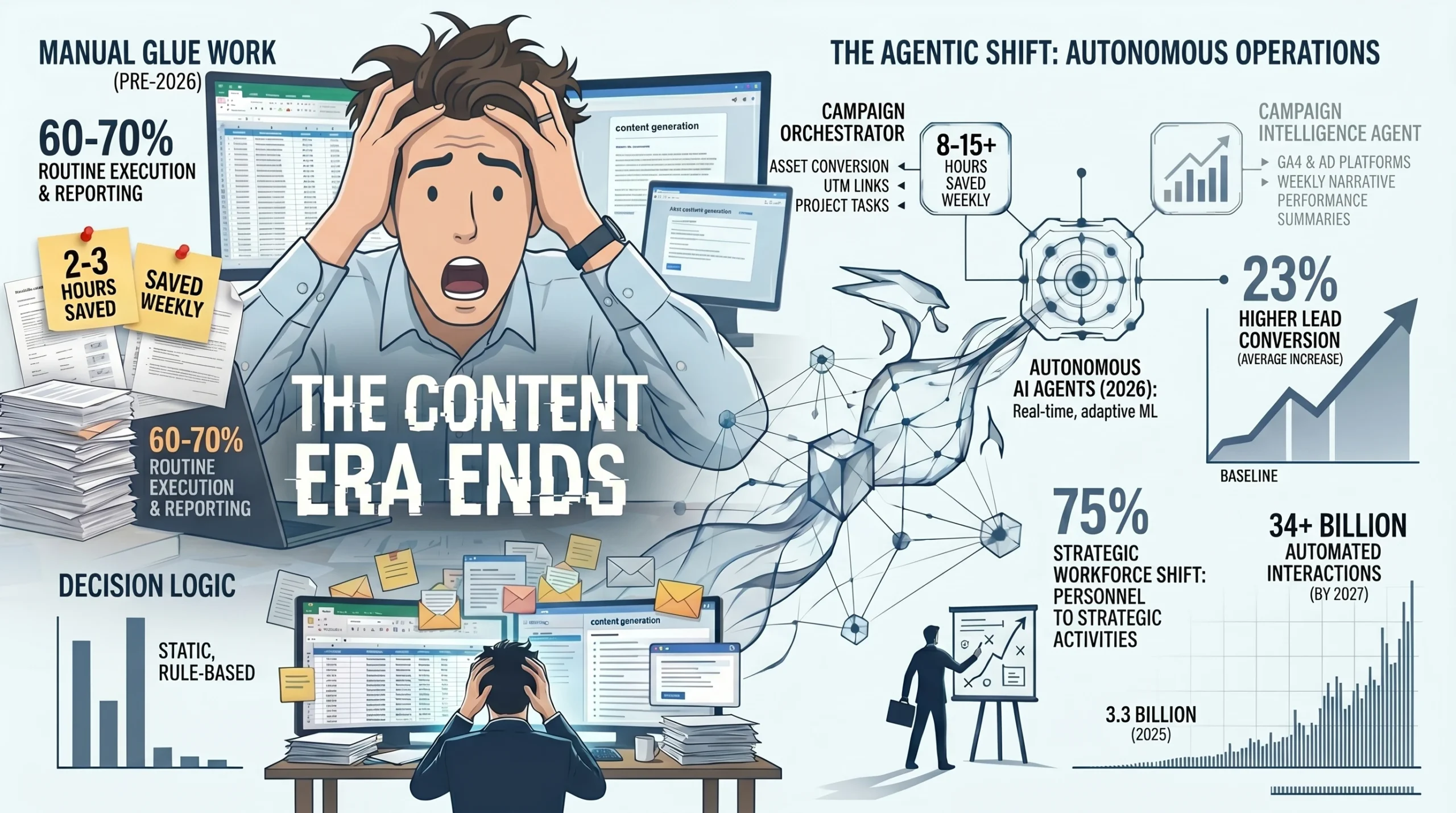
Indian marketing teams currently face heavy operational drag. Relying on manual processes costs brands between THB 23,000 and THB 77,000 every month. This overhead slows campaign execution and drains resources better spent on high-level strategy.
AI in Marketing is the synthesis of LLMs, autonomous agents, and real-time decisioning to automate operations and personalize at scale. This technology represents the master roadmap for brands looking to recover lost efficiency.
The risk of stagnation is extreme in 2026. Competitors using AI agents achieve 23% higher lead conversions, while 65% of all searches have become zero-click. Furthermore, a 5-minute response time yields 9x better conversion, a speed only automated systems can maintain.
What are the Essential Takeaways for 2026?
- 90-Day Implementation: Teams can transform operations in one quarter using a structured roadmap.
- Operational Glue Work: AI now moves beyond content to connect tools like HubSpot and Salesforce.
- The Super-Empowered Consumer: Customers expect instant, personalized assistance at every digital touchpoint.
- AEO and GEO Priority: Optimization must focus on Answer Engines as 30% of searches show AI Overviews.
- Significant ROI: 84% of companies see positive ROI, with production costs dropping 60 to 70%.
What will you learn in this guide?
- Why is AI in Marketing the ultimate game-changer for Indian brands?
- Which AI Agents will run your marketing operations in 2026?
- How do you build a 90-day AI marketing roadmap?
- What are the best AI marketing tools for Indian teams?
- How do you optimize for AEO and GEO in the Indian search landscape?
- What are the ROI expectations and cost benchmarks?
- What are the most common questions about AI in Marketing?
- How can you take the lead in the AI revolution?
Why is AI in Marketing the ultimate game-changer for Indian brands?
The shift from traditional automation to AI-driven engagement allows brands to respond to behavior in real time. Static rules cannot handle modern journeys. AI continuously re-evaluates context to move prospects forward.
Data shows that 84% of companies investing in AI see positive ROI. Furthermore, AI search generates a 4.4x higher conversion rate. These efficiencies are critical for staying competitive in a saturated digital market.
In India, adoption is accelerating beyond Tier 1 tech hubs like Bangalore and Gurgaon. Interest is surging in Tier 2 cities such as Indore and Jaipur as businesses seek scalable growth.
Cost sensitivity remains a factor for local brands. Initial setup costs range from THB 2,33,000 to THB 6,20,000. However, the investment pays off by handling operational glue work that connects CRM platforms and ad networks.
AI is no longer just for generating text. It functions as the infrastructure connecting HubSpot and Salesforce to ensure cross-channel consistency.
Which AI Agents will run your marketing operations in 2026?
AI Agents are autonomous systems that carry out multi-step work without constant human input. They pull data, evaluate it against brand rules, and execute actions across your entire marketing stack.
> What is an AI Marketing Agent?
> An autonomous system using machine learning to make real-time decisions and execute multi-step tasks across different software tools independently.
Operational and Intelligence Agents
These agents handle repetitive tasks and data synthesis to eliminate hours of manual stitching.
| Agent Name | Problem Solved | Key Tool Integration |
|---|---|---|
| Campaign Orchestrator | Translating briefs into channel-ready assets | Google Docs, Asana, Jira |
| Campaign Intelligence | Hours spent manually pulling metrics and reports | Google Ads, GA4, Slack |
| Intent Intelligence | Misclassifying demo requests vs. calculator users | CRM, Website Analytics |
| Routing Orchestration | Leads route to sales without complete enrichment | Clearbit, Salesforce |
| Conversation Intelligence | Marketing lacks feedback from sales calls | Gong, CRM, Notion |
| Lead Enrichment | Inconsistent job titles and messy data entry | CRM, Enrichment APIs |
| Landing Page QA | Broken links and UTM errors waste ad spend | Slack, Headless Browsers |
| Webinar Ops Assistant | Tedious logistics and speaker coordination | Zoom, Marketing Automation |
| Social Listening | Missing opportunities to engage with mentions | Social APIs, Slack |
| Competitor Monitor | Missing subtle pricing or targeting shifts | Scrapers, Diff Checkers |
Content and Engagement Agents
These agents focus on research, quality assurance, and cross-platform visibility for your brand.
| Agent Name | Problem Solved | Key Tool Integration |
|---|---|---|
| SEO Content Brief Agent | Manual research for briefs takes too long | Semrush, Ahrefs, Notion |
| Ad Creative Generator | Writing 50+ variations is mentally draining | OpenAI, Google Sheets |
| Lifecycle Nurture Agent | Underperforming, stale email sequences | Marketo, HubSpot, LLMs |
| User Recapture Emailer | Users drop off without intent-based re-engagement | User Data, HubSpot |
| Content Repurposing | Content dies after a single publish | WordPress, Canva, LinkedIn |
How do you build a 90-day AI marketing roadmap?
Transformation requires a phased approach to manage complexity. A structured timeline ensures your team builds a strong foundation before attempting full-scale autonomous campaigns.
Phase 1: Foundation (Weeks 1-4)
Focus on auditing current content for AEO and GEO readiness. Identify three high-volume routine tasks and select core platforms. Build a comprehensive knowledge base with at least 100 entries to train your future agents.
Phase 2: Implementation (Weeks 5-8)
Deploy AI-powered chatbots on high-traffic pages to qualify leads instantly. Launch your optimized AEO content and set up automated lead response sequences. Ensure all data flows correctly between your chatbot and CRM.
Phase 3: Scale (Weeks 9-12)
Analyze visibility changes in AI search engines and calculate preliminary ROI. Expand optimization to your next 20 priority pages. Establish a monthly review process to refine chatbot responses based on live data.
Budget Allocation
- 30-40% Tools and Platforms: Investment in core technology and AI capabilities.
- 25-35% Content Creation: Writing AEO-optimized articles and knowledge bases.
- 20-25% Automation Systems: Maintaining lead nurturing and booking integrations.
- 10-15% Measurement: Tracking AI visibility and attribution across all channels.
What are the best AI marketing tools for Indian teams?
Selecting the right platform depends on your company size and specific operational needs. In 2026, the best platforms embed AI directly into their core architecture.
| Dimension | HubSpot (Breeze) | Salesforce (Einstein) | Marketo (Adobe) |
|---|---|---|---|
| Learning Curve | Low: Works out-of-the-box | Steep: Requires admin expertise | Moderate: Feature-rich |
| Best For | Mid-market inbound teams | Enterprise with complex sales | Content-heavy enterprises |
| Implementation | 2-4 Weeks | 3-6 Months | 2-4 Months |
Niche Tool Spotlight
- Surfer SEO: Reviews search trends to provide an actionable, AI-powered strategy for ranking.
- Jasper: A generative tool that applies your brand voice to blog posts, emails, and social updates.
- Adzooma: Flags underperforming ads and suggests real-time bid adjustments to maximize spend.
- Reply.io: Combines a lead database with AI to automate outreach via LinkedIn and WhatsApp.
How do you optimize for AEO and GEO in the Indian search landscape?
Traditional SEO is obsolete in 2026. With 65% of searches ending without a click, brands must shift to Answer Engine Optimization (AEO) and Generative Engine Optimization (GEO).
GEO Strategy
Generative engines like Google Gemini reward fact-dense and entity-rich content. You must include expert quotes and citation-worthy statistics to ensure the engine selects your brand as a primary source.
AEO Strategy
To win the 30% of results featuring AI Overviews, use structured data like FAQ and HowTo schemas. Structure your content around clear headers that directly answer common customer questions identified in your Phase 1 audit.
Entity Richness
In the Indian B2B context, visibility on platforms like LinkedIn and WhatsApp is essential. AI agents monitor these channels for mentions and draft on-brand responses, ensuring your brand remains a recognized entity.
What are the ROI expectations and cost benchmarks?
The financial reality of AI implementation favors teams that move quickly. Organizations report that content production becomes 60 to 70% cheaper while maintaining or improving quality.
Customer acquisition costs often drop by 25 to 40% through enhanced targeting and predictive scoring. Most Indian businesses achieve ROI within 6 to 12 months using human-in-the-loop systems.
Measurement Timeline
- Weekly: Track chatbot conversation rates, lead volume, and response times.
- Monthly: Monitor AI search visibility (Share of Voice) and cost per lead.
- Quarterly: Conduct a full ROI analysis and optimize your strategy for the next period.
What are the most common questions about AI in Marketing?
Does AI replace human marketers?
AI does not replace marketers: it replaces those who refuse to use it. The human-in-the-loop concept is essential for success. Humans provide strategic thinking, while AI handles the execution and data processing. Human oversight ensures brand authenticity and accuracy.
What is the budget required for a small Indian business?
Small businesses can start with a monthly budget of THB 6,000 to THB 15,000. This range typically covers basic AI tools for content creation and social media automation. This allows smaller teams to reduce manual coordination and compete with larger enterprises.
How long until I see ROI?
Most organizations see initial returns within 3 to 6 months. Full ROI typically materializes between 6 and 12 months as AI models gather behavioral data. The efficiency gains in production and lead qualification drive these early returns.
What is the difference between AI and traditional automation?
Traditional automation follows fixed if-then rules created by humans. AI marketing automation uses machine learning to analyze behavior and adapt in real time. It predicts what a customer will do next and determines the best action without manual rule updates.
How can I ensure data privacy?
Choose AI vendors that comply with international standards like GDPR and CCPA. Establish clear data governance policies and regularly review tool permissions. Using responsibly collected first-party data ensures your personalization efforts remain ethical and builds customer trust.
How can you take the lead in the AI revolution?
AI marketing is no longer a luxury: it is a competitive necessity for survival in 2026. Teams that adopt agentic systems now will dominate their markets through superior efficiency and personalization.
Take the lead in the AI revolution. Book a free counselling session with an academic counsellor for our AI-powered Niche Specific Digital Marketing course to future-proof your career.