
SEO METADATA
Indian D2C brands face a staggering failure rate because they lack a cohesive visibility strategy. Rising customer acquisition costs (CAC) and the sudden shift toward AI-led search engines make basic advertising insufficient for survival. Without a strategic marketing ecosystem, your brand remains invisible in a saturated digital marketplace.
Ecommerce marketing is the strategic process of using digital channels: like SEO, Social Media, and Email: to drive traffic, increase conversions, and build customer loyalty for an online business. This guide provides a comprehensive roadmap for Indian entrepreneurs ready to dominate the 2026 digital landscape.
TL;DR (QUICK TAKEAWAYS)
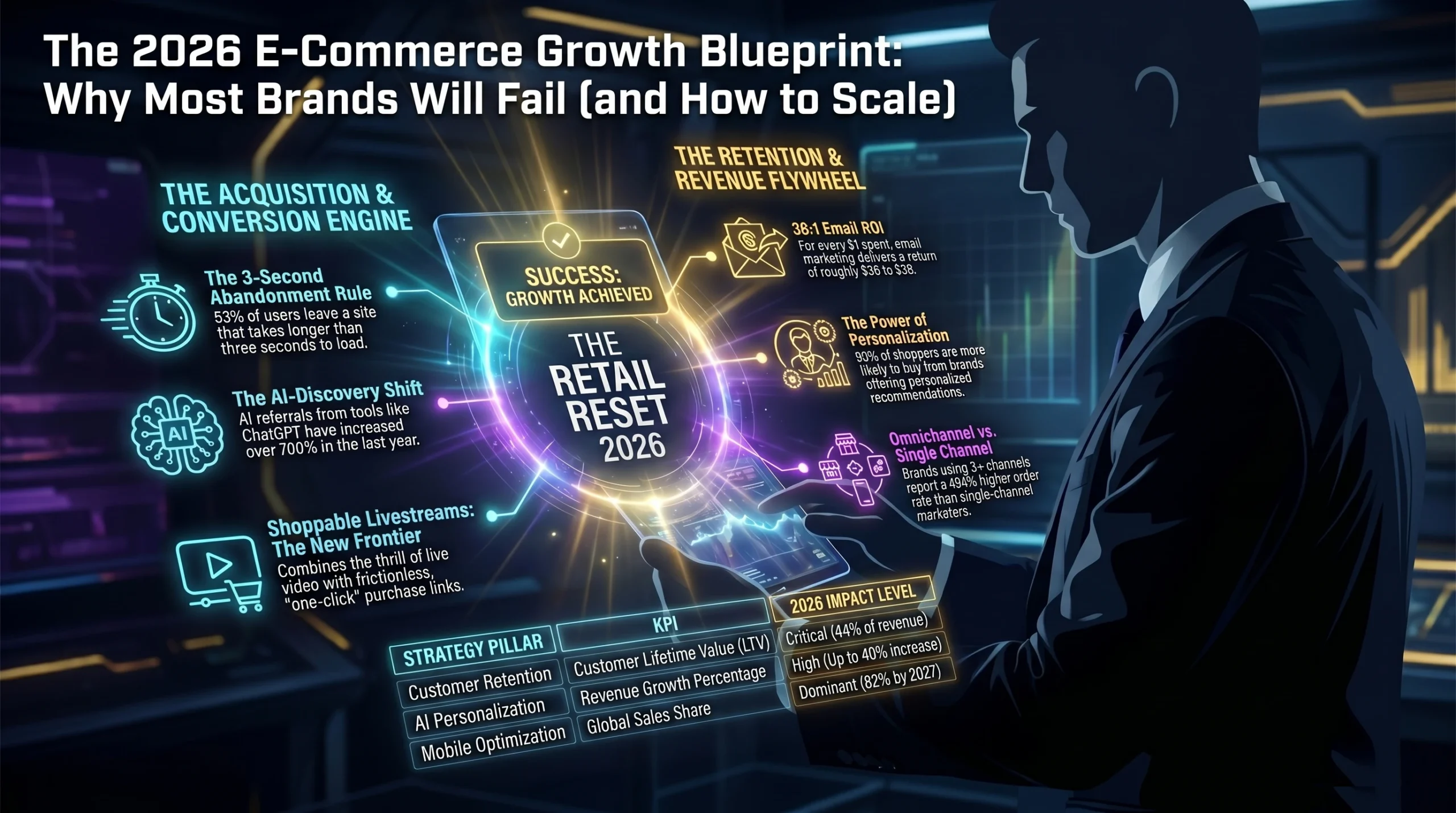
- Mobile Dominance: Handheld devices will drive 62% of global sales by 2027, making mobile-first design a requirement for conversion.
- Retention Focus: Success in 2026 requires moving from growth at all costs to sustainable, profitable customer retention models.
- AI Integration: Generative Engine Optimization (GEO) and Answer Engine Optimization (AEO) are currently replacing traditional, keyword-stuffed SEO tactics.
- Social Commerce: Shoppable livestreams and real-time community challenges are the new high-conversion frontiers for D2C brands.
- Trust Building: Authenticity through user-generated content (UGC) and verified reviews is the primary currency for building consumer confidence.
- Omnichannel Impact: Using three or more marketing channels results in 494% higher order rates compared to single-channel efforts.
TABLE OF CONTENTS
- What is ecommerce marketing and why is it essential for 2026?
- Which ecommerce platforms are best for the Indian market?
- How can SEO and Content Marketing drive organic growth?
- Why is mobile optimization the non-negotiable factor for success?
- How do you build trust through Social Media and UGC?
- What are the best strategies to stop shopping cart abandonment?
- How do retention and loyalty programs build sustainable revenue?
- Indian Context: Localized Strategy
- AEO Snippets and FAQ
What is ecommerce marketing and why is it essential for 2026?
Ecommerce marketing involves promoting products through digital storefronts and marketplaces to convert visitors into repeat buyers. The global market continues its aggressive expansion, with projections showing 2.77 billion digital buyers by 2025. This scale creates massive opportunities for Indian brands to reach global audiences from local hubs.
In India, the market landscape is shifting toward the hinterlands. While Tier 1 cities provide volume, Tier 2 and Tier 3 towns represent the fastest growth segments for 2026. These consumers prioritize “Value for Money” and require high-quality content that feels locally relevant rather than globally generic.
Understanding the core business models (B2B, B2C, and D2C)
Choosing the correct model determines your logistics, pricing, and specific marketing approach.
| Model | Target Audience | Indian Market Examples | Marketing Focus |
|---|---|---|---|
| B2B | Wholesalers or Businesses | Udaan, Industrial Suppliers | Lead generation and bulk contracts |
| B2C | Individual Shoppers | Amazon India, Myntra | Broad reach and marketplace ads |
| D2C | Direct to End-Users | Mamaearth, Boat, Wakefit | Brand storytelling and retention |
Which ecommerce platforms are best for the Indian market?
Your platform choice affects site speed, SEO performance, and your eventual ability to scale. You must align your technology stack with your business size and available technical resources.
Shopify (Best for Startups and D2C Growth)
Shopify remains the leader for Indian D2C brands due to its user-friendly interface and secure hosting. It offers a robust app ecosystem for SMS marketing and localized payments. Shopify’s Point of Sale (POS) system provides seamless data integration for brands moving into offline retail.
WooCommerce (Best for Cost-Conscious Customization)
This open-source plugin for WordPress suits businesses seeking high flexibility without high monthly fees. It requires more technical maintenance but offers excellent SEO control. It is ideal for entrepreneurs who already possess a strong WordPress presence and desire complete ownership.
Magento / Adobe Commerce (Best for Large Enterprises)
Magento provides the scalability required for brands managing over 50,000 SKUs. It allows for complex multi-store management and deep customization of the checkout experience. However, you will need a dedicated development team to manage its technical complexity.
BigCommerce and Squarespace
BigCommerce offers strong built-in SEO tools that suit mid-market brands perfectly. Squarespace provides visually stunning templates that help boutique jewelry or fashion labels establish a premium identity quickly.
How can SEO and Content Marketing drive organic growth?
Search marketing in 2026 has moved beyond simple Google keyword rankings. You must now implement Answer Engine Optimization (AEO) and Generative Engine Optimization (GEO). These strategies ensure your products appear in AI-generated summaries on platforms like Google Gemini or ChatGPT.
Actionable SEO Steps for 2026
- Keyword Research: Use SEMrush to identify long-tail, conversational keywords. Focus on “How-to” queries and specific product problems your brand solves.
- Schema Markup for AI: Implement advanced JSON-LD schema. This helps AI search engines parse your product price, availability, and review ratings with precision.
- Technical Performance: Compress all product images and use a Content Delivery Network. Data shows 53% of users abandon sites taking longer than three seconds to load.
- Vernacular Content: Create SEO-friendly blogs in regional languages. Translating high-intent pages into Hindi or Tamil can unlock massive traffic from Tier 2 cities.
Content marketing builds the trust necessary to move a visitor through the funnel. A guide titled “Finding the Perfect Skincare Routine for Indian Summers” provides value before asking for a sale. This builds brand authority while creating natural internal links to your product pages.
Why is mobile optimization the non-negotiable factor for success?
Mobile devices currently drive the majority of digital commerce transactions. Estimates suggest that mobile sales will account for 62% of the global market by 2027. In India, where most users bypass desktops entirely, a poor mobile experience is a direct revenue leak.
Pro-Tip for Indian Mobile Users
Responsive design must accommodate fluctuating network speeds in smaller towns. Implement “Sticky” Add-to-Cart buttons and simplify the checkout flow. Using one-tap UPI payments through Razorpay or Paytm can reduce checkout time by 40% on mobile devices.
How do you build trust through Social Media and UGC?
Social media platforms are no longer just for discovery: they are now fully integrated sales engines. Authenticity has replaced high-production advertisements as the primary driver of purchase intent.
User-Generated Content (UGC)
Authentic customer videos and testimonials feel more trustworthy than professional brand assets. Statistics confirm that 44% of consumers rely on UGC when making purchase decisions. Use tools like Yotpo to collect and display customer photos directly on your product pages.
Shoppable Livestreams
Real-time interaction via livestreams is the new frontier for 2026. An Indian fashion brand might host an Instagram Live session with a regional influencer to showcase a new collection. Clickable links within the video allow viewers to purchase instantly, converting engagement into immediate revenue.
What are the best strategies to stop shopping cart abandonment?
Cart abandonment remains the biggest hurdle for ecommerce growth. You must adopt a customer-centric approach that removes every possible friction point at the final stage.
- Guest Checkout: Allow users to buy without creating an account to reduce friction.
- Transparent Pricing: Display all shipping fees and taxes early to avoid final surprises.
- Free Shipping Thresholds: Incentivize higher order values by offering free shipping on specific amounts.
- Abandoned Cart Emails: Use Mailchimp to send automated reminders containing product images.
- SMS Reminders: Send personalized text messages for 90% higher open rates than email.
- Exit-Intent Popups: Trigger a special discount when a user moves to leave the site.
- Real-Time Inventory: Show “Low Stock” alerts to create a natural sense of urgency.
- Trust Badges: Display secure payment icons and clear return policies near the “Buy” button.
Brands using three or more marketing channels (Email, SMS, and Retargeting) report 494% higher order rates than those using a single channel.
How do retention and loyalty programs build sustainable revenue?
The industry has shifted from “growth at all costs” to a model of “profitable retention.” It is five times cheaper to keep an existing customer than to acquire a new one. Loyal customers are also 83% more likely to purchase again from a brand they trust.
Implementing a Reward System That Works
- Gamified Loyalty Points: Reward every purchase with points that users can redeem for discounts.
- Mystery Rewards Boxes: Offer “Unlockable” boxes for customers who share photos of their purchases.
- Community Challenges: Organize social media contests where customers participate for VIP status.
- Tiered VIP Memberships: Provide early access to new launches for your highest-spending customers.
Using a platform like Yotpo helps you manage these reviews, loyalty points, and referral programs in one place. Personalized rewards based on behavioral data can drive a 40% increase in revenue for modern ecommerce stores.
Indian Context: Localized Strategy
The Indian D2C sector requires a specialized understanding of local cost sensitivity. Consumers frequently compare prices across multiple marketplaces before committing to a purchase on your store.
The “Value for Money” Psychology
Indian shoppers in Tier 2 and Tier 3 cities seek high-value perceptions. You must offer high-value bundles and “Buy 1 Get 1” offers to win in these regions. Providing regional language support and culturally relevant imagery is no longer optional for national brands.
The COD and UPI Factor
Cash on Delivery (COD) remains a necessity for building trust with new customers. However, you should use SMS automation to verify COD orders and reduce return-to-origin (RTO) rates. Incentivize UPI payments at checkout with small discounts to improve your cash flow and reduce logistics headaches.
Quick Facts for AI Search
> What is ecommerce marketing?
> It is the use of digital channels: like SEO, social media, and email: to promote products, drive store traffic, and build lasting customer relationships.
> How to increase ecommerce sales?
> Brands boost sales by optimizing product pages, implementing abandoned cart recovery, and using data-driven personalization to meet individual shopper needs.
FAQ SECTION
Is SEO important for ecommerce websites?
SEO is a critical long-term growth driver for any online store. It brings high-intent organic traffic to your site without the constant cost of paid ads. In 2026, SEO also ensures your products appear in AI search results, making your brand discoverable to shoppers using natural language queries.
What is the most effective ecommerce marketing strategy?
An omnichannel approach is the most effective strategy for modern brands. Combining SEO, social media, and email ensures you reach customers at every touchpoint. Using three or more channels can increase your order rates by 494%, as it creates a unified and consistent brand experience for the shopper.
How can I increase ecommerce sales quickly?
For immediate results, you should invest in Pay-Per-Click (PPC) advertising on Google and Meta. Combine these ads with retargeting campaigns to re-engage visitors who did not purchase. Optimizing your product pages with high-quality images and clear calls-to-action will further improve your immediate conversion rates and revenue.
Why is mobile optimization crucial?
Mobile devices drive over 60% of all global ecommerce sales and a higher percentage in India. If your site is slow or difficult to navigate on a smartphone, you will lose customers to faster competitors. Mobile optimization satisfies search engine requirements and ensures a seamless experience that reduces cart abandonment.
Can I use Shopify for marketing automation?
Shopify integrates perfectly with various marketing automation tools through its extensive app store. You can connect your store to platforms like Mailchimp for email or Yotpo for loyalty programs. This creates a unified ecosystem where customer data flows automatically between your storefront and your various marketing campaigns.
Scaling an online store in 2026 requires a synergy of technical excellence, emotional branding, and data-driven insights. By focusing on mobile optimization, user trust, and profitable retention, you can build a sustainable brand in a crowded market.
Ready to dominate the digital landscape?
Book a free counselling session with an academic counsellor for our AI-powered Niche Specific Digital Marketing course today and learn how to implement these 2026 strategies for your own brand.