
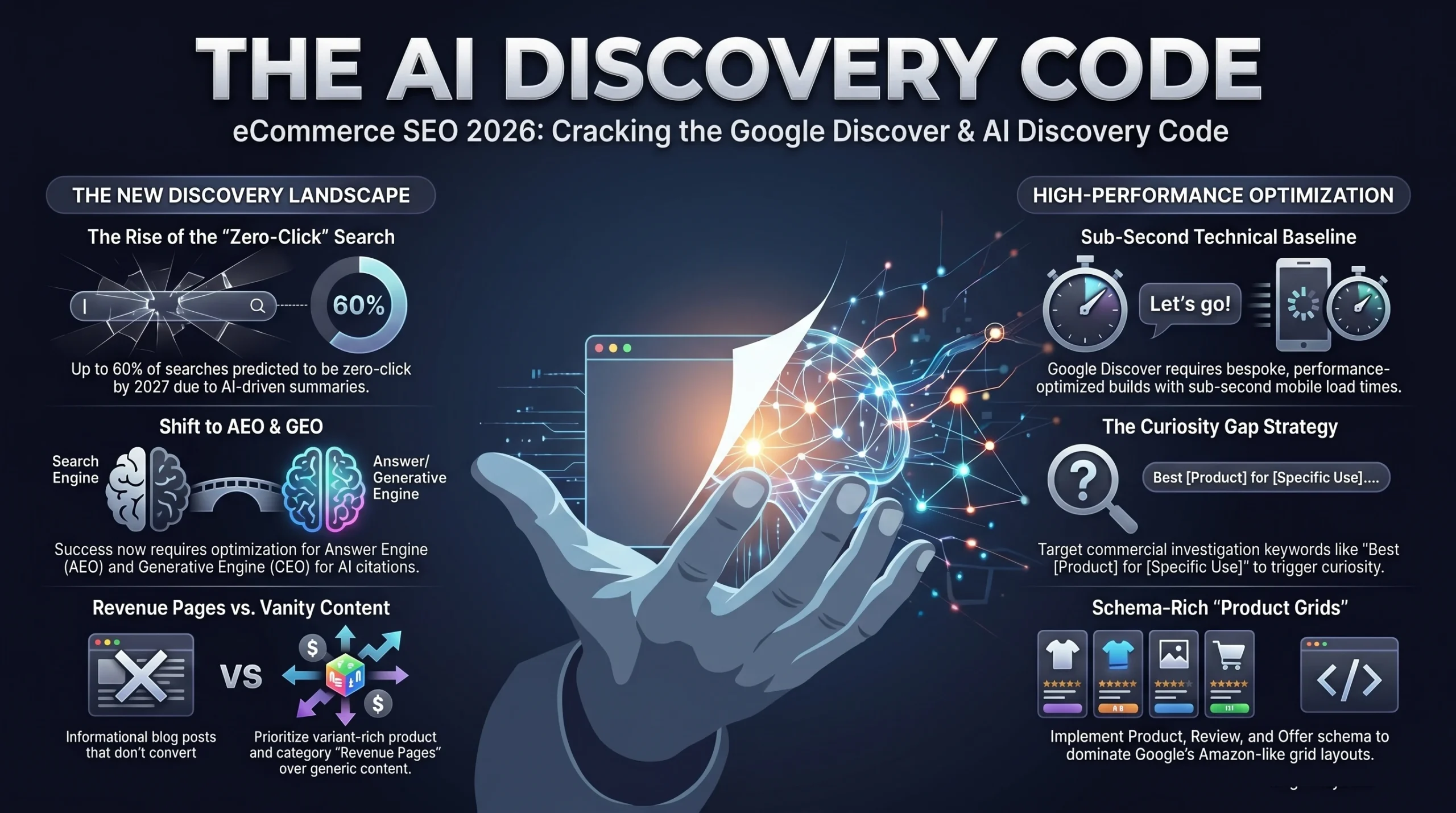
Indian D2C brands struggle to survive against giants like Amazon India, Flipkart, and Nykaa. Rising PPC costs during festivals like Diwali and the shift toward zero-click AI searches make organic visibility a necessity for healthy margins. Many retailers hit a technical ceiling and waste budgets on vanity content that fails to convert. eCommerce SEO is the strategic process of optimizing an online store to rank higher in search engine results pages. This discipline drives qualified, transactional traffic and long-term authority without requiring a payment for every single individual visitor. Comprehensive eCommerce SEO serves as the critical compounding asset that builds your technical sovereignty and sustainable growth in the 2026 discovery landscape.
TL;DR:
- Discovery Engine Hybrid: SEO now demands a hybrid approach combining traditional search, Answer Engine Optimization (AEO), and Generative Engine Optimization (GEO).
- Zero-Click Dominance: Marketers predict 60 percent of searches will be zero-click by 2027, requiring content that AI engines like Perplexity and Gemini can easily cite.
- Mobile Metric Mastery: Meeting India’s mobile performance standards requires an LCP under 2.5 seconds, an FID under 100ms, and a CLS below 0.1 for ranking.
- Revenue Page Focus: Prioritize optimizing category hubs and product variant pages over generic “vanity” blog content to drive immediate transactional growth and sales.
- The Trust Economy: Organic results earn 90 percent of user trust compared to sponsored listings, especially as Indian shoppers seek authentic reviews and local expertise.
- Technical Sovereignty: Moving away from bloated templates toward performance-optimized environments is essential to handle large-scale product migrations and complex faceted navigation.
TABLE OF CONTENTS
- What is eCommerce SEO in the Era of AI Discovery?
- Why is eCommerce SEO Critical for Indian Retailers Today?
- How do you Conduct Keyword Research for Transactional Intent?
- How can Product and Category Pages be Optimized for Conversions?
- What Technical SEO Foundations are Required for Scale?
- How do you Structure Data to Earn Rich Snippets and AI Citations?
- What Content Marketing Strategies Beat Competitors in 2026?
- How can Backlink Building Establish Authority in the Indian Market?
WHAT IS ECOMMERCE SEO IN THE ERA OF AI DISCOVERY?
Modern eCommerce SEO is no longer just about blue links. You must now navigate the intersection of traditional algorithms and Generative AI platforms. Search engines have evolved into discovery engines that synthesize information directly on the results page.
Retailers in 2026 must optimize for three distinct environments simultaneously. Traditional search focuses on ranking in the top results. AEO focuses on providing immediate answers for voice search. GEO ensures that Large Language Models cite your products as authoritative sources.
| Feature | Traditional SEO | GEO (Generative Engine) | AEO (Answer Engine) |
|---|---|---|---|
| Primary Goal | Rank in top 10 blue links | Earn citations in AI Overviews | Provide direct voice answers |
| Content Focus | Keyword density and backlink authority | Authoritative, citable product data | Structured facts and FAQ formats |
| User Intent | Browsing and broad research | Synthesis of multiple product types | Immediate problem solving and facts |
| Discovery | Scrolling through traditional SERPs | Conversational LLM chat responses | Voice assistants and featured snippets |
> Generative Engine Optimization (GEO): The specialized process of optimizing website architecture and content to be accurately interpreted, synthesized, and cited by AI discovery platforms like Google Gemini, ChatGPT, and Perplexity.
This shift is particularly relevant in India as regional language voice search explodes. Shoppers in cities like Jaipur or Bengaluru use conversational “Hinglish” queries to find specific deals. Your data must be structured for these engines to extract and recommend your brand.
WHY IS ECOMMERCE SEO CRITICAL FOR INDIAN RETAILERS TODAY?
Indian retailers face a “PPC trap” where margins vanish into rising ad costs on Myntra and Nykaa. Investing in organic search allows you to build technical sovereignty. While ads stop the second your budget ends, SEO creates a durable asset that delivers free traffic.
Market data shows that 37.5 percent of all online purchases begin with an organic search. Furthermore, 90 percent of consumers prefer organic listings over “Sponsored” tags. This trust factor is essential for converting skeptical first-time shoppers in a crowded digital market.
Search advertising within AI platforms is projected to grow to 26 billion dollars by 2029. This massive investment by Google and Bing confirms that AI discovery is the future. Retailers who optimize now will capture this emerging traffic before competitors adapt.
The long-term benefits for your brand include:
- Cost-Efficiency: Achieve a significantly higher ROI compared to paid media as your organic authority compounds over time.
- Credibility: Secure the top spot on Google to signal quality to the Indian consumer, who views high organic rankings as a mark of reliability.
- Compounding Traffic: Build a visibility foundation that attracts visitors 24/7 without the need for constant financial injections into ad platforms.
HOW DO YOU CONDUCT KEYWORD RESEARCH FOR TRANSACTIONAL INTENT?
Keyword research in 2026 must prioritize buyer intent over search volume. You need to identify the exact phrases Indian shoppers use when they are ready to purchase. I recommend a Three-Tier intent approach to organize your content.
Tier 1 targets transactional keywords like “buy pure silk saree online” or “Redmi Note 13 price in INR.” These users are ready to spend money immediately. Tier 2 focuses on commercial investigation, such as “best budget smartphone under 15000” or “Mamaearth vs Wow skin science.”
Tier 3 covers informational “problem-aware” searches. Examples include “how to remove tan at home” or “best fabric for Chennai humidity.” This content captures users early in the funnel and guides them toward your specific product solutions.
Leveraging Marketplaces for Insights
I suggest using Amazon India and Flipkart autocomplete for long-tail discovery. These platforms reflect actual buyer language, including specific attributes like “under 500” or “with warranty.” These product-focused suggestions reveal the nuances of Indian consumer behavior.
Use Hinglish variations to capture untapped niches. Shoppers frequently mix languages, searching for “sasta and durable laptop bags” or “shaadi guest dress ideas.” Small brands can outrank global giants by targeting these culturally specific semantic variations.
HOW CAN PRODUCT AND CATEGORY PAGES BE OPTIMIZED FOR CONVERSIONS?
Your product and category pages are your “Revenue Pages.” These assets drive actual sales and require a meticulous balance of keyword optimization and user experience. Generic manufacturer descriptions will actively harm your rankings.
Product Detail Page (PDP) Checklist
- Unique Descriptions: Write at least 300 to 500 words highlighting specific benefits, technical features, and measurable results.
- H1-H4 Hierarchy: Use clear headings that naturally incorporate your primary and secondary target keywords.
- Image Optimization: Compress high-resolution images and use descriptive Alt-text like “handcrafted-leather-wallet-jaipur.jpg” for image search visibility.
- Trust Signals: Integrate star ratings, authentic customer reviews, and clear shipping timelines for cities like Mumbai or Bengaluru.
The Formula for High-CTR Meta Descriptions
Your meta description functions as a mini-advertisement on the search page. Use the proven formula: Action Verb + Keyword + Value Prop + CTA. Example: “Shop genuine leather bags at 20% off. Enjoy free shipping across India and UPI payment options. Buy now!”
The Power of Category Hubs
Category pages often rank for the broadest, highest-volume search terms. Transform these pages into “Revenue Hubs” by adding 200 to 400 words of original introductory content. This helps search engines understand the topical depth and authority of your store.
WHAT TECHNICAL SEO FOUNDATIONS ARE REQUIRED FOR SCALE?
Technical SEO is the hidden backbone of your online store. Without a fast and secure infrastructure, your on-page efforts will never yield results. Indian mobile networks demand extreme optimization for ranking.
Core Web Vitals: The New Standard
Indian shoppers often browse on 4G networks with inconsistent speeds. You must hit specific performance metrics to prevent bounce rates. Aim for a Largest Contentful Paint (LCP) under 2.5s, First Input Delay (FID) under 100ms, and Cumulative Layout Shift (CLS) below 0.1.
Infrastructure and Security
Submit a clean XML sitemap via Google Search Console to ensure every new SKU is indexed. Implement HTTPS to protect sensitive customer data during checkout. This is mandatory for building trust during UPI or card transactions in the Indian market.
JavaScript Rendering and Faceted Navigation
JavaScript rendering is often a “hidden killer” for eCommerce sites. If Google’s bots cannot render your dynamic content, your products will remain invisible. Use server-side rendering where possible to ensure every product variant is crawlable.
Faceted navigation allows users to filter by price or color but can create thousands of duplicate URLs. I recommend using canonical tags (rel=”canonical”) to designate the “master” version of a page. This prevents crawl budget waste and protects your ranking authority.
HOW DO YOU STRUCTURE DATA TO EARN RICH SNIPPETS AND AI CITATIONS?
Structured data helps search engines and LLMs like Perplexity understand your catalog. Using Schema.org markup in JSON-LD format allows you to earn rich snippets. These include star ratings and price displays that significantly boost click-through rates.
Essential schema types for 2026 include Product, Offer, AggregateRating, and Breadcrumb. Product schema details the name and image. Offer schema includes the price in INR and availability. AggregateRating showcases verified customer scores.
GEO Strategy for AI Visibility
To earn citations in AI Overviews, your information architecture must be logical. Use “answer-first” content that provides direct responses to common buyer questions. This makes it easy for AI engines to extract your data and recommend you as a source.
“`json
{
“@context”: “https://schema.org”,
“@type”: “Product”,
“name”: “Handcrafted Leather Wallet”,
“image”: “https://example.com/wallet.jpg”,
“description”: “Premium full-grain leather wallet made in Jaipur.”,
“offers”: {
“@type”: “Offer”,
“price”: “1499.00”,
“priceCurrency”: “INR”,
“availability”: “https://schema.org/InStock”
},
“aggregateRating”: {
“@type”: “AggregateRating”,
“ratingValue”: “4.8”,
“reviewCount”: “156”
}
}
“`
WHAT CONTENT MARKETING STRATEGIES BEAT COMPETITORS IN 2026?
Content marketing must go beyond basic blogging to establish E-E-A-T (Experience, Expertise, Authoritativeness, Trust). Google rewards content that demonstrates real-world use and technical depth. AI-generated fluff will no longer rank.
I suggest using “Original Research” or “Comparison Guides.” Instead of saying your scarf is warm, provide thermal imaging data comparing your wool blend to competitors. This level of specificity builds massive trust and attracts high-quality backlinks.
Targeting Tier 2 and Tier 3 Cities
The next wave of eCommerce growth in India comes from cities like Surat, Pune, and Lucknow. Create localized content that addresses regional needs. Examples include “Best cotton fabrics for Chennai humidity” or “Top winter wear for Delhi’s cold wave.”
Address regional payment behaviors by highlighting UPI and Cash on Delivery (COD) trust signals. When you target the specific pain points of a shopper in Jaipur or Pune, you build an authority moat that global marketplaces cannot easily replicate.
HOW CAN BACKLINK BUILDING ESTABLISH AUTHORITY IN THE INDIAN MARKET?
Backlinks serve as a vote of confidence from the digital community. A high-quality link profile signals to Google that your store is a trustworthy authority. I forbid “link dumping” or using low-quality directory submissions that trigger penalties.
Legitimate Link-Building Tactics
- Digital PR Campaigns: Create industry reports or original data that Indian journalists want to cite. A successful campaign can earn links from top-tier news outlets.
- Supplier and Distributor Links: Ask your manufacturers to list your store on their “Authorized Retailer” pages. These links are highly relevant and authoritative.
- Unlinked Brand Mentions: Use tools to find websites that mention your brand without a link. Contact them to request a link to your homepage or a relevant product.
- Guest Posting on Niche Blogs: Write technical articles for Indian lifestyle or tech blogs. Focus on adding value rather than just securing a backlink.
Avoid low-quality tactics that prioritize quantity over relevance. A single link from a respected Indian tech blog is more valuable than 100 links from irrelevant sources. Focus on building genuine relationships within your industry niche.
FREQUENTLY ASKED QUESTIONS (FAQ)
How long does it take to see results from eCommerce SEO?
You should see technical health and crawl improvements within 3 months. Significant ranking growth and organic revenue typically require 6 to 12 months of consistent optimization. SEO is a long-term investment that builds compounding value rather than providing a temporary, expensive traffic spike.
Does Shopify help with SEO for my Indian store?
Shopify offers basic SEO features like automatic sitemaps and canonical tags. However, you must still manually optimize your Hinglish keywords and unique product descriptions. Hosted platforms like Shopify also have URL constraints, such as the /products/ subfolder, which requires strategic navigation planning.
What is the difference between SEO and eCommerce SEO?
Traditional SEO often focuses on informational blog content to build awareness. eCommerce SEO is specifically tailored for online stores. It prioritizes transactional intent, the optimization of complex product variant pages, and technical issues like faceted navigation and structured product data for AI discovery.
How do I handle products that are out of stock?
Do not delete pages for out-of-stock items, as you will lose their accumulated SEO authority. Keep the page live with an “out of stock” label and suggest similar products. For permanently discontinued items, implement a 301 redirect to the most relevant category page.
What are the biggest SEO challenges for WooCommerce users?
WooCommerce offers great flexibility but often suffers from plugin bloat and database technical debt. You must invest in high-quality hosting and regular maintenance to ensure your store remains fast. Poorly managed WooCommerce sites often fail Core Web Vitals, leading to lower rankings.
CONCLUSION
eCommerce SEO is a continuous discipline that demands technical precision and intent-driven content. By focusing on sub-second performance, AI-ready structured data, and the nuances of the Indian market, you can build a sustainable alternative to expensive paid media. Successful brands in 2026 treat SEO as a core business asset, not a one-time technical task.
Ready to dominate the search results and future-proof your career?