
The Ultimate Mobile SEO Checklist: Future-Proofing Your Indian Business for 2026
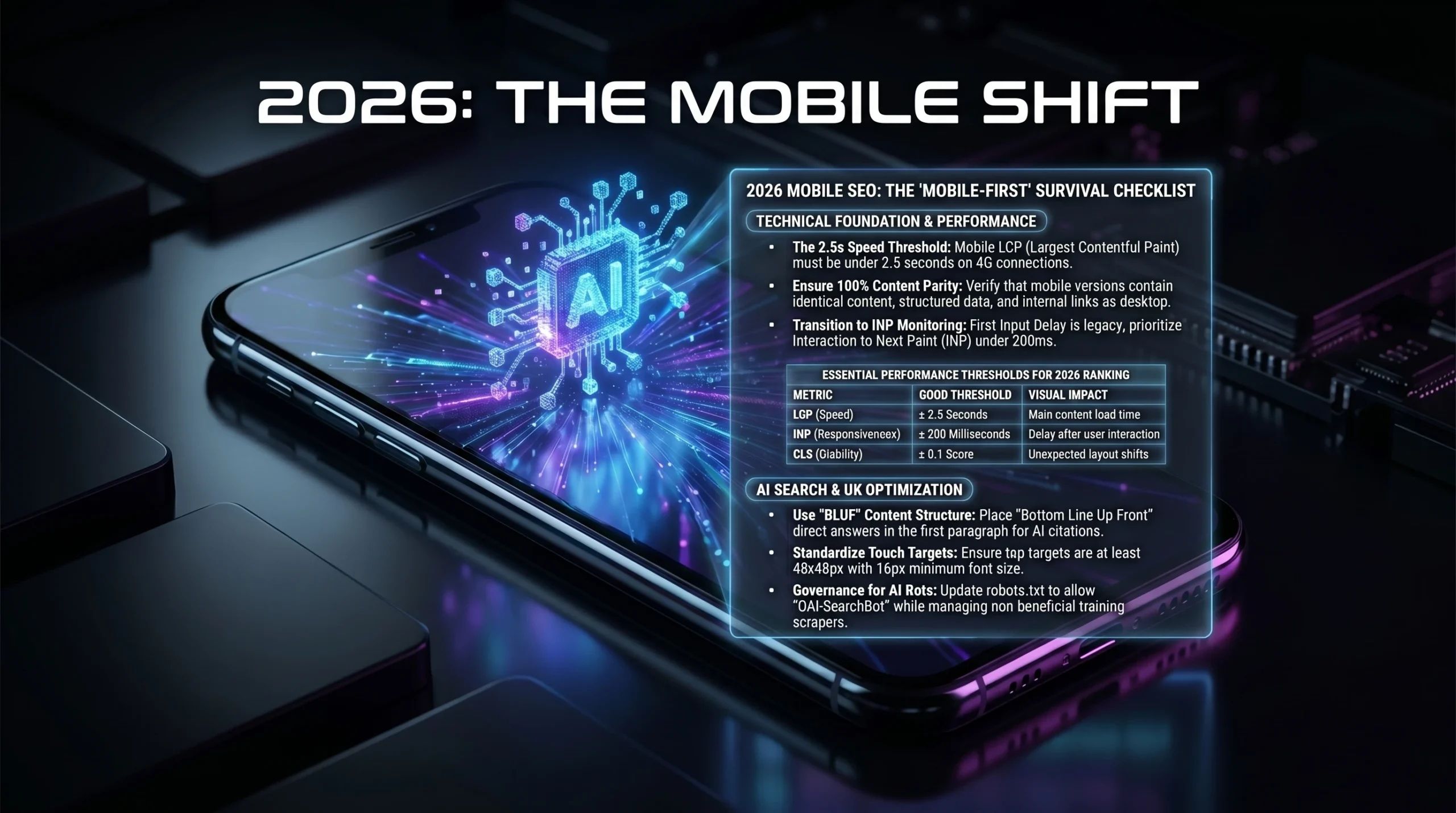
Many Indian businesses are witnessing a silent decline in organic traffic as AI-led search agents take over the digital landscape. What is mobile SEO? Mobile SEO is the specialized practice of optimizing a website to ensure its functionality, usability, and visibility on mobile devices like smartphones and tablets. The problem is that many local brands are losing their visibility to AI overviews because they are still clinging to desktop-first strategies. Since 100 percent of sites are now on mobile-first indexing, “invisible” technical gaps in your mobile rendering are likely killing your rankings. This mobile SEO checklist serves as your definitive 2026 roadmap to ensure your business remains a cited authority in the age of generative search.
Quick Insights:
- The Rendering Shift: As of December 2025, Google may exclude any page returning a non-200 status code (like 4xx or 5xx) from the rendering queue entirely.
- INP Supremacy: Interaction to Next Paint (INP) has officially replaced FID as the primary responsiveness metric, requiring a threshold of under 200ms.
- AVIF over WebP: While WebP was the standard, 2026 technical requirements prioritize AVIF for superior compression on 4G Indian networks.
- Bot Governance: You must differentiate between OAI-SearchBot (retrieval for answers) and GPTBot (training) in your robots.txt to stay visible in AI search.
- Index Budget Management: Managing your “Index Budget” by pruning low-quality pages is now more critical for Indian e-commerce than managing crawl budget.
- The BLUF Method: Leading with the “Bottom Line Up Front” is mandatory for being cited in AI Overviews and RAG-based search engines.
Table of Contents
- Is Your Site Ready for the 100% Mobile-First Reality?
- Why Is Interaction to Next Paint (INP) the New Gold Standard?
- Can Your Technical Infrastructure Survive the December 2025 Rendering Shift?
- Is Your Content Structured for AI Overviews and Generative Engines?
- Why Does Content Parity Between Mobile and Desktop Still Fail?
- How Does Local Mobile Search Drive Real-World Indian Foot Traffic?
- Essential FAQ Section
Is Your Site Ready for the 100% Mobile-First Reality?
Mobile-first indexing is the permanent reality of how Google crawls and ranks the web, meaning the smartphone version of your site is the only version that determines your rankings. In the current Indian digital market, mobile devices account for over 64 percent of all web traffic. Google completed its transition to 100 percent mobile-first indexing in 2024. If your mobile site has less content or fewer internal links than the desktop version, those elements effectively do not exist in the eyes of the algorithm.
In my audits of Indian e-commerce sites, the most frequent rankings-killer is assuming a “responsive” design is enough. SEO experts like Umar Tazkeer emphasize that businesses must move beyond basic templates and adopt “mobile-only thinking.” This involves manual testing where you physically stretch and shrink your browser window to see how elements like header menus and search bars behave. If your mobile navigation relies on a “hamburger menu” that is not present in the DOM until a user clicks it, you are hiding your site structure from the primary crawler.
| Feature | Mobile-First Indexing | Mobile-Only Thinking |
|---|---|---|
| Primary Goal | Parity between mobile and desktop | Optimizing for the mobile user first |
| Crawling | Googlebot Smartphone is the primary agent | Validating 100% of crawls on mobile agents |
| UX Focus | Responsive layout | Touch targets: legible fonts: and speed |
| Indian Context | Standard 4G/5G connectivity | Mid-tier Android device performance |
Why Is Interaction to Next Paint (INP) the New Gold Standard?
Interaction to Next Paint (INP) is a holistic Core Web Vital metric that measures the responsiveness of a page by assessing the delay of every user interaction throughout a visit. Google has deprecated First Input Delay (FID) in favor of INP because FID only measured the very first interaction. For the Indian market, where a large portion of the population uses mid-tier Android devices, such as the Samsung A-series, on 4G connections, INP is the ultimate filter for quality.
A “Good” INP score is defined as 200 milliseconds or less. To understand why this is difficult on Indian devices, we must look at the three phases of INP:
- Input Delay: The time the browser waits for background tasks to clear before it can even acknowledge a user’s tap. On a budget smartphone, a heavy third-party marketing script can block this for seconds.
- Processing Time: The time it takes for your JavaScript to run. Indian mobile CPUs are significantly slower at parsing JS than desktop CPUs, making execution costs much higher locally.
- Presentation Delay: The time it takes for the browser to calculate the new layout and paint pixels.
Actionable Steps to Optimize INP:
- Use scheduler.yield(): This modern API allows long-running JavaScript tasks to yield control back to the main thread. It prevents the browser from “freezing” when a user tries to interact with a site while a heavy script is executing.
- Apply fetchpriority=”high”: Use this attribute on your Largest Contentful Paint (LCP) image, such as a main product banner, to ensure it downloads before non-critical scripts that block the thread.
- Adopt AVIF Formats: Standardize on AVIF for all images. AVIF offers 30 to 50 percent better compression than JPEG, which is critical for reducing the network transfer time on congested Indian 4G networks.
- Debounce Input Handlers: Ensure that search bars do not fire a request for every single keystroke, which can overwhelm the CPU of a mid-range phone.
Can Your Technical Infrastructure Survive the December 2025 Rendering Shift?
The December 2025 Rendering Update clarifies that Googlebot may now exclude any page returning a non-200 status code from the rendering pipeline entirely. This creates a massive risk for Single Page Applications (SPAs) common in modern Indian startups. If your site serves a generic “200 OK” shell but then loads a “404 Not Found” message via JavaScript, Google might index that error state as a valid page. Conversely, if your server throws a 500 error that the JavaScript then hides, the page will be dropped from the index entirely during the rendering stage.
In my experience, the “Invisible 500 Error” is a major threat to React and Vue frameworks. This occurs when a server error happens but the client-side framework catches it and serves a “200 OK” error page. To a bot, it looks like a thin page that should be de-indexed.
Technical Verification Checklist:
- [ ] Robots.txt Governance: Ensure you allow `OAI-SearchBot` for real-time AI retrieval while strategically deciding whether to block `GPTBot` for training. Use a `llms.txt` file in your root directory to guide AI agents.
- [ ] SSL Integrity: Verify that your site enforces HTTPS everywhere, as mixed content warnings are a major negative trust signal for 2026 search.
- [ ] XML Sitemap Status: Ensure your sitemap only contains 200-status, indexable URLs. Exclude all redirects, 404s, and noindex pages.
- [ ] Log File Analysis: Specifically look for “Invisible 500 Errors” where your server has an issue but your framework hides the HTTP status code.
- [ ] Hydration Monitoring: Ensure your “Island Architecture” or Server-Side Rendering (SSR) is serving the primary content in the initial HTML response.
Is Your Content Structured for AI Overviews and Generative Engines?
Generative Engine Optimization (GEO) is the process of formatting content so it can be easily ingested and cited by Large Language Models (LLMs) and AI agents. As we head into 2026, the goal is no longer just “ranking” on a page: it is becoming a cited “grounding truth” for Retrieval Augmented Generation (RAG) systems. When a user asks an AI a question, the system searches for “chunks” of text that it can reconstruct into an answer.
The most effective method for this is the BLUF Method (Bottom Line Up Front). You should provide the direct answer to a user’s query in the very first sentence of your content. AI models look for numerical density and factual clarity when substantiating claims.
Semantic HTML Requirements:
To help AI agents understand your data, use semantic HTML structures:
- Definition Lists: Use `
- ` (List), `
- ` (Term), and `
- ` (Description) for technical specs or product attributes. AI models are 30 to 40 percent more likely to cite content in this format because it acts as a direct entity-value map.
- Organization Schema: Use structured data to connect your brand to the Knowledge Graph. In the 2026 landscape, there are no “rankings,” only “citations.” Linking your brand via `sameAs` properties to verified LinkedIn or Crunchbase profiles is mandatory.
- Hierarchy: Use H1 to H6 tags strictly for structure, not for styling. A disorganized heading structure confuses the AI’s understanding of parent-child relationships within your information.
Why Does Content Parity Between Mobile and Desktop Still Fail?
Content parity failure occurs when the mobile version of a site serves different content, metadata, or internal links than the desktop version, leading to immediate rankings loss. A common problem for Indian e-commerce sites is “Combinatorial Explosion” in faceted navigation. This occurs when filters for size, color, and price generate millions of low-value URLs that waste your “Index Budget.”
For example, a D2C fashion brand in Jaipur might have a category for “Kurtas.” If filters for “Small,” “Blue,” and “Cotton” all create separate indexable URLs, Google’s mobile crawler will get lost in a sea of near-duplicate content. Because Google has a limited “Index Budget” for your domain, it may stop indexing your new, high-value kurtas because it is too busy processing these filter combinations.
Tactical Advice for Content Parity:
- Identical Meta Tags: Ensure meta titles and descriptions are exactly the same on mobile and desktop.
- Canonical Tags: Use a `rel=”canonical”` tag on filtered pages pointing back to the main category root to consolidate ranking power and preserve index budget.
- Structured Data: Schema markup must live on the mobile version of the page. If it only exists on desktop, Google will never see it.
- Internal Linking: Your mobile navigation must contain the same high-value links as your desktop sidebar. If you hide links in a mobile hamburger menu for space, ensure they are still present in the HTML source code.
How Does Local Mobile Search Drive Real-World Indian Foot Traffic?
Local mobile search optimization ensures your business appears in “Near Me” queries, which are the primary driver of physical store visits in the Indian market. Statistics show that 76 percent of local searches on a smartphone result in a physical store visit within 24 hours. For service providers, such as clinics in Bangalore, your mobile presence is your primary conversion tool.
Google Business Profile (GBP) optimization is the bedrock of local visibility. If your business is not optimized here, you are invisible to the majority of high-intent mobile users who rely on maps and local pack results.
Mandatory Mobile Local Elements:
- Click-to-Call: Ensure your phone number uses the `href=”tel:+91…”` format for immediate dialing.
- Maps Integration: Provide a clear “Directions” button that opens the user’s native map app.
- NAP Consistency: Your Name, Address, and Phone number must be identical across your website, GBP, and local directories like JustDial or Apollo.
- LocalBusiness Schema: Use structured data to explicitly tell Google your business hours, location, and specific service type to increase your chances of appearing in AI-led local recommendations.
Essential FAQ Section
What is the most critical technical SEO change for 2026?
The most urgent shift is the December 2025 Rendering Update. Google now excludes pages with non-200 status codes from the rendering queue. You must ensure that your mobile site serves valid content with a 200 OK header before any client-side JavaScript execution begins to avoid being de-indexed by the algorithm.
Should I block GPTBot in my robots.txt?
It is a strategic choice. GPTBot is for training future AI models, whereas OAI-SearchBot is for real-time search retrieval. You should generally allow OAI-SearchBot so your content appears in ChatGPT’s “Search” feature, but you may block GPTBot if you do not want your data used for training future models.
Does hiding content in accordions hurt SEO?
On mobile, Google handles content in accordions or tabs differently than on desktop. It is acceptable to use accordions for better readability, and Google will generally index the full text. However, ensure that your most important keyword-rich content is visible by default without requiring user interaction to improve the citation probability.
How do I fix “Discovered – currently not indexed” errors?
This usually signals a quality or “Index Budget” issue. Google has found the URL but decided it provides no unique value. To fix this, you should prune low-quality pages, tighten your robots.txt to block low-value parameters, and use canonical tags to focus Google on your most important pages.
Why is my mobile page speed slower than desktop?
Mobile devices have slower CPUs and rely on 4G or 5G networks which have higher latency. JavaScript takes significantly longer to execute on a mobile device than a desktop. To improve this, reduce the “Execution Cost” by using Server-Side Rendering (SSR) and modern image formats like AVIF.
Conclusion
Mobile SEO in 2026 has transitioned from simple “mobile-friendliness” to a complex discipline of “data source management.” Your website is no longer just a storefront for humans: it is a structured data feed for AI agents. By mastering rendering, INP, and content parity, you ensure your business remains visible in an era of decentralized search.
Book a free counselling session with an academic counsellor for our AI-powered Niche Specific Digital Marketing course to master these 2026 shifts and lead the Indian market.
Book a Free Counselling Session