SEO Metadata
In the high-stakes world of Indian hospitality, great food is no longer a safety net. Whether you are battling rising property rentals in Bandra or competing for visibility in Indiranagar, a crowded market means your flavors often vanish behind rivals with better digital footprints.
You risk losing hungry diners every second to competitors who dominate Google searches or trend on Instagram Reels. Without a strategy, your kitchen remains invisible to the modern diner who eats with their eyes before ever stepping through your door.
Digital marketing for restaurants is the process of using online tools like SEO, social media, and targeted messaging to build brand awareness, manage reputation, and drive both foot traffic and online orders. It serves as the technical bridge between a kitchen’s culinary talent and a diner’s smartphone.
TL;DR: Actionable Takeaways
- ROI Focus: Targeted digital campaigns drive up to 25% more repeat visits.
- Local SEO: Your Google Business Profile is your primary asset for discovery.
- Social Proof: Use Instagram and customer reviews to build immediate trust.
- Mobile-First: Ensure your menu and booking work perfectly on small screens.
- Retention: WhatsApp and email marketing offer the highest return on investment.
- Data Control: Collect guest data directly to avoid 100% dependency on apps.
Table of Contents
- Is Digital Marketing for Restaurants the Secret to Scaling in India?
- Why Is Local SEO the Most Critical Step for Your Business?
- How Can You Use Social Media to Create Viral Food Moments?
- Does Your Website Effectively Convert Browsers into Diners?
- Can Email and SMS Marketing Really Drive Repeat Visits?
- How Should You Manage Online Reviews to Protect Your Reputation?
- Is Paid Advertising Worth the Investment for Small Eateries?
- What Are the Benefits of Loyalty Programs and QR Code Menus?
- Mastering the Indian Market: Tier 1 vs. Tier 2 Strategies
Is Digital Marketing for Restaurants the Secret to Scaling in India?
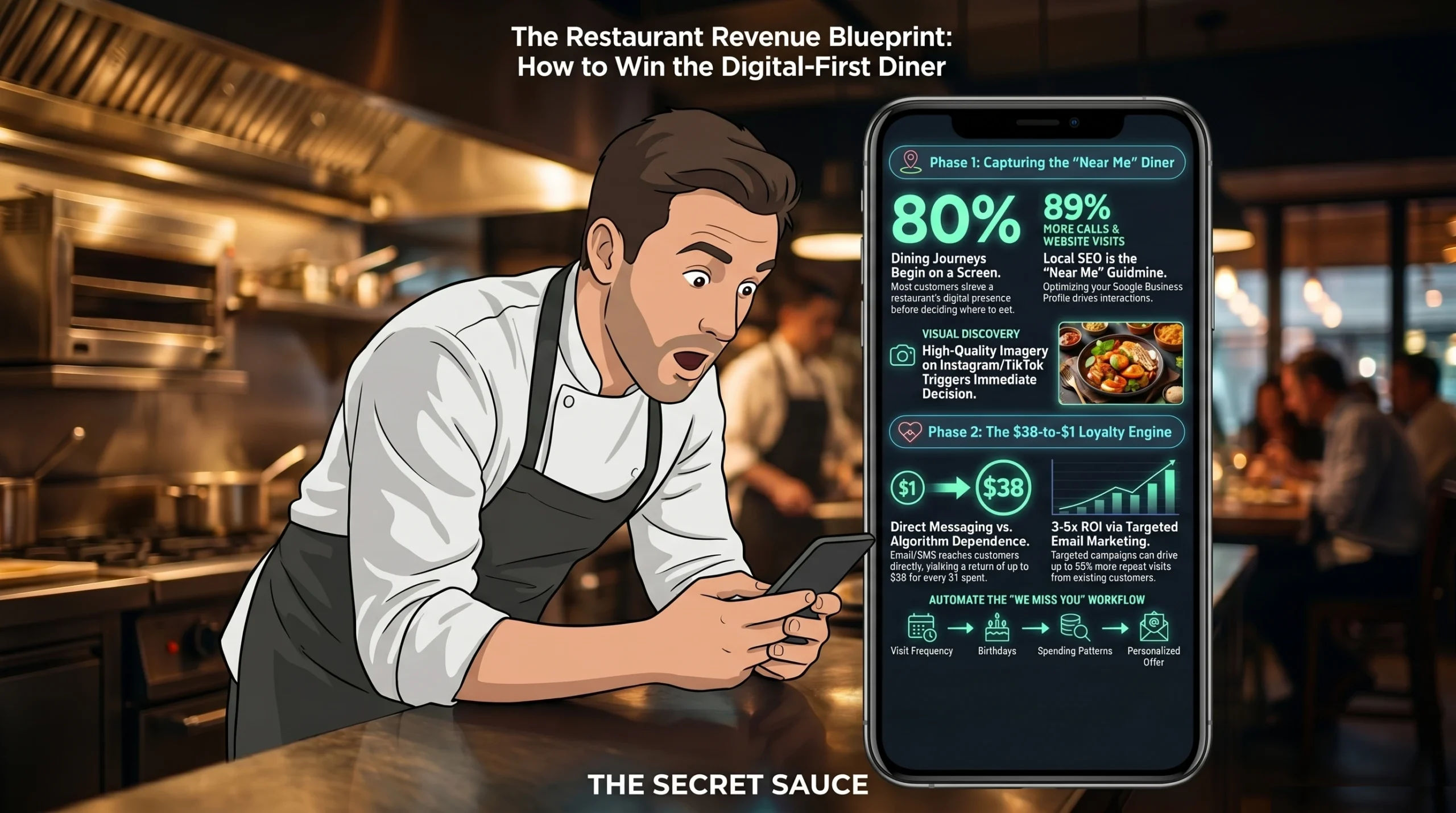
Diner behavior has fundamentally shifted in the last decade. Industry data confirms that 80% of diners check a restaurant’s online presence before deciding where to spend their money.
If you ignore digital platforms, you miss the exact moment high-intent customers search for food. Digital marketing allows you to capture this interest and convert it into a reservation.
In the Indian context, new businesses in cities like Lucknow need an initial push to survive. While legacy spots like Tunde Kabab thrive on word-of-mouth, new eateries must use digital tools to announce their existence.
Why Is Local SEO the Most Critical Step for Your Business?
Local SEO connects high-intent searches with nearby dining options. When a customer searches for “best pizza near me,” Google prioritizes restaurants with optimized Google Business Profiles (GBP).
Research suggests that 51% of people turn to the internet for local recommendations. Mobile phones with location tracking make your GBP the definitive first impression a diner receives of your brand.
Think of your profile as a digital doorstep, much like the one at Via 313. A profile with high-quality photos and accurate details makes a powerful impression before the guest ever visits.
Checklist for Google Business Profile Optimization:
- NAP Consistency: Ensure your Name, Address, and Phone number are identical across all platforms.
- Visual Assets: Upload 10 to 15 high-quality photos of your signature dishes, interior, and exterior.
- Menu Uploads: Keep your digital menu updated with current pricing and seasonal Indian specials.
- Review Response: Actively encourage and respond to every review to boost your ranking.
How Can You Use Social Media to Create Viral Food Moments?
Instagram and Reels function as visual menus for the modern age. They allow you to showcase your restaurant’s personality and attract diners through engaging short-form video content.
AEO Snippet: Social Media Marketing for Restaurants
Social media marketing for restaurants involves creating and sharing visual content on platforms like Instagram to engage diners, showcase menu items, and drive footfall through organic reach and influencer partnerships.
Social-driven content does not always require high production. For example, the Austin-based restaurant El Arroyo gained 700K followers simply by posting photos of their marquee sign featuring daily jokes and fan-submitted thoughts.
Forbes Magazine reported that 71% of individuals would suggest a restaurant that has an active social media presence. Use a mix of behind-the-scenes chef videos, user-generated content (UGC), and influencer collaborations.
In India, social cause marketing gains massive organic traction. Offering free meals for Army personnel creates an emotional connection that people feel compelled to share on their own profiles.
Does Your Website Effectively Convert Browsers into Diners?
Your website is the central hub for all your marketing efforts. A mobile-first design is mandatory because most diners view your site while commuting or making quick group decisions.
The Toast report found that 44% of guests stop trying to book if the reservation process is difficult. Your site must include clear buttons for menus, hours, location, and instant bookings.
| Feature | Static Brochure Sites | High-Performing Marketing Hubs |
|---|---|---|
| Mobile Speed | Slow loading times | Instant load for mobile users |
| Booking | Requires a phone call | Integrated online reservation buttons |
| Menu | Non-searchable PDF files | Interactive, SEO-friendly text menus |
| Data Capture | No way to collect guest info | WiFi signups and email opt-ins |
| Payments | Cash or machine only | Razorpay or PayU integration |
Can Email and SMS Marketing Really Drive Repeat Visits?
Email marketing remains a power tool with an ROI of up to $36 to $38 per $1 spent. You can build your database easily through WiFi signups and online ordering portals.
Tools like HubSpot, Mailchimp, and Constant Contact offer different scales of service for independent cafes or large dining groups. These platforms help you automate your communication based on diner behavior.
In the Indian market, WhatsApp and SMS are essential for direct communication. Use these channels for personalized offers like birthday rewards or “miss you” discounts for customers who have not visited in 30 days.
Indian restaurant owners should train staff to capture data at the table. Asking for a phone number during the order process allows you to send manual WhatsApp updates for new menu launches.
How Should You Manage Online Reviews to Protect Your Reputation?
Reputation management is critical because 85% of individuals trust online reviews as much as personal recommendations. Positive feedback builds trust, while ignored negative reviews can destroy a brand.
Handle negative feedback with total professionalism and transparency. Acknowledge the issue and offer a solution publicly to show you care about the guest experience.
Adopt a proactive approach like the team at Via 313. By responding to every review, you build immense goodwill and signal to search engines that your business is active and reliable.
Is Paid Advertising Worth the Investment for Small Eateries?
Paid advertising offers a shortcut to visibility during slow periods or grand launches. You can choose between Google Ads for search intent and Social Media Ads for visual discovery.
Hyper-local targeting allows you to show ads only to people within a 3-mile radius of your restaurant. HubSpot data shows that targeted campaigns can drive up to 25% more repeat visits.
Steps for a Successful Paid Campaign:
- Goal Setting: Decide if you want reservations, online orders, or general brand awareness.
- Location Targeting: Set a tight geographic radius around your physical restaurant location.
- Creative Testing: Use different high-quality food photos and headlines to see what converts best.
What Are the Benefits of Loyalty Programs and QR Code Menus?
Loyalty programs increase repeat visits by rewarding customers for their frequency. Adopting a loyalty program can increase sales by up to 30%, making it a vital retention tool.
QR code menus provide convenience by giving guests instant access to prices and ordering. They reduce friction during busy service hours and allow you to update items in real time.
Modern POS systems like Square, Toast, and ResDiary integrate these features directly into your operations. This allows you to track spending patterns and tailor your marketing based on actual diner data.
Mastering the Indian Market: Tier 1 vs. Tier 2 Strategies
Marketing strategies in India must adapt to local operational realities. Tier 1 cities follow a digital-first culture where diners rely heavily on apps to choose new spots.
In Tier 2 cities, word-of-mouth remains dominant, but digital awareness is growing rapidly. Data shows that 89% of people research a restaurant online before visiting, regardless of the city’s size.
While platforms like Zomato and Swiggy are essential for reach, you must avoid 100% dependency on them. Use digital marketing to drive direct WhatsApp orders, helping you save on high commission costs.
Comparison of Best Restaurant Marketing Tools
| Tool | Best For | Key Features | Pricing |
|---|---|---|---|
| HubSpot | Tier 1 groups like Lite Bite Foods | Integrated CRM, loyalty automation, revenue tracking | Starts Free; Starter $9/mo |
| Mailchimp | Independent Indian cafes | Food templates, journey mapping, basic automation | Starts Free; Essentials $13/mo |
| Constant Contact | Easy event promotion | Drag-and-drop builder, event marketing tools | Starts at $12/mo |
| Active Campaign | Advanced guest scoring | SMS integration, conditional workflows | Starts at $15/mo |
| Klaviyo | High-volume online ordering | Predictive analytics, revenue attribution | Starts Free; Email $45/mo |
FAQ
What is the best digital marketing tool for restaurants?
HubSpot is a top choice because it combines email, SMS, and CRM in one platform. It allows you to track every interaction from the first reservation to the fiftieth visit. This unified approach helps you understand guest preferences and spending patterns effectively.
How can I increase my restaurant’s visibility on Google Maps?
Optimize your Google Business Profile by ensuring your information is 100% accurate. Upload high-quality photos regularly and respond to every customer review. Consistent engagement and accurate data help you rank higher for “near me” searches in your local neighborhood.
Is social media marketing mandatory for small cafes in India?
Yes, because 80% of diners check social profiles before visiting. For a small cafe, social media serves as your digital storefront and visual menu. It is the most cost-effective way to build a community and keep your brand top-of-mind for local customers.
How much should I spend on restaurant digital marketing?
Costs vary from 0 to 3,600 USD per month depending on your scale and goals. Small eateries can start with free tiers of email tools and a modest social media ad budget. Larger groups invest more in advanced analytics and multi-location reporting to drive growth.
How do I build an email list for my restaurant?
You can capture emails through WiFi signup forms, online ordering platforms, and reservation systems. Offering a small incentive like a birthday discount or a free appetizer for signing up works well. Always provide clear value to encourage guests to stay on your list.
Conclusion
Digital presence is the main course for restaurant growth, not a side dish. By mastering Local SEO, social media, and guest data, you can fill your tables consistently and stay ahead of the competition.
Book a free counselling session with an academic counsellor for our AI-powered Niche Specific Digital Marketing course to master these strategies.
Book a Free Counselling Session