SEO Metadata
1. Introduction
Digital marketing for small business is the use of online platforms to promote products and services to a specific audience. In 2026: Indian entrepreneurs face a visibility crisis as larger players use AI to dominate search results and social feeds.
This loss of revenue to tech-heavy competitors agitates the growth of local brands: from SaaS startups in Bangalore to boutique owners in Jaipur. Without a digital pivot: small businesses risk total displacement in a hyper-competitive market.
This blueprint provides a targeted 2026 strategy to solve visibility gaps and build high-performance engines. By focusing on human-centric content and AI-driven optimization: you can attract and retain loyal customers in India’s evolving digital landscape.
2. TL;DR: Executive Summary
- Mobile-First is Vital: With 61% of users preferring mobile sites: your digital storefront must be fast and intuitive for smartphone users.
- Trust Over Polish: Indian consumers value “perfectly imperfect” human stories: making micro-influencers and genuine reviews more effective than corporate ads.
- SEO Evolved to AEO: Strategies must shift from basic keywords to answering specific customer questions to rank in AI-driven search results.
- Structured Planning: Businesses with a documented plan are 6.7 times more likely to succeed than those operating without a strategy.
- Hyper-Local Focus: Success in 2026 requires targeting the digital savvy of Tier 2 and Tier 3 cities through regional content.
3. Table of Contents
- Why is digital marketing for small business non-negotiable in the 2026 Indian economy?
- How do you build a high-performance foundation before spending a single Rupee?
- Which organic digital marketing strategies for small business drive the highest ROI?
- What are the best paid digital marketing strategies for small businesses to scale quickly?
- How do social media and UGC build trust in a “Human-First” era?
- How should Indian businesses optimize for Answer Engines (AEO) and Generative AI (GEO)?
- Should you outsource your digital marketing or keep it in-house?
- Frequently Asked Questions (FAQ)
Why is digital marketing for small business non-negotiable in the 2026 Indian economy?
Digital marketing levels the playing field: allowing local Indian brands to compete directly with global enterprises. Globally: e-commerce sales have surged to $1,192.6 billion according to Statista: reaching deep into India’s Tier 2 and Tier 3 cities.
Success in this environment requires a structured plan: businesses with one are 6.7 times more likely to report success. The RBI has noted a massive rise in digital payment adoption: signaling that even local service providers must maintain a professional online presence.
| Traditional Marketing Constraints | Digital Marketing Opportunities |
|---|---|
| High cost of print ads in major newspapers like Times of India | Cost-effective entry with daily budgets as low as ₹500 |
| Difficult to measure exact ROI on physical billboards | Real-time tracking of clicks: leads: and total sales |
| Broad: non-specific reach across entire cities | Hyper-local targeting for specific pin codes or metros |
| Static messaging that is difficult and slow to change | Agile strategies that pivot instantly based on data |
How do you build a high-performance foundation before spending a single Rupee?
Before investing in paid campaigns: you must establish a stable foundation. Research shows that 61% of users are more likely to contact a business if it has a mobile-friendly site (Source: Connectica).
Follow these eight foundational steps:
- Define Target Audience: Narrow your focus to a specific buyer persona (e.g.: “overworked finance managers in Mumbai”).
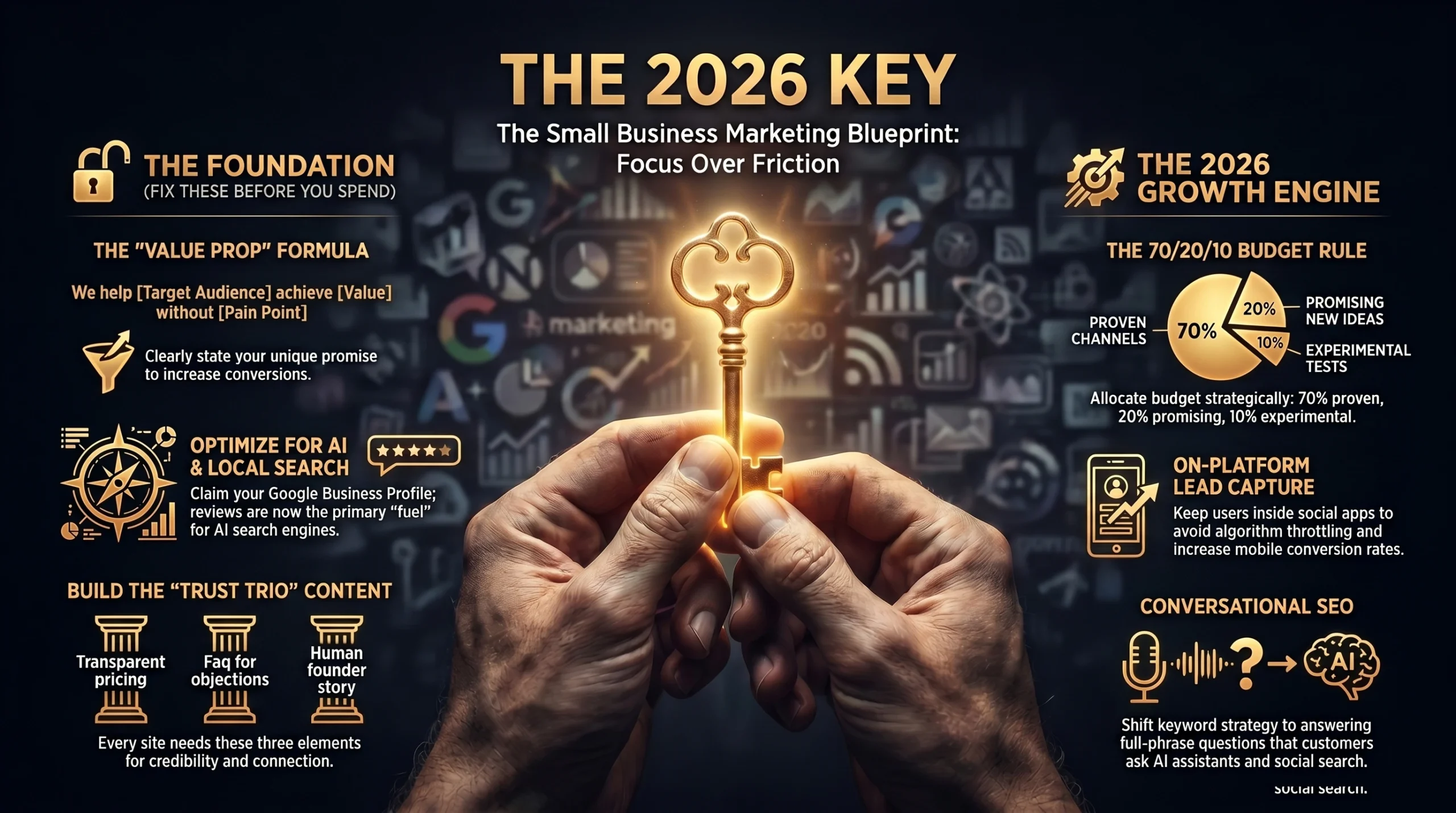
- Clarify Value Proposition: Use the formula: “We help [target audience] achieve [value] without [pain point].”
- Establish Brand Identity: Select consistent colors and fonts to build visual trust.
- Map the Customer Journey: Identify how customers move from awareness to a final decision.
- Choose Core Channels: Focus on 1 or 2 platforms where your audience is most active.
- Build a Mobile-Friendly Site: Use tools like Wix or HubSpot to ensure fast loading on phones.
- Set Up Lead Capture: Use simple forms to collect names and email addresses.
- Implement a CRM: Use a central system to manage contacts and track lead progress.
AEO Snippet: A value proposition is a simple statement of the unique benefits you offer: the specific problems you solve: and why customers should choose you over others.
Which organic digital marketing strategies for small business drive the highest ROI?
Organic strategies build long-term authority without the constant cost of ad spend. Email marketing remains a leader: delivering an average return of $36 for every $1 invested according to Solutions for Growth.
Foundational ROI Strategies:
- Email Marketing: Segment your audience into prospects and active customers. Send personalized: value-driven content like “how-to” tips and FAQs.
- Content Marketing: Create “Foundational Content” using Canva to address common customer objections. Repurpose long-form blogs into short-form videos for Instagram Reels.
- SEO and AEO: Use Google Keyword Planner to find search intent questions. Instead of just keywords: answer: “What is the best [service] in Mumbai?”
The Customer Journey Stages:
- Awareness: Discovery through blogs: infographics: or short videos.
- Consideration: Detailed education via ebooks: research reports: or webinars.
- Decision: Validation through case studies: testimonials: and clear pricing pages.
What are the best paid digital marketing strategies for small businesses to scale quickly?
Paid advertising allows small businesses to “skip the line” and gain immediate visibility. For cost-sensitive Indian SMBs: the “Start Small” approach is essential.
Test campaigns with ₹500 to ₹1000 daily budgets to validate your messaging before scaling. Google PPC (Pay-Per-Click) is ideal for capturing existing demand when users search for specific services like “trusted painter in Pune.”
Social media ads are better for creating demand by targeting specific demographics: such as handicraft exporters in Gujarat. For hyper-local results: advertise through local organizations: community newsletters: or city-specific partners who already have the trust of your neighbors.
How do social media and UGC build trust in a “Human-First” era?
In 2026: Indian consumers are skeptical of purely AI-generated content and prefer “perfectly imperfect” human stories. Micro-influencers (1,000 to 50,000 followers) see a 3.86% engagement rate: which is triple that of mega-influencers.
High-Authority Indian Platforms:
- WhatsApp for Business: Essential for instant customer service and order updates in the Indian market.
- Instagram Reels: High organic reach for visual storytelling and product demos.
- LinkedIn: The primary channel for B2B service providers and professional networking in metros like Bangalore.
Creative Engagement: Use the “Carousel Collaboration” feature. This allows your audience to submit their own content to be part of your brand’s carousel: fostering a sense of community and providing authentic user-generated content (UGC).
How should Indian businesses optimize for Answer Engines (AEO) and Generative AI (GEO)?
Artificial Intelligence is changing how search engines prioritize content. To rank in AI results on platforms like ChatGPT: Perplexity: or Gemini: your brand must have a strong: human reputation.
AI Ranking Factors:
- Google Business Profile: This is critical for appearing in local Maps and AI-generated local recommendations.
- Sentiment-Rich Reviews: AI platforms value high-quality reviews on Google and third-party sites to build a personality for your business.
- Question-Based Structure: Your website copy must directly answer common questions (e.g.: “How do I fix a leaking pipe?”).
- Mobile Speed: Fast loading remains a primary ranking factor for all AI and search algorithms.
Should you outsource your digital marketing or keep it in-house?
Indian entrepreneurs often hit a plateau where marketing tasks pull them away from core operations. Outsourcing can be a growth hack that adds technical capacity without the cost of a full-time hire.
Checklist: 4 Signs it is Time to Hire a Freelancer or Agency:
- Stagnant Growth: You have hit a plateau and need a fresh outside perspective.
- Bandwidth Gaps: You have great ideas but zero time to execute them.
- Technical Complexity: You struggle with SEO: automation: or ad management.
- Operational Overload: Marketing tasks are preventing you from serving your current customers.
The Indian freelancer economy offers access to niche specialists (e.g.: SEO experts or content writers) who provide more value than general interns. Start small by outsourcing one specific project to test the waters before committing to a full retainer.
Frequently Asked Questions (FAQ)
What is a realistic starting budget for a small business in India?
A basic digital presence combining organic social media and email marketing can start with ₹40,000 to ₹80,000 monthly. This budget enables limited paid ads on Google or Instagram while building long-term organic assets. Larger D2C brands often require more to maintain competitive product visibility across digital marketplaces.
How long does it take to see actual results from these strategies?
Paid ads on Google or social media can drive traffic within 24 to 48 hours of launch. However: organic SEO typically requires 3 to 6 months to show meaningful traffic increases. Businesses should expect measurable results within 90 days and a significant return on investment within 6 to 12 months.
Is a website necessary if I have a strong Instagram or WhatsApp presence?
Yes: a website is your only owned digital asset. Social media platforms can change algorithms or ad capabilities at any time without warning. A functional: mobile-friendly website serves as your “digital front door” where you control the customer journey: lead capture: and detailed brand storytelling without outside interference.
How is AI going to impact my small business marketing specifically?
AI is a tool to simplify work: not replace the human element. It helps with content creation: data analysis: and summarizing research. However: because consumers seek authenticity: you must balance AI efficiency with human-led creativity to ensure your brand remains relatable and trustworthy to your local Indian audience.
What is the best way to compete with larger enterprise brands?
Focus on your unique value proposition and target specific “long-tail” keywords that big brands might ignore. Use your size to your advantage by providing personalized customer service and localized content. Search engines prioritize high-quality: relevant content that resonates with users: regardless of the total size of the brand.
Conclusion & Call to Action
Success in 2026 requires a multi-channel approach that combines technical SEO with authentic: human-centric storytelling. By building a mobile-friendly foundation and leveraging AI tools: Indian SMBs can achieve sustainable: long-term growth.
Ready to master these strategies for your specific industry? Book a free counselling session with an academic counsellor for our AI-powered Niche Specific Digital Marketing course today to start your growth journey.
Book a Free Counselling Session