Metadata
Introduction: Navigating the Visibility Crisis in Digital India
Many Indian website owners today are facing a significant visibility crisis. Despite investing heavily in content creation, their pages often remain buried on the second or third page of search results, failing to capture the massive traffic potential from cities like Mumbai, Delhi, and Bangalore. This frustration is compounded by the shifting digital landscape where traditional search is giving way to AI-driven ecosystems.
The challenge has intensified with the arrival of Generative Engine Optimization (GEO) and Answer Engine Optimization (AEO). To thrive in this environment, you must first master the basics. If you are asking what is on page seo, it is the strategic practice of optimizing individual web pages to make them highly relevant, useful, and authoritative for both search engine crawlers and human users. By aligning your content with search intent and technical precision, you build the necessary foundation for high rankings.
In the current Indian market, competition is no longer just local, it is hyper-digital. Users in Tier 2 and Tier 3 cities are increasingly coming online via mobile devices, demanding instant answers from AI summaries. Your on-page strategy for 2026 must be more than just “optimizing,” it must be a technical blueprint for becoming the “Trusted Answer” in an AI-first world.
TL;DR: Key Takeaways
- Content Hierarchy is Non-Negotiable: Organize your page using the “Tree Trunk” model where the H1 serves as the anchor and H2/H3 subheadings guide the flow.
- AEO and Semantic Chunking: Structure content into “chunks” that directly answer user questions to capture AI snippets and LLM citations.
- Regional Relevance: Incorporate Hinglish and regional language nuances (like Tamil or Bengali) to satisfy local Indian search intent.
- Information Gain: Stand out by providing unique data, expert quotes, and localized insights such as pricing in INR or case studies from Pune and Hyderabad.
- Future-Proof URLs: Use short, descriptive, post-name slugs and avoid dates to maintain seasonal relevance during Indian festivals like Diwali.
- Mobile-First Precision: With heavy mobile traffic in India, image compression and fast loading speeds are critical ranking signals for 2026.
Table of Contents
- What is On-Page SEO and Why Does it Matter in the Indian Context?
- How Do You Choose and Place Keywords Without Stuffing?
- How to Structure Your Content for Human Readers and LLMS?
- Why is URL Structure and Metadata the Foundation of CTR?
- How Do Internal and External Links Distribute Authority?
- How to Optimize Images for Search and Accessibility?
- The Ultimate On-Page SEO Checklist for 2026
- FAQ Section
What is On-Page SEO and Why Does it Matter in the Indian Context?
AEO Snippet:
On-Page SEO is the practice of optimizing on-site elements, including content, HTML tags, and internal linking structures, to improve search engine visibility and satisfy user intent.
While off-page SEO focuses on building a website’s popularity through external backlinks, on-page SEO is about establishing immediate relevance. In India, this relevance is inextricably linked to the diverse connectivity landscape. As millions of users in states like Gujarat or Bihar access the web on 4G or 5G mobile networks with varying speeds, on-page factors like page weight and mobile responsiveness become primary ranking drivers. A page that fails to load efficiently on a budget smartphone will suffer from high bounce rates, signaling poor quality to Google.
The strategic weight of on-page execution cannot be overstated. For example, while global giants like Investopedia utilize on-page precision to rank for over 600,000 keywords on a single page, the same principle applies to the Indian BFSI (Banking, Financial Services, and Insurance) sector. A well-optimized page targeting “Best Tax Saving SIPs” or “ELSS Funds” can capture massive organic traffic by simply being the most relevant and technically sound answer available.
Key Stat: According to data from Semrush, high-authority domains that prioritize in-depth on-page optimization often see their pages rank for nearly 1,000 related keywords in the Top 10, demonstrating the compounding value of topical relevance over simple backlink count.
How Do You Choose and Place Keywords Without Stuffing?
Keyword frequency in 2026 is no longer about hitting a specific density percentage, rather, it is about natural topical reinforcement. Modern search engines like Google employ advanced Natural Language Processing (NLP) to detect if a keyword appears naturally within the context of the discussion. For a comprehensive 3,000-word guide, repeating your primary keyword approximately 8 times is generally sufficient to confirm relevance without appearing spammy.
Strategic Placement Checklist
To ensure search robots immediately identify your topic, follow this placement map:
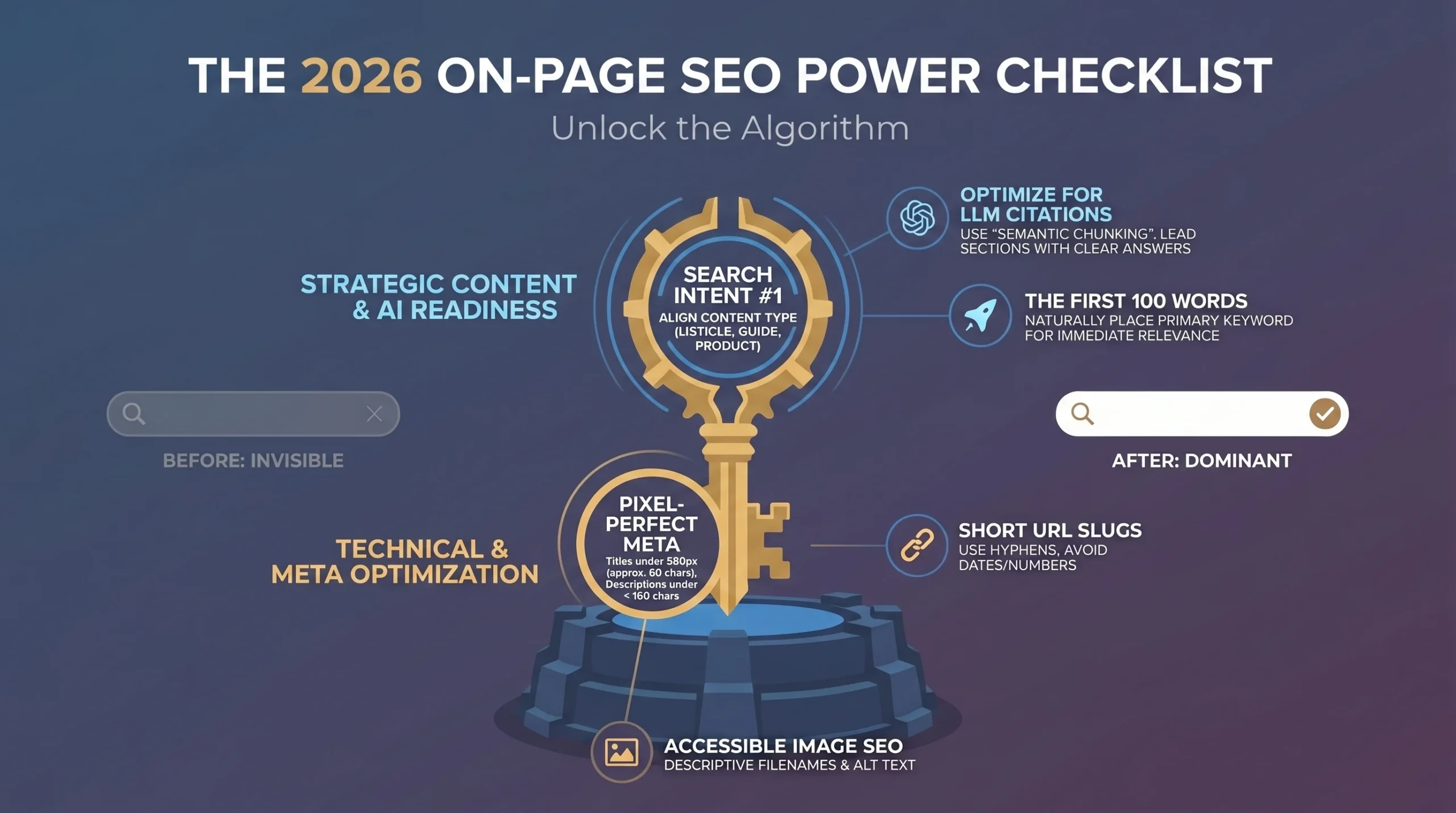
- First 100 Words: Integrate your primary keyword early to set the semantic context.
- H1 Tag: Use the exact keyword, ideally front-loaded, to signal the main theme.
- H2 Headings: Include the primary keyword in at least two main subheadings.
- Final Paragraph: Reiterate the keyword in the conclusion to provide a strong thematic close.
“Information Gain” and Local Nuance
To outrank competitors for terms like “SEO Training in India,” you must offer “Information Gain.” This concept, emphasized by Backlinko, refers to providing unique value not found in existing search results. For the Indian market, this means:
- Cost Sensitivity: Providing clear pricing in INR, which caters to the “value for money” mindset of the Indian consumer.
- Regional Context: Mentioning local training centers in Hyderabad or placement opportunities in Bangalore.
- Language Blending: Using Hinglish or common regional synonyms (like “On-page SEO kaise kare”) to match the conversational search habits of local users.
- Plagiarism and Quality Check: Use tools like Duplichecker and SmallSEOTools to ensure content is 100% unique, as “scraped” or “thin” content is heavily penalized.
Key Stat: Ahrefs research indicates that the average #1 ranking page on Google also ranks in the top 10 for nearly 1,000 other relevant keywords, highlighting the importance of using LSI (Latent Semantic Indexing) keywords to build topical depth without cannibalization.
How to Structure Your Content for Human Readers and LLMS?
The architectural structure of your page is now a dual-purpose tool, it must serve human skimmers and Large Language Models (LLMs). Using the “Tree Trunk” analogy from Rank Math, your content should follow a logical, cascading hierarchy.
The Hierarchy Commands
- The Tree Trunk (H1): The foundation of the page. Use only one H1 to define the primary topic.
- Main Branches (H2): The major pillars of your content that break down the H1 into manageable sections.
- Small Branches (H3): Detailed sub-points that support your H2 sections.
- Strict Rule: Never use an H4 tag without a preceding H3. Skipping levels disrupts the semantic path for crawlers, making it harder for them to index your content’s logic.
Semantic Chunking and AEO Visibility
Winning the “AI Search” battle requires a shift toward “Semantic Chunking.” This involves organizing your content into distinct blocks where the H2 is phrased as a direct question. Following the Backlinko “Seen and Trusted Framework,” the first sentence of that section should be a concise, authoritative answer. LLMs like ChatGPT and Google’s AI Mode do not just crawl, they extract and cite. If your “chunk” is the clearest answer, you are far more likely to be the cited source in an AI Overview.
E-E-A-T and Unique Data
To satisfy Google’s E-E-A-T (Experience, Expertise, Authoritativeness, and Trustworthiness) standards, incorporate expert quotes or original survey data. For instance, citing a digital marketing trend from a Mumbai-based agency adds a layer of “Experience” that AI-generated fluff cannot replicate. Use Content at Scale to audit your writing for robotic patterns, ensuring a human-centric tone remains dominant.
Key Stat: A study by Seer Interactive analyzing thousands of queries found that brands cited in Google AI Overviews earned significantly more organic and paid clicks than those that appeared in the same results but were not cited.
Why is URL Structure and Metadata the Foundation of CTR?
Your metadata acts as your digital storefront. In a market as competitive as India, having a high ranking is useless if your Click-Through Rate (CTR) remains low because your snippet looks unappealing.
URL Optimization: The Future-Proofing Rule
Avoid including dates, numbers, or seasonal years in your URL slug. A URL like `/best-seo-course-2023/` becomes a liability by January 1st of the next year. In India, where the digital market is highly seasonal, dated URLs kill the longevity of pages dedicated to “Diwali Sales” or “Festive Offers.” Use short, descriptive “post-name” slugs like `/seo-course-india/` to ensure your authority accumulates year after year without the need for risky redirects.
Title Tag Mastery and Power Words
Front-loading your primary keyword helps both users and search engines identify relevance within milliseconds. To boost CTR among Indian audiences, use “Power Words” that resonate with local priorities. Phrases like “Updated,” “India’s Best,” or “Comprehensive” suggest value and authority.
CTR Performance Comparison
| Standard Title | Emotional/Optimized Title (2026) | CTR Impact |
|---|---|---|
| On-Page SEO Tips for Beginners | India’s Best On-Page SEO Guide: Proven Tips for 2026 | High |
| How to do SEO in India | Master SEO in India: 10 Actionable Steps for Growth | Medium |
| SEO Course Details | Updated SEO Course in India: Get Certified in 30 Days | High |
Key Stat: Ahrefs research shows that Google rewrites meta descriptions nearly 63% of the time to better match specific user queries, however, a well-optimized original description still serves as a vital signal for maintaining consistent CTR.
How Do Internal and External Links Distribute Authority?
Links are the connective tissue of your website’s authority, acting as the highways that search robots use to discover and prioritize your content.
Internal Linking: The Supporting Content Strategy
Every major “Pillar” post on your site should be supported by internal links to smaller, niche articles. If you have a primary page about “Digital Marketing Services,” it must link to specific articles about “SEO in Pune” or “Social Media in Delhi.” This creates a cluster of topical authority, telling Google that your site possesses deep knowledge rather than just superficial coverage.
Anchor Text Rules
Be cautious with your anchor text. Avoid overusing exact-match keywords for different pages. If you link the term “Digital Marketing” to three separate pages, search engines will struggle to determine which page is the definitive authority. Use descriptive, rankable keywords that tell the user exactly what to expect on the other side of the click.
External Linking for Credibility
Linking to high-authority external domains is a trust signal. For an Indian business, linking to the RBI (Reserve Bank of India) for financial regulations or Statista for market trends proves to Google that your content is grounded in factual evidence. This “association” helps build your own site’s E-E-A-T profile.
Key Stat: Ahrefs data reveals that images alone can generate over 5,000 clicks from 4 million impressions in just three months, but only when those images are properly linked and contextualized within the on-page structure.
How to Optimize Images for Search and Accessibility?
In the mobile-heavy Indian landscape, images are often the biggest bottleneck for page performance. With over 750 million active internet users in India relying on mobile data, unoptimized images can lead to catastrophic bounce rates.
Alt Text and Filename Strategy
Every image should have descriptive Alt Text limited to 125 characters. This text helps screen readers for visually impaired users and provides context to search engines. Use your primary keyword only where it naturally describes the image. For instance, a filename like `on-page-seo-checklist-india.jpg` is far superior to `IMG_9921.jpg` because it provides a semantic clue to the crawler.
Technical Optimization for Speed
- Compression: Use tools like TinyPNG or ShortPixel to reduce file sizes by up to 70% without losing visual quality.
- Responsive Images: Ensure your site serves smaller image sizes to mobile users in Tier 3 cities with slower internet connections.
- ROI of Images: Do not treat images as mere decoration. They are a traffic source.
Key Stat: There are over 8.1 million people with vision impairments who rely on screen readers, making descriptive alt text a legal and ethical necessity that also happens to be a powerful SEO signal.
The Ultimate On-Page SEO Checklist for 2026
| Factor | Requirement | Priority | 2026 Impact |
|---|---|---|---|
| Keyword in H1 | Front-loaded and exact | High | High (GEO/AI) |
| First 100 Words | Include primary keyword naturally | High | Medium |
| Image Alt Text | Descriptive with keyword (once) | Medium | High (Accessibility) |
| Internal Links | 3-5 links to supporting content | High | High (Authority) |
| H-Tag Hierarchy | Logical flow (H1 > H2 > H3) | High | High (AEO/LLM) |
| URL Slug | Descriptive, <75 characters, no dates | Medium | High (Future-Proof) |
| Mobile Speed | Pass Core Web Vitals | High | Critical (India Mobile) |
FAQ Section
How long should an SEO blog post be in 2026?
While quality always beats quantity, high-ranking content in India typically falls between 1,500 and 2,500 words. Deep-dive articles perform better because they satisfy multiple long-tail queries and provide “Information Gain” that brief posts lack, making them more attractive for AI citations and human readers.
Does keyword density still matter for ranking?
Keyword density is an outdated metric. In 2026, Google focuses on keyword frequency and semantic relevance. Instead of stuffing keywords, aim for a natural flow where your target phrase appears in the title, first paragraph, and a few subheadings. Focus on LSI keywords to expand your topical reach.
Is on-page SEO enough to rank on page one in India?
On-page SEO is the foundation, but it is rarely sufficient on its own for high-competition terms. You also need a strong technical SEO base and off-page signals like high-quality backlinks. However, without solid on-page optimization, even the strongest backlink profile will fail to deliver results.
What is the best on-page SEO tool for Indian marketers?
Rank Math is the top recommendation for WordPress users in India due to its automated technical checks and AI features. For deep competitor research and keyword gap analysis, industry-standard tools like Semrush and Ahrefs are essential for any professional digital growth strategist.
Can I change my URL structure without losing rankings?
Changing a URL structure on an established site is risky and not recommended unless the current structure is severely broken. If a change is necessary, you must implement 301 redirects to preserve link equity. For new projects, always use “post-name” slugs to future-proof your digital assets.
Conclusion & Next Steps
On-page SEO in 2026 is a sophisticated balance between technical infrastructure and human-centric value. By mastering the hierarchy of your content, future-proofing your URLs, and optimizing for the specific mobile and regional nuances of the Indian market, you position your brand as a trusted authority for both machines and humans.
If you are ready to transform your digital presence and master these advanced strategies, the time to act is now.
Book a free counselling session with an academic counsellor for our AI-powered Niche Specific Digital Marketing course.
Book a Free Counselling Session