
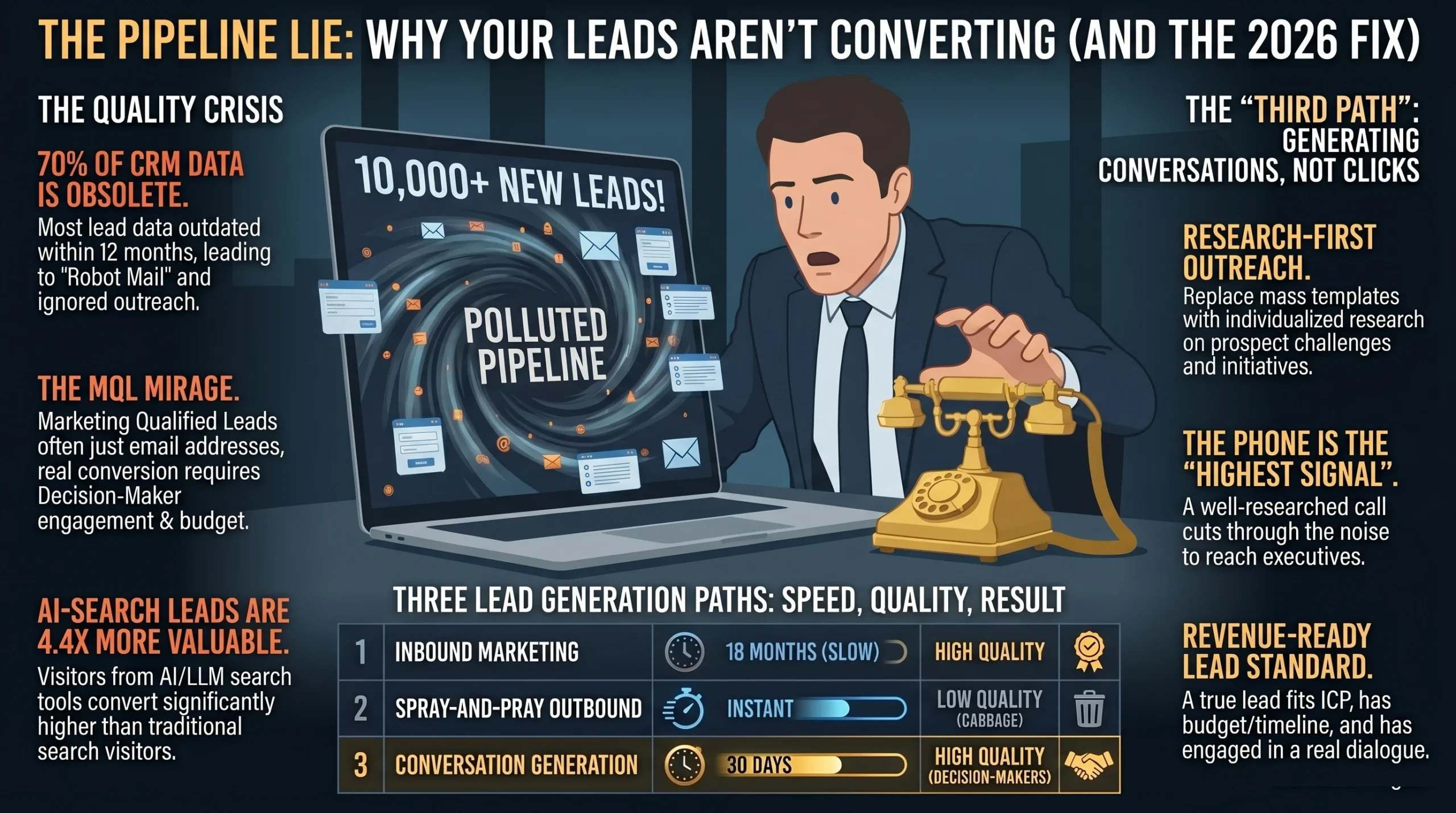
Many Indian businesses struggle with drying sales pipelines because of “spray and pray” email tactics. These generic blasts often fail to reach decision makers, instead trashing your email domain and wasting marketing budgets.
Lead generation is the process of identifying and attracting potential customers for conversion, focusing on those most likely to buy. This guide offers the definitive solution for capturing high-intent prospects in India.
By aligning modern technology with localized strategy, you transform marketing into a consistent, scalable revenue engine. This sophisticated approach ensures you reach the right buyers at the right time.
TL;DR:
- Adobe Framework: Adopt the four pillars of Actionable Profiles, Omnichannel Journeys, Sales Synergy, and Measuring ROI.
- ICP Focus: Define an Ideal Customer Profile (ICP) using firmographic and demographic data to focus only on accounts that close.
- AI Visibility: Shift toward Generative Engine Optimization (GEO) as AI search visitors can be 4.4 times more valuable than traditional search.
- Lead Quality: Prioritize high-intent leads over volume to protect domain reputation and increase overall conversion rates.
- Localization: Balance LinkedIn-heavy strategies in Tier 1 cities with relationship-driven WhatsApp tactics in Tier 2 and 3 hubs.
- Scoring Model: Use a multi-stage qualification model including IQL, MQL, SQL, and PQL for precise sales movement.
Table of Contents
- What is lead generation and how has it evolved in 2026?
- How can you qualify leads using the MQL, SQL, and PQL framework?
- Which content marketing tactics drive the best “generate leads” results?
- How do you build a high-converting lead generation funnel?
- Why is social proof critical for Indian B2B lead generation?
- How can you automate lead generation with tools like Apollo.io and Semrush?
What is lead generation and how has it evolved in 2026?
Lead generation in 2026 is the practice of identifying high-intent buyers through real-time signals and capturing their contact information for sales conversion. It has evolved from simple contact collection to a data-fused bridge between marketing and pipeline.
| Strategy Type | Definition | Core Channels |
|---|---|---|
| Inbound | Attracting prospects searching for solutions. | SEO, Content, Social Media. |
| Outbound | Proactively targeting specific accounts. | Cold Email, LinkedIn, Calls. |
In Indian Tier 1 cities like Bengaluru and Mumbai, businesses have moved from blind cold calling to digital-first intent mapping. Modern strategies now require visibility in Large Language Models (LLMs) to influence the digitally informed buyer.
How can you qualify leads using the MQL, SQL, and PQL framework?
Qualification ensures your sales team focuses on prospects most likely to close. An expert scoring model prioritizes leads based on firmographic fit and behavioral intent signals.
- Information-Qualified Lead (IQL): A prospect researching solutions who shares details for a top-of-funnel resource.
- Marketing Qualified Lead (MQL): A prospect showing high engagement with your content, social posts, or webinars.
- Sales Qualified Lead (SQL): A vetted prospect meeting BANT criteria (Budget, Authority, Need, Timeline).
- Product Qualified Lead (PQL): An individual who has experienced value through a free trial or freemium model.
A SaaS startup in Gurgaon might track trial usage to identify PQLs among Indian SMEs. This allows the team to initiate conversations based on actual product interest rather than generic awareness.
Which content marketing tactics drive the best “generate leads” results?
High-quality content is the foundation of inbound success, but it must be optimized for both search engines and AI agents. Content should share original experiences rather than repeating existing web opinions.
Data from Semrush highlights that visitors from AI search tools are 4.4 times more valuable based on conversion rates. This requires a focus on “brand sentiment” and “LLM perception” within your content strategy.
Use gated assets like eBooks, whitepapers, and webinars to exchange deep value for contact information. For a pattern interrupt, try a “26-minute call” invitation to break the noise of standard meeting requests.
How do you build a high-converting lead generation funnel?
A lead generation funnel maps the journey from awareness to qualification, ensuring a steady stream of candidates. It aligns marketing and sales through shared definitions and service-level agreements.
| Funnel Stage | Primary Goal | Example Assets |
|---|---|---|
| TOFU (Attract) | Build visibility and trust. | SEO Blogs, Social Media, Ads. |
| MOFU (Convert) | Turn awareness into leads. | eBooks, Webinars, Calculators. |
| BOFU (Close) | Enable the final decision. | Demos, Case Studies, Proposals. |
The most effective funnels utilize automated email nurture sequences to maintain momentum. This prevents leads from slipping through the cracks when marketing content begins to gain significant traction.
Why is social proof critical for Indian B2B lead generation?
Social proof builds credibility by demonstrating how other organizations have benefited from your business. Reviews and testimonials on third-party sites also help AI tools like ChatGPT recommend your brand.
Indian buyers are historically cost-sensitive and prioritize domestic reliability. Testimonials from domestic brands, such as a clinic in Pune or a logistics firm in Chennai, significantly increase local trust.
Responding to reviews on platforms like G2 or Google shows prospects that you value professional feedback. This transparency is a non-negotiable floor for 2026 pipeline velocity and brand authority.
How can you automate lead generation with tools like Apollo.io and Semrush?
Automation allows you to generate hundreds of qualified B2B leads in minutes without manual searching. For low-budget startups, manual scraping via Google Maps remains a viable entry-level hack for localized data.
Apollo.io serves as a primary tool for scraping decision-maker filters like Owners or C-suite executives. You can further enrich these leads using Fiverr specialists to find verified mobile numbers for your lists.
Semrush offers an AI Visibility Toolkit to track LLM perception and identify brand mention opportunities. For high-volume outreach, Outreach Engage can orchestrate multi-touch sequences while ZoomInfo MCP provides verified contact data for AI agents.
The Indian Context: Navigating Tier 1 vs. Tier 2 Markets
In Tier 1 hubs like Delhi or Bengaluru, the strategy is LinkedIn-heavy and focuses on high-tech automation. Decision makers in these cities expect sophisticated, data-driven content and digital-first interactions.
In Tier 2 and 3 hubs like Indore or Coimbatore, lead generation relies on relationship-based, offline, or WhatsApp approaches. While digital adoption is growing, these markets still value localized trust and personal networking.
Cost per lead (CPL) varies significantly, with legal services costing around $144 while automotive parts average $27. According to Statista, India’s internet penetration has reached over 50%, making an online-first strategy mandatory for growth.
FAQ Section
1.Is lead generation part of digital marketing?
Lead generation is a core component of digital marketing focused on conversion. It uses channels like social media and SEO to drive traffic to capture forms. This process turns general brand awareness into a list of potential customers for your sales team.
2.What is the difference between a lead and a prospect?
A lead is a person who has shown interest but remains unqualified. A prospect is a lead who matches your ideal customer profile and has been vetted as a good fit. Sales opportunities are leads or prospects very close to a final purchase.
3.How do Facebook lead ads work for Indian small businesses?
Facebook lead ads use “Instant Forms” pre-filled with a user’s contact information to reduce drop-off. Small businesses can target specific local audiences and collect high-intent leads directly within the app. This is highly effective for reducing friction on mobile devices.
4.What is the average cost per lead in India (CPL)?
CPL varies by industry, following global trends where professional services see higher costs than retail. Factors like company size and decision-maker seniority impact the final price. In B2B, targeting specific niches usually results in a more efficient and lower average CPL.
5.Can AI automate my entire lead generation process?
AI can handle research, draft outreach, and prioritize leads, but humans are required for strategy. Automation is most effective when grounded in verified contact data. Tools like ZoomInfo MCP allow AI agents to query live data for accurate, personalized engagement.
Conclusion
Lead generation is a continuous cycle of planning, execution, and optimization. By shifting from disconnected tactics to a data-driven revenue strategy, you can attract the right buyers and prove marketing’s impact on your bottom line.
Ready to master the art of data-driven growth?
Book a free counselling session with an academic counsellor for our AI-powered Niche Specific Digital Marketing course. Gain the tools to dominate search results and fill your pipeline with high-intent prospects.
Book a Free Counselling Session