
Most developers in Bengaluru or Pune face a recurring wall: the AI begins to hallucinate or “forget” specific logic from the start of a long research session. This frustration peaks during multi-file code reviews when the model loses the thread of your architectural constraints. This “context rot” occurs because the input exceeds the model’s physical processing boundary. To build reliable enterprise tools, you must optimize the context window. A context window is the AI’s working memory capacity measured in tokens, representing the maximum amount of information a model can process and reference at one time. In 2026, managing this memory effectively is the difference between a high-performing agent and a disjointed, expensive chatbot.
TL;DR
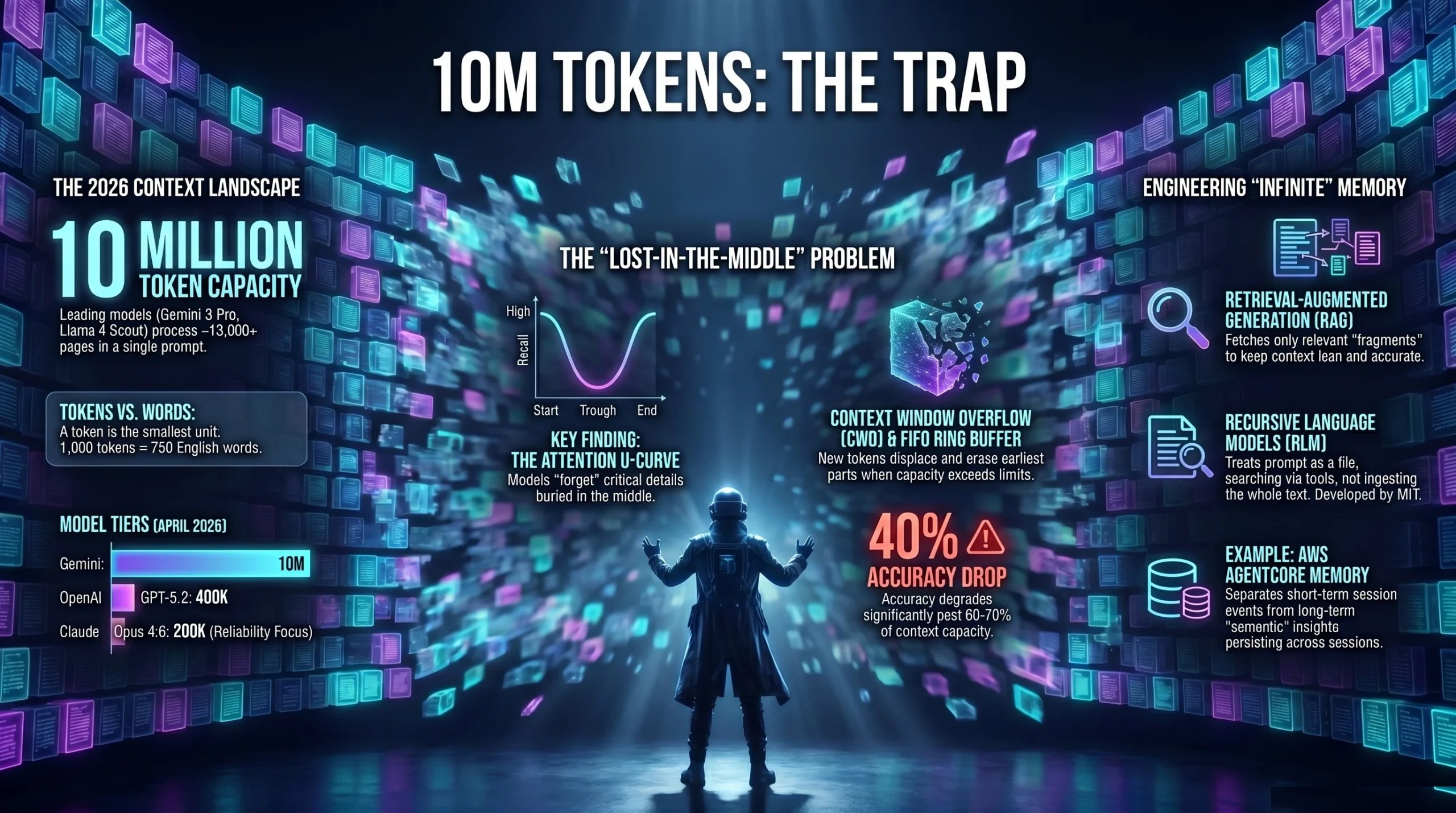
- 10M Token Giants: Gemini 3 Pro and Llama 4 Scout lead the 2026 landscape with 10 million token capacities, allowing for analysis of entire corporate knowledge bases in one go.
- Associative Reasoning vs. Matching: The 2026 NOLIMA benchmark has replaced NIAH (Needle-in-a-Haystack) as the gold standard, testing if models can connect complex ideas rather than just finding literal text matches.
- The Pricing Penalty: Expanding context is not free: Anthropic’s Claude Sonnet 4, for instance, charges 2x for input tokens on any prompt exceeding the 200,000-token threshold.
- AgentCore Memory: Amazon Bedrock now offers AgentCore Memory, which separates short-term session events from long-term “intelligent” memory that can persist for up to 365 days.
- Infinite Context Hacking: Recursive Language Models (RLM) using the MIT “Ripple” environment allow models to interact symbolically with 10M+ tokens for 3x less cost than standard ingestion.
- The India Factor: Local firms prioritize “cost per correct outcome” (INR) over raw token size, balancing high infrastructure expenses with precision for price-sensitive Tier-2 markets.
TABLE OF CONTENTS
- What is a Context Window and how does it affect AI accuracy?
- Which AI models lead the market in 2026 context capacity?
- Why does your AI struggle with the “Lost-in-the-Middle” problem?
- How can Indian developers “hack” context limits efficiently?
- Is a bigger context window always worth the higher cost?
What is a Context Window and how does it affect AI accuracy?
The technical foundation of any context window is the Attention Mechanism within the Transformer architecture. This mechanism allows a model to calculate the relationships and dependencies between different parts of an input, such as words at the beginning and the end of a 200-page document. Because the AI must compute vectors of weights for every token relative to every other token, the compute requirements scale quadratically ($O(n^2)$). This means that if you double the number of input tokens, the model requires four times the processing power.
Accuracy is directly tied to this memory. When a model can reference a complete source rather than a fragmented summary, it remains grounded. Per 2024 research, extending windows from 4,000 to 100,000 tokens reduced hallucinations by 40 percent in complex document analysis. However, tokens are not words. In English, one token is roughly 0.75 words, but for Indian languages like Hindi, Tamil, or Telugu, the ratio changes. A single character or a sub-word addition (like the “a” in “amoral”) can significantly shift the token count, effectively shrinking the usable memory for Indic-language applications.
In 2026, we view the context window as a “whiteboard.” Everything on the board is visible for the model to reason about. Once the board is full, the model must erase earlier notes to make room for new ones, leading to “Session-Only” memory that clears once the conversation ends. Understanding this boundary is vital for Indian SaaS firms building long-horizon tools for legal or clinical reviews.
Which AI models lead the market in 2026 context capacity?
The 2026 model landscape is split between massive “infinite context” models and high-precision reasoning models. While Google and Meta lead in raw token volume, OpenAI and Anthropic focus on reliable reasoning within optimized windows.
| Model | Context Window (Tokens) | Developer | Primary Use Case |
|---|---|---|---|
| Gemini 3 Pro | 10,000,000 | Corporate Knowledge Bases, Global Video Analysis | |
| Llama 4 Scout | 10,000,000 | Meta | Open-source deployment, Local Data Sovereignty |
| Gemini 2.5 Pro | 1,000,000 | Multi-document synthesis, Academic Research | |
| Claude Sonnet 4 | 1,000,000 | Anthropic | Full Codebase Analysis, High-Precision Reasoning |
| GPT-5.2 | 400,000 | OpenAI | Premium Reliable Agents, Ecosystem Integration |
| Claude Opus 4.6 | 200,000 | Anthropic | Medical Ethics, High-Stakes Legal Review |
Tier-1 developers in Bengaluru often leverage Gemini 3 Pro for analyzing years of documentation in a single session. Conversely, price-sensitive startups in Tier-2 cities frequently select Llama 4 Scout for on-premise hosting. This allows them to maintain data sovereignty while accessing the 10M token limit without the high cloud costs associated with proprietary API calls.
Why does your AI struggle with the “Lost-in-the-Middle” problem?
Having a large window does not guarantee the model “sees” everything equally. Research by Liu et al. (2023) confirmed the “Lost-in-the-Middle” phenomenon: models are highly proficient at recalling information from the very beginning and the very end of a prompt, but accuracy plummets for data buried in the center. This creates “Context Rot,” where the model’s focus dilutes as the input grows.
Furthermore, the 2026 NOLIMA (No Literal Matches) benchmark has exposed the limitations of standard NIAH (Needle-in-a-Haystack) tests. While NIAH rewarded models for finding “literal” text matches, NOLIMA tests associative reasoning. For example, if a model is asked “Which character visited Dresden?” and the text only mentions “Yuki lives next to the Semper Opera House,” the model must associate the Opera House with the city of Dresden. Most LLMs struggle with this as context length increases, often reverting to superficial matching.
This effect is exacerbated by the FIFO (First In, First Out) ring buffer mechanism. When the buffer fills, the newest tokens displace the oldest ones. If your primary system instructions are at the very beginning of the prompt, they are the first to be “erased” once the 10M token limit is reached, causing the agent to lose its persona or safety guardrails mid-task.
How can Indian developers “hack” context limits efficiently?
To bypass physical constraints, the industry has moved from simple Retrieval-Augmented Generation (RAG) to Recursive Language Models (RLM). While RAG fetches relevant snippets from a vector database, RLMs use the “Ripple” environment developed by MIT. In this setup, the long prompt is not fed into the model’s neural network weights. Instead, it is saved as a plain-text file in a Python environment. The LLM is then given symbolic tools (like Regex or search functions) to interact with the file.
This strategy is often 3x cheaper than standard summarization for 10M+ token ingestion. Because the model only views selected slices of the context recursively, it avoids the “quadratic cost” spike. Additionally, Amazon Bedrock’s AgentCore Memory has introduced a hierarchy for persistent context:
- Short-term Working Memory: Captures immediate conversation events, organized by actor and session.
- Long-term Intelligent Memory: Uses asynchronous extraction to store user preferences and persistent insights in hierarchical “Namespaces” (e.g., /fintech-agent/user-456/risk-profile/).
By using Namespaces, developers can isolate memory for different users or projects, ensuring that a Mumbai-based fintech bot remembers a customer’s risk appetite from six months ago without needing to reload the entire history into every new query.
Is a bigger context window always worth the higher cost?
For Indian enterprises, the trade-off between latency, compute power, and accuracy is a critical P&L decision. Large-context queries are inherently slower: a 1-million-token query can take several minutes to process compared to seconds for a 128k prompt. There is also a significant pricing penalty to consider. On models like Claude Sonnet 4, prompts exceeding 200,000 tokens incur a 2x price jump for input and a 1.5x jump for output.
Consider a clinical setting in Delhi comparing cost-per-correct-outcome. While a 10M token model might save 60 percent of staff time during a historical case review, the infrastructure costs can be 5x higher than a traditional RAG setup. Indian “Forward Deployed” AI engineers now use “Fast and Slow” decision lanes: they use 128k windows for standard customer support and reserve 1M+ windows for high-stakes audits.
Case studies like TrendMicro’s “Trend’s Companion” show that using a Knowledge Graph via Amazon Neptune can provide structured precision that even a 10M token window cannot match. By grounding the LLM in “entity triples” (e.g., [RBI, regulates, Fintech]), firms achieve higher accuracy with smaller, cheaper context windows. In the Indian market, where every paisa counts, orchestration and “Practical AI” are winning over raw, “Magical AI” demos.
What is a token in AI?
A token is the smallest unit of text an AI processes, roughly equal to 0.75 English words. Tokens are generated using tokenizers in tools like Amazon Bedrock, LangChain, or Anthropic Metaprompt to map semantic relationships between characters or sub-words.
Context Window vs. Tokens
The context window is the total capacity of an AI’s working memory, while tokens are the units measuring that capacity. In 2026, efficient context engineering uses tools like Amazon Bedrock Prompt Management, Ragas, and DeepEval to maximize token utility and reduce “lost-in-the-middle” effects.
INDIAN CONTEXT & LOCAL BENCHMARKS
The “India Factor” in AI is defined by extreme cost sensitivity and the rise of the “Forward Deployed” engineer. Indian SaaS companies are moving away from USD-based token pricing to ROI models based on INR cost-per-correct-outcome. For a developer in a Tier-2 city like Indore, the cost of a single 10M token query ($200+) could equal the weekly salary of a junior engineer.
Local benchmarks show that while Gemini’s 10M window is impressive, Indian firms often find the “sweet spot” in RAG systems using 128k-token windows. This approach avoids the 2x pricing penalty and high latency of million-token prompts. Furthermore, the push for data sovereignty is making Llama 4 Scout a dominant force for Indian banks and government agencies that require massive context without sending sensitive data to foreign cloud servers.
FAQ SECTION
What happens when I exceed the token limit?
The AI model will either return a truncation error or silently drop the earliest parts of your conversation to fit new tokens. This leads to “Context Rot,” where the model forgets initial instructions or safety guardrails. Advanced developers use summarization chains or AgentCore Memory to preserve essential context across sessions.
How do I calculate token count for my text?
The standard rule of thumb is that 1,000 tokens equal approximately 750 English words. However, tokenization varies by model architecture and language. For Indian languages like Hindi, word-to-token ratios are often higher. You should use specific tokenizer tools from Anthropic or OpenAI for precise budget planning.
Should I use RAG or a large context window model?
RAG is superior for massive, dynamic document libraries where you only need specific fragments. Large context windows are better for holistic tasks, such as reviewing an entire codebase or synthesizing a 100-page legal audit where all details are interconnected. Many 2026 systems combine both for optimal performance.
Does GPT-5.2 have a bigger window than Gemini 3 Pro?
No, Gemini 3 Pro leads the market with a 10 million token window. GPT-5.2 focuses on high-reliability reasoning within a 400,000 token limit. For Indian enterprises, this means choosing between Gemini for massive ingestion and GPT for complex, mid-sized tasks requiring extreme precision.
Why is my 1M token query taking so long to respond?
Processing requirements for LLMs scale quadratically with input length. A 1-million-token prompt requires significantly more compute power than a shorter query, leading to higher latency. To optimize this, consider using “provisioned throughput” or recursive strategies like MIT’s Ripple to handle large data more efficiently.
CONCLUSION
The year 2026 represents the shift from experimental AI to practical, orchestrated systems that prioritize “cost per correct outcome” over raw token counts. Success in the Indian landscape requires a deep mastery of context engineering, recursive searching, and intelligent memory management.
Ready to lead the AI revolution in your niche? Book a free counselling session with an academic counsellor for our AI-powered Niche Specific Digital Marketing course to master context engineering and advanced SEO strategies.
Book a Free Counselling Session