
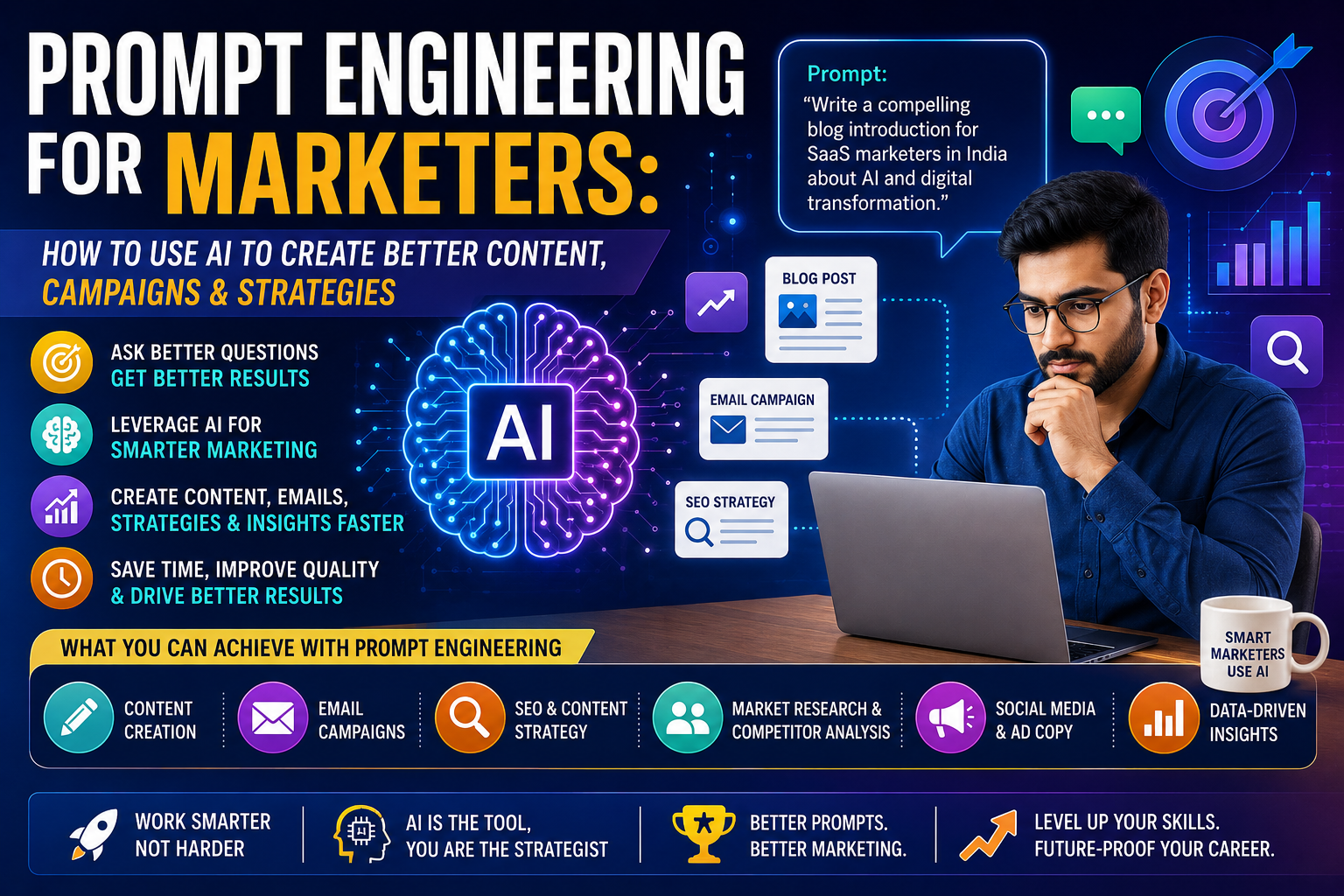
The marketing landscape is experiencing a seismic shift. Artificial intelligence, particularly generative AI models like ChatGPT, Claude, and Google Gemini, has fundamentally transformed how marketing professionals approach their work. Yet, many marketers still view prompt engineering as a highly technical skill reserved for data scientists and software developers.
This couldn’t be further from the truth.
Prompt engineering is simply the art and science of asking AI systems the right questions in the right way to get the most valuable, actionable responses. It’s not about coding—it’s about communication. And if there’s one thing marketers excel at, it’s communication.
TL;DR
Prompt engineering is the ability to communicate effectively with AI systems to generate marketing-ready content, insights, and strategies. It involves crafting clear, specific, and structured requests to get better outputs. Key techniques include:
- Being specific and detailed in your requests
- Providing context and examples for better results
- Using structured frameworks like role-playing and step-by-step instructions
- Iterating and refining your prompts based on outputs
- Leveraging AI for content creation, market research, email campaigns, and SEO strategy
Table of Contents
- What Is Prompt Engineering, and Why Should Marketers Care?
- How Can Marketers Use Prompt Engineering for Content Creation?
- Why Is Asking Better Questions More Important Than Having Better Tools?
- How Can You Leverage Prompt Engineering for Email Marketing Campaigns?
- What Role Does Prompt Engineering Play in SEO and Content Strategy?
- How Can Prompt Engineering Improve Your Market Research and Competitive Analysis?
- FAQ
- Conclusion
What Is Prompt Engineering, and Why Should Marketers Care?
Prompt engineering is fundamentally about optimization through communication. When you send a request (prompt) to an AI model, the quality of your response depends entirely on how well you’ve articulated your needs.
Think of it like this: if you ask a junior team member “Write about our product,” you’ll get something vague and generic. But if you say, “Write a 200-word product description for our website homepage targeting small business owners in India who want affordable software solutions, emphasizing ease of use and cost-effectiveness,” you’ll get something far more useful.
That’s prompt engineering.
In the marketing context, mastering this skill means:
- Faster content production without hiring additional writers
- Consistent brand voice across all marketing channels
- Data-driven insights extracted from AI analysis
- Personalized customer experiences at scale
- Reduced burnout through automation of repetitive tasks
According to recent industry surveys, marketers who effectively use prompt engineering report a 40% increase in campaign output and a 30% improvement in content quality—all while investing less time in routine tasks.
How Can Marketers Use Prompt Engineering for Content Creation?
Content creation is arguably the most immediate application of prompt engineering for marketing professionals. Whether you’re building blog posts, social media content, email sequences, or landing pages, AI-assisted content creation with proper prompting can dramatically accelerate your workflow.
Effective content creation prompts follow a structure:
- Define the role or context: “Act as an experienced content marketer specializing in B2B SaaS…”
- Specify the task: “Write a 500-word blog post outline about…”
- Provide target audience details: “For readers who are marketing managers at mid-sized companies in India seeking automation solutions…”
- Set tone and style: “Write in a conversational, professional tone with actionable insights…”
- Include constraints: “Keep sentences to 15 words or less. Use simple language. Include 3 case studies.”
When marketers in major Indian cities—from Bangalore’s tech hubs to Mumbai’s financial districts—apply these structured approaches, they can generate multiple content variations, test messaging, and refine their marketing message within hours instead of weeks.
The key is that prompt engineering transforms AI from a content generator into a content strategist partner. You’re not just asking for words; you’re guiding the AI toward marketing excellence.
Why Is Asking Better Questions More Important Than Having Better Tools?
This is perhaps the most crucial insight for modern marketers.
The tools matter less than the skill of using them. OpenAI’s ChatGPT, Google Gemini, Anthropic’s Claude, and other large language models are becoming increasingly commoditized. Any marketer can access them. What differentiates high-performing marketers is their ability to extract maximum value through superior prompting.
A poorly phrased prompt sent to an advanced AI will still produce mediocre results. A well-engineered prompt sent to any modern AI will produce exceptional results.
This democratization is revolutionary for Indian marketing professionals who may not have access to expensive agencies or specialized consultants. A marketer in a tier-2 Indian city with strong prompt engineering skills can match the output quality of someone in a premium Mumbai agency—often exceeding it through local market understanding and cultural context.
Critical prompt engineering principles include:
- Specificity beats generality (10/10 times)
- Examples trump explanations (showing beats telling)
- Constraints improve focus (limitations breed creativity)
- Iteration beats perfection (v1 is rarely your best version)
- Context compounds quality (more relevant information = better outputs)
How Can You Leverage Prompt Engineering for Email Marketing Campaigns?
Email remains the highest ROI channel for most marketing professionals—and prompt engineering can significantly enhance email strategy.
Email-specific applications:
A/B Testing Subject Lines: Use prompt engineering to generate 10 variations of subject lines for different segments. Ask the AI to create versions optimized for open rates, including questions, personalization, and urgency variations.
Segment-Specific Content: Write different email body copy for different customer segments (based on behavior, geography, industry). A prompt engineering approach: “Write 3 versions of an email body for segment 1 (Indian SaaS companies with 50-200 employees), segment 2 (established manufacturing firms), and segment 3 (startups). Each should address their specific pain points regarding cost, implementation time, and ROI timeline.”
Personalization at Scale: Generate personalization tokens and dynamic content blocks that can be inserted into email sequences. This requires prompts that understand your data structure and can generate relevant variations.
Re-engagement Campaigns: Create compelling copy for win-back campaigns. Prompt engineering helps you test multiple psychological triggers (curiosity, FOMO, exclusivity) to see what resonates with dormant subscribers.
Compliance and Legal Copy: Generate email disclaimers, unsubscribe language, and compliance statements while maintaining brand voice—particularly important for marketers navigating Indian regulations like TRAI guidelines for commercial communications.
The difference between a generic email and a high-converting email often comes down to how well the marketer has engineered the prompts used to create it.
What Role Does Prompt Engineering Play in SEO and Content Strategy?
Search engine optimization is becoming increasingly dependent on AI-assisted content strategy and prompt engineering.
SEO applications include:
Keyword Research and Strategy: Prompt the AI to analyze your target keywords, suggest content gaps, and recommend topic clusters. Example: “I’m targeting keywords around ‘cloud accounting software India.’ Based on search intent, create a content pillar strategy with 1 cornerstone article and 5 cluster pieces, each optimized for specific long-tail keywords.”
Content Briefs and Outlines: Generate comprehensive, SEO-optimized article outlines before writing. This ensures content covers necessary subtopics for comprehensive rankings.
Internal Linking Strategy: Ask AI to map internal linking opportunities across your content. This improves site architecture and distributes page authority strategically.
Meta Tag Optimization: Generate title tags, meta descriptions, and H1/H2 structures optimized for both users and search engines. Tools work better when you provide existing content, target keywords, and examples of competitor titles.
Content Calendar Planning: Create themed content calendars aligned with seasonal trends, product launches, and industry events relevant to Indian markets.
The integration of prompt engineering into SEO has become non-negotiable for competitive markets in India, where content quality directly impacts search visibility.
How Can Prompt Engineering Improve Your Market Research and Competitive Analysis?
Market research traditionally requires hours of manual work. Prompt engineering can accelerate this dramatically.
Research applications:
Competitor Analysis: Prompt the AI to analyze competitor websites, messaging, and content strategies. Ask it to identify gaps and opportunities. Example: “Analyze these 3 competitor websites [paste URLs or descriptions]. What are their unique value propositions? Where do they overlap? What market segments are they targeting? What gaps exist?”
Customer Insight Generation: Provide customer feedback, reviews, or survey responses. Ask AI to identify patterns, sentiment, and actionable insights. This is particularly valuable for understanding regional preferences across India’s diverse markets.
Market Trend Analysis: Ask the AI to summarize trends in your industry, including regional variations. This helps marketers understand what’s resonating in different Indian cities and demographics.
Persona Development: Generate detailed buyer personas based on customer data, industry reports, or research you provide. This grounds marketing strategy in actual customer understanding.
Campaign Concept Development: Brainstorm marketing campaign concepts, messaging angles, and creative directions. Prompt engineering helps ensure brainstorming is strategic rather than random.
When marketers approach market research through prompt engineering, they can reduce research cycles from weeks to days while generating richer insights.
What Are Common Mistakes Marketers Make With Prompt Engineering?
Understanding what NOT to do is as important as knowing what TO do.
Common mistakes include:
- Vague Prompts: “Write marketing copy” is too vague. Always specify audience, tone, purpose, and constraints.
- Assuming AI Knows Your Business: Never assume. Always provide context about your products, target market, brand voice, and unique positioning.
- Copy-Pasting AI Output Directly: AI-generated content is a starting point, not a finished product. Always review, fact-check, and personalize.
- Ignoring Brand Voice: Without explicit instruction on tone and style, AI defaults to generic corporate speak. Always include brand voice examples.
- Not Iterating: Settling for the first output leaves significant value on the table. Refine, revise, and improve through iteration.
- Asking for Too Much in One Prompt: Complex requests often produce mediocre results. Break them into logical steps.
- Neglecting Fact-Checking: AI can hallucinate data. Always verify statistics, quotes, and case studies independently.
- Forgetting Regional Context: Indian marketing has specific considerations (languages, cultural nuances, regulatory requirements). Always include this context in prompts.
FAQ
1.Do I need to know coding to understand prompt engineering?
No. Prompt engineering is about communication, not code. If you can write clear emails and briefs, you can learn prompt engineering.
2.Which AI tools should I use for marketing prompts?
Popular options include ChatGPT (OpenAI), Google Gemini, and Claude (Anthropic). Most have free and paid tiers. Start with whichever feels most intuitive, then expand once comfortable.
3.How long does it take to become proficient at prompt engineering?
Basic competency takes 1-2 weeks of daily practice. Advanced proficiency takes 2-3 months. The learning curve is relatively shallow, which is one reason marketers adopt it so quickly.
4.How do I ensure AI-generated content is original and doesn’t violate copyright?
AI trained on publicly available content produces original outputs (not copies), but can sometimes reference similar ideas from training data. Always review outputs, add original insights, and fact-check. For important content, use plagiarism checkers.
5.What’s the difference between prompt engineering and using AI tools normally?
Normal usage = asking casual questions and accepting first responses. Prompt engineering = strategic, structured requests that specify exactly what you want, iterating until you get excellence. The difference is discipline and intentionality.
Conclusion
The marketing professionals who will thrive in 2026 and beyond are those who view AI not as a threat, but as a force multiplier. In India’s competitive digital landscape, where talent is abundant but execution speed separates winners from laggards, mastering prompt engineering provides a genuine competitive advantage.
Ready to transform your marketing capabilities?
Techiegigs offers an AI-powered, niche-specific digital marketing course designed specifically for marketing professionals who want to master prompt engineering and advanced AI applications in a structured, practical environment.
Book a Free Counselling Session