
Content creators, marketers, and business owners face a universal challenge: maintaining a consistent publishing schedule without sacrificing quality, sanity, or sleep. The dream of publishing valuable content regularly often becomes a nightmare of missed deadlines, rushed posts, and creative exhaustion. But here’s the truth—burnout isn’t inevitable. It’s often the result of poor planning rather than too much work.
A well-designed content calendar is the foundation of sustainable content creation. It’s not just about organizing dates and topics; it’s about creating a system that works with your natural rhythm, respects your bandwidth, and actually gets used consistently. When you build a content calendar thoughtfully, you transform content creation from a chaotic scramble into a manageable workflow.
This comprehensive guide will walk you through building a content calendar that sustains your business growth without draining your mental and creative resources. We’ll explore strategic planning, practical tools, team coordination, and the mindset shifts necessary to maintain momentum over months and years. Whether you’re a solopreneur managing your own blog or a marketing manager coordinating multiple team members, the principles in this guide will help you create a system that actually works.
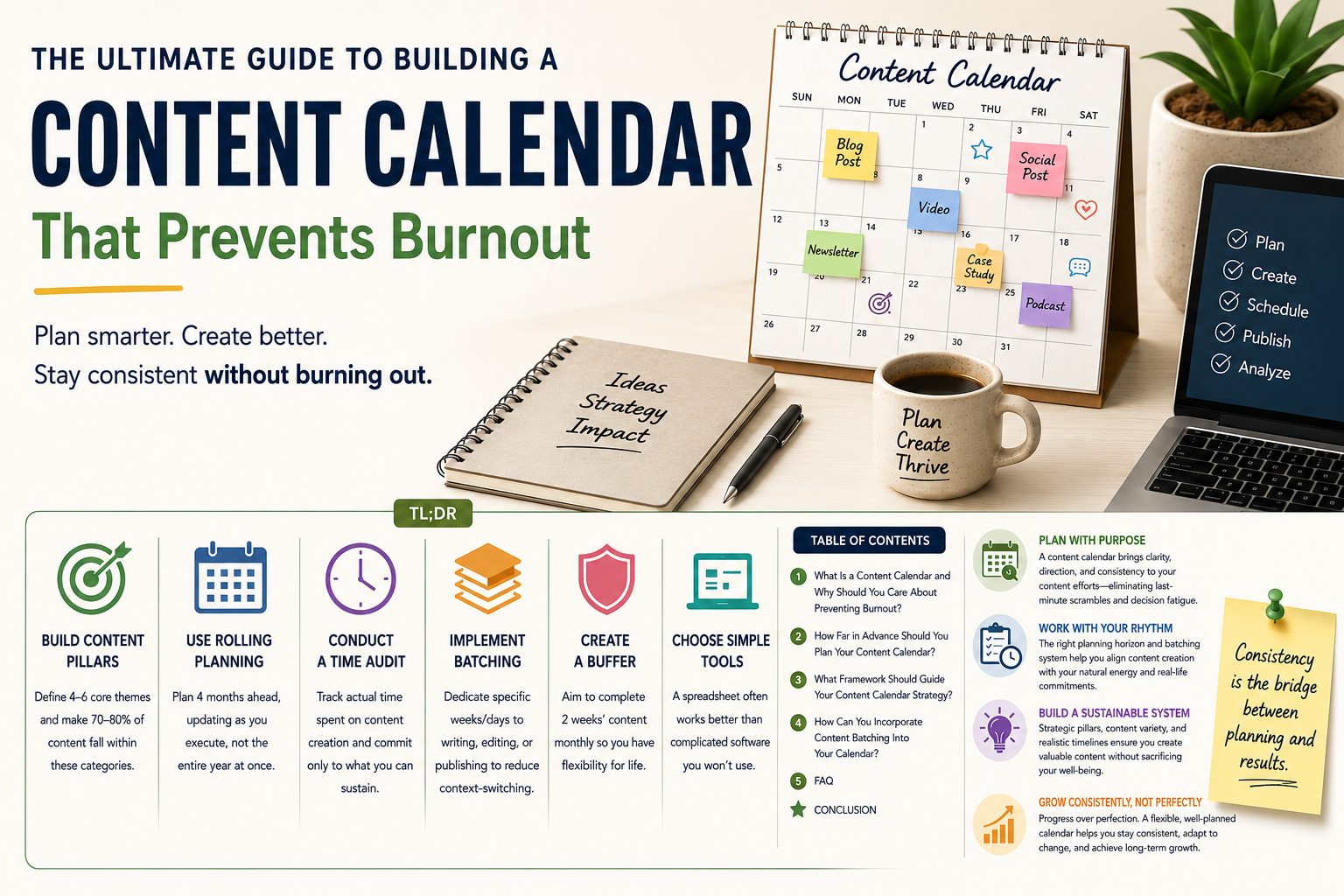
TL:DR
- Build content pillars: Define 4-6 core themes and make 70-80% of content fall within these categories
- Use rolling planning: Plan 4 months ahead, updating as you execute, not the entire year at once
- Conduct a time audit: Track actual time spent on content creation and commit only to what you can sustain
- Implement batching: Dedicate specific weeks/days to writing, editing, or publishing to reduce context-switching
- Create a buffer: Aim to complete 2 weeks’ content monthly so you have flexibility for life
- Choose simple tools: A spreadsheet often works better than complicated software you won’t use
Table of Contents
- What Is a Content Calendar and Why Should You Care About Preventing Burnout?
- How Far in Advance Should You Plan Your Content Calendar?
- What Framework Should Guide Your Content Calendar Strategy?
- How Can You Incorporate Content Batching Into Your Calendar?
- FAQ
- CONCLUSION
What Is a Content Calendar and Why Should You Care About Preventing Burnout?
A content calendar is essentially a strategic planning tool that maps out your content topics, formats, publishing dates, and distribution channels across a specific time period. It goes beyond a simple spreadsheet of dates—it’s a comprehensive system that includes theme planning, resource allocation, team responsibilities, and performance tracking.
The burnout prevention aspect is equally critical. Many content creators approach calendars as a way to create more content faster. They pack their calendars with ambitious publishing schedules, forgetting that quality content requires deep thinking, editing, and refinement. A well-constructed calendar does the opposite: it protects your time and energy by preventing decision fatigue, reducing last-minute scrambles, and helping you work smarter rather than harder.
When you have a clear plan, you eliminate the daily decision-making about what to write next. You reduce context-switching, which is one of the biggest productivity killers. You also create space for inspiration and deep work, rather than constantly reacting to immediate demands. This isn’t about creating less content—it’s about creating better content with fewer resources.
How Far in Advance Should You Plan Your Content Calendar?
The planning horizon for your content calendar depends on several factors: your content type, production timeline, team size, and industry. There’s no one-size-fits-all answer, and choosing the wrong timeline is a common source of burnout.
For most blogging operations, planning 3-4 months ahead is ideal. This timeframe is long enough to catch seasonal trends and upcoming events without becoming so distant that your plans feel irrelevant. It’s also short enough that you can make adjustments without scrapping entire plans. If you’re writing about evergreen topics, you might extend this to 6 months. If you’re in fast-moving industries like tech news or social trends, 4-6 weeks might be more realistic.
The key is to adopt a “rolling calendar” approach. Rather than planning an entire year at once, plan 4 months out, and as you execute month one, you begin planning month five. This creates a continuous cycle that prevents the overwhelming feeling of planning too far ahead while maintaining sufficient preparation time.
What Framework Should Guide Your Content Calendar Strategy?
Building a sustainable content calendar requires moving beyond random topic selection to a strategic framework. This framework prevents the chaotic approach that leads to burnout.
The first pillar of your framework is content pillars—the core themes or topics that define your brand and audience expertise. Rather than chasing every trend, you establish 4-6 main content pillars and ensure roughly 70-80% of your content falls within these areas. The remaining 20-30% can be flexible, trending topics, or experimental content. This structure provides consistency while preventing monotony.
The second pillar is content variety within those themes. Don’t publish the same content format repeatedly. Mix blog posts with videos, podcasts, infographics, case studies, listicles, and guides. This variety keeps your audience engaged and prevents the monotony that makes content creation feel repetitive and exhausting.
The third pillar involves understanding your content production timeline. A typical blog post goes through several stages: ideation (1-2 hours), research (2-4 hours), first draft (2-3 hours), revision (1-2 hours), editing (1-2 hours), and formatting/publication (30 minutes-1 hour). That’s roughly 8-13 hours for a quality piece. When you understand this timeline and build it into your calendar, you stop creating unrealistic expectations that lead to burnout.
The fourth pillar is content batching—dedicating specific days or weeks to similar tasks. Rather than jumping between research, writing, editing, and publishing daily, batch your writing sessions into focused blocks. Write multiple pieces during your “writing days,” edit on “editing days,” and schedule publications on “publishing days.” This reduces context-switching and significantly increases productivity without increasing total hours.
How Do You Prevent Planning Paralysis and Start Execution?
Many people get stuck in the planning phase, endlessly refining their calendar without actually creating content. This “meta-work” of organizing your work becomes procrastination.
The solution is to adopt a “minimum viable calendar.” Rather than waiting for perfect planning, commit to planning just the next 4 weeks in detail and the following 4 weeks in outline form. This gives you enough direction to work without the overwhelm of long-term perfection.
Your first 4-week calendar should include:
- Specific topics for each piece
- Target keywords (2-3 per piece)
- Tentative publication dates
- Assigned owners (if team-based)
- Content pillar alignment
- Format designation
Your following 4-week calendar can be rougher:
- Broad topic themes
- General format mix
- Approximate publication dates
This two-tier system balances planning with action. You have enough structure to prevent chaos but not so much that you spend more time planning than creating.
What Role Does Audience Research Play in Sustainable Calendars?
Your content calendar should be built on audience needs, not just what you want to talk about. When you create content your audience actually wants, it feels less like pushing uphill and more like serving.
Spend time understanding your audience’s questions, pain points, and interests. Use tools like Answer the Public, SEMrush, or Ahrefs to see what people are searching for. Read the comments on your existing content. Monitor social media conversations. Conduct surveys.
How Do You Build Realistic Content Timelines Into Your Calendar?
A major source of burnout is underestimating the time required for content creation. When you consistently miss self-imposed deadlines, motivation plummets and stress escalates.
Conduct a time audit on your existing content. Pick 5-10 pieces you’ve published and track the actual time spent in each stage: research, ideation, writing, editing, formatting, and distribution. Average these numbers. This is your realistic baseline.
Then, schedule accordingly. If your audit shows blog posts actually take 10 hours, don’t commit to one per week if you only have 10 hours available. Instead, commit to bi-weekly publishing. It’s better to publish less frequently and achieve it consistently than to promise more and disappoint yourself.
How Can You Incorporate Content Batching Into Your Calendar?
Content batching—creating multiple pieces of content in focused sessions—is perhaps the single most effective burnout prevention strategy.
Rather than writing one blog post per week across five days, you might dedicate Monday and Tuesday to writing four blog posts for the month. Wednesday and Thursday for editing. Friday for scheduling and distribution planning. This concentrated approach creates momentum and prevents the context-switching that drains mental energy.
Batching works because your brain doesn’t have to constantly switch between “research mode,” “writing mode,” and “editing mode.” You stay in each mode longer, building momentum and reducing the startup friction of context-switching.
Structure your calendar to support batching:
- Month 1, Week 1: Ideation and research (all four pieces)
- Month 1, Week 2: First drafts (all four pieces)
- Month 1, Week 3: Revisions and editing (all four pieces)
- Month 1, Week 4: Final proofing and scheduling (all four pieces)
This creates natural phases that feel manageable rather than overwhelming.
What Should You Track to Optimize Without Overcomplicating?
Measurement prevents you from repeating approaches that drain your energy without delivering results. However, excessive tracking creates additional admin burden that increases burnout.
Track only what directly informs your content strategy:
- Publish date and actual time to create
- Content format
- Traffic and engagement (basic metrics)
- Topic/pillar category
- Creator/team member
FAQ
How Much Content Should I Publish to Avoid Burnout?
There’s no universal number—it depends on your available time, team size, and quality standards. The sweet spot is when you can publish consistently while maintaining quality you’re proud of. For many solo creators, this is 2-4 blog posts monthly plus regular social media activity.
How Often Should I Revise My Content Calendar?
A: Review your calendar monthly to adjust the next 4 weeks based on performance data and changing circumstances. Review your overall strategy quarterly to assess whether your content pillars are right and your format mix is working.
What If Inspiration Strikes Outside My Calendar?
A: Document it! Keep an “inspiration capture” system—a notes app or document where you quickly capture ideas whenever they appear. Review this during your calendar planning sessions.
How Do You Handle Content Calendars for Multiple Platforms?
A: Create one master calendar with a “channel” column specifying where each piece publishes (blog, LinkedIn, Instagram, etc.). Some content might go to multiple channels, others to one.
What Should You Do When Your Actual Output Lags Your Calendar?
A: First, don’t assume you’ve failed. Extend your timeline. If you committed to 4 posts monthly and completed 3, adjust next month to 3. Second, identify the bottleneck—is it ideation, writing, or editing? Third, batch differently or allocate more time. The calendar is a tool to serve you, not a master to serve.
CONCLUSION
Building a content calendar that sustains rather than drains you requires shifting from a “maximize output” mindset to a “create sustainable momentum” mindset. It’s about working smarter, not harder. The strategies in this guide—rolling planning, content batching, realistic timelines, audience research, and strategic tracking—aren’t new innovations. They’re proven productivity practices applied specifically to content creation.
The most successful content creators aren’t those publishing the most content. They’re the ones consistently showing up with quality work, month after month, year after year. They’ve built systems that work with their natural rhythms and capacity, not against them. They’ve learned that a content calendar is a permission structure: permission to plan instead of panic, to batch instead of scramble, to publish less frequently but more consistently.
Your burnout isn’t a sign that you’re not cut out for content creation. It’s usually a sign that your system isn’t matching your capacity. A thoughtfully designed content calendar fixes this. It removes the daily friction of deciding what to create, eliminates the emergency energy of last-minute scrambles, and creates space for the deep work that actually matters—creating something valuable for your audience.
Book a Free Counselling Session