Email marketing remains one of the highest-ROI digital channels, but with over 4.5 billion email users worldwide (and 450+ million in India), standing out requires more than standard campaigns. AI in email marketing is transforming how brands connect with customers—automating personalization, optimizing send times, and predicting customer behavior with unprecedented accuracy.
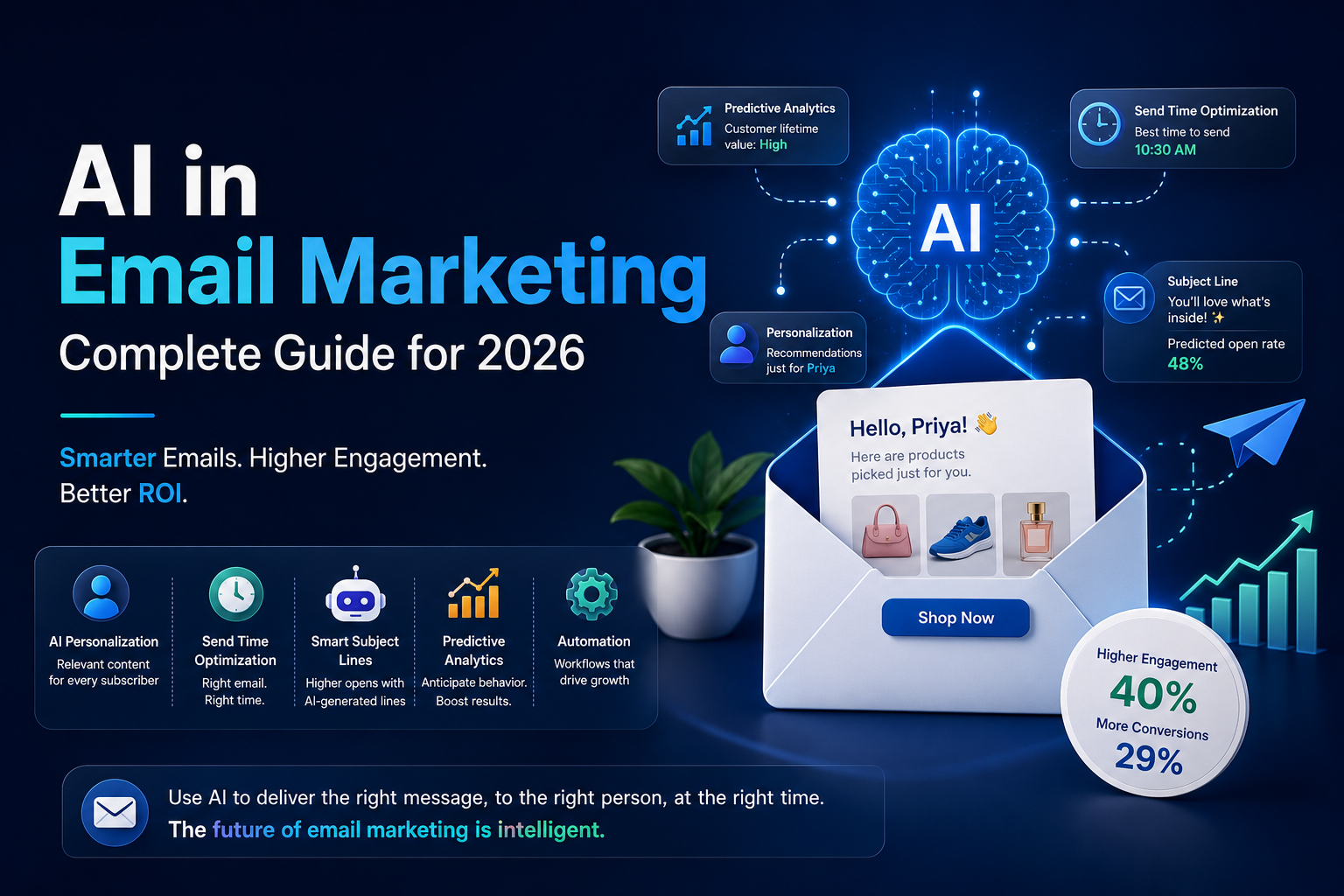
For Indian businesses, from e-commerce startups in Bangalore to service providers in Mumbai, AI-powered email marketing is no longer optional—it’s essential for competitive advantage. Recent studies show that AI email personalization increases click-through rates by 40% and conversion rates by 29%, making it a game-changer for businesses of all sizes.
TL;DR
- AI is transforming email marketing by automating personalization, optimizing campaigns, and predicting customer behavior.
- Traditional email marketing is no longer enough. With crowded inboxes, AI helps brands deliver more relevant and timely messages.
- AI-powered personalization goes beyond first names by recommending products, customizing content, and adapting messaging based on user behavior.
- Smart subject line generation improves open rates by analyzing high-performing patterns, emotions, and audience preferences.
- Send Time Optimization (STO) uses machine learning to determine the best time to send emails to each subscriber, boosting engagement.
- Predictive analytics helps businesses stay proactive by identifying churn risks, forecasting purchases, and estimating customer lifetime value.
Table of Contents
- What Exactly Is AI in Email Marketing and How Does It Work?
- How Can AI Email Personalization Transform Your Campaign Performance?
- What Role Does AI Play in Subject Line Generation and Optimization?
- How Does AI Optimize Email Send Time for Maximum Engagement?
- What Are the Key Benefits of Machine Learning Email Automation?
- How Can AI Predictive Analytics Improve Email Campaign Performance?
- Which AI-Powered Email Marketing Tools Are Best for Indian Businesses?
- What Are the Common Challenges When Implementing AI in Email Marketing?
- What Does the Future of AI in Email Marketing Look Like?
- FAQ
- Conclusion
What Exactly Is AI in Email Marketing and How Does It Work?
AI in email marketing refers to machine learning algorithms and artificial intelligence technologies that automate, optimize, and personalize email campaigns at scale. Unlike traditional email marketing that relies on manual segmentation and static templates, AI systems learn from customer behavior, predict preferences, and adjust campaigns in real-time.
How AI Works in Email Marketing:
- Data Processing & Pattern Recognition
- AI analyzes millions of data points from customer interactions
- Identifies patterns invisible to human analysts
- Processes behavioral signals like opens, clicks, website visits, and purchase history
- Predictive Analytics
- Forecasts customer churn risk
- Predicts optimal product recommendations
- Estimates lifetime customer value
- Real-Time Optimization
- Adjusts email content, subject lines, and send times automatically
- A/B tests variations instantly across segments
- Personalizes dynamic content blocks for each recipient
- Natural Language Processing (NLP)
- Generates subject lines and email copy variations
- Understands customer sentiment from feedback
- Creates personalized greetings and recommendations
For Indian businesses using platforms like Braze, HubSpot, or Klaviyo, AI handles these processes automatically, freeing teams to focus on strategy rather than execution.
How Can AI Email Personalization Transform Your Campaign Performance?
Personalization is no longer just addressing customers by first name. AI email personalization creates hyper-targeted experiences by:
1. Dynamic Content Customization
- Shows different product recommendations to each recipient based on browsing history
- Customizes email templates based on customer segment
- Adjusts tone and messaging based on customer preferences
Example for Indian E-commerce: A Delhi-based fashion brand using AI personalization shows monsoon wear to customers in rainy regions while displaying summer collections to those in drier areas—all within the same campaign.
2. Behavioral Trigger Automation
- Sends emails triggered by specific customer actions
- Adjusts messaging based on user lifecycle stage
- Recommends products based on browsing behavior
Key Metrics Impact:
- Personalized emails deliver 6x higher transaction rates than generic campaigns
- Dynamic product recommendations increase average order value by 15-30%
- Personalized subject lines achieve 50% higher open rates
3. Customer Segment Intelligence
AI doesn’t just divide customers into basic segments. It creates micro-segments based on:
- Purchase frequency and value
- Product category preferences
- Email engagement patterns
- Geographic and demographic data
- Seasonal buying behavior
What Role Does AI Play in Subject Line Generation and Optimization?
Subject lines determine whether an email is opened or deleted. AI subject line generation uses natural language processing to create compelling subject lines that maximize open rates.
How AI Generates Better Subject Lines:
- Pattern Analysis
- Analyzes thousands of subject lines and their open rates
- Identifies high-performing words, length, and structure
- Learns what resonates with your specific audience
- Emotional Intelligence
- Incorporates psychological triggers (urgency, curiosity, FOMO)
- Avoids spam trigger words
- Matches tone to brand voice
- Predictive Performance
- Forecasts open rates for different variations
- Recommends the strongest version before send
- Continuously improves recommendations based on results
How Does AI Optimize Email Send Time for Maximum Engagement?
Sending emails at the right time is critical—an email sent at the wrong hour might go unopened. Send time optimization (STO) using AI determines the exact moment each subscriber is most likely to engage.
Why Send Time Matters:
- Emails sent at optimal times see 40% higher open rates
- Click-through rates improve by up to 30%
- Overall email ROI increases significantly
How AI Determines Optimal Send Time:
- Historical Behavior Analysis
- Reviews when individual subscribers historically open emails
- Tracks time zones and local patterns
- Identifies peak engagement windows
- Real-Time Adjustment
- Factors in current email volume and inbox competition
- Adjusts for device usage patterns
- Considers seasonal variations
- Machine Learning Refinement
- Continuously improves predictions with new engagement data
- Learns from competitor email patterns in user inboxes
- Adapts to changing customer behavior
What Are the Key Benefits of Machine Learning Email Automation?
Machine learning email automation removes manual tasks while improving results. Here’s what it delivers:
1. Scalability Without Additional Resources
- Manage millions of personalized emails with existing team
- Automate workflows that would require 5-10 additional staff members
- Reduce operational costs by 30-40%
2. Improved Customer Journey Mapping
- AI identifies optimal touchpoints in customer journey
- Automatically triggers relevant messages based on behavior
- Eliminates manual nurture sequence creation
3. Reduced Churn Through Predictive Intervention
- AI identifies customers at-risk of canceling
- Automatically sends win-back campaigns
- Increases customer retention by 15-25%
4. Dynamic List Management
- Automatically removes inactive subscribers
- Re-engages dormant customers intelligently
- Prevents deliverability issues from email list decay
How Can AI Predictive Analytics Improve Email Campaign Performance?
Predictive email analytics uses historical data to forecast future customer behavior, allowing brands to act proactively rather than reactively.
Key Predictive Analytics Applications:
- Churn Prediction
- Identifies customers likely to cancel subscription within 30 days
- Enables targeted retention campaigns
- Typically captures 40-60% of at-risk customers before they leave
- Purchase Prediction
- Forecasts likelihood of next purchase
- Predicts product category preferences
- Estimates transaction value
- Engagement Scoring
- Rates subscriber quality and engagement likelihood
- Focuses efforts on high-value relationships
- Prevents resource waste on low-engagement contacts
- Lifetime Value Prediction
- Calculates CLV for each subscriber
- Prioritizes high-value customer communications
- Justifies personalization investment
Which AI-Powered Email Marketing Tools Are Best for Indian Businesses?
The Indian email marketing landscape includes both global platforms with India-specific features and local solutions.
Top AI Email Marketing Tools for Indian Brands:
Enterprise-Grade (₹50,000+ monthly):
- HubSpot Email Marketing – Complete AI personalization, predictive lead scoring
- Braze – Advanced behavioral segmentation, real-time optimization
- Klaviyo – E-commerce focused AI recommendations, SMS integration
Mid-Market Solutions (₹10,000-50,000 monthly):
- ActiveCampaign – AI subject line generation, send time optimization
- Mailchimp (with Intuit AI) – Accessible AI, good for SMBs
- Drip – Automation-focused, affordable AI features
Indian-Founded/Optimized (₹5,000-25,000 monthly):
- Smartech (by Netcore) – India-first platform, local support, easy INR payments
- Unistal Digital – Indian SaaS, personalization, local customer support
- Mavenir – Affordable automation with basic AI features
What Are the Common Challenges When Implementing AI in Email Marketing?
While AI offers tremendous benefits, implementation requires overcoming specific obstacles.
Challenge 1: Data Quality Issues
Problem: Poor data leads to poor AI predictions Solution:
- Audit customer data for completeness and accuracy
- Implement data validation at collection points
- Regularly clean databases (quarterly minimum)
Challenge 2: Privacy Compliance (GDPR, India DPA)
Problem: AI uses customer data that must be protected Solution:
- Choose GDPR/CCPA-compliant platforms
- Ensure consent mechanisms are clear
- Be transparent about data usage
- India: Comply with emerging data privacy regulations
Challenge 3: Integration Complexity
Problem: Connecting AI email tools to CRM, e-commerce, and analytics platforms is complex Solution:
- Choose platforms with pre-built integrations (HubSpot → Shopify)
- Use middleware services like Zapier for custom integrations
- Allocate 2-4 weeks for proper setup
Challenge 4: Learning Curve and Team Training
Problem: Teams lack AI literacy to maximize platform potential Solution:
- Invest in platform-specific training (most vendors offer free onboarding)
- Start with basic features, gradually implement advanced AI
- Hire or train one “email AI specialist”
Challenge 5: Attribution and ROI Measurement
Problem: Unclear how much revenue AI generates vs. other channels Solution:
- Implement UTM parameters on all email links
- Use platform attribution reporting
- Run A/B tests comparing AI vs. non-AI campaigns
- Track email to CRM opportunity conversion
What Does the Future of AI in Email Marketing Look Like?
Emerging AI Email Marketing Trends:
- Omnichannel Personalization
- AI coordinates emails with SMS, push, web personalization
- Unified messaging across all channels
- Consistent customer experience regardless of touchpoint
- Generative AI Email Creation
- AI generates full email campaigns from brief prompts
- Creates variations automatically for A/B testing
- Drafts copy in multiple languages (including Indian languages)
- Predictive Content Optimization
- AI predicts optimal email length, tone, imagery for each person
- Customizes format (mobile-first design varies by device)
- Adjusts visuals based on color preference patterns
- Privacy-First Personalization
- Zero-party data collection (asking customers directly)
- First-party data emphasis as third-party cookies disappear
- AI compliant with upcoming data protection laws
- Real-Time Behavioral Response
- AI detects customer signals in real-time
- Sends intervention emails within minutes of triggering events
- Adapts messaging based on last 30 minutes of customer activity
FAQ
1.Will AI replace email marketers?
No. AI automates repetitive tasks (segmentation, send time optimization, basic personalization), freeing marketers to focus on strategy, creative work, and customer insights. Email marketers who adopt AI become more valuable, not obsolete.
2.How much historical data do I need to start with AI email marketing?
Minimum 3 months of subscriber engagement data is ideal; 6 months is better. However, you can start AI implementation with less data—the model improves as more data accumulates.
3.Is AI email marketing only for large companies?
Absolutely not. Affordable AI email platforms like Mailchimp, Klaviyo, and Drip make AI accessible to small businesses and solopreneurs. Even bootstrap startups can benefit from basic AI personalization.
4.Is AI email marketing expensive to maintain?
Not especially. After initial setup (₹50,000-2,00,000), ongoing maintenance is minimal:
- Platform SaaS cost: ₹5,000-50,000/month depending on list size
- Staff time: 5-10 hours/week for optimization and analysis
5.Which Indian industries benefit most from AI email marketing?
- E-commerce: Myntra, Nykaa, Amazon seller partner programs
- Fintech: Razorpay, CRED, Groww
- EdTech: Unacademy, Vedantu, Byju’s
Conclusion
AI in email marketing is not a luxury—it’s becoming the baseline expectation. Brands that implement AI email strategies today will have a significant competitive advantage over those that wait.
For Indian businesses specifically, AI email marketing offers a unique opportunity: reach customers across diverse geographies, languages, and time zones with personalized, culturally relevant messaging—all automated and continuously optimized.
Book a Free Counselling Session