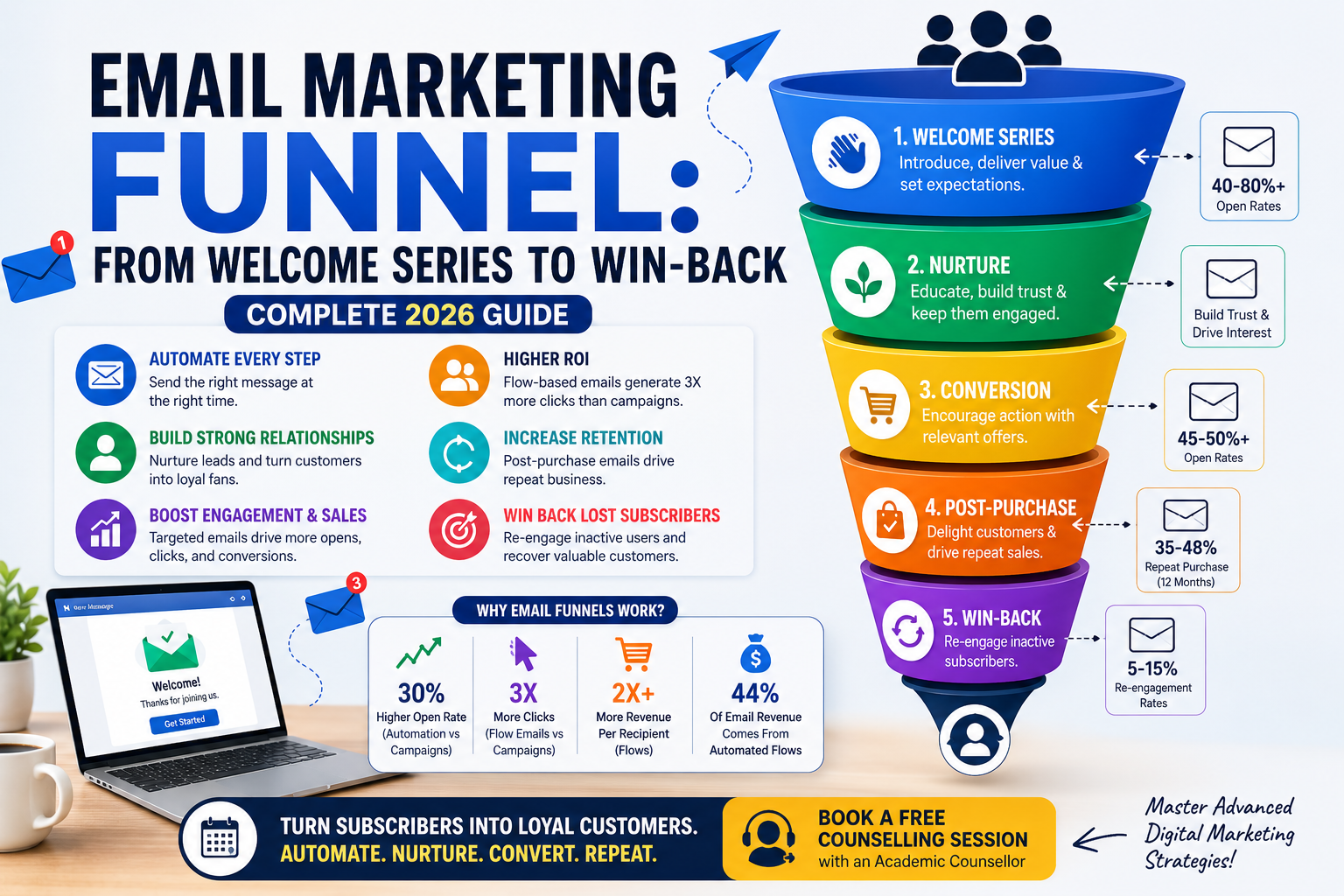
An email marketing funnel is a structured series of automated emails designed to move a contact through specific stages of the customer journey — awareness, consideration, purchase, retention, and re-engagement — without a marketer manually pressing send each time.
Instead of treating email as a single newsletter blast, a funnel treats it as a system. Each email has one job: move the subscriber one step closer to action, whether that’s opening their first email, making a first purchase, buying again, or coming back after going quiet.
This distinction matters because triggered, behavior-based emails consistently outperform generic campaigns. Automated flows reach people at the exact moment of intent — right after signup, right after abandoning a cart, right after a purchase — and that timing advantage shows up directly in the numbers. Industry data from 2026 shows automation emails achieving open rates around 30%, compared to roughly 21% for standard one-off campaigns, and flow-based emails generating click rates nearly three times higher than campaign sends.
TL;DR
- An email marketing funnel is a sequence of automated emails that guides subscribers through the customer journey.
- It moves users from signing up to becoming loyal repeat customers.
- It also helps re-engage inactive subscribers and bring them back into the funnel.
- Each stage is designed to build trust, increase engagement, and drive conversions.
- Brands that automate all five stages generate nearly half of their email revenue from a small percentage of email sends.
- Triggered emails perform better than one-time newsletters because they are timely and relevant.
- An effective email marketing funnel improves customer retention, boosts sales, and maximizes email marketing ROI.
Table of Content
- How Should You Structure a Welcome Email Series?
- How Do You Nurture Leads Who Aren’t Ready to Buy?
- What Makes a Conversion-Stage Email Sequence Actually Convert?
- How Should Post-Purchase Emails Drive Repeat Business?
- When Should You Trigger a Win-Back Email Campaign?
- How Do You Measure Whether Your Email Marketing Funnel Is Actually Working?
- FAQ
- Conclusion
How Should You Structure a Welcome Email Series?
The welcome series is the highest-leverage flow in your entire email marketing funnel, and most brands underuse it.
Welcome emails post the highest open rates of any email type in the funnel — often in the 40–80%+ range depending on industry and list quality — because a new subscriber has just taken an action (signing up) and is primed to pay attention. That window of attention closes fast, which is why the welcome series needs to do real work in the first few days, not just say “thanks for subscribing.”
What should each welcome email do?
A strong welcome series usually runs 3–5 emails over 7–10 days:
- Email 1 (immediate): Deliver on the promise (discount code, lead magnet, free resource) and set expectations for what they’ll receive going forward.
- Email 2 (Day 1–2): Introduce your brand story, mission, or founder — this is where trust is built, not where you sell.
- Email 3 (Day 3–4): Highlight your bestsellers, most popular content, or social proof (reviews, UGC, case studies).
- Email 4 (Day 5–7): Address common objections or FAQs — shipping, guarantees, how it works.
- Email 5 (Day 8–10): Create urgency around the welcome offer if one was given, with a clear deadline.
How Do You Nurture Leads Who Aren’t Ready to Buy?
Not every subscriber converts during the welcome series — in fact, most won’t. This is where the nurture stage of your email marketing funnel takes over, and it’s the stage most brands skip entirely, jumping straight from “welcome” to “buy now” messaging.
What should a nurture sequence include?
Lead nurturing emails exist to build relevance and trust over a longer time horizon. Instead of pushing for a purchase every time, nurture emails should:
- Share educational content related to the problem your product solves
- Answer the “why should I care” question before the “why should I buy” question
- Use behavioral triggers — what pages someone visited, what they clicked, what they downloaded — to personalize the next email
- Mix in social proof, comparison content, and use-case stories
- Gradually increase commercial intent as engagement signals strengthen
How do you know when a lead is “warm enough” to move to a conversion flow?
Use engagement scoring: opens, clicks, site visits, and time-on-site combine into a lead score. Once a contact crosses a threshold (for example, clicking three nurture emails or revisiting a product page twice), shift them into a more sales-focused conversion sequence. This segmentation is what separates a high-performing email marketing funnel from a generic drip campaign — relevance compounds, and irrelevant emails compound unsubscribes instead.
What Makes a Conversion-Stage Email Sequence Actually Convert?
The conversion stage is where intent is highest and where automation pays off fastest — particularly cart and browse abandonment flows.
Why do abandoned cart emails outperform almost everything else?
Cart abandonment sequences are widely considered the single highest-ROI automation in ecommerce. Open rates on abandoned cart flows commonly land around 45–50%+, multiple times higher than a standard campaign, and conversion on the flow itself often lands in the high single digits to low double digits.
What should a conversion sequence look like?
A 3-email cart recovery sequence tends to outperform a single reminder email:
- Email 1 (within 1 hour): Simple reminder — show the exact product(s) left in cart, no discount yet.
- Email 2 (Day 1): Add social proof — reviews, ratings, or a related testimonial — and answer a likely objection (shipping cost, sizing, returns).
- Email 3 (Day 2–3): Introduce urgency or a small incentive — limited stock, expiring discount, or free shipping threshold.
How Should Post-Purchase Emails Drive Repeat Business?
Most brands treat the sale as the finish line. In a real email marketing funnel, the sale is the midpoint — the post-purchase sequence is what determines whether that customer becomes a repeat buyer or a one-time transaction.
What should post-purchase emails cover?
- Order confirmation and shipping updates (transactional, but still a branding opportunity)
- Usage tips and onboarding — how to get the most out of what they bought
- Review and feedback requests — timed to arrive after the product has likely been used or received
- Replenishment or complementary product suggestions — relevant for consumables or product ecosystems
- Loyalty program invitations or referral incentives
Why does this stage matter so much for revenue?
Repeat-purchase behavior is largely decided early. Data on customer repurchase curves shows that the climb in repeat-purchase rate is steep through the first 90 days and flattens significantly afterward — meaning the bulk of a customer’s lifetime repeat-purchase potential is realized (or lost) in that early window. If your post-purchase flow isn’t actively nudging a second purchase inside that 90-day period, you’re leaving compounding revenue on the table.
What’s a healthy benchmark to aim for?
Brands with mature retention programs often see 12-month repeat purchase rates in the 35–48% range, with flow-driven post-purchase sequences contributing meaningfully more revenue per recipient than one-off campaigns sent to the same audience.
When Should You Trigger a Win-Back Email Campaign?
Every email marketing funnel eventually loses people to inactivity — opens stop, clicks stop, purchases stop. The win-back (or re-engagement) campaign exists to recover as many of those subscribers as economically possible before you remove them from your active list.
What counts as “inactive,” and when should the flow trigger?
This depends on your sending cadence and purchase cycle, but a common mistake is waiting too long. If a win-back flow doesn’t trigger until 180 days of inactivity, you’re often past the point where re-engagement economics still work. A trigger window of roughly 60–120 days of inactivity (no opens, no clicks, no purchases) tends to perform better than waiting six months or more.
What should a win-back sequence include?
A typical 3–4 email win-back sequence:
- “We miss you” email — simple, low-pressure, reminds them why they signed up
- Incentive email — a meaningful discount or bonus to re-activate the relationship
- Feedback/objection email — ask directly why they’ve gone quiet, with a short survey or reply prompt
- Final/breakup email — let them know you’ll stop emailing unless they re-engage, with one last clear CTA
What’s a realistic re-engagement rate to expect?
Re-engagement rates on win-back campaigns typically range from 5–15%, depending on how long the subscriber has been inactive and how relevant the offer is. That might sound modest, but reactivating a dormant subscriber is almost always cheaper than acquiring a brand-new one — and the subscribers who don’t re-engage should be suppressed or removed to protect your sender reputation and deliverability for everyone else.
How Do You Measure Whether Your Email Marketing Funnel Is Actually Working?
Tracking the right metrics — not just open rate — is what separates a funnel that’s genuinely performing from one that just looks busy.
Which metrics matter most at each funnel stage?
- Welcome series: Open rate, welcome flow conversion rate (target roughly 8–18%)
- Nurture stage: Click-to-open rate (CTOR), engagement score progression
- Conversion stage: Cart recovery rate, revenue per recipient (RPR)
- Post-purchase stage: Repeat purchase rate at 30/60/90 days
- Win-back stage: Re-engagement rate, unsubscribe/suppression rate
Why is open rate becoming less reliable on its own?
Apple’s Mail Privacy Protection (MPP) pre-fires the open tracking pixel for many users regardless of whether they actually opened the email, inflating open rate data across the board. That doesn’t make open rate useless — a sudden drop still signals a real deliverability problem — but it means click-through rate, click-to-open rate, and revenue per recipient are more trustworthy indicators of actual funnel performance in 2026.
What’s the single most important metric to report on?
Revenue Per Recipient (RPR) — total revenue divided by unique recipients — is increasingly treated as the metric that matters most, because it connects email performance directly to business outcomes rather than vanity engagement numbers. Flow-driven RPR is commonly many times higher than campaign-driven RPR, which is the clearest evidence that funnel architecture, not list size, is what drives email revenue.
FAQ
What is an email marketing funnel?
An email marketing funnel is a series of automated, triggered emails that move a subscriber through defined stages — welcome, nurture, conversion, post-purchase, and win-back — based on their behavior and engagement, rather than sending the same campaign to everyone at once.
What are the stages of an email marketing funnel?
The five core stages are: welcome series, lead nurturing, conversion (including cart/browse abandonment), post-purchase retention, and win-back/re-engagement.
How many emails should be in a welcome series?
Most effective welcome series run 3–5 emails spread across 7–10 days, balancing immediate value delivery with brand storytelling and a time-bound offer.
What is a realistic win-back campaign success rate?
Re-engagement rates for win-back campaigns typically fall between 5% and 15%, depending on the length of inactivity and the strength of the incentive offered.
Should I focus on campaigns or flows first?
Flows first. Welcome series and cart abandonment sequences earn the highest revenue per recipient of any email type and run automatically once built, making them the highest-ROI starting point before investing heavily in one-off campaigns.
Conclusion
A complete email marketing funnel — welcome series, nurture, conversion, post-purchase, and win-back — isn’t a “nice to have” alongside your newsletter. It’s the infrastructure that turns a list of email addresses into a compounding revenue channel. The data is consistent across every major benchmark report in 2026: automated, behavior-triggered flows outperform one-off campaigns on open rate, click rate, conversion rate, and revenue per recipient, often by a wide margin.
The build order matters too. If you only have time to build one flow this quarter, build the welcome series or the cart abandonment flow first — they post the highest engagement of any email type and require the least ongoing maintenance once set up. Then layer in nurture, post-purchase, and win-back as your list and resources grow.
Book a free counselling session with an academic counsellor for our AI-powered Niche Specific Digital Marketing course to master these advanced strategies.