Every day, billions of advertising messages bombard potential customers. Your ads compete against countless others for attention. Your landing pages must convert visitors into paying customers in a matter of seconds. Without a clear framework guiding your copywriting efforts, you’re essentially throwing words at walls hoping something sticks.
This is where copywriting frameworks become your secret weapon.
Copywriting frameworks are proven structures that guide how you arrange ideas to persuade readers and drive them toward a specific action. Instead of guessing what to write, you follow a tested formula that marketers and copywriters have refined over decades. These frameworks remove the guesswork from persuasive writing and give you a clear roadmap from the moment someone sees your ad until they hit the buy button.
In this comprehensive guide, you’ll discover the two most powerful copywriting frameworks used by conversion experts worldwide: AIDA and PAS. You’ll learn when to use each one, how to apply them to different marketing channels, and see real-world examples of how these frameworks generate results.
TL;DR
- Copywriting frameworks are proven formulas that help structure persuasive marketing messages.
- AIDA (Attention, Interest, Desire, Action) is ideal for ads because it grabs attention quickly and guides readers toward taking action.
- PAS (Problem, Agitate, Solve) works best for landing pages by highlighting customer pain points before presenting a solution.
- AIDA is designed to move readers quickly through the sales funnel.
- PAS builds a stronger emotional connection by focusing on the audience’s challenges first.
- Many high-performing marketing campaigns use a hybrid approach, combining AIDA and PAS based on the customer’s stage in the buying journey.
- Mastering these frameworks helps create high-converting ads, emails, and landing pages that increase engagement and drive sales.
Table of Content
- What Are Copywriting Frameworks and Why Do They Matter?
- What Is the AIDA Framework and How Does It Work?
- How Can You Apply the AIDA Framework to Digital Ads?
- What Is the PAS Framework and How Does It Differ From AIDA?
- How Can You Use the PAS Framework to Optimize Landing Pages?
- What Are Common Mistakes When Using Copywriting Frameworks?
- FAQ
- Conclusion
What Are Copywriting Frameworks and Why Do They Matter?
Before diving into specific copywriting frameworks, let’s understand why they’re so valuable. A copywriting framework is essentially a mental blueprint that organizes your message in a psychologically persuasive sequence. Rather than writing randomly, you follow a proven structure that guides readers through your argument step-by-step.
Think of copywriting frameworks like recipes for persuasion. A chef doesn’t randomly throw ingredients together and hope for a delicious meal. They follow a recipe that combines ingredients in a specific order and proportion. Similarly, copywriting frameworks show you exactly what elements you need and in what order to present them for maximum persuasive impact.
The best copywriting frameworks work because they’re based on psychology and human behavior. They acknowledge that people go through predictable stages when making purchasing decisions. By understanding these stages and structuring your copy accordingly, you dramatically increase the likelihood that your reader will take the action you want them to take.
What Is the AIDA Framework and How Does It Work?
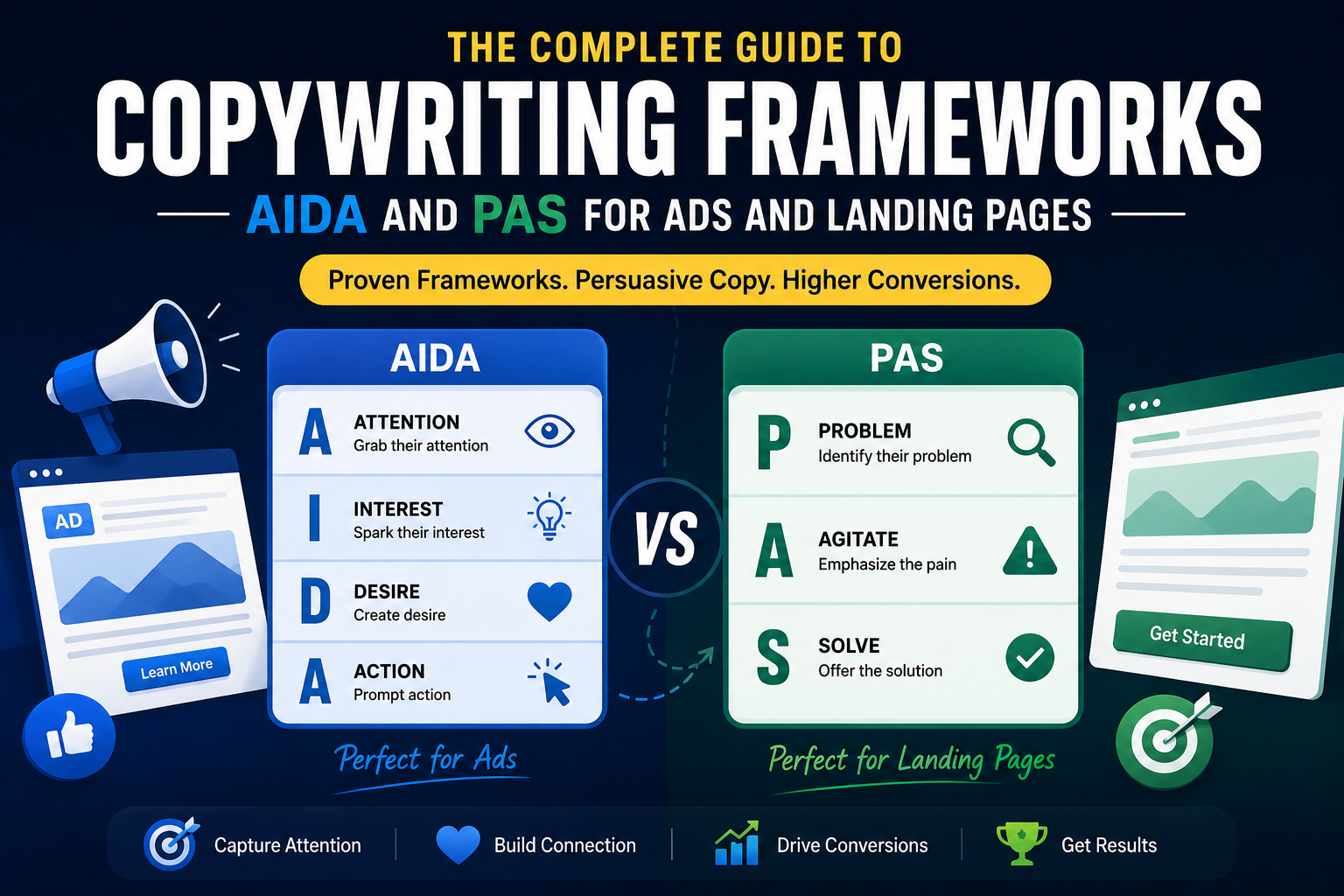
The AIDA framework is one of the oldest and most reliable copywriting frameworks ever created. Developed in the early 1900s, AIDA has stood the test of time because it perfectly mirrors how consumers make purchasing decisions. AIDA is an acronym that stands for:
- Attention – Capture the reader’s focus
- Interest – Make them care about your offer
- Desire – Make them want what you’re selling
- Action – Tell them exactly what to do next
The AIDA framework works by moving readers progressively through the sales funnel. You start with a headline that stops them mid-scroll. Then you build interest by showing that you understand their problem. Next, you amplify desire by demonstrating the transformation your product or service provides. Finally, you ask for the action you want them to take.
Each stage of the AIDA copywriting framework serves a specific psychological purpose. You can’t ask for the sale without first capturing attention. You can’t create desire without building interest. This sequential approach respects where readers are mentally and gradually builds momentum toward a conversion.
How Can You Apply the AIDA Framework to Digital Ads?
Digital advertising is where the AIDA framework truly shines. When you have limited space—a few seconds of a viewer’s time, perhaps just a headline and image—the AIDA framework helps you make every word count. Here’s how to apply the AIDA copywriting framework specifically to paid ads:
Attention: Your headline is everything in an ad. It must stop the scroll. Use curiosity, numbers, questions, or bold claims. For example: “The Copywriting Formula That Converts 35% Better Than Competitor Ads” grabs attention immediately by mentioning a specific benefit and proof point.
Interest: In your ad body text, quickly show that you understand your target audience’s problem or desire. This demonstrates relevance. Example: “Are you frustrated by landing pages that look great but don’t generate leads? We’ve helped 2,000+ marketers fix this exact problem.”
Desire: Create emotional stakes by describing the transformation or benefit. What will their life look like after using your product? “Imagine launching campaigns where you know they’ll convert because they’re built on proven copywriting frameworks.”
Action: Your call-to-action must be crystal clear and specific. Don’t just say “Learn More.” Instead: “Download the Free AIDA Framework Checklist” or “Get Your Free Strategy Call Today.”
When applying the AIDA copywriting framework to social media ads specifically, remember that images and videos enhance each stage. Your image commands attention, your copy creates interest and desire, and your button delivers action.
Real example of AIDA in a Facebook ad:
- Attention (Headline): “Stop Wasting Money on Ads That Don’t Convert”
- Interest (Body): “Most businesses use the wrong copywriting frameworks, which is why their ads underperform. We discovered the 3-framework system that converts at 2x the industry average.”
- Desire (Benefit statement): “Imagine launching campaigns where every dollar generates $5 in revenue instead of $1.50.”
- Action (CTA button): “Show Me How”
What Is the PAS Framework and How Does It Differ From AIDA?
While AIDA is direct and fast-paced, the PAS framework goes deeper into emotion and psychology. PAS stands for:
- Problem – Identify the specific problem your audience faces
- Agitate – Amplify the emotional pain of that problem
- Solve – Present your solution
The PAS copywriting framework is more emotionally driven than AIDA. Instead of moving quickly through attention, interest, desire, and action, PAS takes time to establish a deep emotional connection around the problem. It recognizes that people are more motivated by avoiding pain than by gaining pleasure.
This framework works because it resonates with a fundamental human truth: we’re wired to avoid problems more urgently than to pursue benefits. By amplifying the problem and the pain it causes, the PAS framework creates urgency and emotional buy-in before presenting the solution.
The PAS copywriting framework typically requires more space than AIDA. You need room to fully develop the problem and agitate the pain. This makes it perfect for long-form content like landing pages, sales pages, and email sequences where you can build a narrative.
How Can You Use the PAS Framework to Optimize Landing Pages?
Landing pages are the ideal venue for the PAS copywriting framework because visitors typically have more time to engage with your message. Here’s how to structure a landing page using PAS:
Problem Section: Start your landing page by clearly stating the core problem your audience struggles with. Use specific language that shows you deeply understand their situation. Example headline: “You Have the Perfect Product, But Your Landing Page Isn’t Generating the Leads You Deserve.”
This opening hook acknowledges the reader’s situation and makes them feel understood. It should resonate immediately so they think, “Yes, this person gets what I’m dealing with.”
Agitate Section: Now deepen the emotional connection by exploring the consequences of the problem. What happens if they don’t solve this? What are they losing right now? “Every week you spend without an optimized landing page is a week of lost revenue. On average, small businesses leave $15,000 on the table monthly due to poor conversion copy.”
Agitation isn’t about being manipulative; it’s about helping people understand the true cost of inaction. It creates urgency.
Solve Section: Only after you’ve established the problem and agitated the pain do you introduce your solution. Present your product or service as the natural answer to everything you’ve discussed. “Our copywriting framework training teaches you the exact structures top-performing companies use to convert cold traffic into paying customers.”
What Are Common Mistakes When Using Copywriting Frameworks?
Understanding copywriting frameworks is one thing. Implementing them effectively is another. Here are the most common mistakes marketers make:
Mistake 1: Skipping Stages Don’t rush. Some marketers try to jump straight to the solution in AIDA, skipping the attention and interest stages. This tanks conversion rates. Every stage exists for a reason.
Mistake 2: Over-Agitating in PAS While agitation is important, going overboard makes you sound like a used car salesman. The goal is to honestly reflect the consequences of the problem, not to manipulate with exaggeration.
Mistake 3: Not Matching Framework to Channel Using PAS on a 280-character Twitter ad doesn’t work. Match your copywriting framework to your medium. Twitter and Instagram are AIDA. Long-form landing pages are PAS.
Mistake 4: Ignoring Your Audience The best copywriting framework still fails if it doesn’t speak directly to your specific audience. Use research and customer interviews to inform your problem statement and agitation.
Mistake 5: Weak Calls-to-Action The most common killer of conversions is a weak CTA. Even if you perfectly execute AIDA or PAS, a vague call-to-action (“Click Here”) will underperform. Make your CTA specific and compelling.
FAQ
1. What are copywriting frameworks?
Copywriting frameworks are proven structures that help marketers organize persuasive messages in a way that encourages readers to take a specific action.
2. What does AIDA stand for in copywriting?
AIDA stands for Attention, Interest, Desire, and Action. It is a classic copywriting framework designed to capture a reader’s attention, build interest in an offer, create desire for the product or service, and motivate the audience to take action.
3. What does PAS stand for in copywriting?
PAS stands for Problem, Agitate, and Solve. This framework focuses on identifying a customer’s pain point, emphasizing the impact of that problem, and presenting a solution that addresses their needs.
4. Which is better: AIDA or PAS?
Neither framework is universally better. AIDA works exceptionally well for short-form content such as advertisements, social media campaigns, and email subject lines. PAS tends to perform better on landing pages, sales pages, and long-form content where emotional storytelling can influence purchasing decisions.
5. Can AIDA and PAS be used together?
Yes. Many marketers combine both frameworks to create highly persuasive campaigns. For example, PAS can be used on a landing page to establish emotional connection, while AIDA can guide the call-to-action section to encourage conversions.
Conclusion
You now understand the two most powerful copywriting frameworks used by top-performing marketers: AIDA and PAS. You know when to use each one, how to implement them step-by-step, and how to avoid common mistakes that derail results.
The truth is simple: copywriting frameworks aren’t optional for serious marketers. They’re the difference between copy that converts and copy that falls flat. They’re the reason some businesses scale predictably while others struggle.