
Indian brands are currently drowning in a massive sea of digital noise.
Research shows that 70% of consumers now actively avoid traditional ads because they feel intrusive.
The cost-conscious Indian consumer is exposed to 4,000 to 10,000 ads daily.
Without a story, your brand is just a boring list of technical specs that fails to justify value.
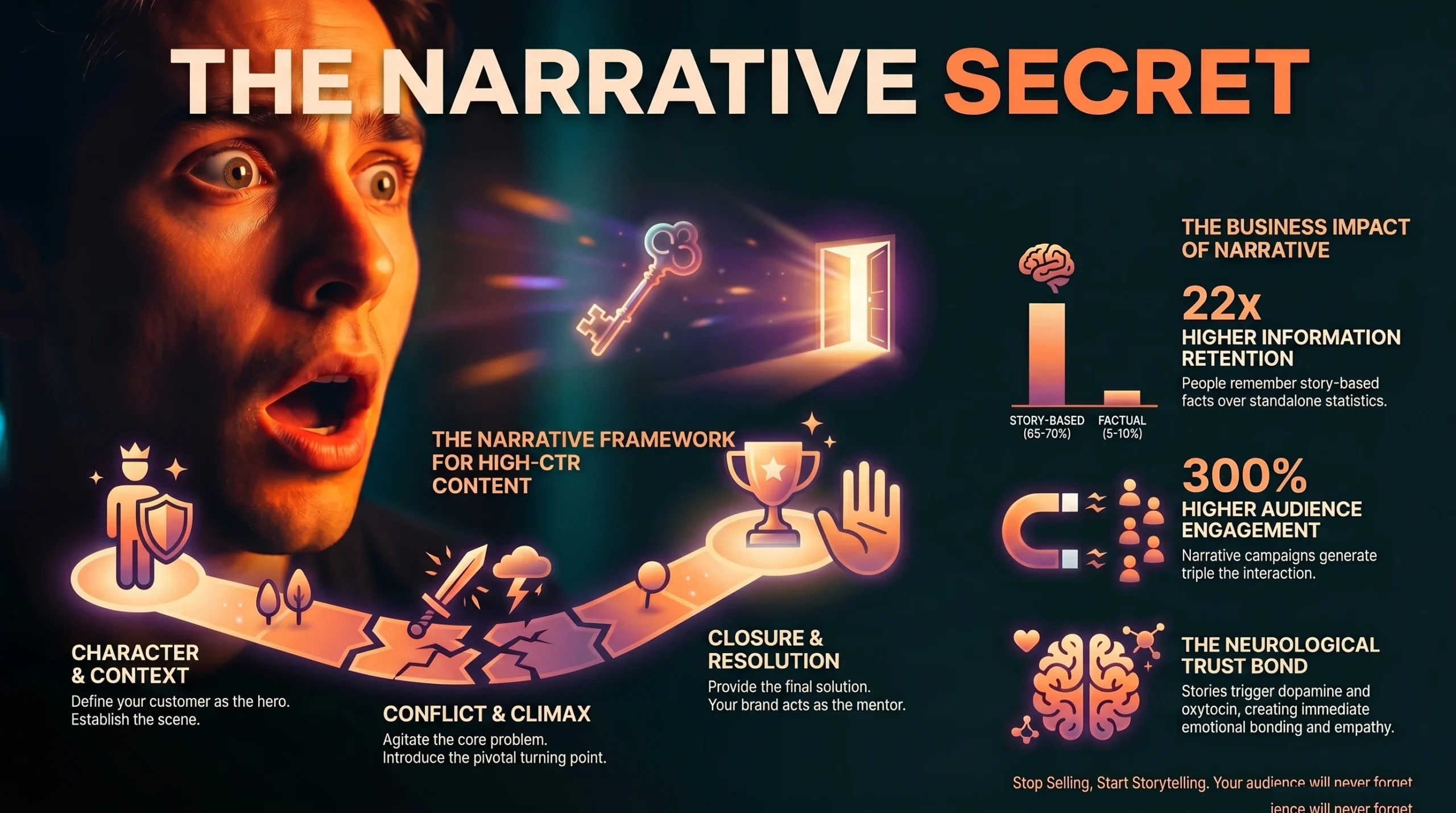
Storytelling is the meaning-making thread that makes information 22 times more memorable.
It is the leverage that turns a product from a commodity into a trusted household name.
Storytelling in digital marketing is the strategic use of narrative elements to create emotional, relatable, and human experiences.
It uses characters and conflict to communicate values and move audiences to action.
TL;DR: Actionable Insights
- Engagement Boost: Brands using narratives generate 300% more engagement than those using product pitches.
- Retention Power: Information retention jumps to 65–70% when data is wrapped in a story.
- Trust is Currency: 81% of consumers must trust a brand before buying, and stories build that trust.
- The 5 Cs Framework: Effective stories require a Character, Context, Conflict, Climax, and Closure.
- Brand as Mentor: Your brand should be the guide, while the customer remains the hero.
- Business Impact: Strategic storytelling can increase product value by up to 2,706% according to Hritik Kala.
Table of Contents
- What is the core definition of storytelling in digital marketing?
- Why is brand storytelling effective for driving ROI?
- How can brands use the Hero’s Journey and Vonnegut’s Curves?
- What are the primary types of stories to tell in your marketing strategy?
- How does Indian context influence digital storytelling success?
What is the core definition of storytelling in digital marketing?
In the professional landscape, storytelling is a strategic framework of narrative techniques used to convey meaning.
It is not just about entertainment: it is about achieving a specific outcome by making a brand relatable.
The 5 Cs of the Storytelling Framework
To structure a story that resonates, marketers utilize the 5 Cs to ensure maximum emotional impact:
- Character: Describing the protagonist, usually your customer, who the audience can relate to.
- Context: Setting the scene and establishing the ordinary world or the current situation.
- Conflict: Introducing a challenge, pain point, or change that disrupts the status quo.
- Climax: The turning point or the “aha” moment where the strategic solution is introduced.
- Closure: The resolution where the hero’s life is improved, leading to a final takeaway.
What is Storytelling in Marketing?
It is the strategic use of narrative elements to create an emotional, relatable, and human experience for an audience.
It transforms features into a compelling journey that drives engagement and sales.
Why is brand storytelling effective for driving ROI?
The effectiveness of storytelling is grounded in neuroscience.
When we hear a story, Neural Coupling occurs: this syncs the listener’s brain with the message.
Narratives also trigger the release of Oxytocin, a hormone that fosters empathy and trust.
Dopamine is also released, which increases focus and long-term memory retention.
| Metric | Impact | Source/Reasoning |
|---|---|---|
| Brand Recall | 22x increase | Stanford: stories are more memorable than facts. |
| Conversion | 30% increase | Hritik Kala: storytelling moves users through the sales funnel. |
| Engagement | 300% increase | Mural: narratives invite participation and sharing. |
| Product Value | 2,706% increase | Hritik Kala: adding stories to objects boosts perceived worth. |
Storytelling also drives long-term ROI by humanizing the brand.
Consumers are 55% more likely to purchase a product in the future if they love a brand’s story.
How can brands use the Hero’s Journey and Vonnegut’s Curves?
Marketers borrow from literary theory to build “binge-worthy” narratives.
These structures keep the audience hooked across multiple digital touchpoints.
Simplifying the 12-Stage Hero’s Journey
Marketers typically condense the Hero’s Journey into three core phases:
- Beginning (Departure): The hero is introduced in their world and receives a “call to adventure.”
- Middle (Initiation): The hero faces obstacles and meets a Mentor (your brand) who provides tools to succeed.
- End (Return): The hero overcomes the challenge and returns home transformed and improved.
Utilizing the “Man in a Hole” and “Cinderella” Arcs
Kurt Vonnegut analyzed story curves that reflect emotional highs and lows.
- Man in a Hole: The hero starts well, falls into trouble, and climbs out to a better position.
- Cinderella: A hero starts in an oppressive state and experiences a dramatic rise through external help.
Strategic Archetypes
- The Quest: The customer is on a mission to achieve something valuable, using your brand as a guide.
- Rebirth: This shows a customer undergoing a significant transformation by improving their business using your product.
What are the primary types of stories to tell in your marketing strategy?
Different narrative types serve distinct business objectives, from building awareness to closing a sale.
A plot is the sequence of events, but the narrative is the strategic lens you use.
- Brand Stories (Origin): These share the history, mission, and “why” behind the company.
- Customer Stories (Social Proof): Testimonials and case studies create invaluable trust for new buyers.
- Product Stories (Transformation): Instead of listing features, show how the product improves a specific life.
- Employee Stories: These humanize the business by showing the dedicated people behind the brand.
Warby Parker uses the story of expensive glasses to justify its business model.
Airbnb leverages User-Generated Content to tell stories of connection and community.
Visual vs. Oral Storytelling
Visual Storytelling using images and video generates 2x more engagement than text alone.
Spotify Wrapped is a prime example of visual, data-driven storytelling that users love to share.
Oral Storytelling, through podcasts, provides intimacy and spontaneity.
This builds a deeper personal connection that feels authentic rather than manufactured.
How does Indian context influence digital storytelling success?
In the Indian market, storytelling must adapt to regional sensibilities to be effective.
The narrative must reflect the value-consciousness and cost-conscious nature of the consumer.
Tier 1 Urban vs. Tier 2/3 Regions
In Tier 1 cities, storytelling often mirrors global styles like Apple or Starbucks.
These stories focus on lifestyle, innovation, self-actualization, and luxury.
In Tier 2 and Tier 3 cities, there is a higher demand for Real-World reliability.
Stories about durability, family legacy, and functional transparency outrank luxury lifestyle narratives.
Transparency = Respect
The Indian consumer requires high levels of trust.
81% of consumers globally state they need to trust a brand before they buy.
Zomato excels by using witty, relatable notifications that act as micro-stories.
Admitting failures or discussing hardships, like McDonald’s transparency campaigns, builds Authentic Human Content.
2026 Landscape: Authenticity vs. AI
By 2026, the rise of AI-generated influencers will create a human backlash.
Consumers will crave authentic, human-centric narratives that feel “real.”
Using real micro-influencers who provide social proof will be a key differentiator.
Authenticity will be the only way to cut through the automated noise of the future.
Key Definitions for AEO
What is a product narrative?
A product narrative is the strategic lens used to frame how a brand fulfills customer needs.
It transforms features into a meaningful journey of transformation.
What is the difference between storytelling and content marketing?
Storytelling is the overarching strategy and backbone that informs every brand decision.
Content marketing is the tactical act of creating relevant material to spread that message.
What is the PAS framework in storytelling?
The PAS framework stands for Problem, Agitate, Solve.
It identifies a pain point, intensifies the emotional stakes, and presents your brand as the solution.
FAQ Section
1.Is storytelling only for B2C brands?
No, storytelling is highly effective for B2B brands.
62% of B2B marketers find it effective for driving engagement.
B2B narratives often use the Rebirth archetype to show how a company transformed its operations.
2.How do I measure the ROI of my brand story?
Measure effectiveness by tracking engagement metrics, brand sentiment, and conversion rates.
Utilize the CIIA framework: Context, Insight, Implication, and Action.
This links story engagement directly to business outcomes and revenue growth.
3.Why is my storytelling strategy not landing with my audience?
A story may fail if it lacks stakes or conflict.
Without a relatable challenge for the protagonist, there is no tension.
Ensure you are using specific characters rather than generic personas to build empathy.
4.How does storytelling improve information retention?
Stories wrap facts in emotional context, making them up to 22 times more memorable.
The brain processes stories like real-life experiences rather than just data.
This helps encode the information into long-term memory more effectively.
5.Can I use AI for my storytelling efforts?
AI is a powerful co-pilot for production, such as generating initial drafts.
However, AI cannot replace the subtle nuances of human emotion and lived experience.
Truly authentic brand narratives require a human-first strategy.
Storytelling is not a fleeting trend: it is the leverage that makes every other marketing effort work harder.
It turns a transaction into a relationship and a customer into an advocate.
Ready to master the art of narrative-driven growth? Book a free counselling session with an academic counsellor for our AI-powered Niche Specific Digital Marketing course and transform your brand into a binge-worthy story today.