
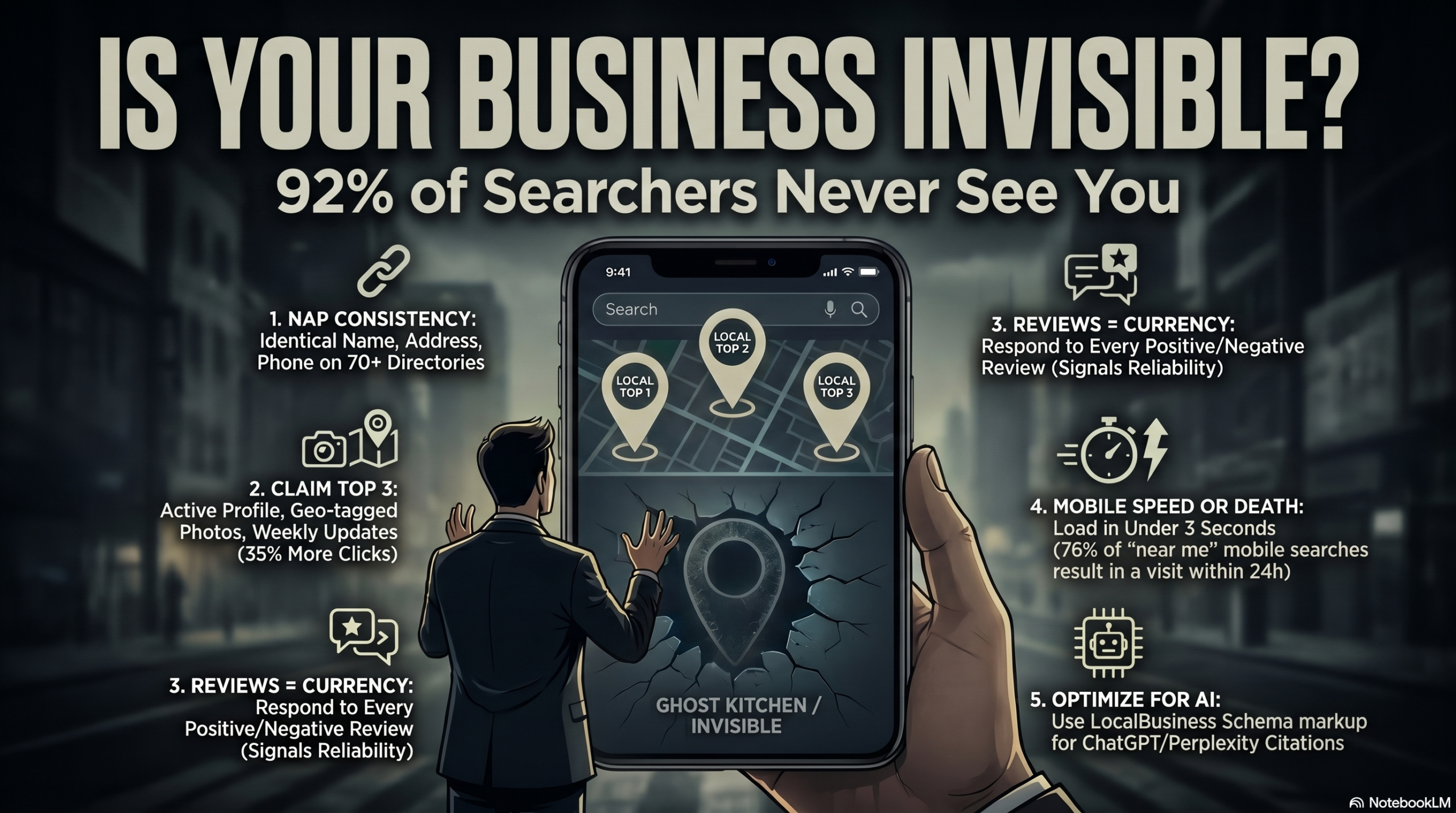
Small businesses across Indian Tier 1 and Tier 2 cities are facing a digital crisis where they remain invisible in the “Map Pack.” While your shop or clinic sits idle, competitors in hubs like Mohali or Bengaluru are intercepting your high-intent leads through superior technical execution. Whether you are a legal firm in Mumbai or a diagnostic center in Chandigarh, failing to appear for “near me” searches is a direct hit to your bottom line. This guide provides the definitive blueprint for local SEO optimisation to reclaim your digital territory and dominate the market.
Local SEO optimisation is the strategic process of enhancing a business’s visibility in geographic search results and map listings. It focuses on tailoring your digital footprint to ensure local customers discover your specific physical location or service area during high-intent search moments.
TL;DR: Actionable Takeaways
- Category Reverse-Engineering: Use the “View Page Source” hack to uncover hidden sub-categories like “Internist” or “Marriage Counselor” that competitors use to rank.
- The AI Search Pivot: Sync with Bing Places immediately; it is the primary data feed for ChatGPT, Perplexity, and Microsoft Copilot.
- ROI-First Strategy: Focus on high-margin services (e.g., MRI scans) where local intent converts at significantly higher rates than global SEO.
- Media Precision: Upload non-stock photos sized at 720×720 for logos and 1024×576 for cover photos to maximise Click-Through Rates.
- The “Photo Review” Hack: Soliciting 5-star reviews via WhatsApp that include customer photos keeps your listing at the top of Google’s search results.
- NAP+W Consistency: Ensure your Name, Address, Phone, and Website are identical across JustDial, the Chamber of Commerce, and your own footer.
Table of Contents
- Why Is Local SEO Optimisation the Highest ROI Channel for Indian SMEs?
- How Can You Reverse-Engineer Competitor Categories for a Ranking Edge?
- Is Bing Places the Secret to Ranking in ChatGPT and AI Search?
- What Are the Non-Negotiable Elements of a High-Converting GBP?
- How Do Reviews Act as a Proxy for Authority in the Indian Market?
- How to Build Local Authority Through the NAP+W Consistency Model?
- Local SEO FAQ: Solving the Toughest Ranking Challenges
Why Is Local SEO Optimisation the Highest ROI Channel for Indian SMEs?
The Indian marketplace has undergone a massive structural shift toward “local intent” commerce. According to reports from MeitY and mobile internet penetration data, the “Near Me” search is now the primary gateway for Indian consumers. Statistics show that the Google “Map Pack” captures approximately 33% of all clicks; while organic listings below it take 44%. For a small business, ranking in that top three is the difference between a thriving enterprise and total digital obscurity.
The ROI on local SEO optimisation is significantly higher than traditional broad-reach marketing because of the intent-to-purchase ratio. Consider a health sector case study from Chandigarh: an MRI center (mrichandigarh.com) targets users specifically searching for diagnostic services in the Tri-city area (Chandigarh, Mohali, Panchkula). With an MRI scan MRP of ₹5,000 and a base cost of ₹2,500, local SEO allows the business to offer a discount to the patient while maintaining a 30% to 35% margin. This “offline affiliate” model is only possible through dominant local visibility.
Current data suggests that over 60% of all local searches are performed on mobile devices. When a user in Gurgaon searches for a “plumber” or a “lawyer,” they are often ready to transact within the hour. Traditional SEO can take months to mature; however, a well-optimised Google Business Profile (GBP) can start generating high-quality calls within a week.
Success in this competitive landscape requires more than just a basic listing. It demands a “Growth Lead” mindset that prioritizes competitor intelligence and technical hacks to outmaneuver the competition.
How Can You Reverse-Engineer Competitor Categories for a Ranking Edge?
The single most important ranking signal for your Google Business Profile is the “Category Match.” Google uses these labels to understand if your business is relevant to a specific user query. Most Indian business owners choose one obvious category and stop there; however, top-ranking competitors often use “hidden” sub-categories to broaden their reach and signal deeper authority to the algorithm.
You can uncover these hidden labels by using the “View Page Source” technical hack. Google does not display all secondary categories on the public-facing profile; but they are hard-coded into the background of the Maps listing. Identifying these allows you to match the exact “relevancy profile” of the market leaders in your niche.
Step-by-Step Guide to the “View Page Source” Hack
- Open Google Maps on a desktop browser and search for your most successful local competitor.
- Click on their listing and locate their primary category (e.g., “Multi-specialty Clinic”).
- Right-click on the white space near the category and select “View Page Source.”
- Press Ctrl+F (or Cmd+F) and type the name of the primary category into the search bar.
- Scan the code immediately following that text: you will see a string of other categories Google has associated with that business.
Primary Category vs. Hidden Sub-Categories (Indian Healthcare Example)
| Primary Category | Hidden Sub-Categories Found in Source Code |
|---|---|
| Holistic Medicine Practitioner | Alternative Medicine Practitioner, Internist, Life Coach, Marriage Counselor |
| Multi-specialty Clinic | Naturopathic Practitioner, Herbalist, Nutritionist, Psychiatrist |
By integrating these hidden categories into your own profile, you provide a massive “relevancy boost.” For instance, a clinic in Delhi might rank for “Life Coach” or “Nutritionist” searches simply by adding these sub-categories that they actually service. While categories define “what” your business is; your presence on other engines defines your authority in the burgeoning age of AI.
Is Bing Places the Secret to Ranking in ChatGPT and AI Search?
Many Indian marketers suffer from a “Google-only” myopia; failing to realize that the search landscape is being rewritten by Generative Engine Optimization (GEO). In high-tech hubs like Bengaluru, Hyderabad, and Gurgaon, professional users are increasingly moving toward AI-integrated search tools. Bing Places for Business has become a critical asset because it serves as the foundational data feed for Microsoft Copilot, ChatGPT, and Perplexity.
When a user asks an AI “Which is the best dental clinic in Gurgaon?”, the Large Language Model (LLM) pulls information from the Bing local index to formulate its answer. If your business is not listed and verified on Bing, you effectively do not exist for the AI-driven consumer. This is no longer optional; it is a core requirement for a 2025 local SEO optimisation strategy.
Technical Execution for Bing Places
- Verification Timeline: Unlike Google’s often instant verification, Bing usually requires a 14-day postcard verification process for new listings.
- GSC Integration: You can speed up the process by importing your verified Google Business Profile data directly into Bing Places via Google Search Console.
- Manual Claiming: If the import fails, you must manually claim the listing and ensure your map pin is placed with pinpoint accuracy using latitude and longitude coordinates.
Establishing this multi-engine presence ensures that your business is not just a link on a page; but a recommended “answer” provided by an AI. This builds an immediate layer of trust and authority with the modern consumer.
What Are the Non-Negotiable Elements of a High-Converting GBP?
A completed profile is merely the baseline; high-level local SEO optimisation requires a focus on the “So What?” layer. Every element of your GBP must be designed to increase your Click-Through Rate (CTR). A higher CTR signals to Google that your listing is the most relevant result for users; which in turn rewards you with higher rankings.
Visual content is your most powerful tool for conversion. Indian consumers are naturally skeptical and use photos to verify the legitimacy of a business. Use non-stock, high-resolution images: 720×720 pixels for your logo and 1024×576 pixels for your cover photo. Showcase your team, your office interior, and your building’s exterior to build immediate “Human-First” trust.
The Relevancy Boost: The Map Embedding Strategy
To signal hyper-local relevancy to Google’s algorithm, you should use the custom “Map Embedding” strategy. This creates a powerful backlink between your website and the Google Maps ecosystem.
- Navigate to Google My Maps and create a new custom map.
- Drop a pin on your exact business location and title it with your primary keyword.
- In the description, add your NAP (Name, Address, Phone) and links to your YouTube videos.
- Select “Embed on my site” and copy the iframe code provided.
- Paste this iframe on your website’s contact page or footer.
For maximum impact, growth leads often scale this by creating 200 to 3,000 Web 2.0 embeds of this map across various local platforms. This creates a massive “relevancy web” that tethers your business to its specific coordinates. Once your technical foundation is set; the focus must shift to the most visible trust signal: reviews.
How Do Reviews Act as a Proxy for Authority in the Indian Market?
The psychology of the Indian consumer is deeply rooted in “Social Proof.” A business with a 4.9-star rating is viewed as an industry authority; while one with fewer than ten reviews is often ignored. Effective local SEO optimisation requires a focus on “Review Velocity” (how fast you get reviews) and “Recency” (how new they are). A review from three years ago is practically useless for modern ranking.
In India, WhatsApp is the most effective channel for soliciting reviews. Send a direct link to your “Review” screen immediately after a successful service or purchase. The “Photo Review” hack is a game-changer: ask your customers to include a photo of the product or your office in their 5-star review. Google’s algorithm prioritizes reviews with images; keeping them anchored at the top of your profile for longer periods.
The Secret of “Contribution Juice”
It is a common frustration when reviews are “filtered” or invisible to the public. However, from a technical SEO perspective, these reviews are not wasted. Every review is tied to a “Contributor ID” and a specific “Place ID.” Even if a review is caught in a quality filter; it still passes “Contribution Juice” to your profile. Google’s backend tracks the total volume of interactions; building your background authority regardless of public visibility.
This hidden authority must be supported by consistent data across the broader web to ensure long-term ranking stability.
How to Build Local Authority Through the NAP+W Consistency Model?
NAP+W stands for Name, Address, Phone, and Website. Consistency across these four data points is the “trust anchor” of local SEO optimisation. If your address uses “Sector 17” on your website but “Sec. 17” on JustDial; Google’s algorithm may view them as two separate entities. This dilutes your ranking power and confuses search engines.
You must also be ruthless about “Name Spamming” in your niche. If a competitor is ranking above you by stuffing their business name with keywords (e.g., “Best Mumbai Lawyer – Rahul Sharma”), you should report them. Google’s guidelines state your profile name must reflect your real-world business name. Reporting these violations—often called the “snitches get riches” strategy—levels the playing field for legitimate businesses.
Local SEO Optimisation Checklist
- Audit all listings to ensure “Street” vs “St.” or “Road” vs “Rd” is identical everywhere.
- Use a local phone number with the correct city code (e.g., 011 for Delhi) rather than an 800 number.
- Verify your office is in a “staffed” location: co-working spaces are acceptable if you are physically there during hours.
- Budget for co-working costs: typically ₹4,000 to ₹30,000 per month depending on the city (Tier 1 vs Tier 2).
- Find the “City Center” by searching your city name on Google Maps: attempt to locate your business as close to this “downtown” pin as possible.
- Build 20+ niche-specific citations on high-authority Indian directories like JustDial or the local Chamber of Commerce.
- Identify and delete duplicate listings that may have been created by previous employees or automated tools.
FAQ
Q: Can I rank if my office is in a co-working space?
Yes; but only if the space is staffed during the business hours you list on your profile. Google strictly prohibits the use of virtual offices or P.O. boxes where no one is physically present.
Q: How do I handle negative reviews in a competitive niche?
Respond professionally and without emotion. If the review is clearly fake or from a competitor; report it as a policy violation. A 4.7 to 4.8-star rating is often seen as more authentic by Indian consumers than a perfect 5.0.
Q: How long does local SEO optimisation take to show results?
With a clean NAP+W and high review velocity; you can see a jump in the Map Pack within 7 to 14 days. However; achieving total dominance in high-competition niches like “Real Estate” or “Law” typically takes three to six months.
Q: Does my website speed affect my map rankings?
Absolutely. Google’s commitment to mobile user experience means that a slow-loading site will drag down your map rankings. Ensure your site is mobile-optimised; as over 60% of your traffic is coming from phones.
Q: What is the difference between GBP and Bing Places for SEO?
GBP targets the massive Google search audience in India. Bing Places is the essential feed for AI search engines like ChatGPT and Copilot. You must have both to be “future-proof” in 2025.
Conclusion
Local SEO optimisation is not a “set it and forget it” task; it is the continuous nurturing of your business’s most valuable digital asset. By implementing these technical hacks and focusing on ROI-driven channels; you ensure that your business becomes the undisputed leader in your local market.
Take the next step in your professional growth. Book a free counselling session with our academic counsellor today to learn how our AI-powered Niche Specific Digital Marketing course can transform your business.
Book a Free Counselling Session