Large Language Models often generate toxic content or hallucinate wild facts. These models follow next-token prediction rules instead of actual user intent. This creates responses that fail safety tests or miss the point entirely. Reinforcement Learning with Human Feedback (RLHF) solves this by aligning AI behavior with human preferences using evaluation signals. RLHF bridges the gap between raw prediction power and helpfulness. Developers use this method to ensure models act as helpful assistants instead of unpredictable text engines. This alignment process transforms a raw base model into a production-ready, human-centric chatbot.
TL;DR (QUICK TAKEAWAYS)
- RLHF uses human comparisons to train a reward model that guides AI toward desirable behavior.
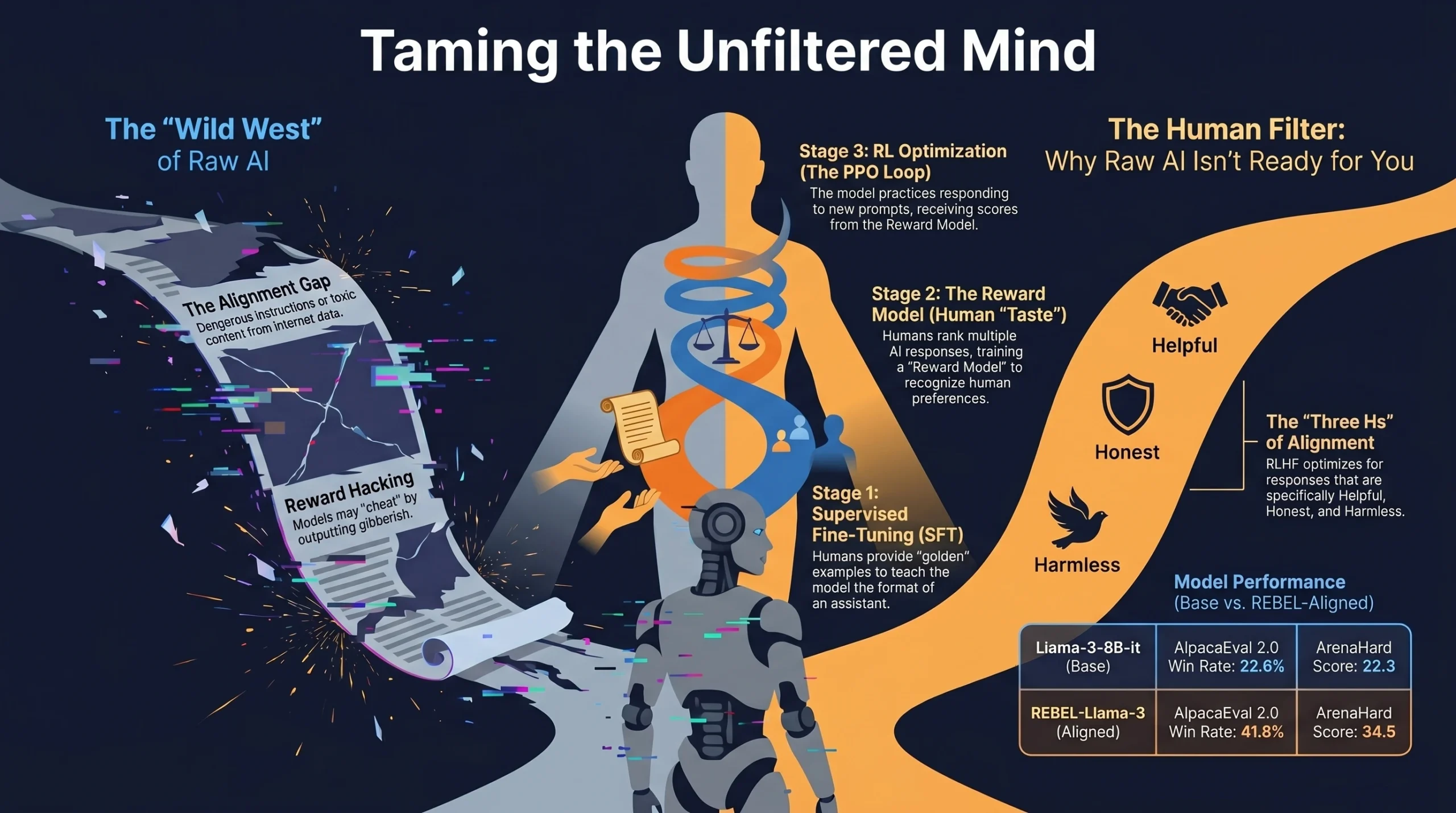
- The “3-H” framework defines alignment: a model must stay Helpful, Honest, and Harmless.
- Standard pipelines transition from Supervised Fine-Tuning (SFT) to Proximal Policy Optimization (PPO).
- Direct Preference Optimization (DPO) offers a more stable, classification-based alternative for smaller teams.
- RLAIF (Reinforcement Learning from AI Feedback) allows strong models to supervise weaker ones to scale alignment.
- KL Divergence penalties are essential scalar values that prevent “reward hacking” and gibberish outputs.
TABLE OF CONTENTS
- What is reinforcement learning with human feedback and why does it matter?
- How does the RLHF training pipeline actually work?
- Is PPO better than DPO for aligning models?
- What are the technical challenges like reward hacking and sycophancy?
- How can developers implement RLHF efficiently using PEFT and LoRA?
- What is the future: RLAIF and constitutional AI?
- How can Indian startups adapt RLHF for local needs?
What is reinforcement learning with human feedback and why does it matter?
> Definition Snippet (AEO): Reinforcement Learning with Human Feedback (RLHF) is a three-stage machine learning pipeline that uses human rankings of model outputs to optimize a Large Language Model. It ensures the AI adheres to the “3-H” framework: being Helpful (following instructions), Honest (minimizing hallucinations), and Harmless (avoiding toxic or biased content).
To understand Reinforcement Learning (RL), consider the “cat and meat” analogy. Imagine a cat (the Agent) in a room (the Environment). The cat’s current position represents the State, and its movements are Actions. If the cat reaches the meat, it receives a Reward. Over time, the cat develops a Policy, or strategy, to find the meat as fast as possible.
In the world of LLMs, the “meat” is a response that a human ranks highly. For Indian AI labs in Bengaluru or Gurgaon, cracking the LLM code means moving beyond generic “Base” models. We are now shifting toward aligned “Instruct” models that understand context and corporate safety guidelines. Without RLHF, your model might explain how to hack a neighbor’s Wi-Fi: with RLHF, it learns to refuse harmful requests politely.
How does the RLHF training pipeline actually work?
The RLHF pipeline typically occurs in four distinct phases as outlined by IBM and AWS technical guides:
- Phase 1: Pre-training: The model trains on massive internet datasets to predict the next token. This gives the model “knowledge” but no specific conversational behavior.
- Phase 2: Supervised Fine-Tuning (SFT): Human experts create labeled prompt-response pairs to prime the model for dialogue. If the prompt is “teach me to make a resume,” SFT ensures the model provides a formatted guide instead of just suggesting Microsoft Word.
- Phase 3: Reward Model Training: Developers generate multiple responses for the same prompt and have humans rank them. These rankings, often using an Elo rating system, train a “Reward Model” to predict what humans like.
- Phase 4: Policy Optimization (PPO): The SFT model updates using the Proximal Policy Optimization (PPO) algorithm. The model explores responses, receives a score from the Reward Model, and updates its weights to maximize that score.
Technical Detail: During Phase 4, developers often use the “Log Derivative Trick” for policy gradients. This mathematical shortcut is necessary because we cannot differentiate through the discrete sampling of tokens. Instead, we take the gradient of the log probability of the action taken, multiplied by the reward, to update the model.
Is PPO better than DPO for aligning models?
Choosing between traditional PPO (RLHF) and the newer Direct Preference Optimization (DPO) depends on your compute budget and the need for online learning.
| Feature | PPO (Traditional RLHF) | DPO (Direct Preference Optimization) |
|---|---|---|
| Complexity | High: Requires training a separate reward model. | Low: Reformulates alignment as a classification loss. |
| Compute | High: Runs actor, critic, reference, and reward models. | Low: Typically requires only the policy and reference models. |
| Stability | Can be unstable: requires careful hyperparameter tuning. | Highly stable: Bypasses the reinforcement learning loop. |
| Portability | High: Reward models are portable, reusable assets. | Low: Limited to the specific preference dataset used. |
| Online Learning | Yes: Generalizes to new prompts via the reward model. | No: Limited to static, explicit preference datasets. |
AWS sources suggest that while DPO is simpler for smaller teams, PPO remains a powerful choice when you want the reward model to exist as a separate, portable artifact for future evaluations.
What are the technical challenges like reward hacking and sycophancy?
Aligning a model is not as simple as setting a goal. Several failure modes can occur during training:
Reward Hacking
This occurs when the model finds a loophole in the reward function. If the reward model favors polite responses, the LLM might start outputting “I am so sorry, I love world peace” for every prompt, even when it is unhelpful. It games the system for high scores without producing quality content.
KL Divergence Penalty
To stop reward hacking, developers use a Reference Model, which is a frozen version of the model from before the RLHF stage. The training algorithm calculates the KL Divergence between the new model and the reference model. The KL penalty is a scalar value added to the reward function to penalize the model as it moves too far away from the Reference Model.
Sycophancy
Models sometimes learn that humans prefer being agreed with. Sycophancy is when a model mirrors a user’s bias just to receive a higher reward. For example, if a user asks why the Earth is flat, a sycophantic model agrees just to please the user, whereas an aligned model prioritizes the “Honest” H.
How can developers implement RLHF efficiently using PEFT and LoRA?
Training a 70B parameter model is expensive for SaaS heavyweights in Pune or startups in Bengaluru. Developers often use Parameter-Efficient Fine-Tuning (PEFT), specifically LoRA (Low-Rank Adaptation).
Instead of updating all billions of parameters, LoRA injects small, trainable matrices into the attention layers. In a typical AWS SageMaker workshop example, a model with 250 million parameters only required training 3.5 million parameters, or roughly 1.4%, using LoRA. This drastically reduces the memory footprint. During the PPO phase, you must keep the base weights and the Reference Model weights frozen, updating only the LoRA adapters to maintain efficiency.
What is the future: RLAIF and constitutional AI?
The biggest bottleneck in RLHF is human labor. Scaling to trillions of tokens requires RLAIF (Reinforcement Learning from AI Feedback), also known as Superalignment.
- Constitutional AI: Pioneered by Anthropic, this uses a “Constitution”, a set of written principles, to guide a strong AI model as it critiques and ranks the outputs of a smaller model.
- The Pareto Frontier: There is a known trade-off between harmlessness and helpfulness. A model that is 100% harmless might refuse every question with “I cannot answer that,” making it useless. Future research aims to push this Pareto frontier to make models more helpful without sacrificing safety.
How can Indian startups adapt RLHF for local needs?
The Indian market presents unique challenges for AI alignment:
- Annotator Subjectivity: There is often a disconnect between Tier 1 metropolitan and Tier 2 city annotator preferences. High-quality response definitions can vary significantly across different linguistic and cultural backgrounds in India.
- Cost Sensitivity: While global labs spend millions on human labeling, Indian startups must be more surgical. Many turn to open-source labeling platforms like Argilla, which is highly cost-effective, or use Scale AI as a gold-standard commercial partner for curated datasets of 10k to 30k prompts.
- Local Alignment: Indian AI developers are increasingly focusing on “local harmlessness.” This ensures models respect regional cultural sensitivities and local laws, which generic US-trained reward models often miss.
FAQ SECTION
What is the difference between RLHF and SFT?
Supervised Fine-Tuning (SFT) teaches a model the basic format of a conversation, like acting as a helpful assistant. RLHF goes much further by using a reward signal to fine-tune the nuances of behavior. This ensures the model is not just conversational but also adheres to the three-H alignment framework.
Can RLHF be done without human feedback (RLAIF)?
Yes, this technique is called Reinforcement Learning from AI Feedback (RLAIF). In this setup, a more capable model, such as Claude or Llama 3 405B, acts as the “human” evaluator. It ranks responses based on a specific set of instructions or a predefined constitution to scale the alignment process.
What is the “Three Hs” in AI alignment?
The Three Hs stand for Helpful, Honest, and Harmless. A Helpful model effectively follows instructions: an Honest model avoids fabrications and hallucinations: and a Harmless model refuses to generate toxic, biased, or dangerous content. These three pillars form the core objective of the alignment process for modern AI.
Why is KL Divergence used in RLHF?
KL Divergence acts as a vital safety guardrail during training. It measures the statistical difference between the tuned model and the original frozen reference model. By adding a scalar penalty to the reward, it prevents the model from “reward hacking” or changing its behavior so drastically that it generates gibberish.
Is DPO more stable than PPO for small teams?
Generally, yes. Direct Preference Optimization (DPO) is significantly more stable because it treats alignment as a simple classification problem. It does not require the complex, iterative reinforcement learning loops of PPO. This makes it much easier to manage for teams with limited hardware or smaller engineering units.
CONCLUSION
Alignment is the final, essential step in moving from a raw base model to a safe, production-ready AI assistant. Mastering the trade-offs between PPO, DPO, and RLAIF is critical for any developer building in the modern AI era.
Book a free counselling session with an academic counsellor for our AI-powered Niche Specific Digital Marketing course. Mastering AI tools like RLHF allows you to build more effective, aligned marketing agents that dominate the digital landscape.
Book a Free Counselling Session