
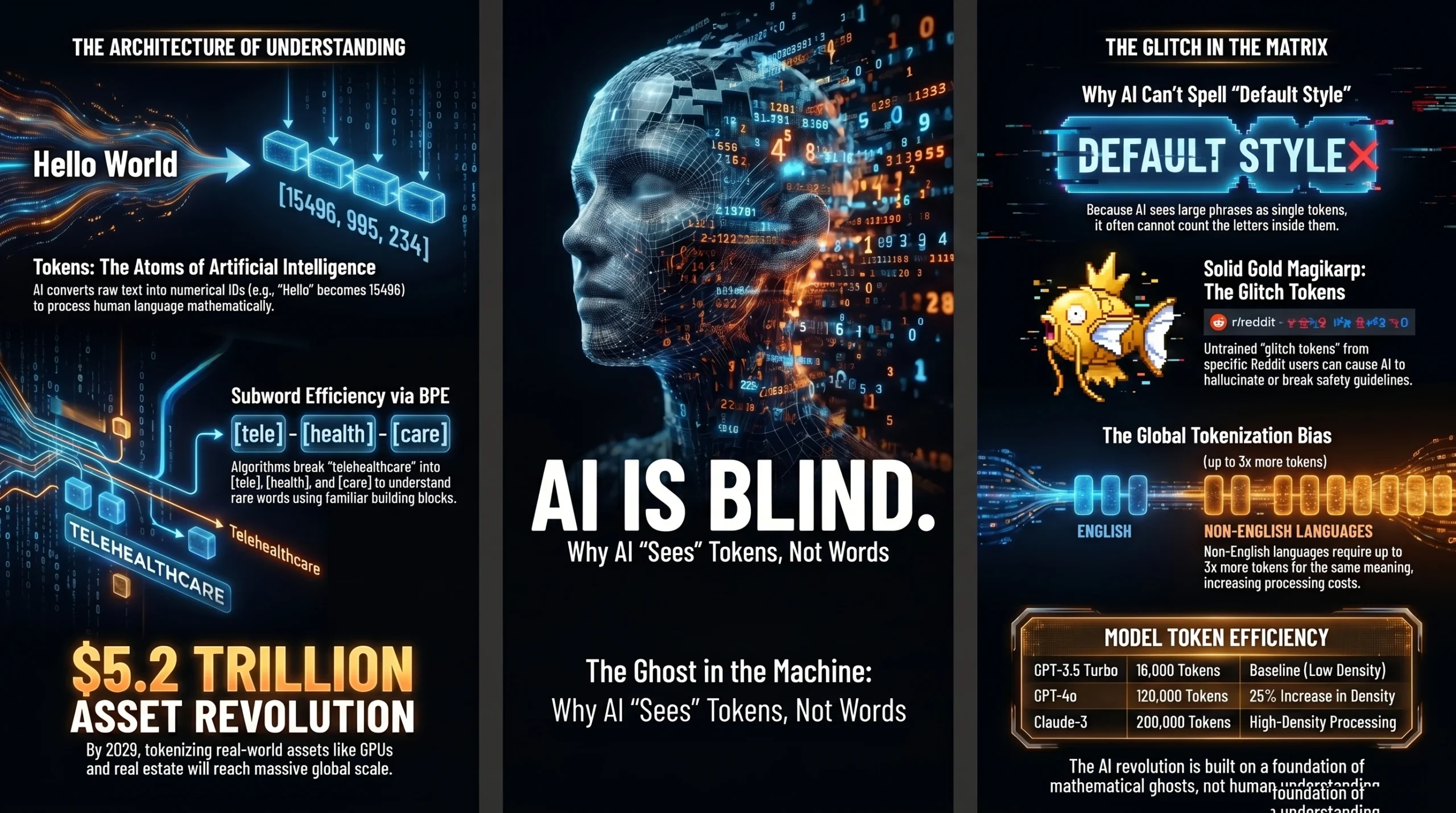
Large Language Models (LLMs) do not “read” text like humans. They are mathematical engines that process sequences of numbers, requiring a sophisticated translation layer to interact with our world.
Inefficient tokenization leads to bloated computational costs and “brain damage” in logical reasoning. For Indian developers, poor token density in regional scripts causes high latency and triples costs for those reaching the next billion users.
Tokenization in AI serves as the critical bridge for efficiency and accuracy. It allows models to handle complex scripts and technical data with mathematical precision.
AI tokenization is the process of converting raw text into standardized mathematical units called tokens. These units represent words or subword fragments that are assigned numerical IDs for a model to process.
- The industry has shifted to subword-level tokenization to improve model density and logic.
- By 2026, AI tokenization will be the standard for securing real-world asset ownership in finance and real estate.
- A 2025 World Economic Forum report, in collaboration with Accenture, highlights tokenization as a key mechanism for modern value exchange.
- The global asset tokenization market is projected to reach USD 5,254.63 billion by 2029.
- Inefficient tokenizing of non-English scripts, like Hindi or Tamil, increases operational costs and wastes context space.
- Modern tokenizers like GPT-4 have improved Python code efficiency by grouping multiple spaces into single tokens.
Table of Contents
- What is Tokenization in AI and How Does it Mathematically Process Language?
- Why is Subword Tokenization the Preferred Standard for Modern LLMs?
- How Does Tokenization in AI Impact the Economics of the Indian Market?
- Can Tokenization in AI Secure Real-World Asset Ownership by 2026?
- What are the Common Challenges and Tokenization Bugs to Watch Out For?
- FAQ:
What is Tokenization in AI and How Does it Mathematically Process Language?
The journey from text to machine understanding begins with the Unicode Consortium standards. Every character is assigned a unique integer called a code point.
For example, the character “h” has a code point of 104. These code points are converted into UTF-8 byte streams, which are variable-length encodings of one to four bytes.
The AI then uses an Embedding Table as a lookup for trainable parameters. This table converts numerical IDs into vectors that the Transformer architecture can process.
Tokenization: The process of converting raw text into discrete mathematical units that an AI model can compute.
Code Points: Numerical identifiers defined by the Unicode Consortium to represent every character across all global writing systems.
Why is Subword Tokenization the Preferred Standard for Modern LLMs?
Subword tokenization, particularly Byte-Pair Encoding (BPE), has emerged as the global standard. It balances word-level simplicity with character-level flexibility.
| Method | Efficiency | Best Use Case |
|---|---|---|
| Word-level | Low flexibility | Simple classification |
| Character-level | Computationally heavy | Spelling correction |
| Subword-level (BPE) | High density | Modern LLMs (GPT-4) |
BPE handles out-of-vocabulary (OOV) words by breaking them into meaningful morphemes, such as “tele-health-care.” This allows the model to handle “doomscrolling” or “metaverse” as novel terms.
In the Indian context, efficiency is a major hurdle. While “Hello” might be one token, “Namaste” in regional scripts often breaks into three or more tokens.
This density gap triples costs for Indian developers. It limits the information they can fit into a model’s context window compared to English-centric competitors.
How Does Tokenization in AI Impact the Economics of the Indian Market?
Token count is directly linked to the Context Window, the finite memory a model has during a session. Wasteful tokenization reduces the data an AI can analyze.
The global GPU market is projected to grow from $65.27 billion in 2024 to $274.21 billion by 2029. This growth is essential for scaling Indian infrastructure.
Indian startups face unique “Tier 1 vs. Tier 2” cost sensitivities. The “Next Billion Users” interact via low-ARPU (Average Revenue Per User) apps.
High token density in vernacular scripts makes these apps economically unviable. Efficiency is the difference between a profitable Indian startup and a failed experiment.
GPT-2 utilized a vocabulary of roughly 50,000 tokens. GPT-4 expanded this to 100,000 tokens, allowing for denser input and significantly better technical performance.
Can Tokenization in AI Secure Real-World Asset Ownership by 2026?
By 2026, tokenization is moving beyond text into Real-World Assets (RWA). The global market for these digital assets could reach USD 5,254.63 billion by 2029.
Strategic collaborations, such as those between Inveniam and Cushman & Wakefield, are already tokenizing commercial property data. This enables institutional-grade management on digital ledgers.
Chirag Bhardwaj (VP – Technology) notes that AI tokenization introduces active decision-making. AI agents now provide automated valuation and identity intelligence for assets.
In India, this technology can tokenize renewable energy via platforms like Powerledger. AI agents will drive fraud detection in real estate across rapidly growing Indian cities.
What are the Common Challenges and “Tokenization Bugs” to Watch Out For?
The “Solid Gold Magikarp” phenomenon involves untrained tokens. These exist in the vocabulary but never appeared in the training set, causing the model to hallucinate.
The “trailing whitespace” bug is another major concern. If a prompt ends in a space, it can move the model off-distribution, leading to poor logical completions.
LLMs often struggle with arithmetic and spelling due to chunking. For example, the word “default style” is a single token in GPT-4.
Because the model sees the whole chunk, it cannot easily count individual letters. It perceives “default style” as an atom, not a sequence of characters.
A non-obvious insight is the “Python Indentation” bug. GPT-2 assigned Token ID 220 to individual spaces, wasting massive amounts of context space.
GPT-4 corrected this by using a tokenizer that groups multiple spaces into single tokens. This “saves” the context window for actual logic and code.
FAQ:
Q1: How does tokenization affect AI pricing?
AI providers charge based on the number of tokens processed. Because different tokenizers break text differently, a model with poor density for your specific language will cost more per request.
Q2: What is the difference between TikToken and SentencePiece?
TikToken (OpenAI) focuses on byte-level BPE for efficiency. SentencePiece (Llama 2) works on Unicode code points and uses “byte fallback” for rare characters. Llama 2 specifically splits all digits to improve arithmetic.
Q3: Why can’t AI spell some words correctly?
AI models see chunks of text rather than individual letters. When “default style” is one token, the model lacks a character-level view, making it difficult to reverse the word.
Q4: Is tokenization the same as encryption?
No. Tokenization is a linguistic translation layer for model processing. While it handles data identifiers, it is primarily a tool for communication rather than a security method for data protection.
Q5: How do “special tokens” like work?
Special tokens are used as delimiters. The token tells the model that a document has ended, ensuring text following it is treated as a new, unrelated context.
Conclusion
Tokenization is the foundational layer of AI efficiency, determining how models perceive language and resources. As we approach 2026, mastering this process is essential for scaling digital ownership and reducing costs in the Indian market.
Book a free counselling session with an academic counsellor for our AI-powered Niche Specific Digital Marketing course. Mastering AI fundamentals like tokenization is the key to driving career growth and staying competitive in the evolving Indian tech landscape.