
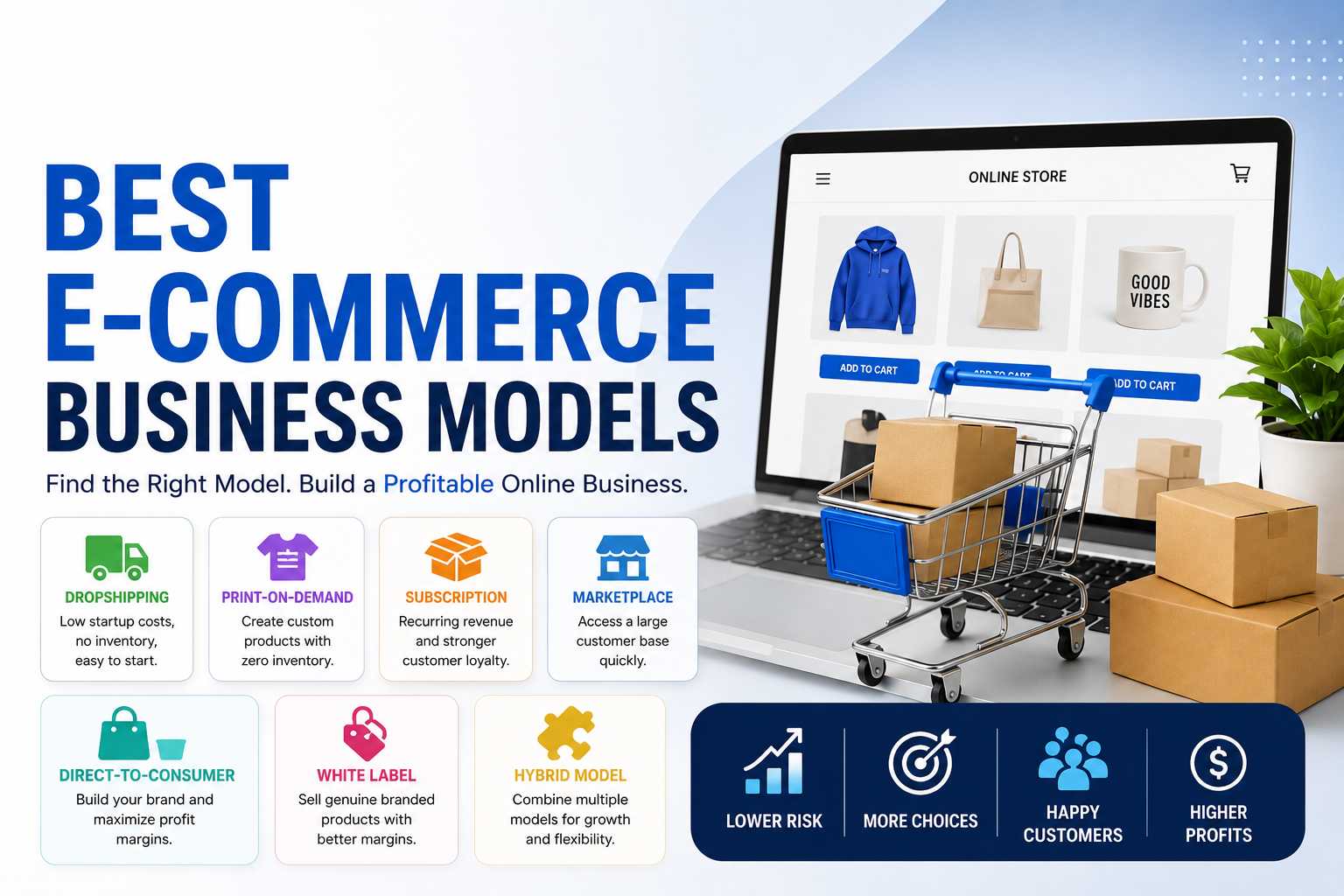
Launching an online business has never been more accessible, yet the success of your venture heavily depends on selecting the right e-commerce business model. In today’s digital marketplace, there’s no one-size-fits-all approach to selling online. Whether you’re a budding entrepreneur with limited capital or an established brand looking to expand, understanding different e-commerce business models is crucial for long-term profitability and growth.
An e-commerce business model essentially defines how your company creates, delivers, and captures value through online channels. It encompasses everything from your inventory management strategy to your customer acquisition methods. The right e-commerce business model can mean the difference between struggling to break even and building a thriving, scalable business that generates consistent revenue.
TLDR
- Dropshipping: Low startup costs, no inventory, minimal profit margins – perfect for beginners
- Print-on-Demand: Creative products, zero inventory, great for designers and artists
- Subscription: Recurring revenue, customer loyalty, higher lifetime value
- Marketplace: Quick access to customers, lower control, platform-dependent success
- D2C: Maximum profitability and control, requires significant marketing investment
- White Label: Genuine branded products, higher startup costs, better margins than dropshipping
- Hybrid: Combine multiple models for diversification and risk reduction
Table of Content
- What Is an E-commerce in Business Model and Why Does It Matter?
- How Does the Dropshipping Model Work for E-commerce?
- What Makes Print-on-Demand Attractive for E-commerce Entrepreneurs?
- How Can You Succeed with Marketplace Selling as Your E-commerce Model?
- What Are the Benefits of Direct-to-Consumer (D2C) as Your E-commerce Model?
- How Does the White Label E-commerce Business Model Function?
- FAQ
- Conclusion
What Is an E-commerce in Business Model and Why Does It Matter?
An e-commerce business model is a strategic framework that outlines how your online business will generate revenue and deliver value to customers. It’s the foundation upon which every successful online venture is built. Before launching your store, you need to understand your chosen e-commerce business model inside and out.
The right e-commerce business model determines several critical factors:
- Startup costs and capital requirements
- Inventory management complexity
- Customer service demands
- Supplier relationships and partnerships
- Profit margins and revenue potential
- Scalability options
- Time investment and operational burden
Many aspiring entrepreneurs jump into the world of online selling without properly evaluating which e-commerce business model suits their situation. This oversight often leads to wasted resources, frustration, and business failure. By carefully selecting from available e-commerce business models, you dramatically increase your chances of building a sustainable, profitable operation.
How Does the Dropshipping Model Work for E-commerce?
Dropshipping represents one of the most popular e-commerce business models for beginners, and for good reason. This e-commerce business model allows you to sell products without holding inventory or managing fulfillment operations directly.
How the Dropshipping E-commerce Business Model Functions:
In a dropshipping e-commerce business model, you partner with suppliers or manufacturers who handle inventory storage and order fulfillment. When a customer purchases a product from your store, you forward the order to your supplier, who then packages and ships the product directly to the customer. Your profit comes from the markup between the wholesale price you pay and the retail price customers pay.
Advantages of the Dropshipping E-commerce Business Model:
- Low startup costs – You don’t need capital for inventory
- Minimal risk – You only pay for products after they’re sold
- Easy to start – Quick to launch your online store
- Location flexibility – Manage your business from anywhere
- Wide product selection – Offer numerous products without storage concerns
- Scalability – Grow without proportional increases in operational complexity
What Makes Print-on-Demand Attractive for E-commerce Entrepreneurs?
Print-on-demand (POD) is another compelling e-commerce business model that eliminates inventory risk while enabling creative entrepreneurs to thrive. This e-commerce business model is particularly suitable for those with design skills or creative vision.
Understanding the Print-on-Demand E-commerce Business Model:
In this e-commerce business model, you create or curate designs, and a POD partner manufactures and ships custom products only when orders arrive. Whether it’s t-shirts, mugs, hoodies, or phone cases, the POD e-commerce business model covers virtually any customizable product category.
Why Choose the Print-on-Demand E-commerce Business Model:
- No inventory investment – Products are made to order
- Creative freedom – Design unique products your customers love
- Easy product testing – Launch new designs with minimal risk
- Sustainable practices – Reduce waste through made-to-order production
- Worldwide reach – International shipping handled by partners
- High profit potential – Build loyal communities around unique designs
- Brand building – Express your brand identity through custom designs
Limitations of the Print-on-Demand E-commerce Business Model:
- Higher per-unit costs – Lower profit margins than traditional retail
- Longer production times – Custom manufacturing requires waiting periods
- Quality inconsistency – Varies by POD partner and product type
- Design copyright concerns – Must ensure design originality
- Partner dependency – Limited control over the final product quality
Why Choose a Subscription Box E-commerce Business Model?
Subscription-based services represent an increasingly popular e-commerce business model that prioritizes customer retention and predictable recurring revenue. This e-commerce business model has transformed how companies think about customer relationships and lifetime value.
How the Subscription E-commerce Business Model Works:
Customers pay a recurring fee (monthly, quarterly, or annually) to receive curated products or services. This e-commerce business model creates a continuous revenue stream and builds deeper relationships with your customer base. Examples range from beauty boxes and coffee subscriptions to niche hobby boxes.
Benefits of the Subscription E-commerce Business Model:
- Predictable revenue – Recurring payments enable accurate forecasting
- Customer loyalty – Regular touchpoints build long-term relationships
- Higher lifetime value – Customers spend more over time with subscriptions
- Reduced acquisition costs – Retain customers at a lower cost than acquiring new ones
- Business resilience – Steady cash flow helps weather market fluctuations
- Data insights – Understand customer preferences through subscription patterns
Drawbacks of the Subscription E-commerce Business Model:
- High churn rates – Customers frequently cancel subscriptions
- Customer acquisition costs – Expensive to convert buyers into subscribers
- Product sourcing complexity – Need reliable suppliers for consistent quality
- Storage requirements – May need warehouse space depending on the model
- Customer service demands – Subscribers expect responsive support
How Can You Succeed with Marketplace Selling as Your E-commerce Model?
Marketplace selling is a distinct e-commerce business model where you leverage existing platforms like Amazon, eBay, Etsy, or Shopify to reach established customer bases. This e-commerce business model removes the burden of driving traffic to your own store.
The Marketplace E-commerce Business Model Explained:
Instead of building your own website, you create seller accounts on popular marketplaces. You list your products, manage customer interactions through the platform, and let the marketplace handle significant portions of customer acquisition. This e-commerce business model trades independence for built-in traffic and credibility.
Advantages of the Marketplace E-commerce Business Model:
- Instant customer access – Tap into established audiences
- Trust and credibility – Platforms bring built-in consumer confidence
- Built-in payment processing – Secure transaction handling
- Fulfillment options – Many marketplaces offer fulfillment services
- Marketing exposure – Platform algorithms help with product visibility
- Lower technical barrier – Minimal website development required
- Reduced operational burden – Platforms handle many backend functions
Challenges with the Marketplace E-commerce Business Model:
- Lower margins – Platform fees reduce profitability
- Limited control – Platforms set rules and can change policies
- Account vulnerability – Risk of suspension or termination
- Brand limitations – Difficult to build unique brand identity
- Intense competition – Compete with countless sellers on same platforms
- Algorithm dependency – Success depends on platform rankings
What Are the Benefits of Direct-to-Consumer (D2C) as Your E-commerce Model?
The direct-to-consumer (D2C) e-commerce business model has emerged as a powerful strategy for brands seeking complete control and maximum profitability. This e-commerce business model involves selling directly to customers through your own channels, eliminating middlemen.
Understanding the D2C E-commerce Business Model:
With a D2C e-commerce business model, you own the customer relationship entirely. You control pricing, messaging, customer experience, and brand narrative. This e-commerce business model requires more effort upfront but offers superior long-term advantages for growth-focused brands.
Why Brands Embrace the D2C E-commerce Business Model:
- Maximum control – Set your own rules and brand direction
- Higher profit margins – Eliminate distributor and retailer markups
- Customer data ownership – Gather valuable insights about your audience
- Brand building – Create unique, memorable brand experiences
- Agility – Quickly adapt to market changes and trends
- Feedback loop – Direct customer communication improves products
- Long-term value – Build lasting customer relationships and loyalty
Obstacles in the D2C E-commerce Business Model:
- High initial investment – Website development, marketing, fulfillment setup
- Customer acquisition costs – Expensive to build awareness independently
- Operational complexity – Manage multiple business functions
- Technology requirements – Need robust systems and tools
- Marketing expertise needed – Can’t rely on platform algorithms
- Fulfillment responsibility – Handle or outsource shipping logistics
How Does the White Label E-commerce Business Model Function?
White labeling represents a sophisticated e-commerce business model where you resell products manufactured by others under your own brand name. This e-commerce business model bridges the gap between dropshipping and having genuine branded products.
The White Label E-commerce Business Model Breakdown:
In a white label e-commerce business model, you partner with manufacturers who produce products to your specifications and brand them with your labels, packaging, and designs. Unlike dropshipping, this e-commerce business model creates genuine branded products you can call your own.
Strengths of the White Label E-commerce Business Model:
- Brand authenticity – True branded products, not generic resells
- Better margins – Higher profits than dropshipping
- Quality control – Specify exact product standards
- Customization – Design unique packaging and branding
- Wholesale relationships – Negotiate better terms at scale
- Differentiation – Stand out from competitors with unique products
- Long-term asset – Build recognizable brand value
Limitations of the White Label E-commerce Business Model:
- Higher startup costs – Minimum order quantities and development fees
- Slower to launch – Product development and customization takes time
- Inventory commitment – Must order stock in advance
- Quality variation – Manufacturer issues directly impact your brand
- Payment risks – Tie up capital in inventory
Why Should You Consider a Hybrid E-commerce Approach?
Rather than committing exclusively to one e-commerce business model, many successful businesses adopt hybrid approaches that combine multiple models. This flexible e-commerce business model strategy maximizes opportunities while diversifying revenue streams.
Examples of Hybrid E-commerce Business Models:
- D2C + Marketplace – Sell through your own site and Amazon simultaneously
- Subscription + Marketplace – Offer subscription options on multiple platforms
- POD + White Label – Use POD for low-volume designs, white label for bestsellers
- Dropshipping + D2C – Test products through dropshipping before committing to inventory
- Subscription + Affiliate – Combine subscription revenue with affiliate partnerships
Advantages of Hybrid E-commerce Business Models:
- Risk diversification – Don’t depend entirely on one revenue source
- Audience expansion – Reach customers across multiple channels
- Flexibility – Test and adapt strategies without abandoning everything
- Revenue optimization – Choose the best model for each product category
- Platform advantages – Leverage strengths of each e-commerce business model
- Growth acceleration – Scale faster by combining complementary approaches
FAQ
Q1: What is the best e-commerce business model for beginners?
Dropshipping and print-on-demand are ideal starting points for beginners because they require minimal upfront investment and no inventory management. Both allow you to test market viability with low financial risk.
Q2: Which e-commerce business model generates the most profit?
D2C and white label models typically generate the highest profit margins because you eliminate middlemen and maintain complete pricing control. However, they also require higher startup investment and more operational complexity.
Q3: Can you combine multiple e-commerce business models?
Absolutely. Many successful businesses use hybrid approaches, combining marketplace selling with D2C channels, or mixing subscription services with standard e-commerce sales. Hybrid e-commerce business models provide diversification and allow you to serve different customer segments effectively.
Q4: How do I choose between dropshipping and print-on-demand?
Choose dropshipping if you prefer product sourcing, supplier management, and selling physical goods across various categories. Choose print-on-demand if you have creative skills, enjoy design, and want to build a brand around customizable products.
Q5.What are the risks of each e-commerce business model?
A: Dropshipping risks include supplier reliability and quality control issues. POD risks involve design copyright and quality inconsistency. Subscriptions risk high churn rates. Marketplaces risk account suspension and policy changes. White label risks include inventory commitments and manufacturer issues. D2C risks involve high customer acquisition costs.
Conclusion
Selecting the right e-commerce business model is one of the most critical decisions you’ll make as an entrepreneur. This foundational choice impacts everything from startup costs to daily operations, profit margins to growth potential, and customer relationships to brand development.
Ready to launch your online business? Take action today by selecting your e-commerce business model, validating your idea, and building your first store. The best time to start was yesterday; the second-best time is right now. Your ideal e-commerce business model is waiting – it’s time to bring your entrepreneurial vision to life.
Book a free counselling session with an academic counsellor for our AI-powered Niche Specific Digital Marketing course
Book a Free Counselling Session