
Creating content takes time. Research, writing, editing, designing, publishing — by the time a single blog post goes live, you’ve often invested hours, sometimes days, of effort. And then what happens? Most marketers hit publish, share it once on social media, and move on to the next piece.
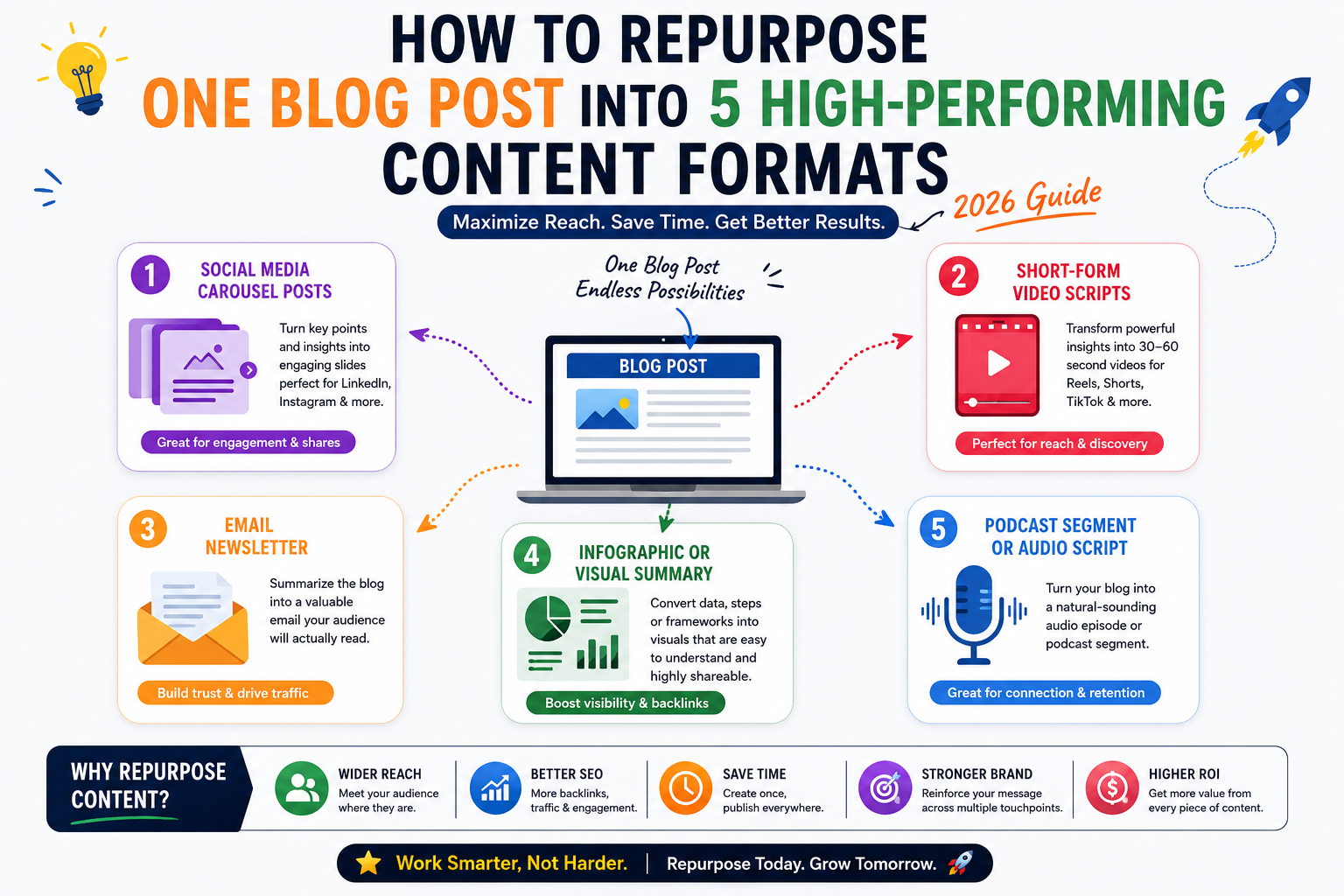
This is where content repurposing changes the game. Instead of treating your blog post as a one-time asset, content repurposing lets you extract maximum value from every piece you create. One well-researched blog post can become a LinkedIn carousel, a YouTube Short script, an email newsletter, an infographic, and a podcast segment — all without starting from scratch.
TL;DR
- Content repurposing means taking one piece of content (like a blog post) and transforming it into multiple formats to reach audiences across different platforms.
- A single blog post can be repurposed into at least five formats: social media carousels, short-form video scripts, email newsletters, infographics, and podcast or audio scripts.
- Smart content repurposing saves time, increases content ROI, improves SEO through backlinks and engagement signals, and helps you show up where your audience already spends time.
- The key to successful content repurposing isn’t copy-pasting — it’s reformatting your message to fit the native style of each platform.
- Below, you’ll find a complete, actionable framework for repurposing content, plus tools, examples, and a FAQ section answering the most searched questions about content repurposing.
Table of Contents
- What Is Content Repurposing and Why Does It Matter?
- Why Should You Repurpose One Blog Into Multiple Formats?
- How Do You Start a Content Repurposing Strategy?
- What Are the Five Best Formats for Content Repurposing?
- How Do You Measure the Success of Content Repurposing?
- What Tools Can Help With Content Repurposing?
- FAQ
- Conclusion
What Is Content Repurposing and Why Does It Matter?
Content repurposing is the process of taking existing content and adapting it into new formats to extend its reach, lifespan, and impact. Rather than creating brand-new content from scratch every time, you take a core piece — your blog post — and reshape its ideas for different platforms and audience preferences.
Why does this matter so much right now? A few reasons:
- Audience fragmentation. Your audience isn’t only reading blogs. Some prefer short videos, others scroll through LinkedIn, and many still check email daily. Content repurposing meets people where they already are.
- SEO compounding. When you repurpose content into videos, infographics, and social posts that link back to your original blog, you create more backlink and traffic opportunities, which strengthens your domain’s authority over time.
- Time and resource efficiency. Producing five pieces of content from one source is dramatically faster than creating five pieces from scratch.
- Message reinforcement. People rarely convert after seeing your message once. Content repurposing increases the number of touchpoints, which improves brand recall and conversion rates.
Why Should You Repurpose One Blog Into Multiple Formats?
If you’ve ever wondered whether content repurposing is “worth it,” consider this: a single blog post represents hours of strategic thinking, keyword research, and writing. Letting that effort live only as a static page on your website is a massive underuse of a valuable asset.
Here’s why repurposing one blog into multiple formats pays off:
- Wider reach across platforms. Not everyone who would benefit from your content is on your blog. Some are on Instagram, others on Spotify, others in their inbox. Content repurposing puts your message in front of each of these audiences in the format they prefer.
- Better SEO performance. Search engines reward content that earns engagement, shares, and backlinks. When your repurposed video or infographic links back to the original blog, it sends positive signals that can improve rankings.
- Stronger brand consistency. Repeating your core message across formats — without sounding repetitive — builds familiarity and trust with your audience.
- Higher ROI on content creation. Instead of measuring ROI per blog post, you start measuring it per content idea, which multiplies the value of every hour spent on research and writing.
How Do You Start a Content Repurposing Strategy?
Before jumping into specific formats, it helps to have a clear framework. Here’s a simple five-step process for setting up an effective content repurposing strategy:
Step 1: Choose the Right Source Content
Not every blog post is a good repurposing candidate. Look for blogs that are:
- Evergreen (not time-sensitive)
- Data-rich or insight-heavy
- Structured with clear sections, lists, or steps
- Already performing well in organic search or engagement
Step 2: Identify the Core Message
Every blog has one central idea. Before repurposing, extract that core message in one or two sentences. This becomes your anchor across every format so your repurposed content stays consistent and on-brand.
Step 3: Map Formats to Platforms
Different formats work better on different platforms. Carousels perform well on Instagram and LinkedIn. Short videos perform well on YouTube Shorts, Reels, and TikTok. Newsletters work for direct audience nurturing. Match the format to where your audience actually engages.
Step 4: Adapt, Don’t Copy-Paste
The biggest content repurposing mistake is simply copying blog text into a new format. Each platform has its own tone, pacing, and visual language. Successful content repurposing means rewriting and redesigning content to feel native to its new home.
Step 5: Link Everything Back
Every repurposed piece should, where possible, link back to the original blog post. This drives traffic, supports SEO, and creates a content ecosystem where each piece reinforces the others.
With this framework in place, let’s look at the five specific formats you can create from a single blog post.
What Are the Five Best Formats for Content Repurposing?
This is the heart of any content repurposing strategy: knowing exactly which formats to create. Below are five proven formats that work for almost any blog topic.
1. Social Media Carousel Posts
Carousels are one of the highest-performing content repurposing formats on LinkedIn and Instagram. Take the key points, statistics, or steps from your blog and turn each one into a slide.
How to repurpose a blog into a carousel:
- Slide 1: Hook (the blog’s main question or surprising stat)
- Slides 2–8: One key point per slide, simplified into a sentence or two
- Final slide: CTA driving traffic to the full blog post
Carousels work because they’re skimmable, visually engaging, and shareable — three qualities that make them ideal for content repurposing.
2. Short-Form Video Scripts (Reels, Shorts, TikTok)
Short-form video is one of the fastest-growing content formats, making it essential for any content repurposing plan. Pull out the single most compelling insight, stat, or contrarian take from your blog and build a 30–60 second script around it.
Repurposing tip: Don’t try to cover the entire blog in one video. Pick one angle per video and create a short series instead — this also gives you more repurposed content from a single source.
3. Email Newsletter Feature
Your email list is one of your most valuable owned channels, and repurposing blog content into a newsletter feature keeps subscribers engaged without requiring brand-new writing. Summarize the blog’s core insight in 150–250 words, add a personal angle or quick takeaway, and link to the full post for readers who want more depth.
This format is especially effective for content repurposing because email already has high intent — your audience opted in, so they’re primed to click through.
4. Infographic or Visual Summary
If your blog includes data, statistics, steps, or comparisons, it’s a strong candidate for visual repurposing. Infographics condense complex information into a scannable visual format, making them highly shareable on Pinterest, LinkedIn, and within other blog posts (yours or others’, via backlinks).
Repurposing tip: Focus on one clear narrative arc — a process, a before/after, or a ranked list — rather than cramming in every detail from the blog.
5. Podcast Segment or Audio Script
Audio content is one of the most underused content repurposing formats, yet it’s incredibly effective for building deeper audience connection. Turn your blog into a 5–10 minute podcast segment or audio script by:
- Reading the core argument in a conversational tone
- Adding personal commentary, examples, or recent updates not in the original post
- Ending with a clear next step or link to the blog
How Do You Measure the Success of Content Repurposing?
Repurposing content is only valuable if it actually performs. Here’s how to track success across formats:
- Traffic attribution: Use UTM parameters on every repurposed piece so you can see exactly how much traffic each format sends back to your original blog.
- Engagement metrics: Track likes, shares, comments, and saves on social formats; open and click-through rates on email; watch time on video.
- SEO impact: Monitor backlinks, organic traffic, and keyword rankings for the original blog post after repurposed content goes live.
- Content velocity: Measure how much content output increases per hour of original research and writing — this is the true efficiency gain of content repurposing.
What Tools Can Help With Content Repurposing?
You don’t need an entire production team to execute a strong content repurposing workflow. Here are categories of tools that simplify the process:
- Design tools (like Canva) for carousels and infographics
- Video editing tools (like CapCut) for short-form video scripts and clips
- Email platforms (like Mailchimp or ConvertKit) for newsletter repurposing
- AI writing assistants for drafting scripts, summaries, and captions from your original blog content
- Project management boards (like Trello or Notion) to map out which blog gets repurposed into which formats and when
FAQ
Q.What is content repurposing in digital marketing?
Content repurposing in digital marketing is the practice of transforming an existing piece of content, such as a blog post, into different formats — like videos, infographics, or social posts — to reach new audiences and maximize the value of the original content.
Q.Why is content repurposing important for SEO?
Content repurposing supports SEO by generating additional backlinks, social signals, and engagement that point back to the original blog post, which can improve search rankings and organic visibility over time.
Q.What types of content are best for repurposing?
Evergreen, data-rich, and well-structured blog posts with clear steps, lists, or statistics are the best types of content for repurposing because they translate easily into visual or short-form formats.
Q.What is the difference between content repurposing and content recycling?
Content repurposing involves transforming content into a new format (like a blog into a video), while content recycling typically means republishing or updating the same format (like refreshing an old blog post) without changing its structure.
Q.How long does it take to repurpose one blog post into multiple formats?
With a clear content repurposing framework and the right tools, creators can typically repurpose one blog post into five formats within a few hours, especially when using templates for carousels, scripts, and newsletters.
Conclusion
Content repurposing isn’t about doing more work — it’s about extracting more value from the work you’ve already done. One well-crafted blog post contains enough insight, structure, and substance to fuel a carousel, a short video, a newsletter feature, an infographic, and a podcast segment. Each format reaches a different slice of your audience, reinforces your message, and drives traffic back to your original content.
The brands and creators who win in 2026 won’t necessarily be the ones publishing the most new content — they’ll be the ones who repurpose smartest, turning every blog post into a multi-platform content engine.