Digital marketing in 2026 doesn’t look like it did even two or three years ago. Search engines now sit alongside AI chat assistants. Budgets are tighter, and businesses want proof that every rupee or dollar spent actually moves the needle. At the same time, the tools available to marketers have multiplied — automation platforms, AI copywriting assistants, predictive analytics dashboards — which means the bar for what counts as a “skilled” marketer has risen too.
If you’re a student exploring this field, a working professional trying to stay relevant, or a business owner trying to understand what to look for when hiring, you need clarity on the skills in digital marketing that actually matter right now — not the ones that mattered in 2019. The top digital marketing skills to learn in 2026 include SEO and AI SEO (AEO), performance marketing, content and thought leadership, social media strategy, data analytics, marketing automation, and AI-powered tools, since businesses are shifting toward AI-first search, privacy-led advertising, and outcome-driven growth.
TL;DR
- Digital marketing in 2026 requires much more than posting on social media or running ads.
- Employers and clients want marketers who can combine creativity, data analysis, and AI tools.
- Modern marketers must optimize content for both traditional search engines and AI-powered answer engines like ChatGPT and Gemini.
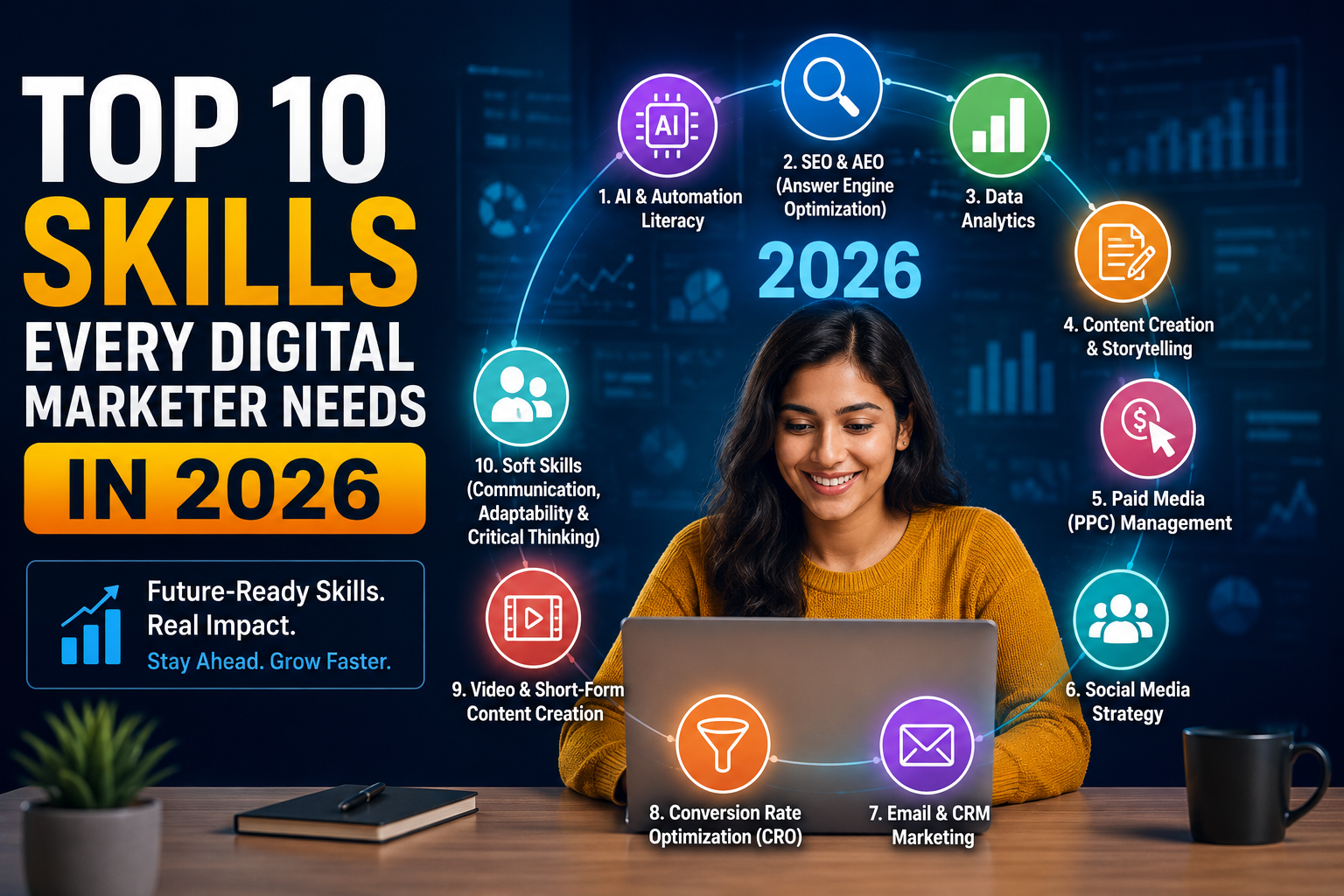
- The 10 essential digital marketing skills for 2026 are AI and Automation Literacy, SEO & Answer Engine Optimization (AEO), Data Analytics, Content Creation & Storytelling, Paid Media (PPC) Management, Social Media Strategy, Email & CRM Marketing, Conversion Rate Optimization (CRO), Video & Short-Form Content Creation, and Soft Skills like Communication, Critical Thinking, and Adaptability.
- Learning even 5–6 of these skills can give you a strong competitive advantage in the digital marketing job market.
- This guide includes a detailed explanation of each skill, real-world examples, practical applications, tips for building a future-proof digital marketing career, and an FAQ section covering the most common questions about digital marketing skills in 2026.
Table of Content
- Why Is AI and Marketing Automation Literacy a Must-Have Skill in 2026?
- How Important Is SEO and Answer Engine Optimization (AEO) for Digital Marketers?
- Why Do Digital Marketers Need Strong Data Analytics Skills?
- What Content Creation and Storytelling Skills Do Marketers Need Today?
- How Should Digital Marketers Approach Paid Media and PPC Skills?
- Why Is Social Media Strategy More Than Just Posting Content in 2026?
- What Role Does Email Marketing and CRM Knowledge Play in a Digital Marketer’s Skill Set?
- How Does Conversion Rate Optimization (CRO) Fit Into a Marketer’s Skill Set?
- Why Is Video and Short-Form Content Creation a Core Digital Marketing Skill Now?
- Which Soft Skills Separate Good Digital Marketers From Great Ones?
- FAQ
- Conclusion
Why Is AI and Marketing Automation Literacy a Must-Have Skill in 2026?
AI is no longer an optional add-on to a marketer’s toolkit — it’s becoming part of the daily workflow. Many marketing teams are under pressure to do more in less time, and have started using AI tools to handle repetitive work like drafting emails, testing ad copy, or setting up basic workflows — not to replace people, but to speed things up where possible.
This doesn’t mean every digital marketer needs to become a machine learning engineer. A basic understanding is becoming important — you don’t need deep technical knowledge, but knowing how to use AI tools in daily tasks can make your work faster and more efficient. What employers actually expect is “AI curiosity” — a willingness to experiment, learn, and continuously evaluate new tools. In 2026, AI isn’t just another tool; it’s part of every marketer’s workflow, and the strongest professionals aren’t expected to know everything about AI, but they are expected to stay curious. Businesses also need marketers who regularly review their martech stack and identify where AI tools can improve speed, accuracy, and outcomes.
How to build this skill:
- Learn prompt engineering basics for content drafting and idea generation
- Get comfortable with at least one automation platform (HubSpot, Zapier, Mailchimp automation, or similar)
- Practice using AI tools for research, A/B test copy variations, and reporting summaries
- Regularly audit your tool stack to spot redundancies or gaps
How Important Is SEO and Answer Engine Optimization (AEO) for Digital Marketers?
SEO has long been considered one of the most foundational skills in digital marketing, and that hasn’t changed — but what SEO means has expanded. SEO remains one of the most sought-after skills in digital marketing, with more brands focusing on increasing organic visibility by targeting the right keywords for their audience, while also expanding into Answer Engine Optimization, which focuses on getting content visibility on AI and LLM tools like ChatGPT, Perplexity, and Gemini.
This is a big shift. Traditionally, SEO meant optimizing for Google’s ranking algorithm. Now, marketers also need to think about how AI chatbots summarize and cite content when users ask questions directly instead of typing search queries. Sixty-six percent of marketers worldwide already use artificial intelligence in their roles, a trend expected to grow further as brands optimize for AI and LLM-driven search and answer engines.
On the traditional side, the fundamentals still apply. As search engines get smarter and user intent becomes more nuanced, digital marketers must stay current with algorithm updates, invest in technical SEO, and create content that stands out amid the rise of AI-generated content.
Core SEO and AEO skills to develop:
- Keyword research and search intent mapping
- Technical SEO (site speed, crawlability, structured data/schema markup)
- Content structuring for featured snippets and AI summarization (clear headings, direct answers, FAQ blocks)
- On-page optimization and internal linking
- Monitoring brand visibility inside AI chat tools, not just Google rankings
Why Do Digital Marketers Need Strong Data Analytics Skills?
If creativity is the heart of marketing, data is the nervous system that tells you whether it’s working. Data is at the heart of smart digital decision-making, and top marketers leverage analytics to gain deep insights into consumer journeys, campaign performance, and market opportunities — familiarity with advanced data visualization, Google Analytics 4, and even basic database logic like SQL is moving from a desirable skill to an expected one.
Even entry-level marketers aren’t exempt from this expectation anymore. Data drives decision-making in digital marketing, and even at entry level, employers expect comfort with basic data analysis that turns numbers into actionable insights.
Analytics skills worth prioritizing:
- Google Analytics 4 (GA4) navigation and reporting
- Reading and interpreting dashboards (not just generating them)
- Basic SQL or spreadsheet-level data manipulation
- Attribution modeling and understanding the customer journey
- Translating numbers into a clear business recommendation
What Content Creation and Storytelling Skills Do Marketers Need Today?
Despite all the talk about AI and automation, content remains the backbone of every campaign. Content remains at the heart of digital marketing, and employers look for candidates who understand how to plan, create, and manage content that connects with audiences and supports business goals.
But the bar for “good content” has risen because AI-generated text is everywhere now, which makes genuinely strong writing stand out more, not less. Writing is considered one of the most crucial skills in digital marketing, since every marketing asset is centered around words, and a well-written campaign can double conversions without making major changes to design or targeting. By 2026, companies favor candidates with a deep understanding of tone, voice, audience psychology, structural flow, readability, and call-to-action placement.
This applies across formats — blogs, landing pages, email, video scripts, and social captions all rely on the same underlying skill: knowing how to hold someone’s attention and move them toward a decision.
How to sharpen content skills:
- Practice writing for different formats: long-form blogs, ad copy, email subject lines, video scripts
- Study audience psychology — what makes people click, trust, or convert
- Learn basic brand voice and tone consistency across channels
- Use AI tools as a first draft assistant, not a replacement for editing and judgment
How Should Digital Marketers Approach Paid Media and PPC Skills?
Paid advertising is where most marketing budgets actually get spent, which makes it one of the highest-leverage skills in digital marketing to master. Paid advertising across platforms like Google Ads, Meta Ads, and LinkedIn Ads requires analytical thinking, budgeting, A/B testing, ad copy planning, targeting logic, and performance tracking, making it one of the highest-value digital marketing skills since businesses are the largest spenders in this channel.
What separates a good paid media marketer from an average one is the ability to connect ad performance to business outcomes, not just vanity metrics like impressions. A marketer capable of managing advertising dashboards, analyzing CTR and CPC metrics, interpreting conversion paths, and optimizing campaigns based on data stands out immediately. This also includes learning bidding strategies, keyword match types, cost optimization, and landing page alignment.
Even at the entry level, foundational paid media knowledge is now expected. Entry-level paid advertising skills include understanding different types of paid ads across search, display, and social, even though advanced tactics are typically reserved for senior roles.
Paid media skills to build:
- Campaign setup across Google Ads, Meta Ads, and LinkedIn Ads
- A/B testing ad creatives and landing pages
- Budget allocation and bid strategy basics
- Reading CTR, CPC, ROAS, and conversion data
- Aligning ad targeting with landing page messaging
Why Is Social Media Strategy More Than Just Posting Content in 2026?
Social media management has matured from “post consistently” into a genuinely strategic discipline. Effective marketers know how to capitalize on platform trends, tailor message formats, and schedule posts for maximum engagement, while social listening and real-time analytics provide critical feedback that guides ongoing strategy and rapid adjustment.
Performance expectations have also tightened significantly. By 2026, social media will be more performance-driven, and companies will expect marketers to be skilled at measuring engagement quality, cost per result, and retention value — not just follower counts. This requires understanding how each platform’s algorithm actually behaves. Social media marketing requires understanding algorithm behaviors, audience segmentation, content calendars, engagement planning, and brand storytelling, with success hinging on building identity, delivering consistent brand experiences, and converting followers into leads.
Social media skills to focus on:
- Platform-specific content formatting (Reels, LinkedIn carousels, X threads, etc.)
- Social listening and community management
- Influencer and creator partnership management
- Reading platform analytics beyond likes and followers
- Building content calendars tied to business goals
What Role Does Email Marketing and CRM Knowledge Play in a Digital Marketer’s Skill Set?
Email is often overlooked in favor of flashier channels, but it remains one of the most reliable performers in any marketing stack. Email continues to be the highest-returning digital channel when executed well, making it a critical skill for customer retention, lead nurturing, and remarketing.
Email and CRM skills worth developing:
- List segmentation and personalization
- Automated drip and nurture sequences
- A/B testing subject lines and send times
- CRM data hygiene and lead scoring basics
- Connecting email performance to revenue, not just open rates
How Does Conversion Rate Optimization (CRO) Fit Into a Marketer’s Skill Set?
Driving traffic is only half the job — converting that traffic into customers is where CRO comes in. This skill sits at the intersection of design, psychology, and data, and it’s becoming a more explicit requirement as businesses focus on efficiency over raw volume. Marketing now directly shapes the experience customers have with a brand, which makes journey mapping and friction-removal skills essential, and with tighter budgets across the industry, marketers must allocate spend efficiently and prove the value of every channel.
Practically, this means digital marketers are increasingly expected to work closely with landing pages, checkout flows, and forms — not just hand that off entirely to a design or product team.
CRO skills to build:
- A/B and multivariate testing fundamentals
- Heatmap and session recording analysis
- Landing page copy and layout optimization
- Reducing friction in checkout or sign-up flows
- Mobile-first UX awareness, since with most browsing and social activity happening on phones, mobile marketing is a must-have skill, and mobile-optimized experiences from product pages to checkout should be near the top of any ecommerce marketing skills list.
Why Is Video and Short-Form Content Creation a Core Digital Marketing Skill Now?
Video isn’t a “nice to have” anymore — it’s often the primary format audiences engage with first. It’s no surprise that video is a top priority in most digital marketing skills roadmaps, since short, attention-grabbing videos about a product can significantly increase engagement on platforms like TikTok, YouTube, or Instagram Reels.
This ties directly back into broader industry trends. AI-driven marketing, data-based decision making, short-form video, and performance marketing are some of the key areas shaping how campaigns are planned and executed in 2026, with marketers who understand both data and creativity expected to dominate the industry.
Video skills to develop:
- Basic editing using accessible tools (CapCut, Canva, Premiere Rush)
- Writing strong hooks for short-form video
- Repurposing long-form content (webinars, blogs) into short clips
- Understanding platform-specific video specs and best practices
- Captioning and accessibility basics
Which Soft Skills Separate Good Digital Marketers From Great Ones?
Technical skills get marketers in the door, but soft skills are often what determines long-term success and leadership potential. This is one of the most underrated yet very important skill sets in digital marketing — specialization in a particular skill set might not be sufficient if a marketer doesn’t know how to convey ideas clearly and interact with clients, since while technical skills are important, soft skills can make the difference between a good marketer and a great one.
This becomes even more relevant as AI takes over repetitive technical tasks. Technical skills are the foundation, but soft skills are what turn good campaigns into great ones, bridging the gap between technical execution and strategic business impact.
There’s also a growing emphasis on brand judgment as a uniquely human skill. AI can optimize performance, but human marketers still shape brand meaning, and a strong understanding of brand strategy is becoming more important as short-term performance pressures rise — brands that invest in long-term fame outperform competitors, and marketers who understand this will be in high demand.
Soft skills worth building deliberately:
- Clear communication, especially when explaining data to non-technical stakeholders
- Adaptability — comfort with constantly changing platforms and algorithms
- Strategic thinking beyond just executing tasks
- Collaboration across design, sales, and product teams
- Curiosity and a habit of continuous learning
FAQ
1.What are the most important skills in digital marketing for 2026?
The most important skills in digital marketing for 2026 include AI and automation literacy, SEO combined with Answer Engine Optimization (AEO), data analytics, content creation, paid media management, social media strategy, email and CRM marketing, conversion rate optimization, video content creation, and soft skills like communication and adaptability
2.Do I need to learn AI tools to work in digital marketing?
Yes, but not at a technical engineering level. You don’t need deep technical knowledge, but knowing how to use AI tools in daily tasks can make your work faster and more efficient, and most employers value curiosity and willingness to experiment with AI more than formal AI credentials
3.Is SEO still relevant with the rise of AI search tools?
Yes — SEO has evolved rather than disappeared. Beyond traditional search, brands are also expanding into Answer Engine Optimization (AEO), which focuses on optimizing content to gain visibility on AI and LLM tools like ChatGPT, Perplexity, and Gemini. Marketers now need both classic SEO skills and an understanding of how AI tools summarize and cite content.
4.What digital marketing skills are best for beginners to start with?
Free digital marketing skills beginners could learn include SEO, content marketing, social media marketing, analytics basics, AI prompt engineering, and email marketing, many of which are available through free online resources before investing in paid certifications.
5.Are soft skills really that important in digital marketing?
Very much so. Technical skills are the foundation, but soft skills are what turn good campaigns into great ones, bridging the gap between technical execution and strategic business impact. Communication, adaptability, and strategic thinking often determine who gets promoted into leadership roles.
Conclusion
The skills in digital marketing that mattered five years ago haven’t disappeared — SEO, content, social media, and paid ads are all still here. What’s changed is the depth and breadth expected of marketers who want to stand out. As AI, automation, and data-driven insights reshape the industry, creativity alone is no longer enough, and marketers must embrace newer technology and approaches to make smarter, quicker decisions.
If you’re serious about future-proofing your career, don’t try to learn everything at once. Pick the skill from this list that feels most urgent for your current role or goals, commit to genuinely learning it over the next 30 days, and build something real with it — a campaign, an audit, a piece of content — instead of just collecting another course certificate.
Book a free counselling session with an academic counsellor for our AI-powered Niche Specific Digital Marketing course to master these advanced strategies.