If you’ve typed “write me 10 Facebook ad headlines” into an AI tool and gotten back ten versions of the same generic sentence, you’ve already discovered the limit of AI ad copy without a workflow. The tool isn’t broken — the process around it is missing.
An AI ad copy workflow is what separates marketers who get usable, scroll-stopping copy from marketers who spend an hour editing AI output that still doesn’t sound right. It’s not about finding the “best” AI tool. It’s about building a system — research, prompting, generation, scoring, and testing — that turns raw AI output into copy that actually performs in live campaigns.
TL;DR
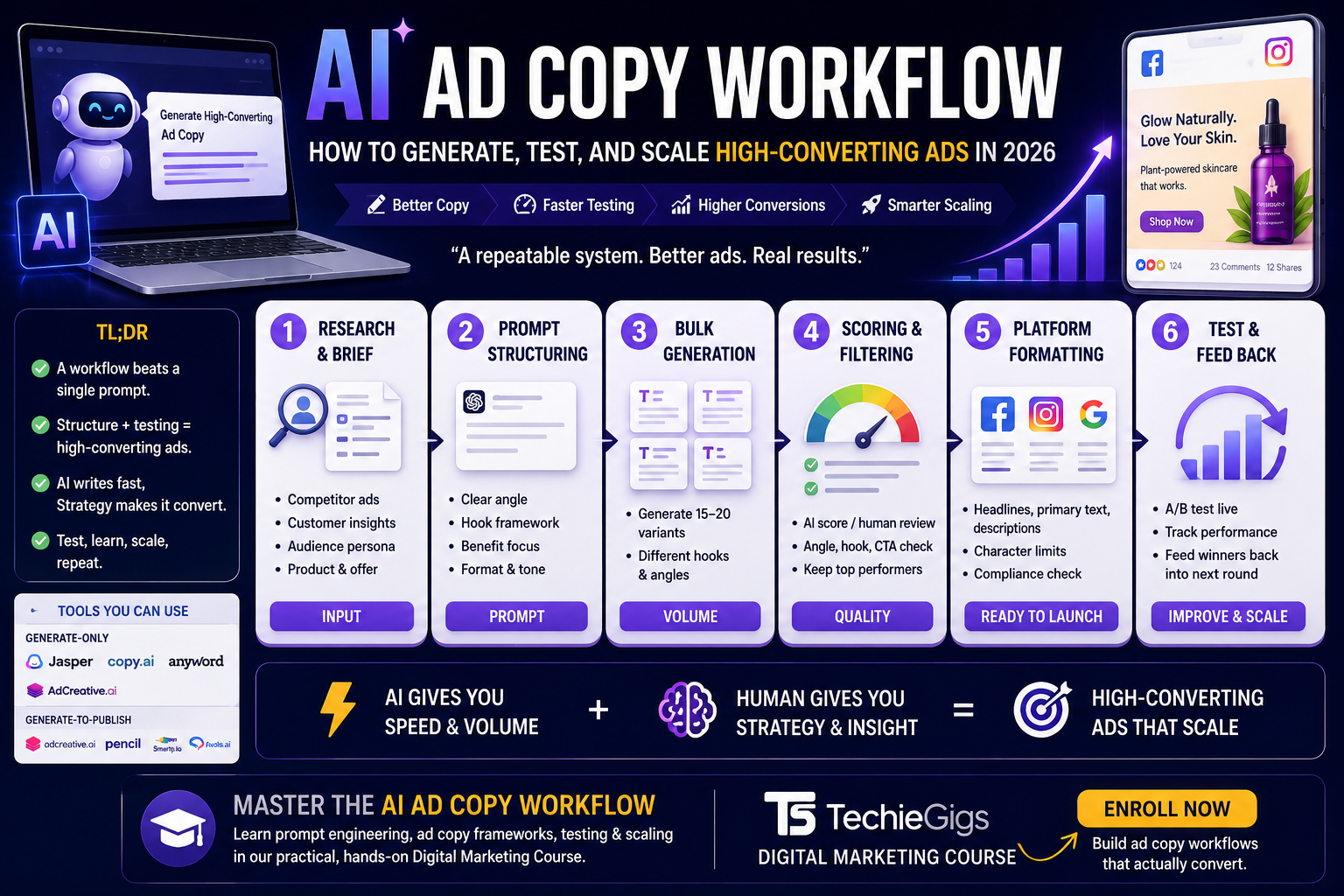
- An AI ad copy workflow is a repeatable system — not a single prompt — that takes you from brief to published, tested ad copy.
- Most teams fail with AI ad copy because they treat it as a one-shot generator instead of a structured pipeline with research, generation, scoring, and review stages.
- A solid workflow has 6 stages: research and brief, prompt structuring, bulk generation, AI/human scoring, platform formatting, and performance feedback loops.
- Tools today fall into two buckets: generate-only (Jasper, Copy.ai, Anyword, AdCreative.ai) and generate-to-publish platforms that push copy directly into ad accounts.
- AI speeds up volume and iteration, but strategic judgment — audience insight, hook tension, brand voice — still needs a human in the loop.
- Want to actually build this skill instead of just reading about it? TechieGigs’ Digital Marketing Course teaches the full AI ad copy workflow hands-on, from prompt engineering to live campaign testing.
Table of Content
- What Is an AI Ad Copy Workflow?
- Why Does Most AI-Generated Ad Copy Fail to Convert?
- What Are the Core Stages of an AI Ad Copy Workflow?
- How Do You Choose Between Generate-Only and Generate-to-Publish Tools?
- How Do You Keep AI Ad Copy On-Brand at Scale?
- FAQs
- Conclusion
What Is an AI Ad Copy Workflow?
An AI ad copy workflow is the structured sequence of steps a marketer follows to turn a campaign brief into tested, platform-ready ad copy using AI tools at each stage — rather than relying on a single prompt-and-done interaction.
The difference matters more than it sounds. A prompt gives you a draft. A workflow gives you a system that consistently produces usable output, because it forces structure at every stage instead of leaving quality to chance.
A typical AI ad copy workflow includes:
- Input stage — audience research, competitor ads, product data, brand voice guidelines
- Generation stage — structured prompts or templates that produce multiple copy variants
- Filtering stage — scoring or human review to separate usable copy from scaffolding
- Formatting stage — adapting copy to each platform’s character limits and ad formats
- Testing stage — running variants live and feeding performance data back into future prompts
Why Does Most AI-Generated Ad Copy Fail to Convert?
The honest answer: because the input was weak, not because the AI is bad at writing.
AI models generate copy based on patterns. Give them a vague brief — “write Facebook ad copy for a skincare brand” — and you get plausible, grammatically correct, completely generic output. It reads fine. It converts nobody. Industry testing backs this up: users across every AI ad copy platform report editing 50 to 80 percent of generated copy before it’s usable, and the gap between draft and AI-generated visuals shows the same pattern across the board.
There are three specific failure points worth naming:
No angle specificity. Generic prompts produce generic angles. “Highlight the benefits” isn’t an angle; it’s an instruction with no creative direction.
No hook tension. Cold-traffic ads live or die in the first five words. AI without a hook framework defaults to safe, descriptive openers that don’t interrupt the scroll.
No platform awareness. Copy that ignores character limits, native tone, or placement context (feed vs. Stories vs. search) reads like it was pasted from somewhere else — because it was.
What Are the Core Stages of an AI Ad Copy Workflow?
Think of the workflow as a five-stage pipeline. Each stage has a clear input, a clear output, and a clear handoff to the next stage.
Stage 1: Research and Brief
Before any generation happens, gather:
- 3-5 competitor ads in the same category (what angles are already saturated?)
- Voice-of-customer language (reviews, support tickets, social comments)
- One clear, narrow audience persona per ad set
Stage 2: Bulk Generation
Use your structured prompt to generate 15-20 variants per ad set, not 3-5. Volume is the actual advantage AI gives you here — standalone copywriting tools can generate 10, 20, or 50 variants quickly, and that volume is what makes meaningful A/B testing possible without weeks of manual writing.
Stage 3: Scoring and Filtering
This is where most workflows break down because teams skip it. Some tools build scoring in directly — for example, Anyword’s Predictive Performance Score rates every piece of copy from 0 to 100 based on historical ad spend data. If your tool doesn’t score automatically, build a manual rubric: does this variant have a specific angle, a real hook, and a clear CTA? Cut anything that fails on two of three.
Stage 4: Platform Formatting
Reformat surviving variants for each platform’s actual ad units — headline, primary text, description — respecting character limits exactly. This is also the stage where you check compliance language if you’re in a regulated category.
Stage 5: Test and Feed Back
Launch the surviving variants, and crucially, take what wins back into your next prompt. Tools that train on existing creative performance data compound output quality over time — you can replicate this manually by feeding winning copy examples back into your prompts as style references for the next batch.
How Do You Choose Between Generate-Only and Generate-to-Publish Tools?
This is the single biggest fork in the road when building your workflow, and it depends entirely on your team’s bottleneck.
Choose generate-only tools if writing is your bottleneck and you have time (or a media buyer) to handle uploads, formatting, and platform-specific setup manually. Generate-only platforms solve production speed but leave the distribution problem entirely to you — fine if your team already has a smooth upload process.
Choose generate-to-publish tools if distribution is eating your time. AI agent platforms create assets and push them straight into ad accounts through direct API connections, with no export step. This kind of platform can eliminate hours of manual upload work per week once you’re running across 5+ platforms.
A rough rule of thumb: if you’re managing fewer than 10 ad accounts and have a dedicated media buyer, generate-only tools paired with a manual workflow are usually cheaper and give you more creative control. Past that volume, the time saved by direct-publish tools starts to outweigh the cost.
How Do You Keep AI Ad Copy On-Brand at Scale?
Brand drift is the most common complaint from teams running AI ad copy at volume — copy that’s technically fine but doesn’t sound like the brand wrote it.
Three things fix this reliably:
Train a brand voice profile before scaling generation. Most platforms support this directly. Brand voice features let you upload style guides and product information so outputs stay aligned with brand standards, but they only work if you actually feed them real examples — five generic bullet points won’t train a useful voice model.
Build a swipe file of approved phrasing. Keep a running document of words and phrases your brand never uses (and ones it always does). Paste this into your prompt as a constraint every time.
Review at the angle level, not the sentence level. Don’t edit AI copy line by line — that’s slow and inconsistent. Instead, ask: does this variant’s angle match how we actually talk about this problem? If not, regenerate with a sharper prompt rather than hand-editing wording.
FAQ
What is an AI ad copy workflow?
An AI ad copy workflow is a repeatable, multi-stage process — research, prompt structuring, generation, scoring, formatting, and testing — used to produce ad copy with AI tools, rather than relying on a single prompt to do everything.
Is AI ad copy as effective as copy written by a human copywriter?
AI-assisted copy can match or outperform human-only copy on speed and testing volume, but strategic elements like brand positioning, audience insight, and emotional resonance still benefit from human direction. The most effective workflows combine AI for iteration speed with human review for strategic judgment.
Which AI tool is best for ad copy in 2026?
There’s no single best tool — it depends on your bottleneck. Generation-focused tools like Jasper and Copy.ai are strong for volume and brand voice training, Anyword is built for predictive performance scoring, and AI agent platforms are better suited to teams whose real bottleneck is distribution and publishing across many platforms.
How many ad copy variants should I generate per campaign?
Most workflows benefit from generating 15-20 variants per ad set, then filtering down to 3-5 for live testing. Generating only 3-5 from the start skips the filtering stage that actually improves output quality.
Do I need to know prompt engineering to run an AI ad copy workflow?
Basic prompt structure — specifying audience, angle, framework, and format constraints — makes a measurable difference in output quality. You don’t need to be a prompt engineer, but you do need a consistent prompt template rather than ad hoc requests.
Conclusion
An AI ad copy workflow isn’t a single tool, a single prompt, or a single “best app” — it’s a system. Research feeds your prompts, structured prompts produce testable variants, scoring filters out the noise, formatting makes copy platform-ready, and live performance data feeds back into the next round. Skip any stage, and you’re back to generic copy that needs heavy editing. Build all five, and AI becomes a genuine speed advantage instead of a shortcut that creates more work than it saves.
Want to build this entire workflow hands-on instead of piecing it together from blog posts? TechieGigs’ Digital Marketing Course walks you through the full AI ad copy workflow step by step — prompt engineering, tool selection, campaign testing, and performance analysis — with real campaigns, not just theory.
Enroll in the TechieGigs Digital Marketing Course today and start building ad copy