
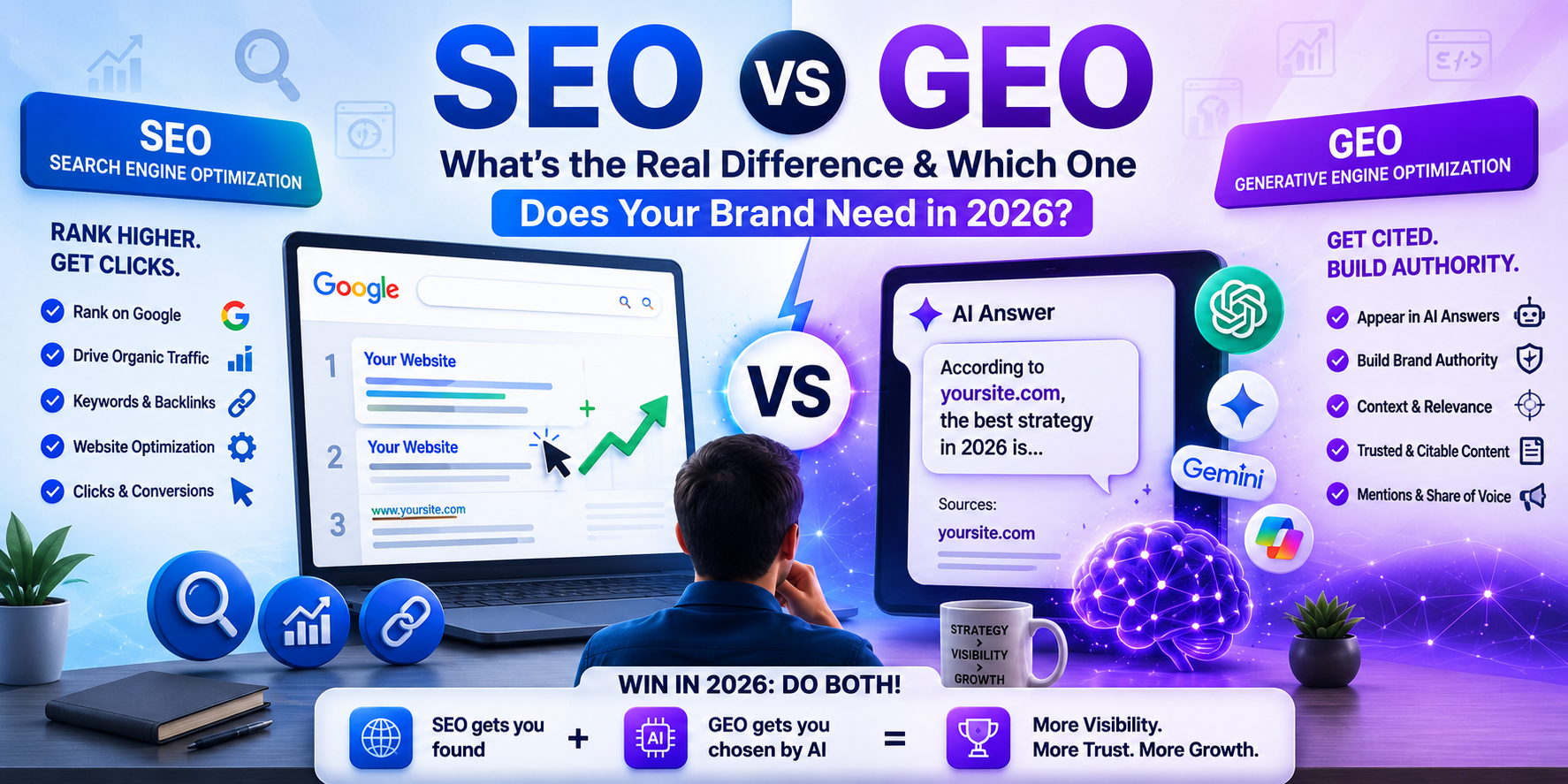
If you’ve spent any time in a marketing meeting in the last year, you’ve probably heard someone say, “We need a GEO strategy now, not just SEO.” And if you immediately wondered what the difference actually is, you’re not alone.
For two decades, ranking on page one of Google was the finish line. You wrote keyword-rich content, built backlinks, fixed your site speed, and watched your rankings climb. That playbook — search engine optimization, or SEO — still works. But it isn’t the whole story anymore.
A growing share of searches now end inside an AI-generated answer instead of a list of blue links. People ask ChatGPT, Gemini, Perplexity, or Google’s AI Overviews a question and get a synthesized response pulled from multiple sources — sometimes with no click to any website at all. That’s where generative engine optimization (GEO) comes in: the practice of shaping your content so AI systems choose to cite, quote, or recommend you inside that answer.
TL;DR
- SEO (Search Engine Optimization) is the practice of optimizing your website to rank higher in traditional search engines like Google and Bing, earning clicks and traffic.
- GEO (Generative Engine Optimization) is the practice of optimizing your content so AI tools like ChatGPT, Gemini, Perplexity, and Google’s AI Overviews cite, quote, or recommend your brand directly inside their answers.
- The biggest difference: SEO chases rankings and clicks; GEO chases citations and trust, often without any click at all.
- GEO isn’t replacing SEO — it’s layering a new requirement on top of it. Strong SEO fundamentals (authority, structure, clarity) still feed AI visibility.
- Winning brands in 2026 run both strategies together: technical SEO and backlinks for search rankings, plus structured, conversational, fact-dense content for AI citations.
Table of Content
- What Is SEO?
- What Is GEO (Generative Engine Optimization)?
- How Is GEO Different From SEO?
- Why Does GEO Matter Now?
- Is GEO Replacing SEO?
- How Do You Optimize for GEO?
- Do SEO and GEO Use the Same Keywords?
- FAQ
- Conclusion
What Is SEO?
Search Engine Optimization (SEO) is the long-standing practice of structuring and promoting a website so it ranks higher in traditional search engine results pages (SERPs) — primarily Google and Bing. Search engine optimization is the practice of improving your website so it ranks higher in traditional search results from Google, Bing, and other search engines, with the goal of driving organic, unpaid traffic by matching what people search for with content they can click through to.
SEO has three core pillars:
- Technical SEO — site speed, mobile-friendliness, crawlability, structured data, and clean architecture
- On-page SEO — keyword placement, headings, meta titles and descriptions, internal linking, and content quality
- Off-page SEO — backlinks, domain authority, and brand mentions across the web
SEO has been the default discovery strategy for two decades because, until recently, search engines were the front door to the web. The goal has always been the same: get found, get clicked, get converted.
What Is GEO (Generative Engine Optimization)?
Generative Engine Optimization (GEO) — sometimes called AI search optimization or AEO (answer engine optimization) — is the practice of optimizing content so AI platforms like ChatGPT, Claude, Gemini, and Perplexity treat your brand as an authoritative, citable source within their generated answers. GEO aims to position your content as the primary source that AI engines reference when generating answers, rather than focusing on ranking in search results to earn clicks.
The mechanics behind GEO are different from classic crawling and indexing. GEO is powered by large language models built on transformer architecture and trained on massive datasets from books, articles, and forums; instead of scanning the web for exact keyword matches, these systems interpret the intent behind a question, consider context, and generate a unique, synthesized answer on the spot, with many models continuously improving through human feedback and some blending in real-time search results to stay current.
In practice, GEO means writing content that:
- Answers specific questions clearly and directly, in natural, conversational language
- Provides enough factual depth and context that an AI model can confidently quote or summarize it
- Establishes credibility through expertise, data, and consistent terminology
- Shows up not just on your own site, but across forums, review platforms, and other sources AI models pull from
How Is GEO Different From SEO?
The clearest way to separate the two is by what they’re optimizing for. Traditional SEO optimizes for visibility in search results to earn clicks and convert users on a website, while GEO optimizes to become the authoritative source that gets cited in AI responses, building brand recognition and authority instead.
| Factor | SEO | GEO |
| Target platforms | Traditional search engines like Google and Bing | AI-driven search engines and chat platforms like ChatGPT, Gemini, Claude, and Copilot |
| Result type | Multiple search results pages for users to explore | A single, summarized answer |
| Content approach | Relies on keywords, backlinks, and metadata for indexing | Must be conversational and contextually relevant |
| Success metric | Rankings, organic traffic, click-through rate | Citations, brand mentions in AI answers, share of voice |
| Content format | Primarily text-based results that encourage click-throughs to top-ranking sites | Diverse formats presented on one page, reducing the need to click at all |
Why Does GEO Matter Now?
The honest answer: because user behavior is shifting, and the numbers back it up.
In 2026, 68% of Google searches ended without a click, as AI Overviews sit at the top of results with a summary that gives people what they need before they ever scroll down. That’s a massive shift from the click-driven traffic model SEO was built around.
The shift isn’t limited to Google’s own AI features, either. Gartner predicts a 30% drop in traditional search volume by the end of 2026 as AI Overviews and generative engines continue to dominate user queries, and brands that adapt are seeing real gains: companies using generative engine optimization report 35% higher brand visibility in AI-generated answers than those relying solely on traditional SEO, and GEO-optimized brands see up to three times more citations in AI answers compared to SEO-only sites.
The search journey itself is also getting messier — and that’s a good thing for brands that show up everywhere. People may start their research on ChatGPT and complete their journey through Google, or bounce between different AI platforms and traditional search engines, meaning the search path is becoming far more diverse than the old, linear model.
Is GEO Replacing SEO?
No — and this is one of the most common misconceptions in the SEO vs GEO conversation.
GEO is not a replacement for SEO, but an essential evolution that adapts to the changing realities of how users discover and consume information, with traditional SEO remaining critical for organic search visibility even as more users interact with AI-generated answers.
Even Google has weighed in directly on this debate. From Google Search’s perspective, optimizing for generative AI search is optimizing for the search experience, and is therefore still SEO at its core — and the best practices for SEO continue to be relevant because Google’s generative AI features are rooted in its core search ranking and quality systems. Google specifically advises against chasing unproven “GEO hacks”: marketers should prioritize effective SEO strategies over tactics like content chunking, creating unnecessary AI text files such as llms.txt, or pursuing inauthentic brand mentions.
The practical takeaway is the same across nearly every source on this topic: SEO drives rankings and traffic, while GEO ensures your content can be used by generative AI systems — both are necessary, and the relationship between them is a balance, not a competition.
How Do You Optimize for GEO?
Optimizing for AI search requires a different mindset than chasing keyword rankings. Here’s how to approach it:
1. Write in a question-and-answer structure
AI models retrieve and summarize content best when it’s structured around the questions people actually ask. Structuring sections in a question-answer format, weaving in verified facts, and avoiding ambiguity all help make content a more reliable source for generative engines.
2. Build topical depth and clarity
Optimizing for GEO means thinking in conversations over keywords — writing the way people naturally ask questions, providing enough background for an AI model to confidently summarize or quote the content, and directly answering the kinds of questions an audience is likely to ask.
3. Establish expertise and trust (E-E-A-T)
Showcasing expertise is a major trend for 2026 because both traditional and generative search engines want to deliver helpful, credible, trustworthy information, and building expertise improves a website’s E-E-A-T, which helps rankings in both traditional and generative engines.
4. Get mentioned beyond your own website
GEO extends past your domain. AI engines pull from third-party mentions, forums, reviews, and other off-site sources to decide what to cite, so the best strategy is integrating GEO into an existing SEO workflow rather than treating it as a separate channel. Tactically, that means: participating actively in industry forums and communities, publishing on major content platforms like Medium and LinkedIn, creating video content with optimized transcripts, engaging in podcast interviews that generate transcribed content, and contributing to open-source projects and public knowledge bases.
5. Diversify your content formats
Diversifying content formats beyond plain text — using video and interactive formats — helps boost visibility in generative AI search.
6. Keep your data centralized and consistent
For product-driven or B2B sites, consistency matters enormously to AI systems. Both GEO and SEO rely on high-quality, consistent product information, and when data is fragmented across spreadsheets, ERPs, and CMSs, it becomes difficult for generative engines to determine what’s accurate — centralizing that data ensures both search engines and AI models access the same source of truth.
Do SEO and GEO Use the Same Keywords?
Not exactly — and this is where keyword strategy needs to evolve.
Traditional SEO keyword research is built around short, fragment-style queries: “best running shoes,” “SEO vs GEO,” “GEO meaning.” GEO keyword strategy needs to account for full, natural-language questions, because that’s how people actually talk to AI tools — for example, “what’s the real difference between SEO and GEO for a small business in 2026?”
The fix isn’t to abandon traditional keyword research; it’s to layer conversational, question-based phrasing on top of it. Build content that targets your core keyword (like “SEO vs GEO”) while also directly answering the long-tail, conversational versions of that same question. This is precisely why structuring content in H2 headings phrased as questions — the way this article is built — helps satisfy both traditional search intent and the conversational retrieval patterns AI models look for.
FAQ
What does GEO stand for in marketing?
GEO stands for Generative Engine Optimization — the practice of optimizing content so AI platforms like ChatGPT, Gemini, Claude, and Perplexity cite or reference your brand inside generated answers.
What is the main difference between SEO and GEO?
SEO focuses on ranking your website higher in traditional search engine results to earn clicks. GEO focuses on getting your content cited, quoted, or recommended inside AI-generated answers, often without any click happening at all.
Is GEO the same as AEO?
GEO and AEO (Answer Engine Optimization) are closely related terms often used interchangeably. Some call it GEO, some call it AEO, and some simply call it SEO — the acronym matters less than understanding that content also needs to be optimized for AI search.
Does ranking well in Google help with GEO?
Yes, significantly. Many AI search tools pull heavily from existing search indexes, so content that already ranks well in traditional search has a real advantage in AI-generated answers too.
Will AI search eventually replace traditional search engines entirely?
Unlikely in the near term. Most current evidence suggests AI search and traditional search will coexist, with users moving between both depending on the type of query and stage of their research journey.
Conclusion
SEO vs GEO isn’t really a competition — it’s a partnership. SEO built the foundation: technical health, authority, structure, and discoverability that search engines (and increasingly, AI models) still rely on. GEO is the newer layer on top, focused on earning trust and citations inside the AI-generated answers that a growing share of searchers now see first.
Ready to make sure your content shows up everywhere people are searching — in Google’s results and inside AI answers?
Book a free counselling session with an academic counsellor for our AI-powered Niche Specific Digital Marketing course to master these advanced strategies.
Book a Free Counselling Session