Twitter marketing has changed more in the last two years than in its previous decade combined. The rebrand to X, the rise of Grok-powered ranking, and a complete overhaul of how reach is calculated mean that tactics which worked in 2022 can actively hurt you in 2026. Hashtag stuffing? Ignored. Posting a link straight to your blog? Punished. Chasing likes? You’re optimizing for the wrong metric entirely.
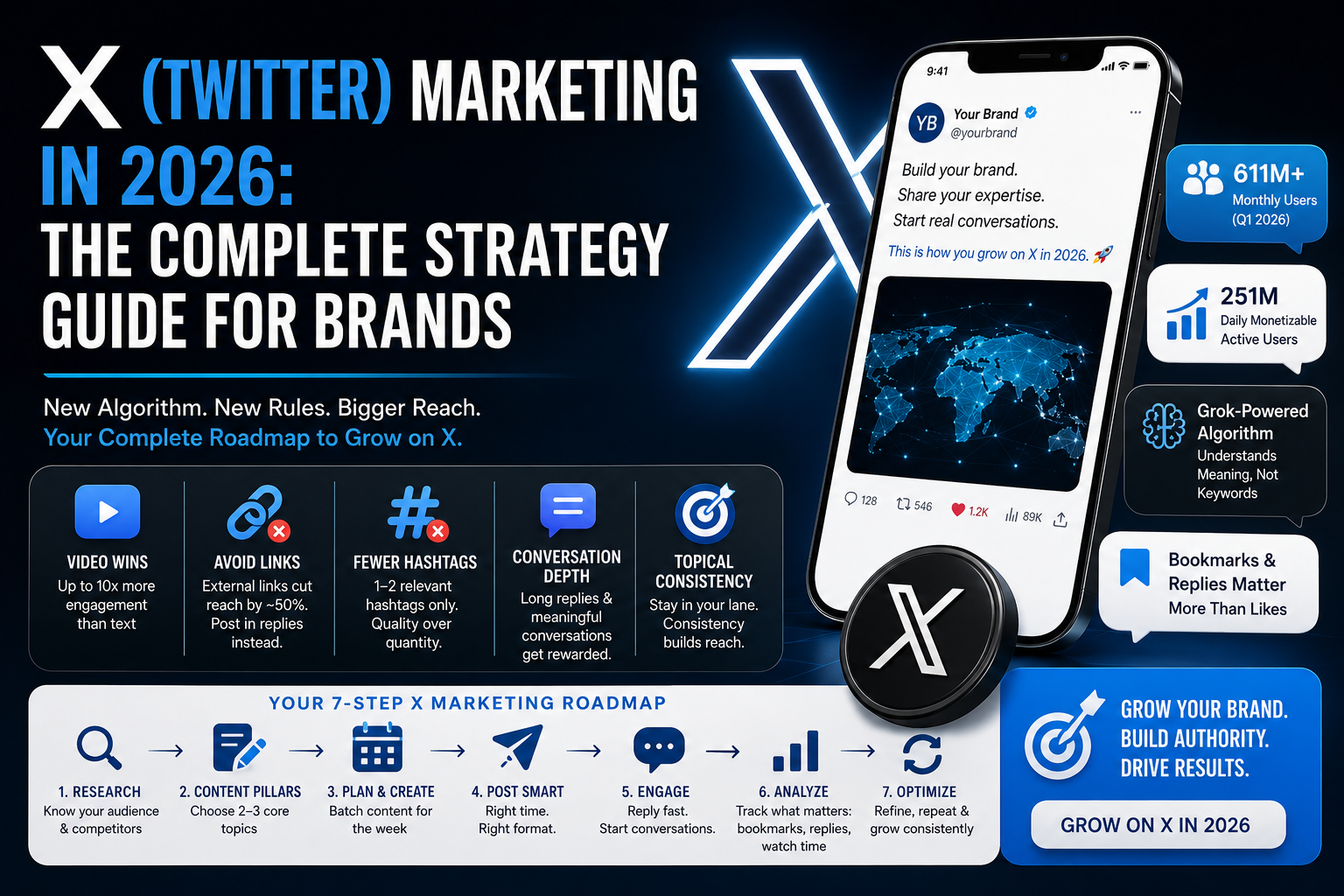
But here’s the good news: brands and creators who understand how the platform actually works right now are seeing some of the best organic reach available on any social network. X reached 611 million monthly users in Q1 2026, up from 588 million a year earlier, with daily monetizable active users climbing to 251 million — meaning the audience is not just present, it’s growing. Twitter marketing in 2026 rewards genuine expertise, consistent posting, and content built for the platform rather than repurposed from somewhere else.
TL;DR
- Twitter marketing (now running on the X platform) is no longer about hashtag spam or posting links — it’s about native content, conversation depth, and topical consistency.
- The 2026 algorithm uses a Grok-powered transformer model that reads and understands every post semantically, not by keyword matching.
- External links in your first post suppress reach by roughly 50%; post the link as a reply instead.
- Video and rich media get up to 10x more engagement than plain text.
- Bookmarks, long replies, and time-spent-reading now matter more than likes or retweets.
- A clear Twitter marketing strategy — content pillars, consistent posting, and genuine engagement — compounds into real business results over time.
Table of Content
- What Is Twitter Marketing and Why Does It Still Matter in 2026?
- How Does the Twitter/X Algorithm Actually Work in 2026?
- What Content Format Performs Best on Twitter in 2026?
- Why Do Links Hurt Your Reach on Twitter and How Do You Work Around It?
- Do Hashtags Still Work for Twitter Marketing in 2026?
- Does an X Premium Subscription Actually Boost Your Reach?
- How Should You Build a Twitter Marketing Strategy Step by Step?
- FAQ
- Conclusion
What Is Twitter Marketing and Why Does It Still Matter in 2026?
Twitter marketing is the practice of using the X platform (formerly Twitter) to build brand awareness, grow an audience, drive engagement, and ultimately generate leads or sales through organic posts, threads, replies, and paid ads. It’s one of the few platforms where a single well-written post — with zero ad spend — can reach hundreds of thousands of people within hours.
It matters in 2026 because X has stabilized after years of post-acquisition turbulence. CPMs are down, brand-safety scores are up, and total ad spend has grown for five consecutive quarters. The advertiser mix has also shifted toward financial services, software, gaming, and direct-to-consumer brands using the platform for performance rather than pure awareness. In other words, X is no longer a risky, chaotic platform for marketers — it’s a measurable, performance-driven channel with a real, engaged audience.
For B2B brands, thought leaders, SaaS companies, and personal brands especially, Twitter marketing remains one of the highest-leverage channels for organic distribution available today.
How Does the Twitter/X Algorithm Actually Work in 2026?
This is the single most important thing to understand before posting anything. In January 2026, xAI released a Grok-powered version of the algorithm, replacing the legacy ranking system with a transformer model that reads every post and watches every video to match users with content. The platform now processes 500 million daily tweets and makes 5 billion ranking decisions every day.
Here’s the simplified version of how ranking works:
Stage 1 — Candidate Sourcing. The algorithm pulls tweets from three sources: accounts you follow (in-network), accounts that similar users engage with (out-of-network), and tweets from your interest graph — creating a pool of roughly 1,500 candidate tweets for your feed.
Stage 2 — Neural Network Scoring. Every post is scored using a model called the Heavy Ranker, which weighs predicted engagement, author reputation, and content signals — not simply follower count.
Stage 3 — Heuristics and Filtering. Final adjustments are applied before the feed is assembled, including penalties for certain behaviors (more on this below).
A few engagement signals matter far more than people assume. Conversation depth is heavily weighted — a reply that gets a reply back from the original author carries a weight of roughly +75, compared to just +0.5 for a like. The algorithm also now weighs bookmarks, long replies, and time-spent disproportionately versus likes and reposts — meaning two posts with identical engagement rates can perform very differently depending on which signals make up that engagement.
Content clustering also plays a major role. The 2026 algorithm uses what X calls “SimClusters” — roughly 145,000 topic clusters that group users by shared interests; when you post, the model determines the semantic meaning of your content and matches it to the most relevant clusters. This is precisely why topical consistency outperforms scattershot posting — if an account that usually posts about a specific niche suddenly posts something unrelated, the algorithm doesn’t know which cluster to serve it to, engagement drops, and future distribution is suppressed.
What Content Format Performs Best on Twitter in 2026?
Video is the clear winner. Video content delivers up to 10x more engagement than text-only posts, with images and GIFs also producing significantly higher engagement than plain text. X’s own data shows four out of five user sessions on the platform now include watching video, which tells you exactly where attention is going.
That doesn’t mean text posts are dead — far from it. X’s algorithm now actually favors single long-form posts (using the expanded character limit) over multi-tweet threads for distribution purposes. This is a real shift from a few years ago, when threads were considered the gold standard for storytelling on the platform.
Practical format takeaways for your Twitter marketing strategy:
- Short-form video under 60 seconds gets the strongest algorithmic boost, especially when it crosses a 50%+ completion rate.
- Long-form single posts now often outperform threads for reach — save threads for when the structure genuinely adds value (step-by-step guides, numbered lists).
- Native images and polls consistently beat plain text and bare links.
- Captions on video measurably improve watch time, so never skip them.
Why Do Links Hurt Your Reach on Twitter and How Do You Work Around It?
This trips up more brands than almost anything else. External links in your first tweet reduce reach by approximately 50% because the platform wants to keep users on-site, and the penalty for posts containing external URLs was measurably tightened again in early 2026. The data backs this up at scale: click-through rates to external links fell from 1.8% in 2024 to just 1.2% in 2026, reflecting the algorithm’s continued de-prioritization of off-platform traffic.
The workaround is simple and well-documented. Post your main tweet without any links, then immediately reply to your own tweet with the link as a second post in the thread — this preserves reach on the main post while still giving interested readers a way to click through, and can double your reach on link-sharing posts.
If you do need to include a link directly in a post:
- Frame the link with genuine value and context rather than posting it bare — the algorithm prioritizes native content, so explain why someone should click before they get there.
- Use a short link service or the platform’s built-in preview, and avoid including more than one link per post.
- Better yet, redirect people to your bio link or drop the URL in the first reply.
Do Hashtags Still Work for Twitter Marketing in 2026?
Largely, no — at least not the way they used to. Hashtags now have minimal impact on reach because the algorithm uses semantic understanding through natural language processing to categorize content rather than relying on hashtags. X’s engineering team confirmed in its open-source repository that content understanding now operates on semantic embeddings rather than keyword or hashtag matching, and the era of hashtag volume as a reach tactic is officially over.
That said, hashtags aren’t entirely useless. Using multiple hashtags can actually get you penalized by the algorithm, but one or two well-chosen hashtags still help categorize your post and make it discoverable in on-platform search. The practical rule for 2026: stick to one or two hashtags maximum, choose ones that genuinely describe your post, and avoid spaces or punctuation within the hashtag itself.
Does an X Premium Subscription Actually Boost Your Reach?
This is a genuinely contested area, but the directional evidence is strong. Premium accounts reportedly receive roughly 10x more reach per post compared to free accounts, and one analysis found at least half of free account posts see zero engagement at all. X Premium itself hit 14.2 million subscribers in 2026, growing 38% year-over-year, with the no-ads Premium+ tier reaching 4.7 million subscribers — showing subscription has become a real structural part of the platform’s economy rather than a side experiment.
If X plays a meaningful role in your marketing mix and you’re not seeing traction, a Premium subscription is one of the lowest-effort variables to test before assuming your content strategy is the problem.
How Should You Build a Twitter Marketing Strategy Step by Step?
Here’s a practical framework you can implement this week:
- Pick 2–3 content pillars. Choose topics tightly aligned with your brand or expertise — this builds the topical consistency the algorithm rewards through cluster matching.
- Build a weekly content mix. Blend educational threads, single long-form insight posts, short video, and 1–2 polls or open questions per month to invite participation.
- Front-load value, not links. Lead every post with the insight itself; if a link is necessary, drop it in the first reply.
- Batch and schedule. Create a week’s worth of content in one sitting, then schedule posts for mid-morning weekday slots.
- Engage in the first hour. Reply to every comment you can in the 30–60 minutes after posting — this is your highest-leverage window.
- Track the right metrics. Watch bookmarks, reply depth, and watch-time/completion rate on video — not just likes.
- Review weekly. Compare performance month over month, identify which formats and topics are working, and double down.
FAQ
Is Twitter marketing still effective in 2026?
Yes. With over 611 million monthly active users and a maturing, more stable advertising ecosystem, X remains a highly effective channel for organic reach and paid performance marketing, particularly for B2B, SaaS, and direct-to-consumer brands.
What is the best time to post on Twitter/X for engagement?
Data from over a million tweets points to Wednesday at 9 a.m. as the strongest single time slot, with Monday and Tuesday mid-morning following closely behind. Mid-morning weekday posting generally performs best.
Do hashtags help on Twitter in 2026?
Only marginally. The algorithm now relies on semantic understanding rather than hashtag matching, so using more than one or two hashtags can actually hurt reach instead of helping it.
Why does my tweet get less reach when I include a link?
External links are actively suppressed by the algorithm to keep users on the platform, cutting reach by roughly half. Post the core content first, then add the link as a reply to preserve distribution.
How many times a day should I post on Twitter for marketing?
Three to five high-quality posts per day, spaced at least two hours apart, tends to outperform high-volume, low-effort posting, which can actually suppress future reach.
Conclusion
Twitter marketing in 2026 rewards exactly what good marketing has always rewarded: genuine value, consistency, and real conversation — just with a new set of platform-specific rules layered on top. Understand how the Grok-powered algorithm clusters and scores content, lead with native value instead of links, post on a sustainable schedule, and actually show up in your replies. Do that consistently, and X remains one of the best organic distribution channels available to any brand willing to put in the work.
Strategy, however, is only half the equation — execution, consistency, and staying current with platform shifts is where most brands fall behind. If you want to go beyond this guide and build real, hands-on expertise across Twitter marketing, paid social, SEO, and the full digital marketing stack, enroll in TechieGigs’ Digital Marketing Course today and learn directly from practitioners who build these strategies for a living.