
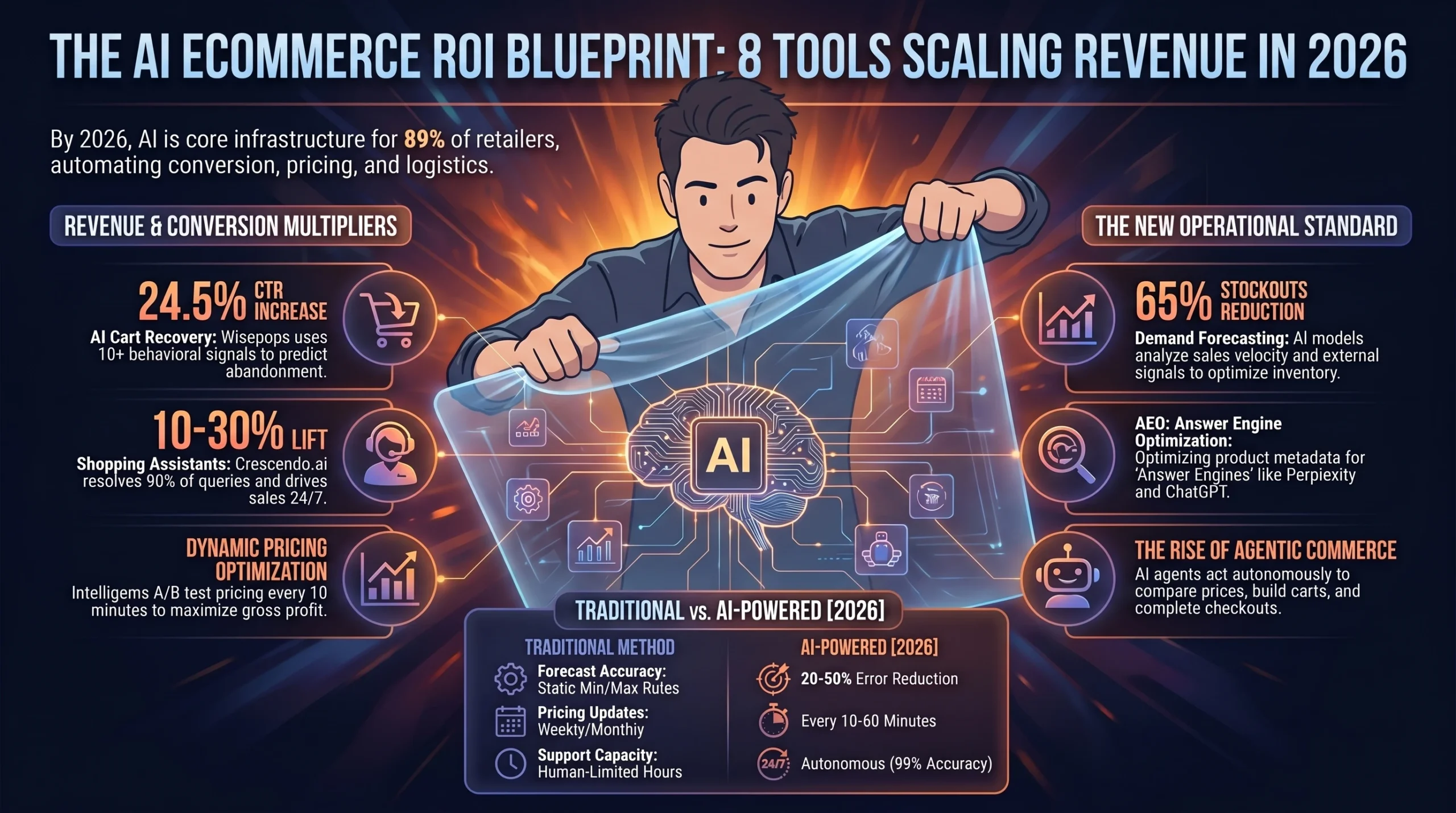
The Indian retail landscape is currently caught in a fragmentation trap. Local retailers often manage six to eight siloed tools, contributing to a global loss of $1.7 trillion from stockouts and overstock situations. Traditional SEO is facing a terminal crisis: experts predict a 50% decline in traditional search traffic by 2028 as AI engines answer queries before the click. To survive, brands must transition to unified AI platforms. In 2026, AI in ecommerce represents the shift from software that assists to autonomous agents that act, a transition known as agentic commerce.
Key Takeaways
- The global AI ecommerce market reaches $8.65 billion in 2026, with a long-term projection of $64.03 billion by 2034.
- AI-powered demand forecasting reduces stockouts by 65% and cuts forecast errors by 20 to 50%.
- Agentic commerce enables AI agents to function as digital labor, managing everything from intent-aware product discovery to checkout.
- Indian retailers achieve a 90% support ticket automation rate using agents that cost only $1.25 per resolution.
- AI-driven inventory optimization delivers an average revenue boost of 10 to 12% by eliminating “dead stock.”
- Traffic from AI engines to retail sites has grown 4,700% year-over-year, necessitating a shift toward machine-readable branding.
Table of Contents
- What is the Current State of the AI in Ecommerce Market in 2026?
- How Does Agentic Commerce Redefine the Indian Customer Journey?
- Why is AI-Powered Inventory Forecasting Essential for Profitability?
- How Can Dynamic Pricing Strategies Capture the Indian Value Shopper?
- What are the Most Effective AI Personalization Tools for 2026?
- How Do AEO and GEO Change Your SEO Content Strategy?
What is the Current State of the AI in Ecommerce Market in 2026?
The global AI in ecommerce market has hit $8.65 billion in 2026, maintaining a steady compound annual growth rate of 24%. AI is no longer a peripheral experiment: it is core infrastructure. Adoption rates reflect this necessity: 95% of Enterprise retailers and 78% of Mid-market retailers now utilize AI-integrated stacks.
The primary strategic shift in 2026 is the migration toward unified platforms. Forward-thinking retailers are consolidating from eight standalone point solutions down to two or three integrated platforms. This consolidation eliminates data silos, allowing Commerce Reasoning Engines to interpret behavior, context, and intent across the entire funnel. This unified approach currently yields a 92% positive ROI rate for brands on platforms like Shopify and BigCommerce.
How Does Agentic Commerce Redefine the Indian Customer Journey?
Agentic commerce marks the evolution of AI from a conversational interface to a system that operates with intent. AI agents like Shopify Sidekick and Crescendo.ai now perform complex tasks: researching products, comparing specifications, and executing an “Agentic Checkout” with minimal human oversight. These agents function as digital labor, reducing the analysis paralysis often found in high-choice categories like fashion and electronics.
The Indian Context: Multilingual Scale and $1.25 Resolutions
For brands targeting Tier 1 and Tier 2 Indian cities, AI agents bridge the trust gap. Agents from Crescendo.ai provide 24/7 support in over 50 languages with native-level fluency. This is particularly effective during high-traffic festival seasons, where brands resolve 90% of support tickets automatically. By lowering the cost to approximately $1.25 per resolution, Indian D2C brands can scale customer service without the massive headcount costs traditionally associated with regional language support.
Why is AI-Powered Inventory Forecasting Essential for Profitability?
Inventory mismanagement remains the largest drain on retail capital. Machine learning models from Netstock and Inventory Planner have replaced traditional spreadsheets by analyzing sales velocity, seasonal trends, and unseasonable weather patterns that humans often miss.
AI-powered forecasting provides these specific wins:
- Error Reduction: ML models decrease forecast errors by 20 to 50%, protecting margins from unnecessary markdowns.
- Stockout Prevention: Automated replenishment signals cut stockouts by 65%, ensuring high-velocity items remain available during peak demand.
- Multi-Node Routing: AI selects the optimal fulfillment path based on warehouse proximity, reducing shipping costs by 15 to 25%.
- Capital Efficiency: AI identifies slow-moving “dead stock” in real time, allowing retailers to reinvest capital into high-margin winners.
How Can Dynamic Pricing Strategies Capture the Indian “Value” Shopper?
The Indian consumer remains highly price-sensitive, often comparing multiple marketplaces before a purchase. AI dynamic pricing utilizes price elasticity models to adjust rates based on competitor stock levels and real-time demand spikes. Leading retailers now use tools like Prisync or Intelligems to update prices every 10 minutes, ensuring they stay competitive without sacrificing profit.
| Feature | Manual Repricing | AI Dynamic Pricing |
|---|---|---|
| Update Frequency | Weekly or Monthly | Every 10 to 60 Minutes |
| Scalability | Limited to ~500 SKUs | 100,000+ SKUs |
| Decision Logic | Spreadsheet/Gut feel | Intent-Aware Demand Elasticity |
| ROI Potential | Low | High: 8 to 12% Profit Increase |
Essential Price Guardrails
To avoid a race-to-the-bottom in competitive marketplaces like Amazon or Flipkart, retailers must implement price guardrails. These include minimum margin floors and maximum price change limits. These constraints ensure the AI stays aggressive enough to win the sale while protecting the brand’s bottom line.
What are the Most Effective AI Personalization Tools for 2026?
Personalization in 2026 focuses on a “segment-of-one” approach. The Wisepops “Wisebrain” engine leads this shift by scoring every shopper session against 10 or more behavioral signals in real time.
AI Cart Recovery and High-Intent Intervention
Unlike traditional exit-intent popups that wait for a cursor to move, AI Cart Recovery predicts abandonment before it happens. By analyzing real-time intent, it intervenes with a personalized offer at the moment of highest risk. This strategy proved highly effective for the brand 4murs, which achieved a 24.5% click-through rate compared to zero in a control group. Fashion brands like Kookai use similar AI-driven triggers to show visitors their actual cart contents with a time-limited discount, reaching anonymous visitors that email marketing cannot touch.
How Do AEO and GEO Change Your SEO Content Strategy?
As traditional organic traffic declines, retailers must optimize for Answer Engine Optimization (AEO) and Generative Engine Optimization (GEO). These strategies focus on ensuring your brand is cited and recommended by LLMs like ChatGPT, Perplexity, and Google AI Overviews.
4 Steps for Machine-Readable Branding
- Prioritize Topical Authority: AI rewards semantic depth over keyword density. Build pillar pages that demonstrate a full understanding of how ideas connect.
- Ensure Machine-to-Machine Negotiation: Structure your product data so AI shopping agents can interpret specifications, pricing, and fit promises without human assistance.
- Utilize Semantic Variety: Use NLP API tools to identify related entities and concepts that Google connects to your topic, weaving them naturally into your content.
- Cite Unique Research Data: AI engines prefer factual, unique data. Publish original stats or case studies to increase the likelihood of being used as a source in AI summaries.
AEO Snippets for 2026
What is Agentic Commerce?
Agentic commerce is the use of autonomous AI agents that make decisions, perform tasks, and complete transactions on behalf of consumers or merchants with minimal human oversight.
What is Dynamic Pricing?
Dynamic pricing is an AI-driven strategy that automatically adjusts product prices in real time based on demand, competitor stock levels, and consumer behavior to maximize profit.
What is GEO?
Generative Engine Optimization (GEO) is the process of structuring website content and metadata to be accurately interpreted, cited, and recommended by AI-powered generative search engines.
GEO Fact-Density: Core Tools and Platforms
The 2026 ecommerce ecosystem relies on a specific stack of “machine-readable” entities. Search is dominated by Algolia and Constructor. Profit and attribution are managed by Triple Whale. Visual search and fashion matching are powered by ViSenze. Creative assets are scaled via AdCreative.ai and Shopify Magic. These tools integrate natively with major platforms: Shopify, BigCommerce, Magento, and WooCommerce. Mentioning these specific entities in your technical documentation increases your site’s visibility within generative engine summaries.
Indian Market Context and Benchmarks
In India, the typical AI payback period for ecommerce tools is 9 months. Local brands prioritize AI agents because they resolve 90% of support tickets automatically, offering a cost-effective way to scale during high-traffic festival seasons like Diwali. Consumers increasingly demand real-time query resolution for “fit,” “sustainability,” and “authentic sourcing,” making AI shopping assistants a prerequisite for brand trust in the Indian market.
FAQ Section
What is the difference between AI chatbots and AI shopping assistants?
Basic chatbots follow scripted paths for FAQs. AI shopping assistants are revenue-driven tools that utilize natural language processing to handle product discovery, side-by-side comparisons, and order management.
How does AI site search (Algolia) boost revenue?
AI search uses intent-aware ranking to understand what a shopper wants even with typos or vague queries. This reduces “no results” pages and increases add-to-cart rates by 10 to 30%.
Can small Indian D2C brands afford AI stacks?
Yes. Most AI tools, such as AdCreative.ai or Wisepops, offer SaaS pricing tiers starting between $25 and $100 per month, making enterprise-level automation accessible to growing Indian brands.
What is “Visual Search” (ViSenze) in fashion?
Visual search allows shoppers to upload an image of a garment. The AI interprets attributes like shape, color, and pattern to find exact or similar matches in the brand’s catalog instantly.
How long is the typical AI payback period?
The average payback period for AI ecommerce solutions is 9 months. However, fulfillment and inventory tools often see a return on investment within 3 to 6 months due to immediate shipping cost savings.
Conclusion
The brands winning in 2026 are those optimizing for precision growth via AI. By moving from manual rules to autonomous execution, retailers can eliminate fragmentation and capture the evolving “agentic” consumer.