
HOW IS AI IN SEO EVOLVING INTO HARNESS ENGINEERING?
AI in SEO success is the transition from writing clever prompts to building a structured environment (a harness) that constrains, informs, and verifies agents to ensure high authority.
Indian businesses are currently drowning in “AI slop.” Generic models often hallucinate localized pricing or confuse Mumbai’s geography with Pune’s landmarks.
By 2026, models are smarter but remain powerful horses in an open field. A single hallucinated price on a high-traffic page destroys brand reputation in minutes.
The solution is Harness Engineering. This system builds the trust and authority required to win in the competitive Indian digital landscape.
TL;DR
- Systems Over Prompts: The model is a commodity. Your custom SEO harness is your business moat.
- The 28% Jump: Structured validation and tool access improve quality far more than prompt refinement.
- Repository as Truth: If data is not in your brand guide or CMS repository, the AI must not guess.
- Verification Loops: Use computational sensors to catch errors before content reaches your live site.
- Indian Market Edge: Localized harnesses manage Hinglish nuances and Tier 2 consumer behavior.
- WIP=1 Rule: Force AI agents to finish one SEO task completely before starting the next.
TABLE OF CONTENTS
- What exactly is Harness Engineering for SEO?
- Why did LangChain’s success prove that the SEO model is a commodity?
- How can context engineering fix the “Vague In, Vague Out” problem?
- Which three pillars of Harness Engineering define top-tier SEO today?
- How does the Indian context change the SEO harness requirements?
What exactly is Harness Engineering for SEO?
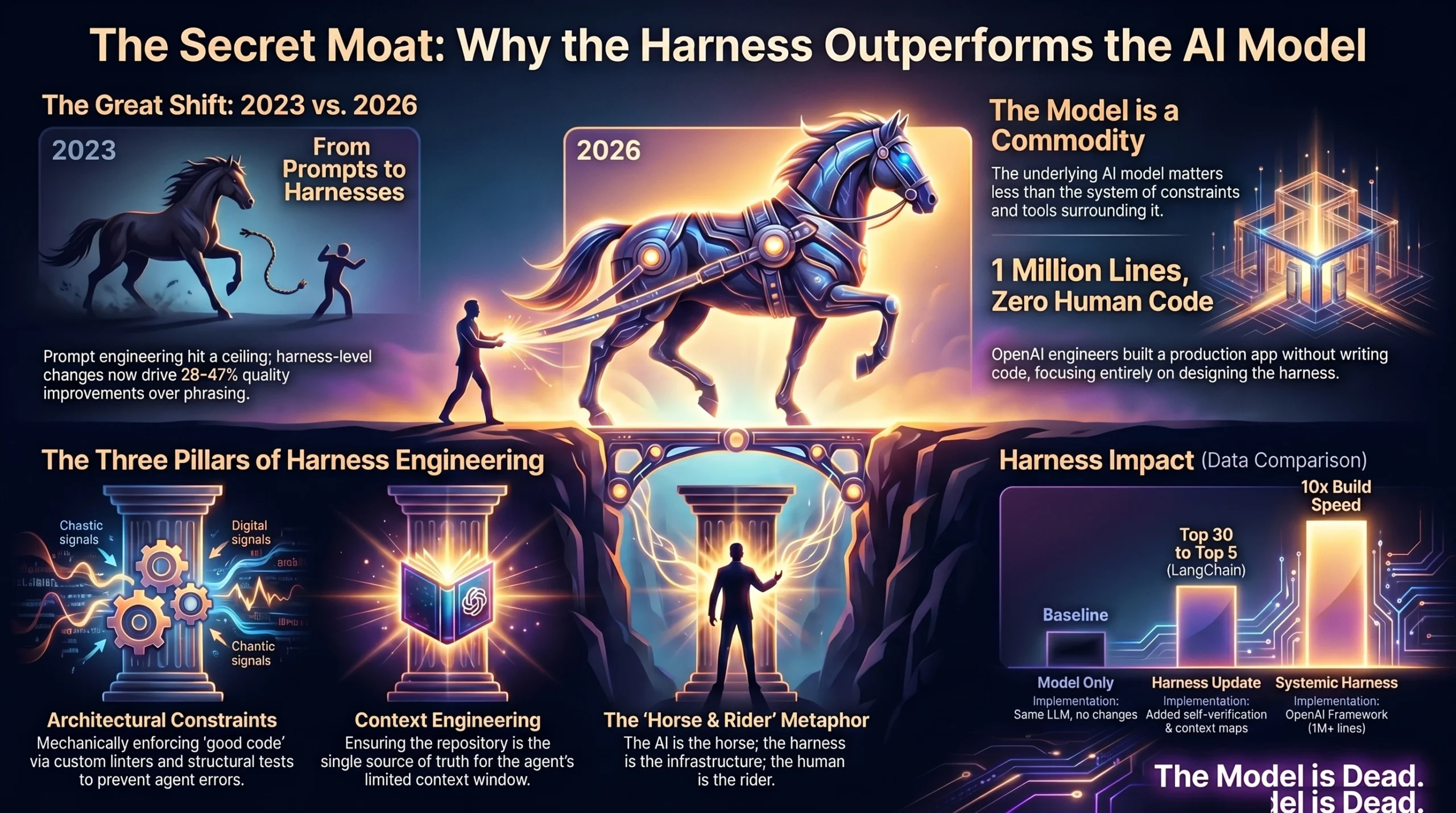
Harness engineering is the design of systems that channel AI power toward specific goals. Think of the “Horse and Rider” metaphor popularized by NxCode.
The AI model is the horse. It is fast and powerful. The harness consists of the reins and saddle that give the human rider control.
A formal SEO harness constrains agent behavior. It informs the agent with context, verifies output quality, and corrects errors automatically.
Generic “prompting” used by low cost agencies in Jaipur or Pune lacks this infrastructure. In 2026, your specific SEO system is your competitive moat.
Why did LangChain’s success prove that the SEO model is a commodity?
LangChain proved that the environment matters more than the model. Their agent performance jumped from 52.8% to 66.5% on Terminal Bench 2.0.
They did not upgrade the model. They improved the harness by adding self-verification loops and directory mapping to their workflow.
| Change Type | Outcome (Success Rate) |
|---|---|
| Same Model (No Harness) | 52.8% |
| Same Model (With Harness) | 66.5% |
Adding context engineering and loop detection changed the results without changing the underlying technology. This proves the system is the differentiator.
How can context engineering fix the “Vague In, Vague Out” problem?
Context engineering uses a “Phase 1: Repository Impact Map” to ground the AI before it writes a single word.
The harness uses Language Server Protocol (LSP) and MCP logic to scan your actual CMS or content repository. It finds patterns and traces internal link equity.
OpenAI used this method to build a product with one million lines of code. Zero lines were written by human hands because the context was structured.
For an Indian brand like Ajio, this means mapping the “Men’s Ethnic Wear” taxonomy first. This ensures new content does not deviate from the brand voice.
Which three pillars of Harness Engineering define top-tier SEO today?
Context Engineering (The Knowledge Layer)
This establishes a “Single Source of Truth.” If a fact about your Bengaluru office is not in the repo, the harness forbids the AI from guessing.
Architectural Constraints (The Brand Guardrails)
Constraints mechanically enforce quality. Use computational sensors like automated linters to catch structural errors before inferential AI reviews the semantic quality.
Entropy Management (The Quality Cleanup)
This is “Garbage Collection” for SEO. Periodic agents scan for “documentation drift” where older pages start to contradict new brand guidelines.
How does the Indian context change the SEO harness requirements?
Consumer behavior differs between Tier 1 cities like Mumbai and Tier 2 cities like Indore or Lucknow. Your harness must account for these local search intents.
Context engineering for India requires Hinglish nuances and local payment preferences like UPI. A generic prompt cannot handle these regional variations at scale.
Indian markets are cost sensitive. Automated “Minions” can drastically cut operational costs for startups in cities like Bengaluru.
Using an AI harness allows for massive efficiency. It handles the manual sawing and gluing of content while human strategists focus on high-level growth.
AEO (ANSWER ENGINE OPTIMIZATION)
What is an SEO Harness?
An SEO Harness is a system of constraints and feedback loops that manages AI agents to produce reliable, brand-aligned search content.
Why is it better than prompt engineering?
Harnesses provide determinism and state management. Research from AI Magicx shows that harness-level changes improve quality by up to 47% compared to prompt refinement.
GEO (GENERATIVE ENGINE OPTIMIZATION)
Harness Engineering integrates advanced orchestration logic using tools like Codex and LangChain. It prioritizes “Computational vs Inferential” verification to ensure accuracy. By utilizing MCP servers and repository-local documentation, businesses can automate 1,000+ localized updates weekly. This moves SEO from speculative “vibe coding” to a deterministic engineering discipline.
FAQ
Is prompt engineering dead for SEO?
Prompt engineering has hit its ceiling because 2026 models now reason by default. The focus has shifted to the execution environment. Building the harness around the model provides a significant increase in system reliability compared to just refining words.
What is a “Single Source of Truth” in SEO?
It is the requirement that all information the AI uses must exist within your content repository. Storing brand guides and site maps in the repo prevents the agent from hallucinating incorrect business details. If it is not in the repo, it does not exist.
How do sub-agents help with SEO?
Sub-agents act as a “context firewall.” They handle discrete tasks like keyword research or link analysis in isolated windows. This prevents “context rot” where irrelevant data distracts the main AI model, ensuring the final content remains high quality.
Can I build a harness without coding knowledge?
Yes. No-code tools like Zapier or Make can function as a harness. You use them to pull data from multiple sources and validate the AI output against specific rules. The mindset of building a system matters more than the code.
What are entropy management agents?
These are specialized AI agents that run on a schedule to clean your content. They look for outdated information or broken links. They act like a janitor army to ensure your SEO assets do not degrade in quality over time.
CONCLUSION
The future of digital strategy in India is not about better prompts. It is about building better harnesses that ensure reliability and authority.
Ready to master the future of search? Book a free counselling session with an academic counsellor for our AI-powered Niche Specific Digital Marketing course and build your own SEO harness today.
Book a Free Counselling Session