Many Indian entrepreneurs face a brutal reality where organic reach is hitting rock bottom. Spending lakhs on ads only to see “faceless” content ignored is a recipe for bankruptcy in a market with skyrocketing Customer Acquisition Costs. When your digital presence feels like a corporate broadcast, user engagement goes stale, leaving the door wide open for competitors to steal your audience. Community management is the humanizing bridge that solves this. What is community management? It is the process of building genuine and vibrant connections between customers, staff, and partners through managed platforms where the audience interacts, shares experiences, and builds relationships with your brand. By humanizing your brand through these connections, you bridge the gap between simple transactions and long-term, high-value loyalty.
Quick Takeaways
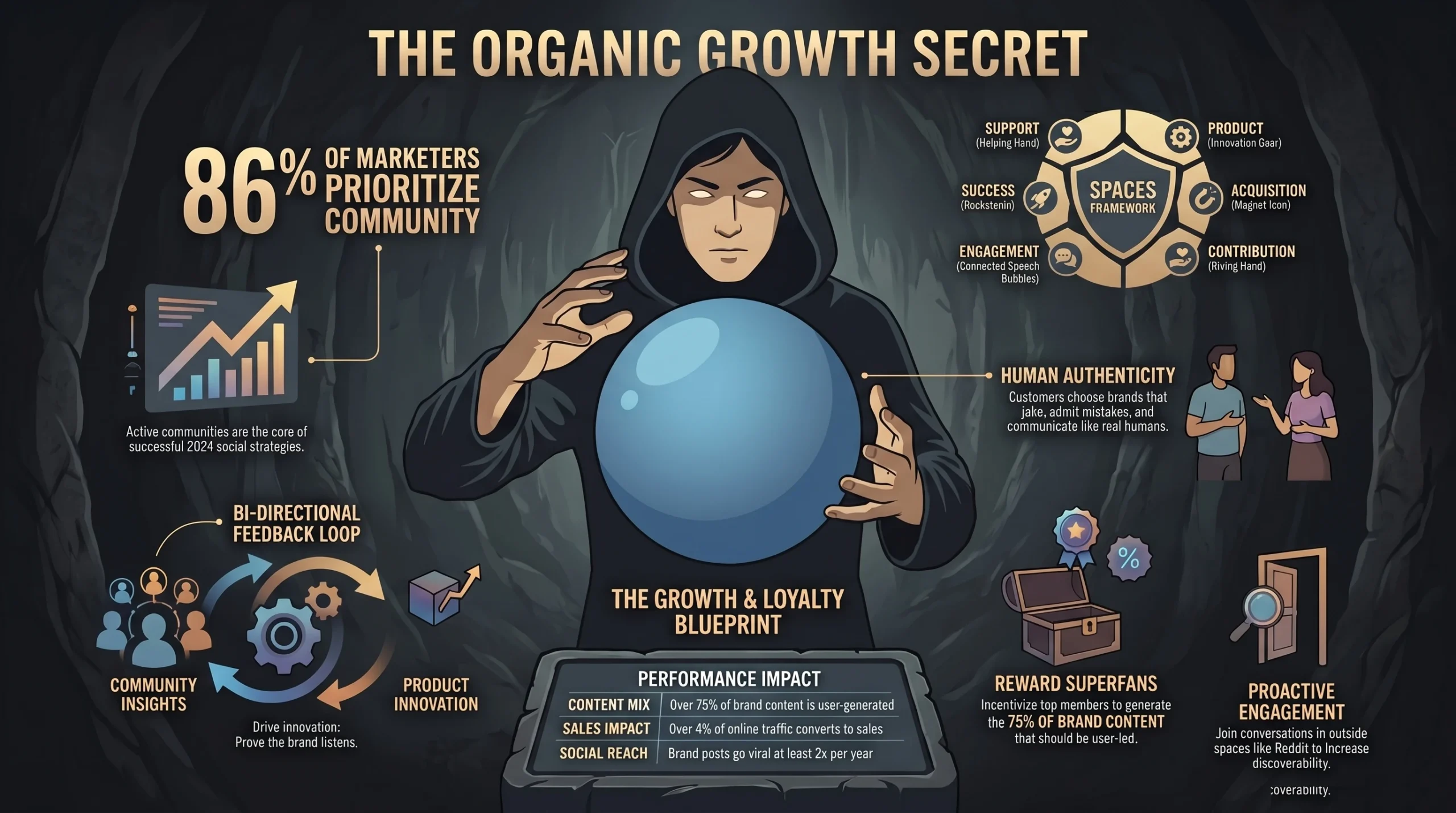
- According to HubSpot, 86 percent of social media marketers consider active online communities essential for success in the current year.
- Successful brand communities can achieve over 75 percent user-generated content, drastically lowering the cost of content production.
- The SPACES model (Support, Product, Acquisition, Contribution, Engagement, Success) aligns your community efforts with specific business goals.
- High-performing communities drive conversion rates of over 4 percent, significantly outperforming traditional social media broadcast methods.
- Community management acts as a “digital storefront” that replicates the trusted relationship of a traditional Indian Kirana store.
- Identifying and rewarding superfans turns casual users into brand evangelists who provide free, high-trust organic amplification for your brand.
Table of Contents
- Why is Community Management the backbone of modern brand loyalty?
- How can you build a Community Management strategy that actually works?
- Which type of community management model (SPACES) fits your business?
- What are the best practices for driving organic engagement?
- What can we learn from global and local community examples?
- Indian Context: The Rise of Community-Led Growth
Why is Community Management the backbone of modern brand loyalty?
Modern consumers no longer want to passively consume content. They expect to interact directly with brands that communicate humanly, admit mistakes, and offer genuine support. According to a HubSpot report, 86 percent of social media marketers state that building an active online community is crucial to a successful social media strategy in 2026. For Indian brands, this is not just a global trend: it is a survival mechanism.
In India, there is a deep-seated “trust deficit” when it comes to digital transactions, especially in Tier 2 and Tier 3 cities. Consumers are wary of faceless corporate entities. Community management builds trust by moving the brand away from being a cold, transactional machine. It creates a space where a brand communicates like a person, which is the primary driver of brand preference over competitors who offer similar prices but lack personality.
The data supports this transition. McKinsey research indicates that successful communities see more than 75 percent of their content generated by users rather than the brand itself. This creates a valuable feedback loop where businesses gain deep insights into customer preferences and pain points. By fostering a sense of belonging, brands can increase conversion rates to over 4 percent and ensure that brand-related posts go viral at least twice a year.
How can you build a Community Management strategy that actually works?
Building a high-octane community requires a methodical approach that moves beyond simply replying to comments. You must follow a six-step process: defining objectives, identifying the audience, choosing the right channels, setting measurable targets, engaging consistently, and analyzing results. A successful strategy ensures that the community aligns with core business goals like gathering user feedback or reducing customer support tickets.
Without clear accountability and dedicated resources, community discussions can quickly go stale. This is why many Indian D2C brands now hire dedicated Community Managers rather than just Social Media Managers. While the latter focuses on high-level content planning, the Community Manager acts as the brand’s voice, ears, and heart, navigating the nuances of one-to-one or one-to-few interactions.
Choosing the right channels for the Indian demographic
It is vital to meet your community where they are already active. While global brands may lean heavily on Discord or Reddit, the Indian demographic thrives in more accessible spaces like WhatsApp, Telegram, or Instagram. For example, a niche Indian skincare brand might find more success in a dedicated WhatsApp group where mothers share advice than on a complex Discord server.
Choosing the right platform influences the trajectory of your growth. Hosting a community directly on a brand website allows for better collection of first-party data and more control over the user experience. However, third-party platforms like Facebook or Reddit offer a larger existing user base. For Indian brands looking to scale, a hybrid approach often works best, where social media serves as the “top of funnel” to drive users into a more controlled, owned community space.
Which type of community management model (SPACES) fits your business?
The SPACES model helps brands categorize their community efforts based on their primary function. This is essential for Indian SaaS, EdTech, and D2C brands to ensure their community is driving actual business value rather than just vanity metrics.
| Model Type | Best For | Primary Function |
|---|---|---|
| (S) Support | Software, gadgets, or complex technical products. | Empowers members to answer questions and solve problems for each other, reducing support costs. |
| (P) Product | Consumer-oriented companies and D2C brands. | Allows customers to share feedback and ideas for future improvements and product roadmap decisions. |
| (A) Acquisition | Startups and newly-established Indian D2C brands. | Creates a network for brand ambassadors and advocates to build awareness through word-of-mouth. |
| (C) Contribution | Media companies and creative industries. | Encourages users to post content or collaborate on projects, such as open-source software or design contests. |
| (E) Engagement | Lifestyle brands and large corporate organizations. | Connects consumers or employees based on shared interests or internal company goals to boost morale. |
| (S) Success | Service-oriented businesses and EdTech platforms. | Helps customers work together to use products effectively to achieve specific educational or professional outcomes. |
For the booming Indian EdTech sector, the “Success” model is vital. It allows students to collaborate on learning, which increases course completion rates and drives repeat purchases. Similarly, Indian SaaS companies use the “Support” model to create a peer-to-peer help network that functions far more efficiently than a traditional ticketing system.
What are the best practices for driving organic engagement?
Driving engagement requires setting clear expectations from the start. You must establish firm participation guidelines to create a safe space for interaction. It is also important to build the community with the members, not just for them, by involving them early in the decision-making process. This creates a sense of ownership among your Indian audience, who value being heard by the brands they support.
Encouraging member-to-member interaction is the hallmark of a healthy community. If the brand is the only one talking, it is just a broadcast channel. A true community thrives even when the brand is not the primary moderator, as seen in many successful Indian startup Telegram groups where users help each other with technical issues.
Incentivizing participation and rewarding superfans
Identifying and rewarding superfans is a critical strategy for growth. These are the individuals who defend your brand in the comments and share your posts without being asked. A global example is Lucky Charms, which identified Olympic medalist Alysa Liu as a superfan. The athlete even uses Lucky Charms marshmallows as her social media profile photo. By collaborating with her, the brand generated a campaign with 750,000 likes.
In India, rewarding superfans does not always require large monetary incentives. For cost-sensitive Indian consumers, exclusive access to new product launches, personal shout-outs from the founder, or tokens of appreciation can make them feel like VIPs. This transforms high-energy participants into brand evangelists who promote products with a level of trust that no paid influencer can replicate.
What can we learn from global and local community examples?
Global brands provide excellent blueprints for community-led growth that can be adapted for the Indian market. LEGO Ideas uses a platform where fans share designs, and the most popular ones are actually produced by the company. GoPro centers its community on user-generated content, rewarding users with cash prizes for submitting high-quality videos under the hashtag #shotongopro. Sephora’s Beauty Insider Community has attracted millions of members who provide non-sponsored recommendations to each other, creating a high-trust environment.
In the Indian context, these models must be adapted for local social engagement. Zomato has mastered Tier 1 engagement through humor and relatable content that encourages thousands of comments. However, for Tier 2 and Tier 3 cities, brands like Meesho have successfully built communities of resellers who rely on community-led support and training to build their own small businesses.
Indian SaaS and D2C brands are increasingly using community-led growth to navigate high customer acquisition costs. By allowing customers to help each other or contribute to product roadmaps, brands reduce the need for expensive traditional marketing. This shift focuses on building a “community-at-the-core” model where the community is not a separate silo but the heart of the business operation.
Indian Context: The Rise of Community-Led Growth
The Indian market is currently undergoing a massive shift toward Community-Led Growth (CLG). This is a direct response to the skyrocketing cost of digital advertising on Meta and Google. For many Indian D2C brands, the Customer Acquisition Cost (CAC) has become unsustainable, making “faceless” brands go bankrupt. The solution is to focus on First-Party and Zero-Party data by hosting communities on owned platforms or dedicated WhatsApp channels.
This transition allows brands to bypass the rising costs of third-party advertising. In India, where trust is built through personal recommendations, a community acts as the digital equivalent of a Kirana store relationship. The store owner knows your name and your preferences, and community management allows a digital brand to scale that intimacy to millions of users across the country.
Furthermore, the rise of vernacular content is a major factor in Indian community management. Building communities that communicate in regional languages like Hindi, Tamil, or Marathi helps bridge the trust deficit in Tier 3 cities. Tools like HubSpot and Sprout Social are now being used alongside localized pricing strategies to help brands manage these diverse, multi-lingual communities efficiently.
What is Social Media Community Management?
Social media community management is the process of engaging audiences across social networks to increase brand loyalty and build authentic connections through one-to-one or one-to-few interactions.
What is the SPACES model?
The SPACES model is a strategic framework that organizes community management into six distinct categories: Support, Product, Acquisition, Contribution, Engagement, and Success, based on the primary business objective.
Frequently Asked Questions
What is the difference between Social Media Management and Community Management?
Social media management focuses on high-level content planning and distribution. In contrast, community management handles the reactions to that content. It focuses on audience behaviors, interests, and one-to-one interactions in DMs, comments, and niche forums to build deeper relationships and encourage brand advocacy.
How should a brand handle negative comments or crisis management?
Brands should treat negative interactions with transparency and respect. Clear escalation paths must be established for customer support or PR issues. While trolls seeking a reaction should often be ignored, genuine concerns must be addressed promptly to maintain community trust and demonstrate that the brand is listening.
How can a business measure the ROI of community management?
Success is measured through engagement rates, sentiment analysis, and direct sales metrics. According to McKinsey research, high-performing communities can convert 4 percent of their online traffic into direct sales. Furthermore, the cost savings from user-generated content and community-led support provide a high-octane return on investment.
What are the best platforms for hosting an Indian brand community?
The choice depends on your target demographic. Third-party platforms like WhatsApp, Telegram, and Instagram offer high accessibility for Indian users. However, hosting a community directly on your website provides greater control over user data, consistent branding, and improved conversion rates through the collection of first-party data.
Why is consistency in brand voice important for community engagement?
Consistency ensures that every interaction feels like it is coming from a single brand persona rather than different employees. Documented guidelines help your team maintain a unified tone and cadence, which builds a reliable and identifiable brand identity that community members can trust and recognize.
A healthy brand community creates a powerful flywheel effect where engaged members generate content, provide feedback, and drive organic sales. By humanizing the brand and prioritizing authentic connections, companies can move beyond the limits of falling organic reach. Investing in community management is the most sustainable way to foster long-term loyalty and visibility.
Ready to master the art of community-driven growth?