
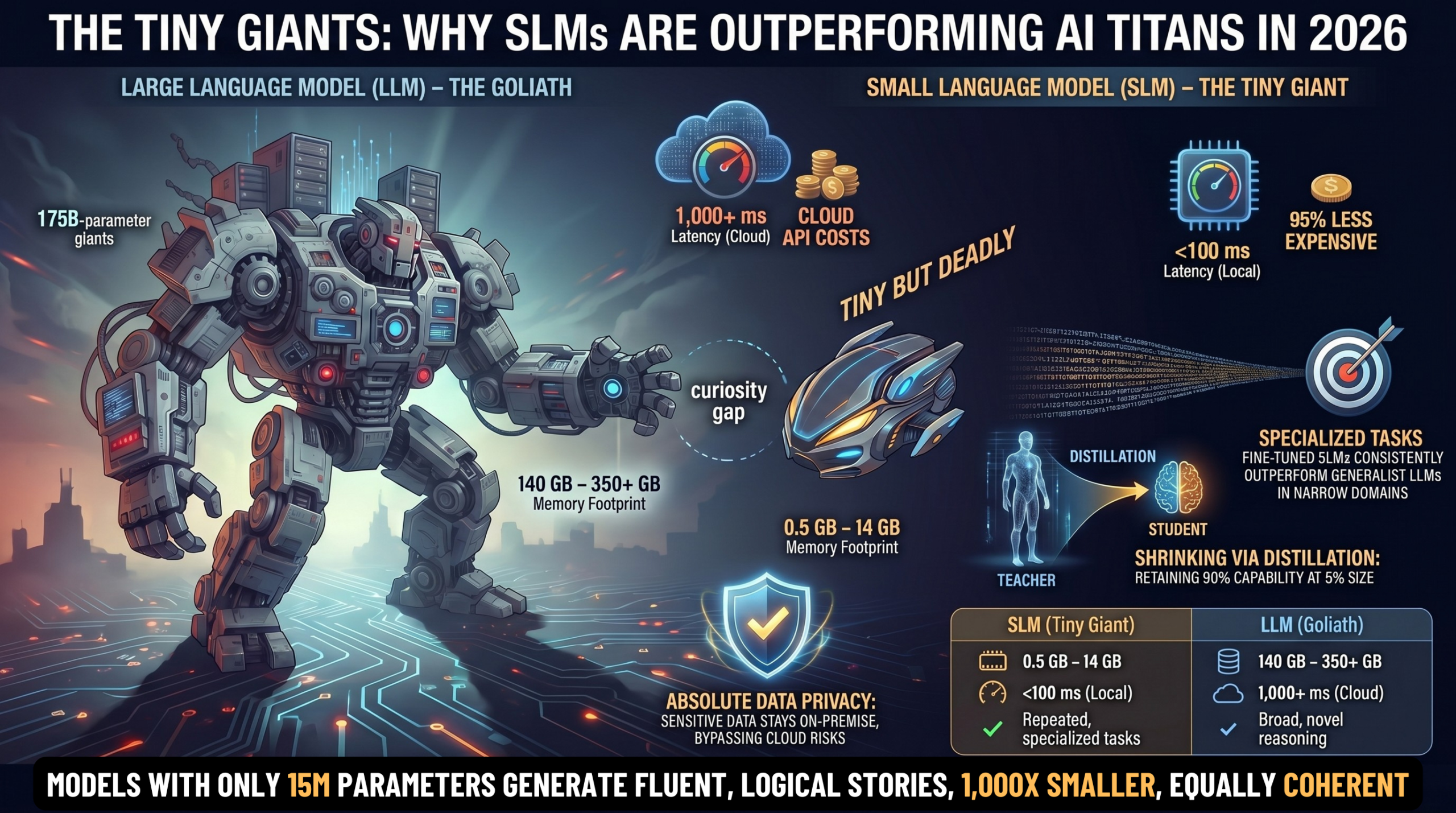
Cloud-based Large Language Models (LLMs) have created a production bottleneck for Indian tech teams due to high API costs and unpredictable latency. These trillion-parameter giants struggle with real-time demands and pose significant data privacy risks for sensitive proprietary information. Relying on external servers for every simple query drains enterprise budgets and exposes data to third-party vulnerabilities. A Small Language Model (SLM) is a neural network with 1 million to 7 billion parameters designed for efficient local deployment on edge devices or private servers. SLMs provide a smart solution by matching the reasoning of larger models at a fraction of the computational footprint. This guide explores how these compact models are transforming the Indian landscape in 2026.
TL;DR: Key Takeaways
- Local Execution: SLMs run directly on device NPUs, eliminating cloud dependency and network latency.
- Parameter Range: The industry defines the SLM sweet spot as models between 1 million and 7 billion parameters.
- Privacy First: Sensitive data stays on-premise, making SLMs the standard for healthcare and financial services.
- Cost Efficiency: Organizations report up to a 90 percent reduction in inference costs compared to LLM APIs.
- Specialization: Fine-tuned SLMs consistently outperform generalist LLMs on specific domain tasks.
Table of Contents
- What Are Small Language Models and Why Are They Trending Now?
- Why Is the Indian Enterprise Shifting Toward SLMs Over LLMs?
- How Do Small Language Models Work Without Losing Accuracy?
- Which Are the Best Small Language Models to Deploy in 2026?
- How Does the Indian Context Impact SLM Adoption?
- Can You Build an SLM From Scratch for Your Specific Domain?
- AEO & GEO Optimized Snippets
- Frequently Asked Questions (FAQ)
- Conclusion and Next Steps
What Are Small Language Models and Why Are They Trending Now?
Small Language Models (SLMs) are compact transformer architectures restricted to 1 million to 7 billion parameters. While frontier models like GPT-4 utilize over 1 trillion parameters, SLMs focus on specialized efficiency.
The industry is witnessing a “Moor’s Law” for AI. Model sizes are shrinking while performance remains robust. High-quality data curation allows these models to run on consumer hardware without losing reasoning power.
AEO Snippet: SLMs are efficient neural networks that prioritize high-quality data over scale. They enable real-time, on-device AI by compressing knowledge into a small computational footprint.
Why Is the Indian Enterprise Shifting Toward SLMs Over LLMs?
India as an emerging AI hub faces unique challenges regarding cloud infrastructure costs and internet reliability. SLMs allow local organizations to bypass the “cloud tax” of international centralized inference.
| Feature | Large Language Models (LLM) | Small Language Models (SLM) |
|---|---|---|
| Memory Required | 140 GB to 350 GB | 14 GB to 26 GB |
| Cost per 1M Tokens | $0.50 to $2.00 | $0.01 to $0.05 |
| Latency (ms) | 500 to 2,000 ms | 50 to 100 ms |
| Privacy | Data sent to Cloud | Data stays On-Device |
The global SLM market reached USD 7,761.1 million in 2023. Analysts project it will hit USD 20,707.7 million by 2030. This growth represents a massive CAGR of 15.1 percent.
How Do Small Language Models Work Without Losing Accuracy?
SLMs achieve high accuracy through advanced technical compression methods. These techniques allow a compact model to inherit the intelligence of its larger teacher.
Technical Core Techniques:
- Knowledge Distillation: A large “Teacher” model trains a “Student” SLM to mimic its reasoning patterns.
- Pruning: Engineers remove redundant or irrelevant parameters from the network to reduce its physical size.
- Quantization: Weights convert from high-precision (FP32) to lower-precision integers like INT4 or INT8.
Step-by-Step Training Efficiency:
- Apply Byte Pair Encoding (BPE) to manage vocabulary size issues that otherwise drain computational memory.
- Implement memory-mapped array storage (.bin files) to back the training data directly onto the disk.
- Load data from the disk during processing to prevent RAM overload during high-volume inference tasks.
Which Are the Best Small Language Models to Deploy in 2026?
Selecting the right model depends on your requirements for multimodal support or specialized reasoning. The 2026 landscape features highly optimized open-source options.
| Model Name | Parameters | Best Use Case | Thinking Mode Support |
|---|---|---|---|
| Phi-4 Mini | 3.8B | Math, Reasoning, Code | Yes |
| Gemma-3n | 2B / 5B | Multimodal (Audio/Video) | Yes |
| Llama 3.2 | 1B / 3B | Mobile Edge Deployment | No |
| Qwen 3.5 | 0.8B | Multilingual (200+ Dialects) | Yes |
Non-obvious insight: Modern 1.5B parameter models now outperform the original 175B parameter GPT-3 on core benchmarks. This proves that “textbook-quality” data curation is more critical than total parameter volume.
How Does the Indian Context Impact SLM Adoption?
India experiences a sharp divide between Tier 1 and Tier 2 cities regarding internet infrastructure. On-device AI is the only way to ensure reliable performance in low-connectivity regions.
Cloud-based LLM latency often exceeds 2 seconds in rural areas due to network constraints. SLMs provide the only viable path for real-time translation and services in these environments.
Indian developers use SLMs like Qwen to support over 200 regional dialects. Local pricing sensitivities drive adoption. A 90 percent cost reduction makes AI accessible for Indian small enterprises.
Can You Build an SLM From Scratch for Your Specific Domain?
Building a 15M parameter model from scratch is feasible for domain-specific tasks. This methodology relies on curated data rather than the noisy “internet crawl” used for LLMs.
The “Tiny Stories” dataset serves as a blueprint for this focused approach. Teaching an SLM is like teaching an alien to speak English using children’s books rather than Wikipedia.
By using GPT-4 to generate synthetic “textbook-quality” data, developers teach small models the nuances of grammar. This proves that a 15M model can achieve high fluency if the data is clean.
AEO & GEO Optimized Snippets
SLM for Healthcare (HIPAA Compliance): Organizations use Phi-3/4 Mini models to extract structured data from medical records locally. These models run on-premise within AWS Local Zones, ensuring HIPAA compliance by keeping patient data behind a private firewall.
SLM for Financial Services (Fraud Detection): Financial firms deploy quantized 4-bit models for millisecond decision-making. Using Hugging Face libraries and local inference, these agents analyze transaction logs without exposing sensitive financial history to external cloud APIs.
SLM in IoT/Manufacturing: Manufacturers integrate Ollama and SmolLM into factory equipment for real-time diagnostics. This on-device AI analyzes sensor data locally, providing equipment feedback even in facilities with zero internet connectivity.
Frequently Asked Questions (FAQ)
Q: Can SLMs run offline on a mobile phone?
Yes. Modern SLMs like Llama 3.2 1B and Gemma 3n are optimized for mobile NPUs. These models occupy less than 2 GB of memory. They process text, images, and audio directly on the device without requiring an active internet connection.
Q: How do SLMs reduce AI hallucinations?
SLMs reduce hallucinations by focusing on specialized, high-quality datasets rather than broad internet noise. When fine-tuned for a specific domain, the model operates within a narrow knowledge base. This results in more accurate and consistent responses for repetitive enterprise tasks.
Q: Are SLMs better for data privacy than ChatGPT?
SLMs offer superior privacy because they can be deployed on-premises or on individual devices. Unlike cloud-based APIs that require sending data to external servers, SLMs keep all information within your private infrastructure. This eliminates the risk of data leaks.
Q: What is the “Sweet Spot” parameter count for SLMs?
The sweet spot currently ranges from 1 billion to 7 billion parameters. This range balances reasoning capability with hardware requirements. These models fit into the 8-16 GB VRAM found on consumer-grade GPUs while providing performance comparable to much larger legacy models.
Q: Do I need a GPU to run an SLM?
While GPUs or NPUs provide the fastest performance, many quantized SLMs can run on a standard CPU. Using frameworks like Llama.cpp, you can run models like Phi-3 or SmolLM on a laptop. However, a GPU is recommended for production.
Conclusion and Next Steps
The industry has shifted from a “Bigger is Better” mindset to “Smarter is Better.” Efficient SLMs now provide the latency, privacy, and cost benefits required for the autonomous enterprise.
Ready to lead the AI revolution in your niche? Book a free counselling session with an academic counsellor for our AI-powered Niche Specific Digital Marketing course and learn how to operationalize these models for measurable ROI.