Let me paint a scenario you’ve probably experienced: You’re sitting in a marketing meeting, and your manager asks, “Should we increase our Google Ads budget or shift focus to Meta Ads?” You pause. You realize you don’t have a clear answer—and honestly, neither does anyone else in that room.
Here’s the truth: both platforms are dominators in the digital advertising space, but they work in completely different ways. Google Ads and Meta Ads (Facebook, Instagram, and audience network) are like two different chefs—both excellent, but with entirely different cooking styles.
Google Ads is the search maestro—it catches people actively looking for solutions. Meta Ads is the attention architect—it captures people scrolling through their feeds, creating desire for products they didn’t even know they needed.
In 2026, the competition between these platforms has intensified. Each has rolled out game-changing updates, new AI capabilities, and pricing adjustments that fundamentally change how we should approach digital advertising strategy.
TL;DR: The Quick Answer
Can’t read the whole thing? Here’s what you need to know:
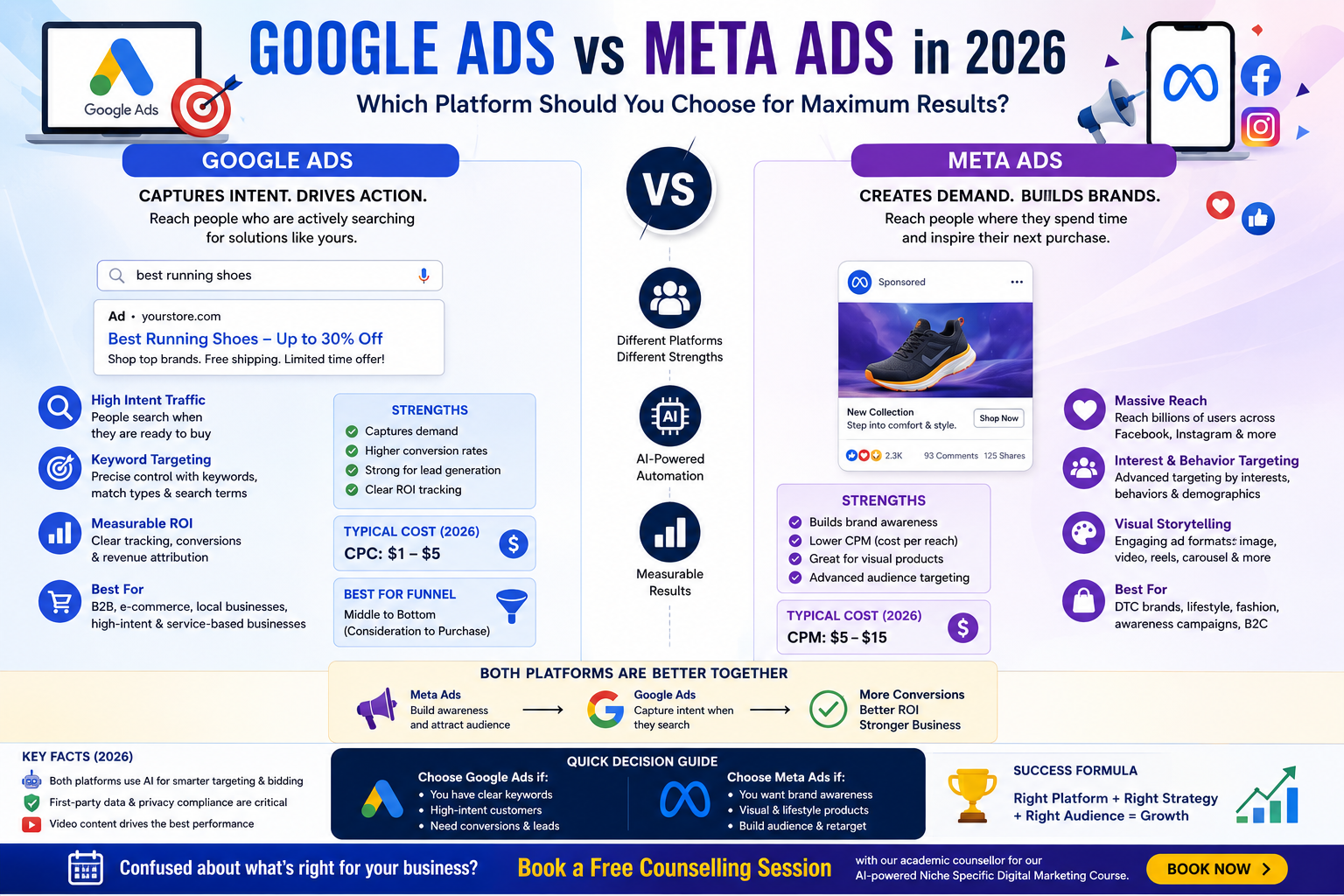
- Choose Google Ads if: You want to capture high-intent customers actively searching for your products/services. Better for B2B, e-commerce with clear keywords, and local businesses.
- Choose Meta Ads if: You want to build brand awareness, create visual storytelling, and reach audiences based on interests and behaviors. Perfect for lifestyle products, fashion, and DTC brands.
- The Real Answer: Most successful campaigns use BOTH. Google Ads generates immediate conversions; Meta Ads builds the funnel top.
- Game-Changer: Both platforms now use AI-powered audience targeting and automated bidding strategies. Manual optimization is becoming obsolete.
- Budget Reality: Average CPM (cost per thousand impressions) on Meta: $5-15. Average CPC (cost per click) on Google: $1-5. Your business model determines which makes sense.
Table of Contents
- What’s the Fundamental Difference Between Google Ads and Meta Ads?
- Which Platform Offers Better Targeting? Where Do You Reach YOUR Customers?
- What’s the Learning Curve? Which Is Easier to Master?
- What About AI and Automation? Should You Let the Machine Drive?
- FAQ
- Conclusion
What’s the Fundamental Difference Between Google Ads and Meta Ads?
Google Ads operates on demand-capture. Someone types “best running shoes for flat feet” into Google, and your ad appears. The customer is already in buying mode. You’re not creating demand—you’re capturing it.
Think of it like this: A customer is actively shopping, and you have a store right in their path.
Meta Ads operates on demand-creation. Someone scrolls through Instagram, sees a gorgeous photo of sneakers they never knew existed, falls in love with it, and clicks. You created the desire.
Think of it like this: You’re bringing customers to a store they didn’t know they wanted to visit.
The Implication? Google Ads typically has higher conversion rates but requires significant ad spend to reach your target audience. Meta Ads has lower conversion rates but reaches a broader audience and builds long-term brand awareness.
Real Example:
- A customer searching “Nike Air Max 90 sale” on Google = Google Ads gold mine
- A customer browsing Instagram who sees a beautiful Nike ad = Meta Ads opportunity
Google Ads operates on demand-capture. Someone types “best running shoes for flat feet” into Google, and your ad appears. The customer is already in buying mode. You’re not creating demand—you’re capturing it.
Think of it like this: A customer is actively shopping, and you have a store right in their path.
Meta Ads operates on demand-creation. Someone scrolls through Instagram, sees a gorgeous photo of sneakers they never knew existed, falls in love with it, and clicks. You created the desire.
Think of it like this: You’re bringing customers to a store they didn’t know they wanted to visit.
The Implication? Google Ads typically has higher conversion rates but requires significant ad spend to reach your target audience. Meta Ads has lower conversion rates but reaches a broader audience and builds long-term brand awareness.
Real Example:
- A customer searching “Nike Air Max 90 sale” on Google = Google Ads gold mine
- A customer browsing Instagram who sees a beautiful Nike ad = Meta Ads opportunity
Which Platform Offers Better Targeting? Where Do You Reach YOUR Customers?
This question separates strategic thinking from guessing.
Google Ads Targeting Strengths:
- Intent-Based Targeting – Keywords, search behavior, and audience segments based on past shopping
- Detailed Keyword Control – You can target specific phrases and exclude irrelevant searches
- Custom Audiences – Upload your customer list and find similar customers
- In-Market Audiences – Target people actively researching products like yours
- Contextual Targeting – Ads appear on websites discussing relevant topics
Best for: B2B services, high-intent products, anything with clear keywords
Meta Ads Targeting Strengths:
- Interest & Behavior Targeting – Target by hobbies, interests, past purchases, and lifestyle choices
- Lookalike Audiences – Find people similar to your best customers
- Detailed Demographics – Age, location, education, relationship status, job titles
- Pixel Data – Track user behavior on your website and build audiences from website visitors
- Layering Options – Combine multiple targeting parameters for precision
Best for: Consumer products, lifestyle brands, awareness campaigns, visual products
The New Reality:
Both platforms now emphasize Broad Targeting + AI Optimization. Overly narrow targeting actually hurts performance because it limits data for AI algorithms. The sweet spot is medium-broad audiences (10K-50K people) with AI handling the real optimization.
Practical Insight: Your customer avatar matters most. If your ideal customer is “eco-conscious women 25-35 interested in sustainable fashion,” Meta crushes it. If it’s “facilities managers searching for industrial cleaning supplies,” Google dominates.
What’s the Learning Curve? Which Is Easier to Master?
Honestly? They’re equally complex. But they’re complex in different ways.
Google Ads Learning Curve:
- Easy to understand the basic concept (pay for clicks)
- Moderate to master keyword research and bidding
- Hard to avoid wasting money on irrelevant keywords early on
- Time to competence: 2-3 months
- Common beginner mistake: Bidding on overly broad keywords and hemorrhaging budget
Meta Ads Learning Curve:
- Easy to set up campaigns visually
- Moderate to build audiences and understand pixel tracking
- Hard to resist constantly tweaking creative and audiences
- Time to competence: 1-2 months (faster to see results, but takes longer to optimize)
- Common beginner mistake: Changing campaigns too frequently before they have enough data to optimize
The Verdict: Meta Ads are slightly faster to grasp initially, but both platforms reward deep expertise.
How Do You Actually Know Which Is Working? Tracking & ROI
Google Ads Tracking:
- Conversion Tracking: Clear and direct. Someone clicks your ad, lands on your site, makes a purchase. You know exactly what you paid for that conversion.
- Attribution Model: Google defaults to last-click attribution (the Google Ads click gets all the credit). This often inflates its effectiveness.
- iOS Impact: Less severe than Meta because search behavior is tracked differently
- Data Quality: Generally reliable and transparent
Meta Ads Tracking:
- Conversion Tracking: Uses pixel data. You install Meta Pixel on your site, track user behavior
- Attribution Model: Also uses last-click primarily, but increasingly more limited by iOS privacy changes
- iOS Impact: Severely limited post-2021. Meta can now only reliably track 8 conversion types per domain
- Data Quality: Increasingly challenged by privacy regulations
The Reality Check: Both platforms probably overstate their contribution to your business. That customer might have:
- Seen your Meta ad (brand awareness)
- Searched for you on Google days later
- Clicked Google and converted
Google takes 100% credit. Meta gets no credit. The reality is 40/60 contribution maybe.
What Smart Marketers Do: Look at incrementality tests, compare performance months, and rely on multiple data sources. Don’t trust a single attribution model.
What About AI and Automation? Should You Let the Machine Drive?
The short answer: Yes, but with guardrails.
Google Ads AI Features:
- Performance Max: AI runs the entire campaign
- Smart Bidding: Automated CPC, tCPA (target cost per action), tROAS (target ROAS)
- Auto-Optimization: Automatically pauses underperforming keywords and ads
Meta Ads AI Features:
- Advantage+ Shopping: AI handles audience, creative, and bidding
- Generative AI Creatives: Automatically generates ad variations
- Dynamic Creative Optimization: Tests different combinations automatically
The Recommendation:
- Start with AI: Let the platform optimize. It genuinely works better than manual optimization in most cases.
- Monitor, Don’t Micromanage: Check weekly, not daily. Let the algorithm gather data.
- Add Guardrails: Set daily budgets, exclude irrelevant placements, define quality standards
- Supplement with Insights: Use your business knowledge to inform AI settings, not to override them constantly
Real Talk: The best performers in 2026 aren’t the ones who manually optimize keywords. They’re the ones who set smart parameters and let AI do the heavy lifting.
FAQ
1. Which is better in 2026: Google Ads or Meta Ads?
There is no one-size-fits-all answer. Google Ads is ideal for capturing high-intent users actively searching for products or services, while Meta Ads excel at building brand awareness and creating demand through visually engaging content. Many businesses achieve the best results by using both platforms together.
2.Which platform provides better targeting options?
Both platforms offer advanced targeting capabilities. Google Ads focuses primarily on search intent, keywords, and in-market audiences, whereas Meta Ads allows advertisers to target users based on interests, behaviors, demographics, and lookalike audiences.
3.Is Google Ads better for B2B businesses?
Yes. Google Ads is often more effective for B2B companies because decision-makers typically search for solutions, vendors, and services directly on Google. This intent-driven behavior generally results in higher-quality leads.
4.Can I run successful campaigns using only one platform?
Yes, but relying on a single platform may limit your growth potential. Businesses with smaller budgets can start with the platform that best aligns with their goals and audience, then gradually expand to include the other platform for a full-funnel marketing strategy.
5.Which platform delivers better return on investment (ROI)?
ROI depends on your industry, audience, offer, and campaign objectives. Google Ads often produce quicker conversions due to higher user intent, while Meta Ads can deliver strong long-term returns by nurturing prospects and increasing brand awareness.
Conclusion
Here’s what we’ve covered:
Google Ads is a precision instrument. It captures high-intent customers ready to buy. It’s ideal for B2B, professional services, and businesses with clear keywords. The cost per conversion is higher, but the quality of customers is often superior.
Meta Ads is the brand builder. It creates awareness, drives consideration, and reaches massive audiences affordably. It’s ideal for consumer brands, lifestyle products, and businesses focused on long-term growth.
The 2026 Reality: Both platforms have converged toward AI-driven automation. Manual optimization is becoming less important than setting smart parameters and letting algorithms work. Privacy changes mean first-party data is gold. Video is king.
But Here’s the Meta-Truth:
The best advertising strategy isn’t “Google vs. Meta.” It’s “Google and Meta” in a coordinated dance:
- Meta builds awareness and creates desire
- Google captures that intent when customers search
- Together, they create a complete customer journey
The best advertising platform is the one your customers are on, at the moment they’re ready to engage with your brand. For most businesses, that’s both Google and Meta—at different stages of their journey.
Your job isn’t to choose between them. It’s to orchestrate both toward a single goal: building a profitable, sustainable business through paid advertising.
Book a free counselling session with an academic counsellor for our AI-powered Niche Specific Digital Marketing course.
Book a Free Counselling Session