
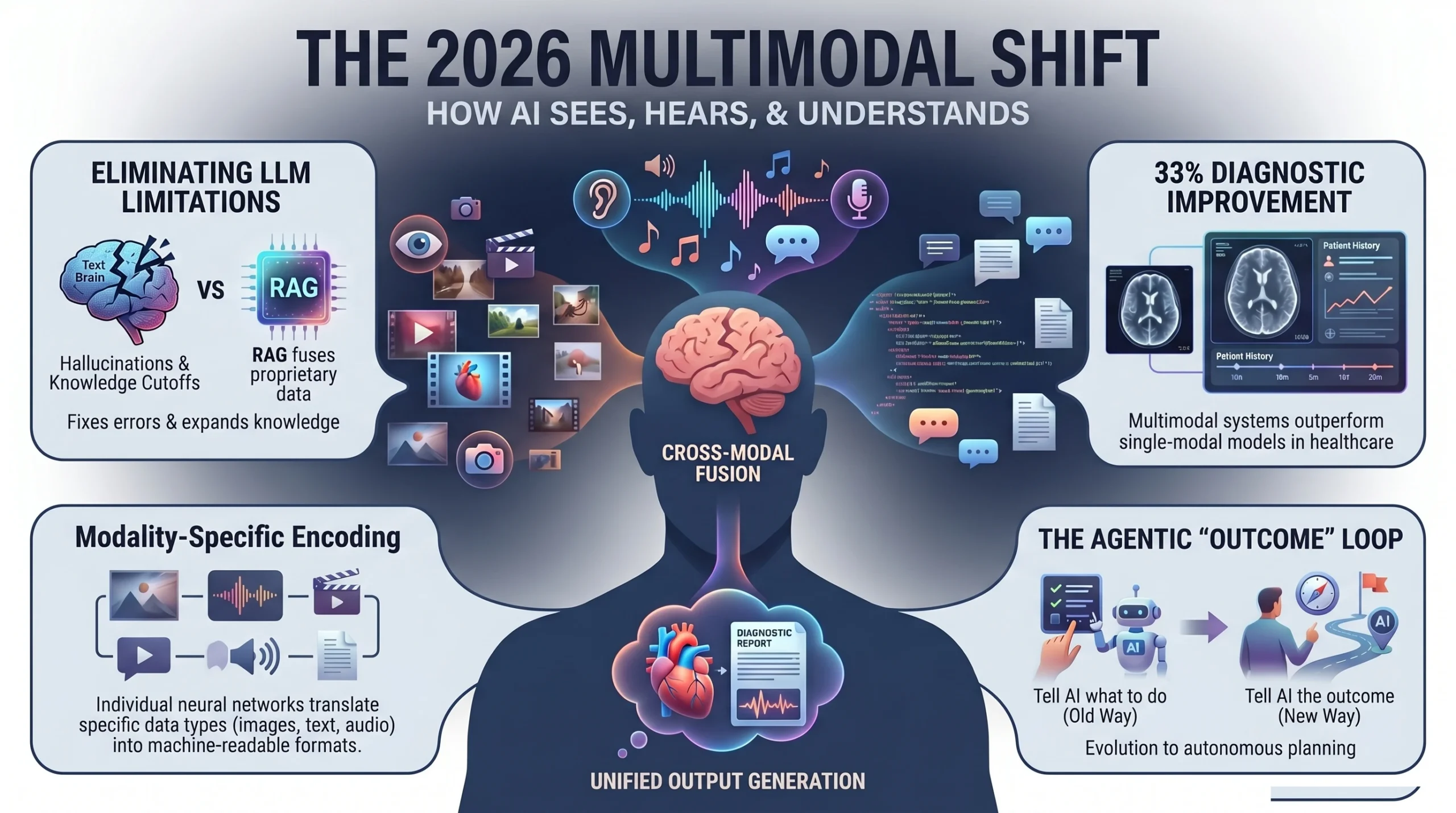
Traditional enterprise AI systems in India currently face severe “unimodal” limitations because they process only text. These systems ignore the critical context hidden within images, audio, and video streams. In the high-velocity Indian market, relying on text alone often leads to model hallucinations and missed business insights, particularly in sectors like retail or insurance where visual evidence dictates the bottom line. Multimodal AI provides the necessary unified intelligence solution by processing and integrating diverse data types simultaneously. This technology fuses text, images, audio, and video into a single cohesive framework. It mimics human-like understanding to deliver precise, context-rich outputs that drive superior enterprise operations.
Quick Summary of Key Insights
- Unified Intelligence: Multimodal AI integrates text, images, and video to provide a holistic understanding of complex enterprise data.
- Explosive Growth: Experts value the multimodal AI market at USD 1.2 billion in 2023, with a projected CAGR exceeding 30% through 2032.
- Amazon Nova Family: This suite (Micro, Light, Pro) on Amazon Bedrock offers Indian startups a high price-performance balance for scaling AI.
- Multimodal RAG: By retrieving context from varied data formats, these systems significantly reduce hallucinations and improve accuracy.
- Architecture Focus: Modern models leverage Vision Transformers (ViT) and Q-Formers to bridge the gap between visual tokens and linguistic reasoning.
- Strategic Local Advantage: Indian enterprises in hubs like Bengaluru and Pune can use these tools to automate insurance claims and localized retail search.
Table of Contents
- What is Multimodal AI and how does it differ from traditional systems?
- How does the architecture of Multimodal AI work under the hood?
- What is Amazon Nova and why is it a game-changer for Indian developers?
- How can businesses implement Multimodal RAG for complex data?
- What are the primary enterprise use cases for Multimodal AI in India?
- What are the key risks and ethical considerations for Multimodal AI?
- Frequently Asked Questions
What is Multimodal AI and how does it differ from traditional systems?
Multimodal AI represents a fundamental shift from single-channel processing to a holistic intelligence framework. While unimodal AI excels at narrow tasks like basic transcription, it hits a wall when challenges require multiple data streams. For instance, a unimodal customer service bot might read a complaint but miss the frustration evident in a customer’s voice or facial expression. In the Indian context, where consumer sentiment is often expressed through a mix of regional languages and visual cues, unimodal systems simply cannot keep pace.
The market for these advanced systems is expanding rapidly. Valued at USD 1.2 billion in 2023, the industry anticipates a compound annual growth rate (CAGR) exceeding 30% through 2032. This growth reflects the enterprise need for systems that see, hear, and understand context at scale.
| Feature | Unimodal AI | Multimodal AI |
|---|---|---|
| Data Input | Single type (Text or Image) | Multiple (Text, Image, Video, Audio) |
| Context Awareness | Limited to one channel | High; synthesizes cross-source signals |
| Accuracy | Prone to semantic ambiguity | High; uses cross-source validation |
| Example | Basic keyword search | Autonomous navigation or visual RAG |
Indian tech leaders in “Tier 1” hubs like Bengaluru and “Tier 2” hubs like Pune are now prioritizing multimodal frameworks. These systems use neural networks and deep learning models to draw insightful conclusions that were previously invisible to traditional technologies. By processing various data sets simultaneously, the AI interprets nuance in a way that aligns with human cognition.
How does the architecture of Multimodal AI work under the hood?
The architecture of a multimodal system generally comprises three core components: an Input Module, a Fusion Module, and an Output Module. Each plays a specific role in transforming raw sensory data into actionable intelligence.
The Role of Multimodal Embeddings
The process begins when the system converts all data types into numerical vectors called embeddings. Whether the input is a Marathi sentence or a JPEG image, the system translates it into a comparable mathematical format. For text, this involves a sophisticated algorithm called Byte Pair Encoding (BPE). BPE splits words into subword units, ensuring the model can handle “out of vocabulary” terms by breaking them into familiar characters. For example, if the model does not know a specific local dialect word, it breaks it into characters, adds a “/w” boundary, and counts the most frequent pairs to merge them into a recognizable token.
Vision Transformers (ViT) and Linear Projection
Vision Transformers treat images similarly to how Large Language Models (LLMs) treat text. The system breaks a 128×128 image into small patches, typically 16×16 blocks. This results in 64 total patches. These patches are then flattened and passed through a “linear projection” to create a vector. In a standard ViT architecture, this projection results in a 768-dimension vector output for each patch. This allows the transformer architecture to process visual data as a sequence of tokens, complete with positional embeddings to maintain the spatial layout of the original scene.
Complex Data Fusion Methods
The Fusion Module integrates information from different sources using three primary methods:
- Early Fusion: This method combines raw inputs before processing. Joining a written complaint with a voice recording allows the system to identify emotional urgency through tonal analysis.
- Intermediate Fusion: The system merges partially processed representations. Video streaming platforms use this to combine visual elements of a trailer with a user’s viewing history to generate recommendations.
- Late Fusion: Models process inputs independently and only combine outputs at the end. Autonomous vehicles in India’s complex traffic scenarios rely on this. LiDAR calculates distances while cameras identify objects; the system only merges these independent findings for final braking or steering decisions.
What is Amazon Nova and why is it a game-changer for Indian developers?
Amazon Nova is a new family of models hosted on Amazon Bedrock, offering state-of-the-art multimodal capabilities with a focus on cost-to-performance. For the Indian market, where “frugal innovation” or “Jugaad” is the guiding principle, Nova provides an affordable entry point for both startups and established enterprises.
The Amazon Nova family currently includes:
- Nova Micro: A text-only model optimized for lightning-fast performance and extreme cost-efficiency.
- Nova Light: A fast, affordable multimodal model capable of processing text, images, and video.
- Nova Pro: A high-performance model designed for advanced reasoning, complex code generation, and deep video understanding.
- Nova Premier: An upcoming “any-to-any” model slated for 2025, which will generate images and video directly from multimodal prompts.
Technical Constraints and Payload Management
When building with Nova, developers must manage specific limits to ensure efficiency. Amazon Bedrock caps the payload size at 25MB for base64 encoded images or videos. For longer video files, developers must use Amazon S3, which supports files up to 1GB. Crucially, Nova uses a sampling rate of 1 frame per second (fps) for video understanding. This remains consistent for videos up to 16 minutes long, resulting in exactly 960 frames. This sampling ensures the model captures critical visual information without the computational overhead of processing high-fps data, making it ideal for large-scale video analysis in the Indian logistics or security sectors.
How can businesses implement Multimodal RAG for complex data?
Retrieval-Augmented Generation (RAG) reduces hallucinations by grounding AI responses in trusted proprietary data. For Indian enterprises dealing with complex documents like KYC forms, bank statements, or regional medical reports, Multimodal RAG is no longer optional.
Building the RAG Pipeline
The implementation involves three critical steps:
- Extraction: Developers use tools like PyMuPDF to extract images and Tabula for complex tables from PDF documents.
- Embedding and Normalization: Generate embeddings using models like Amazon Titan Multimodal Embeddings. Here, “Normalization” is critical. By ensuring a unit length of 1 for the output vector, developers guarantee scale uniformity. This is essential for accurate cosine similarity scores during retrieval.
- Storage: Store these vectors in high-performance databases like OpenSearch Serverless or PGVector.
Three Enterprise Strategies for RAG
- Option 1 (Raw Retrieval): The system stores raw image and text embeddings. When a user queries the system, the vector database returns the most relevant raw image or text chunk directly to a multimodal LLM like Nova Pro.
- Option 2 (Summary Retrieval): The system generates text descriptions (captions) of images and tables first. It stores only these text summaries. This allows developers to use cheaper, unimodal LLMs for the final generation, though it risks losing deep visual nuance.
- Option 3 (Hybrid Search): The system searches based on text summaries but retrieves the original raw image for the final prompt. This ensures the LLM has full visual context while keeping the initial search index fast and lightweigh
What is a Q-Former?
A Q-Former acts as a technical bridge in architectures like Blip-2. It connects a pre-trained image encoder with a frozen LLM. It extracts the most relevant visual features and provides them as a “Soft Visual Prompt” to the language model, making the system highly efficient for vision-language tasks without needing to retrain the underlying LLM.
What are the primary enterprise use cases for Multimodal AI in India?
Healthcare and Life Sciences
Multimodal systems improve diagnostic accuracy by combining imaging scans with textual patient histories. Research from Stanford Medicine showed that a diagnostic system for melanoma achieved 87% accuracy when using multimodal inputs, compared to only 76% accuracy when using unimodal image analysis alone. In rural India, where access to specialists is limited, such high-accuracy tools can provide a critical first line of defense.
Insurance Claim Lifecycle Automation
The Indian insurance sector often suffers from manual processing bottlenecks. By leveraging Amazon Bedrock Agents and Knowledge Bases, companies can automate the entire lifecycle. When a customer uploads a photo of a vehicle accident, a multimodal model analyzes the damage. The system simultaneously queries a knowledge base for policy details and triggers a Lambda function to approve or flag the claim. This reduces processing time from several days to mere minutes.
Retail and E-commerce
Indian retail platforms are adopting visual search to mimic the “StyleSnap” experience. Users upload a photo of a garment found in a local market, and the AI identifies patterns, colors, and textures to find similar items in the catalog. This cross-modal search outshines traditional keyword queries by understanding the aesthetic intent of the shopper.
What are the key risks and ethical considerations for Multimodal AI?
While the benefits are significant, Indian CTOs must account for several enterprise risks:
- Privacy: Multimodal systems require access to sensitive personal data like voiceprints and images. Indian enterprises must implement stringent safeguards to comply with emerging data protection regulations.
- Misinterpretation: Combining different data types is powerful but not foolproof. The AI might misunderstand the nuance between an image and its accompanying text, leading to harmful automated outcomes.
- Bias: Systems can perpetuate existing biases found in training data. In a diverse market like India, ensuring fairness across regional demographics and languages is a primary technical challenge.
- Complexity: Managing multimodal pipelines is significantly more difficult than unimodal systems, often leading to higher operational costs and technical debt.
- Machine-Generated Content: Organizations like Stanford HAI warn that high-quality multimodal generation makes it easier to create deepfakes and misleading content, which could destabilize consumer trust.
Frequently Asked Questions
Q1: What is the difference between Multimodal and Unimodal AI?
Unimodal AI processes a single data type, typically text or images. Multimodal AI integrates multiple formats like images, audio, and video simultaneously. This allows the system to understand complex contexts, such as recognizing customer frustration through voice tone even when their written words seem neutral or professional.
Q2: Can Amazon Nova process video data for Indian logistics?
Yes, Amazon Nova Light and Nova Pro process video data efficiently. You can provide video via base64 encoded strings for small files under 25MB. For larger files up to 1GB, you should upload the video to an Amazon S3 bucket and provide the URI to the model.
Q3: What is the sampling rate for Nova’s video understanding?
Amazon Nova uses a sampling rate of exactly 1 frame per second. This rate remains consistent for videos up to 16 minutes long, resulting in a maximum of 960 frames. This approach ensures the model identifies key visual information without the massive computational overhead of processing every single frame.
Q4: Is Multimodal RAG better than traditional RAG for complex PDFs?
Multimodal RAG is far superior for PDFs containing charts, tables, and images. Traditional RAG often ignores non-text elements, leading to incomplete or hallucinated answers. Multimodal RAG embeds all entities, allowing the AI to “see” the charts and “read” the tables to provide a comprehensive, accurate enterprise response.
Q5: What are the token limits for Titan Text Embeddings V2?
Amazon Titan Text Embeddings version two handles a maximum of 8,192 tokens per input. If your document exceeds this limit, you must implement a chunking strategy, such as recursive character splitting, before sending data to the embedding model to ensure no critical business information is lost.
The future of intelligence for the Indian enterprise lies in the ability to bridge the gap between visual, auditory, and textual data. By adopting multimodal frameworks and tools like Amazon Nova, businesses can move beyond simple automation to create truly context-aware systems that drive efficiency and consumer trust across the subcontinent.
Ready to lead the AI revolution?
Book a Free Counselling Session with an academic counsellor for our AI-powered Niche Specific Digital Marketing course and master the tools driving the future of the Indian enterprise.