The Indian marketing sector is currently facing a massive wave of anxiety regarding AI-driven job displacement. As automation handles everything from copywriting to complex data mining, professionals in hubs like Bangalore and Mumbai fear their roles may soon become obsolete.
This fear is agitated by a staggering “AI skills gap” where nearly 75% of employers struggle to find talent with the necessary AI literacy. If you stay stagnant while the industry shifts, you risk being left behind in a market that moves at the speed of an algorithm.
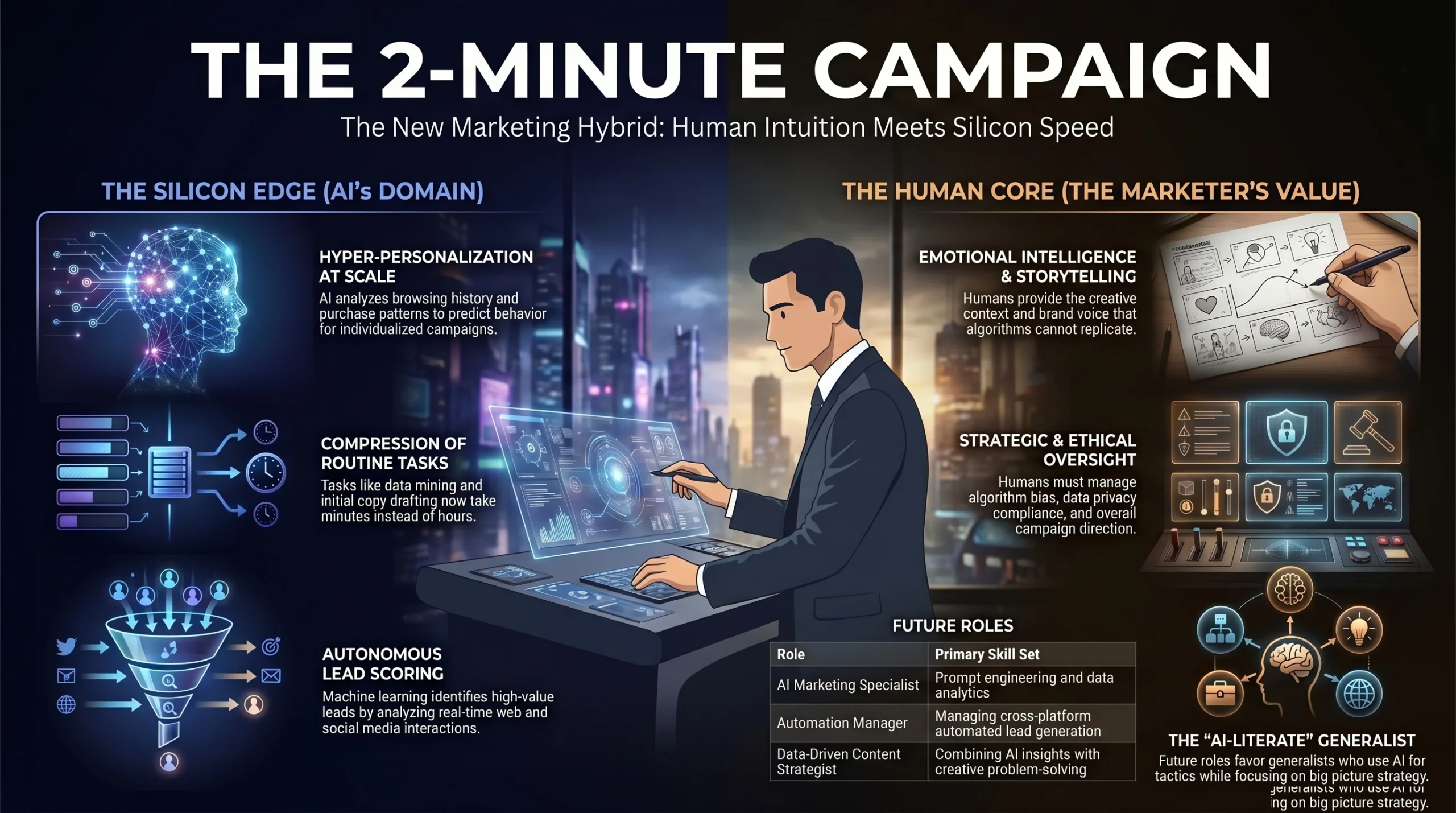
The solution is the hybrid model of “Human + AI” which serves as the definitive future of our industry. The future of digital marketing is defined by human-led strategy powered by technological efficiency, where human creativity provides the essential context for automated outputs.
TL;DR:
- Massive Efficiency: Tasks like resizing assets or mining data that once took hours now take minutes, allowing for faster client feedback loops.
- The New Mantra: AI will not take your job, but a person using AI as a creative partner certainly will.
- Hyper-Personalization: We are moving beyond broad demographics to individual behavior patterns, mimicking the Netflix and Spotify recommendation models.
- Orchestrator Roles: The industry is shifting from specialized silos toward “Generalist” roles where professionals act as orchestrators of various AI agents.
- Human-in-the-loop: Ethical oversight is non-negotiable to prevent algorithmic bias and manage data privacy concerns in a mobile-first market.
- Upskilling is Mandatory: With 4 in 5 employers prioritizing AI-skilled talent, micro-credentials are the new currency for career longevity.
Table of Contents
- Why is the future of digital marketing defined by Human-AI collaboration?
- How is AI reshaping Indian marketing workflows today?
- Which AI marketing tools are essential for the modern professional?
- Why does personalization at scale require human storytelling?
- What are the ethical risks of AI in the corporate landscape?
- How can Indian professionals upskill for an AI-driven career?
- Frequently Asked Questions
Why is the future of digital marketing defined by Human-AI collaboration?
The shift in the global marketing landscape is best summarized by Christina Inge from Harvard Professional & Executive Development. She argues that AI must be viewed as a creative partner rather than a competitor for human roles.
The modern marketer is rapidly moving from a narrow “specialist” role into a strategic “generalist” or “orchestrator” role. In this new dynamic, AI handles the tactical, repetitive executions while the human professional focuses on brand direction and emotional resonance.
The demand for this collaboration is reflected in recent hiring trends across the globe. Data shows that 4 in 5 employers now prioritize candidates who possess AI-related skills to stay competitive in an increasingly digital-first economy.
In the Indian context, marketing agencies in hubs like Bangalore are shifting towards “human-in-the-loop” workflows. This ensures that while AI generates the volume, human experts provide the cultural nuance required for the local market.
The goal is to use AI to “sketch out” ideas and demonstrate concepts quickly for stakeholders. This allows for faster feedback loops with clients, significantly driving efficiency across the entire campaign lifecycle from start to finish.
This partnership allows marketers to focus on high-level strategy rather than getting bogged down in administrative tasks. By automating the “how,” we free up cognitive space to focus on the “why” behind every campaign.
How is AI reshaping Indian marketing workflows today?
AI is fundamentally transforming how marketing departments operate by automating repetitive, data-heavy tasks. This allows teams to prioritize strategy and storytelling over manual labor and basic asset management.
Content Production
Generative AI (GenAI) is now used to write initial drafts of scripts, articles, and product descriptions in seconds. It can also resize creative assets for different platforms like Instagram and LinkedIn, which traditionally took hours of designer time.
Data Analysis and Reporting
Marketing teams are moving away from manual data mining and spreadsheet crunching. AI tools can rapidly process massive datasets to provide real-time insights into campaign performance and changing consumer sentiment.
Predictive Lead Scoring
Businesses now use machine learning to prioritize potential customers based on specific data points. According to the source context, there are five critical types of lead scoring that professionals must master:
- Social media-based scoring: Using data gleaned from engagement and social interactions.
- Webpage-based scoring: Examining how users interact with specific pages on a company website.
- Event-based scoring: Considering how users participate in webinars or live events.
- Predictive lead scoring: Using machine learning to forecast the likelihood of a lead conversion.
- Dynamic scoring models: Creating models that adapt to changing consumer behavior in real time.
| Traditional Workflow | AI-Augmented Workflow | Human Oversight Required |
|---|---|---|
| Manual data mining and spreadsheet analysis | Real-time automated insights and pattern recognition | Identifying strategic opportunities and checking for data bias |
| Multiple manual iterations of creative copy | Instant GenAI drafts and iterative concept sketching | Ensuring brand voice alignment and cultural nuance |
| Targeting based on broad demographics | Hyper-specific predictive segments and lead scoring | Validating the ethical use of consumer data |
| Fixed social media posting schedules | Dynamic scheduling based on real-time engagement data | Approving final messaging for brand safety |
| Manual resizing of ad visuals for platforms | Automated asset resizing and dimension optimization | Final quality check for visual consistency |
Which AI marketing tools are essential for the modern professional?
Modern professionals must master a suite of tools to remain relevant in a competitive market. These platforms integrate data analysis, campaign management, and creative production into streamlined, single-interface dashboards.
HubSpot is a critical tool for lead tracking and personalizing marketing content at scale. It allows users to manage social media accounts and track the progress of complex ad campaigns while attracting leads through landing pages.
Adobe Sensei provides advanced capabilities for campaign management and predictive modeling. It helps marketers integrate data analysis directly into their design workflows, making it easier to create data-informed visuals.
Synthesia has become an essential tool for high-speed video production. It allows for the creation of personalized campaign videos and training content without the need for traditional film crews or expensive studio equipment.
A non-obvious insight for social media managers is the use of Blaze for scheduling. This tool can generate a full week or month of social media content calendars and explainer videos with just a few clicks.
Other vital tools include Jasper for high-volume content generation and Optmyzr for pay-per-click (PPC) management. Using Google Gemini or Microsoft Copilot helps in evaluating large amounts of information and drafting marketing plans.
Why does personalization at scale require human storytelling?
Consumers today expect brand interactions to feel customized to their specific needs. AI makes this possible by analyzing vast amounts of data to deliver the right message at the exact right time to the right person.
This model is already visible in the recommendation engines of global giants like Netflix and Spotify. These platforms analyze viewing history and search patterns to suggest content that feels uniquely curated for the individual user experience.
Hyper-personalization vs. Segmentation
Traditional segmentation groups people by broad categories like age, gender, or location. Hyper-personalization uses AI’s predictive power to anticipate an individual’s preferences based on their real-time behavior and past interactions with the brand.
The Role of Emotional Intelligence
While AI can identify a pattern, it cannot replicate the emotional resonance of a human story. Human oversight ensures that personalized messages remain authentic and do not feel intrusive, robotic, or culturally tone-deaf.
In India, this applies to the unique mobile-first consumer behavior seen across the country. Brands like Zomato or Reliance Retail can use AI to trigger personalized offers during festive surges like Diwali or Eid.
However, human strategists must craft the cultural themes and emotional hooks that truly connect. Reaching the “Bharat audience” in Tier 2 and Tier 3 cities requires vernacular AI content that respects local dialects and sensibilities.
Effective storytelling cuts through the noise of information overload. It ensures that the hyper-targeted message actually connects with the consumer on a human level, inspiring long-term brand loyalty rather than just a one-time click.
What are the ethical risks of AI in the corporate landscape?
The rapid adoption of AI brings significant challenges regarding data privacy and algorithmic integrity. Organizations must navigate these risks to ensure they are using technology in a responsible, transparent, and sustainable manner.
Algorithmic Bias: A flaw in AI models where historical or representational prejudices in training data lead to unfair discrimination or skewed results.
This occurs when systems repeat biased patterns, necessitating human oversight to audit datasets and ensure fairness in automated decisions.
Data privacy remains a primary concern for both consumers and regulators. AI systems require massive amounts of consumer data to function, leading to questions about how this information is collected and whether it is used without explicit permission.
Christina Inge notes that a licensing deal, similar to what the music industry uses for streaming, may be necessary. This would ensure that AI companies pay for the data and content they use to train their increasingly sophisticated models.
Another major issue is the environmental impact of AI technology. The high energy consumption required to train and run complex machine learning models is becoming a critical topic for corporate social responsibility (CSR) departments worldwide.
To mitigate these risks, companies must audit their systems regularly for accuracy. Ensuring that data sets are representative and that human oversight is present at every stage is essential for building long-term trust with the audience.
Compliance with international regulations, such as the European Union’s General Data Protection Regulation (GDPR), is no longer optional. Transparent data practices are the foundation of ethical AI adoption in any sector, including the Indian market.
How can Indian professionals upskill for an AI-driven career?
The transition to an AI-driven workplace requires a proactive approach to education and professional development. Professionals must shift their mindset from “learning once” to a continuous process of microlearning and reskilling to stay relevant.
- Assess Skills Gap: Research current industry standards for AI adoption in your specific role. Identify the tools and concepts, like prompt engineering or predictive analytics, where your knowledge is currently lacking compared to peers.
- Choose Education Path: Look for specialized certificates or micro-credentials that focus on AI in marketing. Flexible online programs allow working professionals to balance their studies with existing job responsibilities in a fast-paced environment.
- Build a Portfolio: Apply your new skills to real-world projects and showcase them. Demonstrate how you have used AI for critical problem-solving, engineering better prompts, or achieving quantifiable results in data analysis and reporting.
- Networking in AI Groups: Connect with other AI-literate professionals through online communities or in-person groups. Building relationships with those already working in hybrid roles can provide valuable career insights and potential job opportunities.
FAQ Section
Will AI replace marketing professionals in India?
AI will not replace professionals, but it will automate repetitive and data-intensive tasks. Humans are still essential for creativity, strategy, and emotional intelligence. The future belongs to those who use AI as a partner to enhance their productivity rather than viewing it as a direct replacement.
What are the top 3 AI skills for 2026?
The first is data literacy, which is the ability to analyze and interpret AI-generated reports. Second is prompt engineering for generative AI tools to ensure high-quality, brand-aligned content output. Third is data-driven storytelling, which involves using AI insights to craft compelling, human-centric narratives that resonate with audiences.
How does Generative AI improve content ROI?
GenAI allows marketing teams to produce high volumes of platform-specific content in seconds. By reducing the time and cost associated with manual production, companies can experiment with more iterations of a campaign. This leads to better performance data and a significantly higher return on investment for creative projects.
What is the role of a “Data-Driven Content Strategist”?
This professional combines technical AI analytics with creative storytelling insights. They use AI tools to research audience behavior and SEO patterns, then craft a content strategy that aligns with brand goals. This role bridges the gap between raw data insights and engaging, human-centric brand narratives.
How should companies handle AI data privacy?
Companies must establish clear, written policies regarding how consumer data is collected and used for AI training. They should prioritize transparency by informing users when AI is involved in their experience. Adhering to global regulations like GDPR and seeking constant customer feedback are also vital for maintaining consumer trust.
Conclusion
The future of digital marketing does not belong to the most advanced algorithms, but to the professionals who know how to direct them. AI is a powerful creative partner that allows humans to focus on what they do best: storytelling, strategy, and genuine connection.
Ready to future-proof your career?
Book a free counselling session with an academic counsellor for our AI-powered Niche Specific Digital Marketing course and master the tools of tomorrow today.