
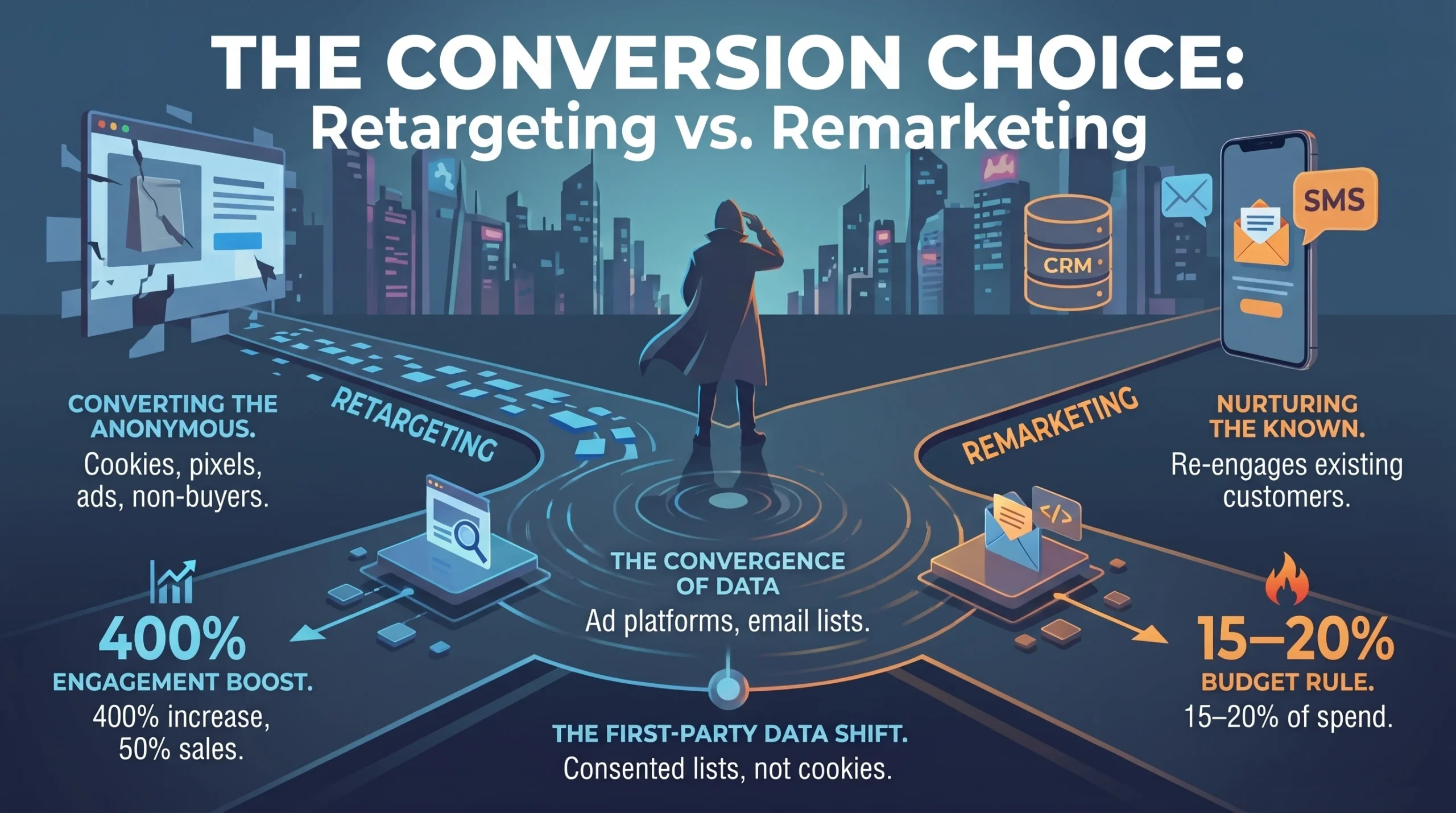
Many Indian e-commerce brands struggle with high bounce rates and the “one-time visit” struggle where users vanish after seconds. This wasted ad spend and lost conversion opportunity agitates your marketing budget, leaving your ROI stagnant while competitors capture your audience. The strategic use of remarketing and retargeting provides the ultimate solution. Retargeting uses paid ads to reach anonymous visitors who left your site, while remarketing utilizes owned data like email or CRM lists to re-engage known customers. Understanding this distinction is the first step toward digital dominance in the 2026 Indian digital ecosystem.
TL;DR
- Definition: Retargeting targets anonymous site visitors via paid ads. Remarketing focuses on known customers through owned channels like email and SMS.
- Budget Allocation: Performance marketers in India should allocate 15 to 20 percent of their total paid campaign budget specifically for re-engagement.
- Privacy Shift: Success now depends on first-party data and Conversion APIs rather than traditional, dying cookie-based tracking.
- The 1,000 User Threshold: Your audience lists must reach at least 1,000 active users before most platforms will allow ads to serve.
- ROI Impact: Industry benchmarks show that effective retargeting can increase engagement by 400 percent and boost sales by 50 percent.
- Local Strategy: Indian brands should leverage “free” remarketing via WhatsApp and email to maintain high margins in cost-sensitive segments.
- Data Ownership: Future-proofing requires moving toward Data Clean Rooms and Composable CDPs to protect customer privacy and campaign accuracy.
Table of Contents
- Why is the Core Difference Between Remarketing and Retargeting Important for Your ROI?
- How Does Modern Retargeting Work in a Privacy-First World?
- When Should You Prioritize Remarketing Over Retargeting?
- What are the 10 Costly Mistakes to Avoid in Your Indian Campaigns?
- How Do You Set Up a Remarketing Funnel Using Google and Meta?
- Why is the Line Blurring Between These Two Strategies?
- How Can Indian Brands Future-Proof Their Data Strategy?
- Frequently Asked Questions (FAQ)
Why is the Core Difference Between Remarketing and Retargeting Important for Your ROI?
Distinguishing between these two tactics is vital for budget efficiency. If you confuse them, you risk sending expensive paid ads to people you could have reached for free via email or WhatsApp. Retargeting captures the “window shoppers.” These are anonymous users who browsed your site but did not leave an email. Remarketing focuses on the “known entities.” These are users already in your database, such as past buyers or newsletter subscribers.
| Feature | Retargeting | Remarketing |
|---|---|---|
| Target Audience | Anonymous visitors and social engagers | Known customers and email subscribers |
| Primary Channel | Paid ads (Google Display, Meta, LinkedIn) | Owned data (Email, SMS, CRM) |
| Data Source | Cookies, Pixels, and Server-side signals | First-party data, CRM, and Purchase history |
The Indian Context. Consider a platform like Myntra. When you browse a pair of sneakers and then see those sneakers on your Instagram feed, Myntra is using retargeting. However, if you bought those sneakers and Myntra later sends you an email offering a 10 percent discount on matching socks, they are using remarketing. For a local boutique in Bangalore or a D2C brand in Delhi, remarketing via WhatsApp is often more cost-effective than running broad display ads.
How Does Modern Retargeting Work in a Privacy-First World?
The mechanics of retargeting have shifted as third-party cookies face deprecation. Marketers now rely on first-party data and server-side connections to maintain accuracy. This shift is critical for Indian brands where mobile users often clear browser caches or use ad-blockers. Data shows that retargeting can increase engagement by 400 percent and sales by 50 percent. However, you must cross the “too small to serve” threshold. Platforms like Google and Meta require an audience list of at least 1,000 users before your ads start appearing to ensure user privacy.
The 3-Step Retargeting Process:
- Tagging: You install a pixel or link Google Analytics 4 (GA4) to your site to track specific events. This “Conversion API” or “Server-side” signal sends data directly from your server to the ad platform, bypassing browser limitations.
- Audience Building: You group these users in your Audience Manager based on their behavior. Examples include “Visitors who stayed longer than 2 minutes” or “Users who viewed the pricing page twice.”
- Ad Deployment: You launch a campaign specifically targeting these segments with personalized creatives. Dynamic Creative Optimization (DCO) can even show the exact product the user viewed.
A recent campaign for the action RPG “Building and Fighter” achieved 1.6 million impressions using these segments. By using geo-location and dynamic variations, the brand identified peak engagement times and reached high-intent users across display and video networks.
When Should You Prioritize Remarketing Over Retargeting?
Remarketing is your strongest tool for increasing Customer Lifetime Value (CLV). Because it uses “free” or low-cost channels like email or SMS, it is a high-margin strategy for cost-sensitive Indian businesses facing high Customer Acquisition Costs (CAC).
The Power of Customer Lists
Your email and phone number lists are gold mines. Uploading these to ad platforms allows you to target your best customers directly. This is ideal for win-back campaigns where you reach out to someone who has not purchased in six months. In India, where “Festival Season” sales drive massive volume, using your 1st-party lists ensures you are not just bidding against everyone for new eyes, but staying top-of-mind with people who already trust you.
Automated Email Sequences
Automation allows you to nurture leads without manual effort. If a customer in Mumbai buys a high-end camera, an automated sequence can suggest lenses or tripods over the next three weeks. Remarketing thrives on this type of upselling and loyalty building. By using a Composable CDP, brands can build audiences from any data source and sync them to email tools for hyper-personalized messaging that drives repeat sales.
What are the 10 Costly Mistakes to Avoid in Your Indian Campaigns?
- Relying on third-party cookies. Fix: Prioritize first-party data like customer lists and server-side tracking to stay ahead of browser-level privacy changes.
- Avoiding Lookalike Audiences. Fix: Use 1 percent Lookalike or Similar Audiences to find new Indian prospects who mirror the behavior of your highest-spending buyers.
- Under-excluding audiences. Fix: Exclude recent converters from your awareness campaigns to save your budget for net-new prospects who have never visited your site.
- Siloing SEO and PPC teams. Fix: Sync GA4 audiences so your paid ads can target the high-quality organic traffic brought in by your SEO strategy.
- Using generic ad copy. Fix: Tailor your message to the specific stage of the funnel, such as addressing common price objections for cart abandoners in Tier 2 cities.
- Targeting audiences under 1,000 users. Fix: Wait for your lists to fully populate or broaden your parameters until you hit the platform’s minimum service threshold.
- Ignoring Observation Mode. Fix: Use the “Observe” setting first to gather data on how an audience performs before committing your full budget to “Target and Observe.”
- Lacking a clear brand stance. Fix: Decide if you want to exclude organic branded clicks to save budget or target them to protect your brand from aggressive competitors.
- Operating in channel silos. Fix: Upload customer lists from one channel, such as Meta, to create Similar Audiences on another channel like Google.
- Failing to set a dedicated budget. Fix: Allocate a specific 15 to 20 percent of your total budget for re-engagement campaigns rather than lumping it in with top-of-funnel awareness.
How Do You Set Up a Remarketing Funnel Using Google and Meta?
For the Indian digital marketer, technical execution is everything. You must ensure your tracking is flawless to avoid wasting INR on incorrect audiences or double-counting conversions.
Google Ads: GA4 and Tag Manager Integration
The most efficient way to start is by linking your GA4 property to Google Ads. In GA4, navigate to Admin and select “Google Ads Linking” under Product Links. Choose your account and hit confirm. Within 24 hours, your GA4 audiences will flow into your Google Ads Audience Manager. For more granular control, use Google Tag Manager (GTM) to fire a “Google Ads Remarketing Tag.” Ensure you have a “Conversion Linker” tag firing on all pages to maintain tracking accuracy on mobile browsers.
Meta Ads: Advantage+ and Hybrid Ad Sets
Modern Meta strategy involves the “Hybrid Ad Set.” Within an Advantage+ campaign, you add your custom audiences as “Audience Suggestions.” However, if you want a strict retargeting campaign, you must toggle to “Original Audience Options” in the ad set level. This allows you to set “Audience Controls,” which are hard constraints. If you do not use these hard constraints, Meta will often expand beyond your custom list to find what it believes are better conversion opportunities. This is the difference between a “Suggestion” and a “Hard Constraint.”
Local Insight. When targeting India, remember the nuances between Tier 1 and Tier 2 cities. Tier 2 cities often show high mobile usage but may require different creative suggestions due to varying purchasing power. A campaign in Nagpur might perform better with localized language “Suggestions” than a broad English campaign in Gurgaon.
Why is the Line Blurring Between These Two Strategies?
The boundary between remarketing and retargeting is disappearing. Platforms now allow you to use “Remarketing data” like email lists to perform “Retargeting actions” such as display ads. When you upload a customer list for “Customer Match,” the execution looks exactly like retargeting, but you are reaching known customers. This convergence means your focus should shift from academic definitions to tangible results. As privacy limits traditional tracking, staying visible in AI-driven results becomes the new top-of-funnel anchor.
Definition Snippet: Generative Engine Optimization (GEO). GEO involves creating fact-dense, entity-rich content that helps your brand appear in AI-generated search summaries. This ensures visibility as search engines evolve, feeding your remarketing lists with high-intent users.
How Can Indian Brands Future-Proof Their Data Strategy?
Privacy laws and emerging frameworks mean you must own your data. Leading brands are moving toward “Data Clean Rooms” (DCR). This technology allows an advertiser and a publisher to match data safely without sharing raw personal information. This ensures compliance while maintaining the precision required for high-performance campaigns.
The TopCC Success Story. TopCC, a wholesaler, used a data clean room to reactivate 1,800 inactive customers. By securely matching their CRM data with publisher sets, they achieved a massive 3.5x ROI. Indian retailers can mirror this success by focusing on data activation. Instead of just collecting data, use a Composable CDP to put that data in motion across every touchpoint.
Frequently Asked Questions
Is retargeting better than remarketing?
Neither is objectively better. Retargeting is superior for converting new visitors who have not yet shared their contact details. Remarketing is better for building long-term loyalty and repeat sales from people who already trust your brand. Most successful Indian businesses use a strategic blend of both.
What is the cost of remarketing in India?
The cost varies based on the channel. Remarketing via email or SMS can be very low-cost. For paid retargeting ads, costs typically range from 20 INR to 120 INR per click. This depends heavily on the industry competition and whether you are targeting Tier 1 or Tier 2 cities.
How many users do I need for a remarketing list?
Major ad platforms require a minimum of 1,000 active users in a list before your ads will serve. If your audience is smaller, the platform will label it as “too small to serve.” It typically takes 24 to 48 hours for a newly created list to fully populate.
Can I do retargeting without cookies?
Yes. You can use server-side tracking and Conversion APIs to send data directly from your server to the ad platform. This bypasses the limitations of browser-based cookies and provides more accurate tracking in a privacy-first world. This is becoming the industry standard for 2026.
Does retargeting work for B2B in India?
Retargeting is highly effective for B2B. Since B2B sales cycles in India are often long and involve multiple stakeholders, retargeting helps keep your brand top-of-mind. You can show professional case studies or whitepapers to prospects who previously visited your pricing or demo pages.
Indian brands must move beyond basic advertising and embrace a dual strategy of retargeting for acquisition and remarketing for retention. This holistic approach ensures you never lose a high-intent lead and maximizes the value of every customer you acquire. Mastering these strategies for the Indian market is essential for navigating the complex and competitive digital ecosystem.
Ready to master advanced re-engagement strategies for the Indian market? Book a free counselling session with an academic counsellor for our AI-powered Niche Specific Digital Marketing course and future-proof your digital career.
Book a Free Counselling Session