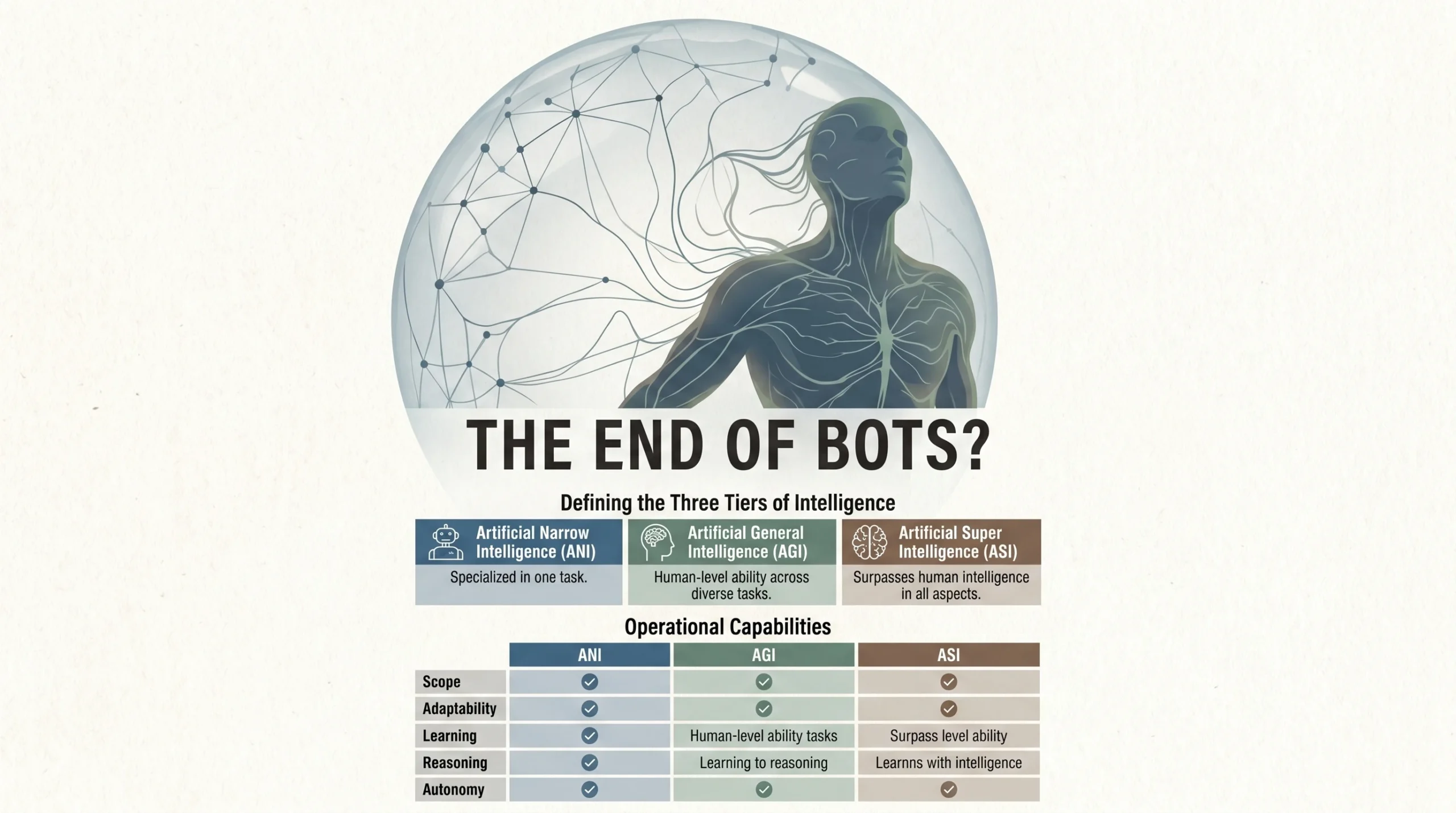
Indian IT leaders face a critical bottleneck because traditional bots are failing to handle the complexity of modern business data. When rules change or data becomes messy, your rigid automation breaks, leading to massive maintenance costs and lost productivity in hubs like Bengaluru and Hyderabad. To survive the 2026 tech landscape, you must distinguish between your tools. AI Automation follows rigid, if-then rules; AI Agents use reasoning to complete specific tasks; Agentic AI orchestrates multiple agents to manage complex, autonomous workflows. This guide explores the strategic differences between an ai agent vs agentic ai vs ai automation to help you build a resilient, silicon-based workforce. By moving beyond isolated pilots, your enterprise can achieve true outcome-based orchestration and maintain a competitive edge in the global market.
TL;DR: THE 2026 AI BLUEPRINT
- The Rise of Digital Labor: 2026 marks the transition from software tools to autonomous digital workers that parse multimodal inputs and interpret the real world.
- Multi-Agent Orchestration: No single agent excels at everything. The future relies on teams or “swarms” of specialized agents working under a coordinating layer.
- The Reliability Gap: Current autonomous systems still fail over 65% of the time in complex tasks, making Human-in-the-Loop (HITL) designs essential for Indian enterprises.
- Governance as Code: With the EU AI Act setting the global template, 2026 systems must be auditable, traceable, and transparent to ensure compliance.
- Reasoning at the Edge: Small models on local devices are becoming “thinking models.” This ensures data privacy for Indian consumers by keeping data off the cloud.
- Outcome over Task: Strategy is shifting from completing narrow steps (Automation) to achieving broad, system-wide business goals (Agentic AI).
TABLE OF CONTENTS
- What is Traditional AI Automation and Why is it Breaking?
- How do AI Agents Move Beyond Simple Bots?
- What is Agentic AI and How Does Orchestration Work?
- Agentic AI vs. AI Agents vs. Automation: The 5 Key Distinctions?
- How to Choose the Right System for Your Business?
- What are the Real-World Limitations and Risks to Watch in 2026?
- What are the Top AI Trends for 2026?
- AEO & FAQ Section
WHAT IS TRADITIONAL AI AUTOMATION AND WHY IS IT BREAKING?
Traditional AI automation, often categorized as Robotic Process Automation (RPA), operates on a foundation of strict, rule-based logic. As Jolissa Skow notes in Search Engine Land, these systems function through “if-then” sequences to perform high-volume, repetitive tasks. In the Indian context, these tools have powered massive back-office operations in IT hubs like Pune and Bengaluru for years. They excel at handling structured data like payroll calculations, scheduled reports, and lead routing.
However, traditional automation is fundamentally brittle because it relies on static environments. If an invoice format changes slightly or a customer email contains unstructured text, the automation fails. It cannot reason through ambiguity or adapt to new requirements without manual code modifications. For Indian BPO and KPO firms, this creates a “maintenance hell.” The cost of fixing rigid scripts in response to every minor change often outweighs the initial efficiency gains. As global business data becomes increasingly unstructured, the deterministic nature of RPA no longer supports a modern “silicon workforce” that must remain flexible.
HOW DO AI AGENTS MOVE BEYOND SIMPLE BOTS?
AI agents represent a major leap forward by using Large Language Models (LLMs) as a central brain to perceive, reason, and act. Unlike a bot that follows a script, an agent is goal-oriented. It understands the “why” behind a request and uses tools to achieve it. For example, if you ask an agent to book the cheapest flight to Delhi, it does not just search. It identifies multiple options, reasons through the price differences, and uses a travel API like Expedia to execute the booking autonomously.
According to Amy Brennen and the Moveworks team, enterprise AI agents typically fall into three internal classifications:
- Aggregation Agents: These gather and synthesize data from multiple sources to present a clear picture to the user.
- Action Agents: These translate intent into specific tasks, such as updating a CRM or processing a refund with precision.
- Ambient Agents: These operate in the background, monitoring systems for signals like security threats and acting only when necessary.
The adoption rate for these systems is skyrocketing. McKinsey reports that 62% of organizations already utilize AI agents, while Gartner predicts that 40% of all enterprise applications will include task-specific AI agents by 2026. This shift allows employees in Indian enterprises to move away from narrow task management and toward high-value strategic oversight.
WHAT IS AGENTIC AI AND HOW DOES ORCHESTRATION WORK?
Agentic AI moves the focus from individual tasks to system-level intelligence. It is the orchestration layer that manages a “swarm” or a team of specialized agents. While an AI agent might handle one specific job (like writing code), Agentic AI acts as the project manager. It decomposes a massive goal into smaller steps, assigns those steps to the right agents, and checks their work for errors.
IBM Technology experts Martin and Aaron Baughman explain that this multi-agent orchestration introduces “swarm computing.” In this model, a coordinating layer manages different worker agents. A critical component here is the “critic agent.” This agent evaluates the outputs of other agents and flags issues before final execution. This cross-checking significantly reduces hallucinations and errors, which are major pain points for Indian enterprises scaling their AI operations.
Krish Naik provides a definitive real-world example of this orchestration (converting a YouTube video into a high-ranking blog post). In an agentic system, one agent extracts the transcript, a second agent generates a compelling title, a third agent writes the detailed description, and a fourth agent summarizes the conclusion. This collaboration ensures that the final output is cohesive, verified, and ready for publication.
Comparison: AI Agent vs. Agentic AI
| Feature | Single AI Agent | Agentic AI (Orchestration) |
|---|---|---|
| Focus | Task-focused (Specific action) | Outcome-oriented (Broad goal) |
| Intelligence | Reasoning within a narrow domain | Multi-step reasoning across domains |
| Coordination | Operates independently | Coordinates “swarms” of agents |
| Adaptability | Reactive to local task context | Plans and adapts entire workflows |
| Decision Logic | Bounded autonomy | Strategic autonomy and planning |
AGENTIC AI VS. AI AGENTS VS. AUTOMATION: THE 5 KEY DISTINCTIONS?
To build an effective 2026 strategy, you must understand the core differences in how these systems function. The primary keyword of ai agent vs agentic ai vs ai automation is defined by these five pillars:
- Autonomy and Decision-Making: AI Automation has zero autonomy and follows hard-coded scripts. AI agents make decisions within a fixed task boundary. Agentic AI possesses strategic autonomy, choosing different paths and adjusting plans based on evolving objectives and enterprise policies.
- Complexity and Learning: Automation cannot learn from experience. AI agents improve at specific tasks through feedback and data. Agentic AI adapts at the workflow level, identifying bottlenecks and restructuring its entire approach if conditions change.
- Functional Scope: Automation is isolated to single, repetitive tasks. AI agents focus on narrow, goal-directed tasks. Agentic AI spans across entire systems, teams, and data sources to manage end-to-end processes with shared context.
- Proactiveness: Automation is purely reactive to triggers. AI agents react to user prompts or specific events. Agentic AI is proactive. It can detect recurring issues and suggest or initiate remediation workflows before a human even identifies a problem.
- Planning and Execution: Automation requires you to map every step in advance. AI agents follow simple sequences. Agentic AI generates its own sub-tasks, breaking down complex instructions into a logical, multi-step execution plan.
HOW TO CHOOSE THE RIGHT SYSTEM FOR YOUR BUSINESS?
Choosing the right level of intelligence is both a financial and an operational decision. For an Indian SME in Jaipur, the cost of token consumption might be a primary concern. Conversely, a Mumbai-based global enterprise might prioritize risk tolerance, auditability, and scalability.
The High-Level Strategic Framework
- Predictability: Does the task follow the exact same steps every time? If yes, stick with Traditional Automation. It is cheaper and more reliable for deterministic work like lead routing.
- Context: Does the task require understanding messy, unstructured data or making judgment calls? If yes, use AI Agents. They can interpret context, such as analyzing sentiment in customer feedback.
- Orchestration: Does the workflow span multiple systems (e.g., HR, IT, and Finance) and require dynamic planning? If yes, invest in Agentic AI. It handles complex handoffs and adjusts when a step fails.
- Risk and Cost: Traditional automation has medium upfront costs but low ongoing costs. Agentic AI has high upfront costs and significant recurring API fees.
According to stats from Azilen Technologies, monthly operating costs for production AI agents typically range from $3,200 to $13,000. For an Indian business, this means balancing developer time in INR against the rising cost of per-token API calls billed in USD. For high-volume, low-risk tasks, automation remains king. For complex, customer-facing interactions, agentic systems are the new gold standard.
WHAT ARE THE REAL-WORLD LIMITATIONS AND RISKS TO WATCH IN 2026?
Despite the hype, autonomous systems are not foolproof. Research from Carnegie Mellon University indicates that current AI agents only complete about 34.4% of assigned tasks successfully in realistic office environments. This “reliability gap” means that if you chain five steps together, a single error in step two can break the entire chain.
Security is another major hurdle for the Indian market. Obsidian Security research shows that 90% of AI agents hold far more permissions than they actually need. An agent might move 16 times more data than a human user. In one case, a single agent downloaded over 16 million files while all other human users combined downloaded only 1 million. For the Indian BFSI (Banking, Financial Services, and Insurance) sector, which is heavily regulated and risk-averse, this creates a massive surface area for data breaches.
Furthermore, the influence of the EU AI Act will reach Indian shores by mid-2026. Any enterprise dealing with global clients must ensure their AI is auditable and transparent. The Human-in-the-Loop (HITL) model is no longer optional for high-risk decisions in finance or legal sectors. Humans must provide the “strategic rails” to prevent autonomous drift and ensure ethical decision-making.
WHAT ARE THE TOP AI TRENDS FOR 2026?
As we move toward 2026, several convergence points will redefine the Indian enterprise. Martin and Aaron Baughman from IBM identify these critical trends:
- Physical AI: We are moving from models that generate text to models that understand the 3D world. “World Foundation Models” will allow humanoid robots to move from research labs to commercial production in Indian manufacturing sectors.
- Verifiable AI: As regulations tighten, AI must prove its data lineage. Transparency in synthetic text and auditable logs will be mandatory for global compliance.
- Quantum Utility: Quantum computing will begin solving real-world optimization problems that were previously out of reach for classical hardware, integrated directly into agentic workflows.
- Reasoning at the Edge: This is a major breakthrough for Indian data privacy. Small reasoning models (3B to 8B parameters) will run locally on phones or laptops. This allows for real-time, mission-critical decisions without your data ever leaving the device or the country.
FAQ SECTION
Is Agentic AI the same as a Chatbot?
No. A chatbot is a reactive interface designed for simple question-and-answer exchanges based on a knowledge cutoff. Agentic AI is a proactive system-level intelligence that can plan, use tools, and coordinate multiple specialized agents to complete complex, multi-step workflows without constant human prompting.
Which is cheaper: Traditional Automation or Agentic AI?
Traditional automation is generally cheaper for high-volume, repetitive tasks because it has low ongoing compute costs. Agentic AI is significantly more expensive. Azilen Technologies reports that monthly operating costs range from $3,200 to $13,000 due to high API consumption and the need for continuous optimization.
Can AI agents handle Indian regional languages?
Yes. Modern AI agents powered by advanced LLMs can reason across various regional languages. However, their performance depends on the quality of training data. Indian enterprises are increasingly looking at “Indic LLMs” like Krutrim or BharatGPT to ensure better accuracy in languages like Hindi, Tamil, or Bengali.
What is human-in-the-loop AI?
Human-in-the-loop (HITL) is a design requirement where a human provides oversight, correction, and strategic guidance to an AI system. It ensures that for high-risk or ambiguous tasks, the AI proposes an action while the human makes the final decision or approves the execution.
How does Agentic AI help in SEO and Content Marketing?
Agentic AI can manage the entire content lifecycle. It can research trending keywords, analyze competitor gaps, generate high-quality drafts, and optimize technical metadata. By coordinating specialized agents for research, writing, and editing, it ensures content is both search-engine optimized and contextually relevant.
CONCLUSION
The transition from isolated AI pilots to the agentic enterprise represents the next great shift in global business. By understanding the nuances of AI automation, individual agents, and multi-agent orchestration, Indian enterprises can successfully deploy a silicon workforce that is both efficient and governed.
Ready to lead the AI revolution in your industry? Book a free counselling session with an academic counsellor for our AI-powered Niche Specific Digital Marketing course and master the transition from automation to agentic orchestration.